
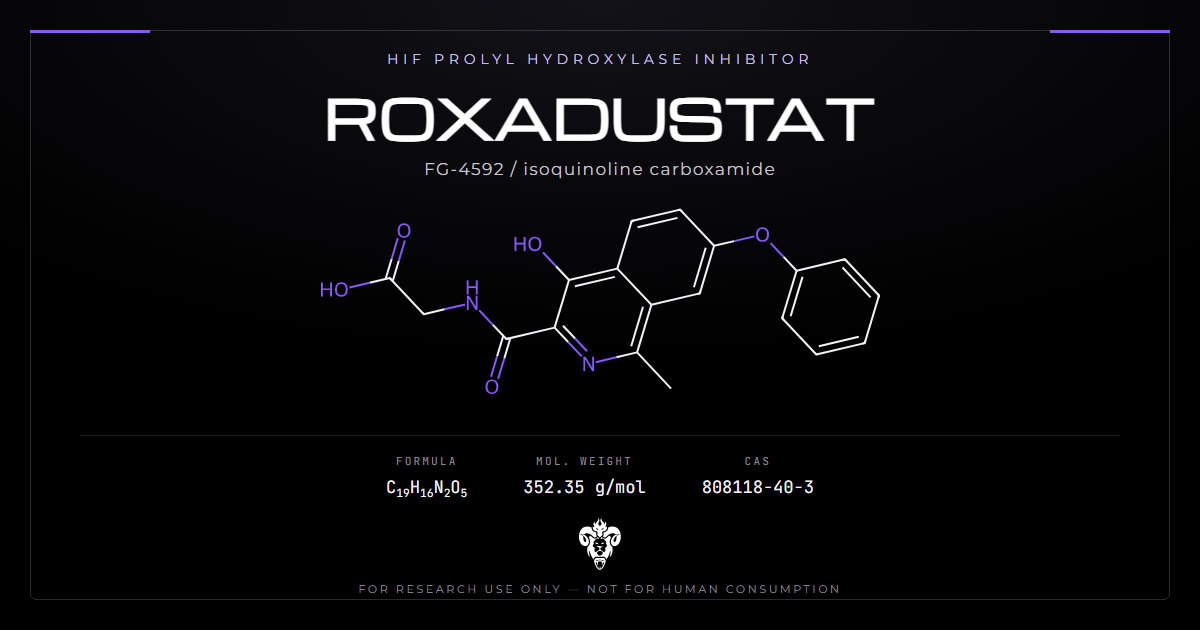
Roxadustat makes the body behave as though it were short of oxygen. Blocking the enzymes that mark hypoxia-inducible factor for destruction produces what one review calls a transient pseudo-hypoxic state [1]. The cell responds by making erythropoietin.
That is a genuinely different route to treating anaemia than injecting erythropoietin, and it works. The compound is approved in Japan, China and the European Union. The same evidence package did not produce approval in the United States.
Three things make the file worth reading carefully. The class promised superiority and settled for non-inferiority, against a wide margin. The most recent meta-analysis finds serious adverse events raised. And the compound is detectable in urine eight months after a single dose.
Chemical identity
| Property | Value |
|---|---|
| Common names | Roxadustat, FG-4592, ASP-1517, Evrenzo |
| Molecular formula | C19H16N2O5 |
| Molecular weight | 352.34 g/mol |
| CAS | 808118-40-3 |
| PubChem CID | 11256664 |
| InChIKey | YOZBGTLTNGAVFU-UHFFFAOYSA-N |
| Class | Isoquinoline carboxamide, HIF prolyl hydroxylase inhibitor |
| Route | Oral |
| Appearance | White to pale green solid |
The catalogue carries it as Roxadustat FG-4592.
Reading the structure
An isoquinoline core carries a phenoxy substituent, a methyl group and a phenol. A glycine amide hangs off the carboxamide. That glycinamide is the business end. It mimics 2-oxoglutarate, the co-substrate the prolyl hydroxylases need, and competes for the same site.
The compound is small, oral and not a peptide, which is the whole design argument against erythropoiesis-stimulating agents. Those require injection and cold chain.
One consequence of that chemistry shows up later in this article. A 352 Da small molecule with a carboxylic acid is a straightforward substrate for glucuronidation and for renal handling, and it behaves nothing like a glycoprotein hormone in an assay. That is why the detection literature on roxadustat reads like a small-molecule problem rather than a biologics problem, and why the numbers involved are picograms per millilitre.
How the mechanism differs from injected EPO
Prolyl hydroxylase enzymes tag hypoxia-inducible factor for degradation when oxygen is plentiful. Inhibit them and the factor survives, translocates and switches on a coordinated set of genes.
More than erythropoietin
The gene programme is broader than one hormone. Locatelli and colleagues set out the rationale [1]. Anaemia of kidney disease was long blamed on low erythropoietin alone. The modern account adds disordered iron handling through raised hepcidin and reduced clearance.
Activating the pathway addresses both arms at once. Endogenous erythropoietin rises, and iron availability very likely rises with it. That coordination is what the injectable agents cannot reproduce, since they supply the hormone and leave the iron problem alone.
What the animal work adds
Gao and colleagues gave adenine-diet CKD rats roxadustat with and without a polysaccharide iron complex [10]. The combination raised haemoglobin faster than either alone. The compound also lowered hepcidin, interleukin-6, tumour necrosis factor alpha, interleukin-1 beta and HMGB1.
Masson staining and expression of alpha-smooth muscle actin and fibronectin both pointed to less renal fibrosis. Those are rat data on an adenine model, and they describe the mechanism rather than a clinical claim.
The iron difference, measured
The clearest human demonstration that this is not simply oral erythropoietin comes from a switching study. Ogawa and colleagues followed 30 haemodialysis patients moved from darbepoetin alfa to roxadustat [3]. They tracked reticulocyte haemoglobin content against iron stores.
The thresholds moved down. Serum ferritin sufficient to keep reticulocyte haemoglobin at or above 32.0 pg fell from 49.7 ng/mL to 35.5 ng/mL across 28 days. Transferrin saturation fell from 21.6% to 16.2%.
Haemoglobin synthesis therefore continued at iron levels that would have been marginal on the injectable agent. The same paper gives a practical corollary. To avoid iron deficiency in the four weeks after switching, aim for ferritin near 81.6 ng/mL and saturation near 23.9% beforehand.
What the phase 3 programme showed
| Analysis | Population | n | Endpoint | Result |
|---|---|---|---|---|
| Barratt 2021 [5] | Dialysis-dependent | 4,714 | MACE vs ESA | HR 1.09 (0.95-1.26) |
| Barratt 2021 [5] | Dialysis-dependent | 4,714 | MACE+ vs ESA | HR 0.98 (0.86-1.11) |
| Barratt 2021 [5] | Dialysis-dependent | 4,714 | All-cause mortality | HR 1.13 (0.95-1.34) |
| Martínez-Miguel 2025 [12] | All CKD, 15 RCTs | 10,284 | Serious adverse events | OR 1.13 (1.04-1.23) |
| Martínez-Miguel 2025 [12] | Non-dialysis vs placebo | subgroup | Hypertension | OR 1.39 (1.13-1.73) |
| Martínez-Miguel 2025 [12] | Non-dialysis vs placebo | subgroup | Hyperkalaemia | OR 1.31 (1.02-1.69) |
The pooled cardiovascular analysis
Barratt and colleagues pooled four open-label phase 3 studies in dialysis-dependent patients [5]. PYRENEES, SIERRAS, HIMALAYAS and ROCKIES randomised 4,714 patients between them. Haemoglobin change from baseline met non-inferiority against erythropoiesis-stimulating agents in every study.
Read the margins before reading the conclusion. Non-inferiority for major adverse cardiovascular events was assessed at a 1.8 margin, and for the expanded composite at 1.3. A hazard ratio of 1.09 clears a 1.8 margin comfortably and would not clear a tighter one. Several authors on that analysis are employees of the developer, which the paper states.
What the class review concluded
Locatelli and Del Vecchio put the finding in their title [7]. Theoretical superiority became clinical non-inferiority. Roxadustat, vadadustat and daprodustat all underwent extensive cardiovascular safety investigation. All except vadadustat in the non-dialysis population met their pre-specified margins.
Their caution is the part worth carrying. Secondary analyses of some randomised trials raised a higher incidence of thrombosis. The authors call for post-marketing experience before deciding when these agents beat the established ones.
The most recent safety pooling
Martínez-Miguel and colleagues pooled 15 randomised trials and 10,284 patients [12]. Overall adverse events did not separate. Serious adverse events did, at an odds ratio of 1.13 with a confidence interval of 1.04 to 1.23.
Two specific signals appeared against placebo in non-dialysis patients: hypertension and hyperkalaemia. Notably, no difference emerged against erythropoiesis-stimulating agents on any endpoint studied, so the comparator determines the answer. All adverse events except cardiovascular events and hyperkalaemia rose with treatment beyond 30 weeks.
Where roxadustat looks better than EPO
Two findings run in the compound’s favour and deserve equal weight.
Left ventricular mass
Tan and colleagues randomised 114 haemodialysis patients to roxadustat or recombinant human erythropoietin for 12 months [8]. Both arms targeted the same haemoglobin range of 10.0 to 12.0 g/dL. Left ventricular mass index fell from 116.18 to 110.70 g/m on roxadustat and rose from 109.35 to 114.99 on erythropoietin.
The between-group difference reached significance. Left ventricular hypertrophy carries mortality risk in dialysis, so regression is a meaningful endpoint rather than a surrogate of convenience. Other cardiac geometry measures and adverse event rates did not separate.
Haemoglobin attainment in practice
Zhu and colleagues reported 31 peritoneal dialysis patients in a before-and-after design [6]. Mean haemoglobin rose from 86.2 to 112.4 g/L, and the proportion reaching 110 g/L went from 16.1% to 67.7%.
That is a single-centre retrospective self-control study with no randomisation and no blinding. It describes attainment under routine care rather than efficacy. A broader review places these results in the wider treatment picture for renal anaemia [11].
The excretion finding
The pharmacokinetics contain something genuinely unusual, and it comes from anti-doping laboratories rather than nephrology.
Sobolevsky and colleagues report detection in urine for eight months after a single dose [9]. Concentrations by then sit below 10 pg/mL. Under three-times-weekly treatment at 70 to 100 mg, anaemic patients still excreted detectable drug 9 to 18 months after stopping.
One athlete admitted roughly a year of use at 50 mg three to five times weekly. That person tested positive repeatedly across 15 months, at an estimated 3 to 8 pg/mL. The first of those positives arrived 12 months after discontinuation. The authors describe the terminal excretion kinetics as unusually prolonged and tell testing authorities to account for it.
That profile mirrors what the catalogue found on zuclomiphene. A month of dosing there left the isomer measurable for four to nine months. Detection windows measured in months rather than days are becoming a recurring feature of small molecules assayed at picogram sensitivity.
What the metabolism studies found
Hansson and colleagues investigated the compound across five in vitro systems and one human doping control sample [2]. Twelve metabolites appeared in total, but the distribution across models is the interesting part.
Human and equine liver microsomes each gave one monohydroxylated metabolite. The fungus Cunninghamella elegans gave eleven. Human hepatocytes and equine liver S9 fraction gave none at all. In the actual human urine sample, exactly one metabolite appeared, a direct glucuronide.
Mathew and colleagues then dosed thoroughbred horses orally and detected 13 urinary metabolites [4]. Seven were phase I, one phase II and five conjugates of phase I products. Hydroxylation dominated, with a glucuronide as the major phase II product.
The lesson generalises. A metabolite map is a property of the model as much as of the molecule. Choosing hepatocytes over microsomes over a fungus changes the answer by an order of magnitude.
The rest of the class
Roxadustat is not alone, and the class comparison sharpens what its file does and does not show.
Three compounds, one target, different outcomes
Three HIF prolyl hydroxylase inhibitors went through extensive cardiovascular safety programmes: roxadustat, vadadustat and daprodustat [7]. All three demonstrated efficacy in anaemia correction and maintenance, against placebo where superiority was the comparison and against erythropoiesis-stimulating agents where non-inferiority was.
On the primary safety analyses, all met their non-inferiority margins except vadadustat in the non-dialysis population. Locatelli and Del Vecchio say plainly that the reason for that discrepancy is difficult to explain, which is a more honest position than the class-effect reasoning it would have been easy to reach for.
That single exception matters for how the class gets read. If the compounds shared a clean class effect, one failing in one population would be surprising. If they do not, results from one agent do not transfer to another, and roxadustat’s file has to stand on its own trials.
What the class shares
The mechanistic advantages are common property. Every member produces endogenous erythropoietin rather than supplying it, raises iron availability, and comes as an oral tablet. One further shared property is worth noting: the review suggests efficacy and dose requirement are less influenced by inflammation than with erythropoiesis-stimulating agents [7].
That last point is the strongest theoretical case for the class. Inflammation drives hepcidin, hepcidin locks up iron, and locked-up iron is a common reason patients stop responding to injected erythropoietin. A mechanism that lowers hepcidin should be less vulnerable to that failure mode, and the rat data support the hepcidin part of the chain directly [10].
Whether that theoretical advantage produces better outcomes remains the open question, and it is the same question the class review ends on.
What the compound does outside the kidney
Hypoxia-inducible factor is a general oxygen sensor, so a drug that stabilises it acts wherever the pathway operates. That breadth is the source of both the interest and the caution.
Vascular tone and potassium
The two signals that separated against placebo in non-dialysis patients were hypertension and hyperkalaemia [12]. Neither is obviously explained by erythropoiesis alone, and both are the kind of finding that a mechanism acting on many tissues would predict.
The practical instruction in that paper is short and specific: monitor potassium and blood pressure in non-dialysis patients. That is a clearer recommendation than most safety meta-analyses produce.
Duration changes the picture
The same analysis found that every adverse event category except cardiovascular events and hyperkalaemia rose once treatment ran beyond 30 weeks [12]. Short trials therefore understate the event rate that longer exposure produces.
Most of the phase 3 efficacy endpoints were read at weeks 28 to 36 [5]. The efficacy window and the window in which adverse events accumulate are close enough together that a trial can report its efficacy result before its safety profile has fully declared itself.
Why the regulatory outcomes diverged
Nothing in the indexed literature explains the split directly, and it would be dishonest to invent a reason. What the literature does supply is the material both regulators read.
The efficacy case is not in dispute. Haemoglobin non-inferiority held in every pooled phase 3 study [5], and the oral route is a real advantage over an injectable requiring cold chain.
The safety case turns on how much weight a reader gives to three things: a wide non-inferiority margin, a thrombosis signal confined to secondary analyses [7], and serious adverse events raised against placebo but not against the active comparator [12]. A regulator weighing the placebo comparison heavily reaches a different conclusion from one weighing the active comparison heavily, on identical data.
How to read a roxadustat study
Five questions separate the claims that hold from the ones that travel further than their data.
Which comparator was used?
Against placebo the compound shows adverse-event signals; against erythropoiesis-stimulating agents it does not [12]. Papers reporting “no safety difference” and papers reporting raised serious adverse events can both be right about different comparisons.
What was the non-inferiority margin?
A 1.8 margin on major cardiovascular events is wide [5]. Non-inferiority is a claim about a pre-specified boundary rather than a claim of equivalence. The boundary belongs in any summary of the result.
Dialysis-dependent or not?
The hypertension and hyperkalaemia signals sit in the non-dialysis population [12]. Pooled figures that mix both populations dilute a signal that belongs to one of them.
Who funded and who authored it?
The largest pooled cardiovascular analysis carries developer affiliations [5]. That does not invalidate it, and it is a reason to weigh the independent meta-analyses alongside it [7][12].
Is the endpoint haemoglobin or an outcome?
Most of this literature reports haemoglobin, an intermediate. Left ventricular mass [8] and cardiovascular events [5][12] are the endpoints that matter. Both appear less often and with wider intervals.
Verifying research material
The compound is a defined small molecule with published identifiers, so verification is measurement. Batch documentation sits on the certificates of analysis page.
Identity
Formula C19H16N2O5, molecular weight 352.34, CAS 808118-40-3, InChIKey YOZBGTLTNGAVFU-UHFFFAOYSA-N. That InChIKey carries the UHFFFAOYSA block, reflecting a molecule with no defined stereocentres. Stereochemical verification is not the concern here that it is for peptides.
Purity and related substances
Both the isoquinoline core and the phenoxy ether absorb strongly in the ultraviolet. Chromatography with diode-array detection therefore separates the compound and its related substances readily. The published metabolite maps give a reference for what hydroxylated and glucuronidated species look like on a chromatogram [2][4].
Handling and contamination
One detail from the doping literature belongs in any handling discussion. Some adverse analytical findings were attributed to contaminated dietary supplements [9]. At picogram sensitivities, cross-contamination in a shared workspace becomes a real analytical risk rather than a theoretical one. Segregate weighing and use dedicated glassware.
Common questions about roxadustat
Is roxadustat approved? Yes in Japan, China and the European Union under the name Evrenzo, and no in the United States. The phase 3 package was substantially the same.
Does it work as well as injected EPO? On haemoglobin, yes. Every pooled phase 3 study met non-inferiority for haemoglobin change from baseline [5].
Is it safer than EPO? The evidence does not support that claim. Against erythropoiesis-stimulating agents no endpoint separated [12], and secondary analyses raised a thrombosis question [7].
Why does it affect iron? The pathway coordinates erythropoiesis with iron mobilisation and lowers hepcidin, so haemoglobin synthesis proceeds at lower ferritin and saturation than on the injectable agent [1][3].
How long is it detectable? Eight months after a single dose, and 9 to 18 months after regular treatment [9].
What related compounds does the catalogue carry? ITPP works on the other side of the same problem, shifting haemoglobin oxygen release rather than haemoglobin mass. TND1128 and SLU-PP-332 sit in adjacent mitochondrial and metabolic work.
Summary of the evidence
Strongest evidence sits in the phase 3 programme [5]. Four pooled trials covered 4,714 dialysis-dependent patients. Haemoglobin non-inferiority was met throughout, and cardiovascular non-inferiority against the pre-specified margins. A 15-trial meta-analysis covering 10,284 patients supplies the independent counterweight [12]. A 12-month randomised trial gives a genuine advantage on left ventricular mass [8].
Weakest evidence is everything about long-term outcomes. The class review calls explicitly for post-marketing data before deciding where these agents belong [7]. That thrombosis signal comes from secondary analyses. Fibrosis and inflammation findings are rat data on an adenine model [10].
Read plainly, roxadustat is an oral route to a result that previously required injection. Its safety file reads adequate against one comparator and unsettled against another. That regulatory split between Europe and the United States shows how the same numbers can be read two ways. More of this literature sits in the metabolic category.
Status: supplied for laboratory research use only.
References
- Locatelli F, Fishbane S, Block GA, Macdougall IC. Targeting hypoxia-inducible factors for the treatment of anemia in chronic kidney disease patients. Am J Nephrol. 2017;45(3):187-199. PMID 28118622. DOI
- Hansson A, Thevis M, Cox H, Miller G, Eichner D, Bondesson U, Hedeland M. Investigation of the metabolites of the HIF stabilizer FG-4592 (roxadustat) in five different in vitro models and in a human doping control sample using high resolution mass spectrometry. J Pharm Biomed Anal. 2017;134:228-236. PMID 27918992. DOI
- Ogawa C, Tsuchiya K, Tomosugi N, Maeda K. Hypoxia-inducible factor prolyl hydroxylase domain inhibitor may maintain hemoglobin synthesis at lower serum ferritin and transferrin saturation levels than darbepoetin alfa. PLoS One. 2021;16(6):e0252439. PMID 34143801. DOI
- Mathew B, Philip M, Perwad Z, Karatt TK, Caveney MR, Subhahar MB, Karakka Kal AK. Identification of hypoxia-inducible factor (HIF) stabilizer roxadustat and its possible metabolites in thoroughbred horses for doping control. Drug Test Anal. 2021;13(6):1203-1215. PMID 33569900. DOI
- Barratt J, Sulowicz W, Schömig M, Esposito C, Reusch M, Young J, Csiky B. Efficacy and cardiovascular safety of roxadustat in dialysis-dependent chronic kidney disease: pooled analysis of four phase 3 studies. Adv Ther. 2021;38(10):5345-5360. PMID 34523074. DOI
- Zhu XW, Zhang CX, Xu TH, Jiang GN, Yao L. Efficacy of roxadustat in treatment of peritoneal dialysis patients with renal anaemia. World J Clin Cases. 2021;9(26):7682-7692. PMID 34621819. DOI
- Locatelli F, Del Vecchio L. Hypoxia-inducible factor-prolyl hydroxyl domain inhibitors: from theoretical superiority to clinical noninferiority compared with current ESAs? J Am Soc Nephrol. 2022;33(11):1966-1979. PMID 36041790. DOI
- Tan W, Wang X, Sun Y, Wang X, He J, Zhong L, Jiang X, Sun Y, Tian E, Li Z, He L, Hao Y, Tang B, Hua W, Ma X, Yang J. Roxadustat reduces left ventricular mass index compared to rHuEPO in haemodialysis patients in a randomized controlled trial. J Intern Med. 2024;295(5):620-633. PMID 38343089. DOI
- Sobolevsky T, Fedoruk M, Dellanna F, Geyer H, Ahrens B, Thevis M. Long-term excretion of roxadustat in urine. Drug Test Anal. 2025;17(7):1088-1092. PMID 39350653. DOI
- Gao Z, Gao Y, Wang Q, Wang Q, Lu P, Lv H, Xue H, Ma X, Li S, Hu Z. Study on HIF-PHI combined with iron supplement in treatment of renal anemia in rats. BMC Nephrol. 2025;26(1):125. PMID 40050784. DOI
- Lu CM, Hsu YH, Lin IH, Kuo KL, Liao JF, Huang HF, Lu PH. Conventional and complementary alternative medicine therapies for renal anemia: a literature review. Front Endocrinol (Lausanne). 2025;15:1342873. PMID 39911241. DOI
- Martínez-Miguel P, Fernández-Antón E, Rodríguez-Puyol D, de Abajo FJ, López Ongil S. Safety of roxadustat in chronic kidney disease patients: an updated systematic review and meta-analysis. Pharmaceuticals (Basel). 2025;18(10):1566. PMID 41155680. DOI
Roxadustat is sold for laboratory research use only. Not for human consumption, nor medical, veterinary, or household uses.
Literature retrieved from PubMed.