Three papers on this compound end by recommending clinical evaluation. The first appeared in 1994, the second in 1997, the third in 1998 [1][5][7].
No published human trial followed any of them. RU58841 left development, and the search demand outlived the research programme by three decades.
That absence is the honest headline, and the second point follows from it. Nothing about the molecule is skin-selective. RU58841 is an ordinary androgen receptor antagonist, with potency comparable to hydroxyflutamide [7]. Its reputation for local action rests on applying micrograms rather than on any property of the compound.
Chemical identity
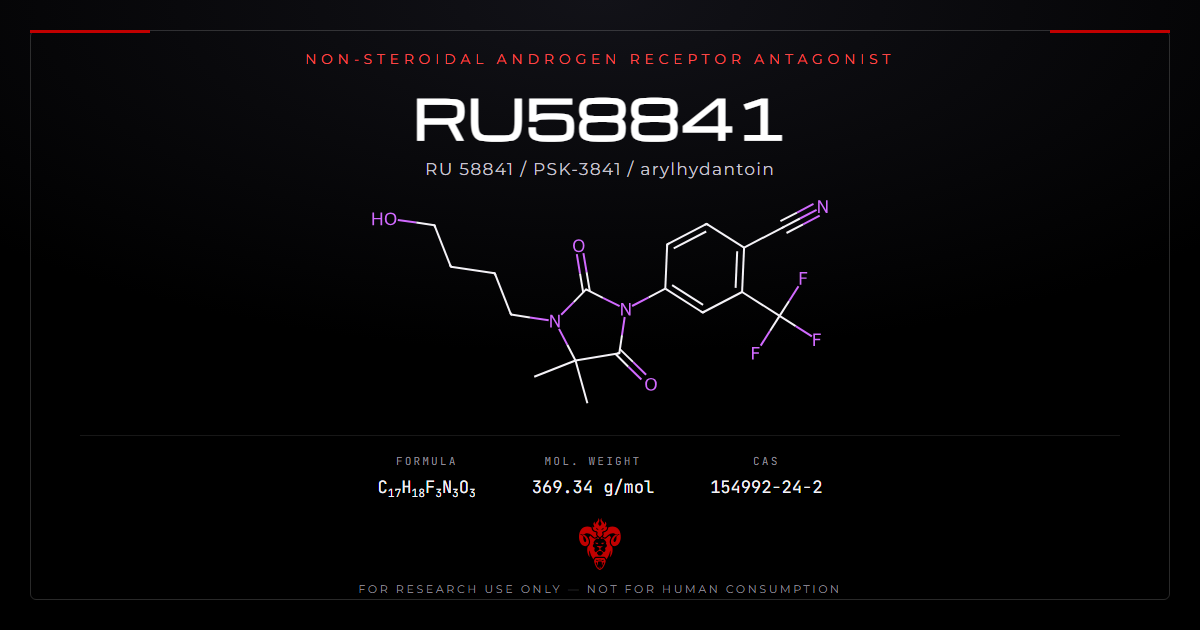
An arylhydantoin: a substituted imidazolidinedione ring on a trifluoromethyl benzonitrile, from the same series as the approved antiandrogen nilutamide.
| Property | Value |
|---|---|
| Systematic name | 4-[3-(4-hydroxybutyl)-4,4-dimethyl-2,5-dioxoimidazolidin-1-yl]-2-(trifluoromethyl)benzonitrile |
| Common names | RU58841, RU 58841, PSK-3841 |
| Molecular formula | C17H18F3N3O3 |
| Molecular weight | 369.34 g/mol |
| Monoisotopic mass | 369.1300 Da |
| CAS number | 154992-24-2 |
| PubChem CID | 132981 |
| InChIKey | ARBYGDBJECGMGA-UHFFFAOYSA-N |
| Calculated logP | 2.1 |
| Stereocentres | 0 |
| Class | Non-steroidal androgen receptor antagonist |
| Originator | Roussel-Uclaf |
Reading the structure
Three fragments, each doing a recognisable job in this drug class.
The benzonitrile carries a nitrile and a trifluoromethyl group on the ring. That combination appears across non-steroidal antiandrogens, including nilutamide and bicalutamide. It is what anchors the molecule in the receptor pocket.
The hydantoin ring is the imidazolidine-2,5-dione core, gem-dimethylated at position 4. A hydroxybutyl chain hangs off the other ring nitrogen. That hydroxyl is the handle chemists have used for every derivative since.
The hydantoin series
RU58841 sits inside a structure-activity series that has been mapped for a different purpose.
Van Dort and Jung built side-chain derivatives to develop androgen receptor radioligands [8][9]. Their work reports affinities across the series. The well-tolerated side chains fall in the low nanomolar range, with hydroxybutyl and methyl variants performing best.
Two caveats belong with those numbers. The derivatives replaced the trifluoromethyl group with iodine in the later series, and the affinities were measured against rat receptor [9]. They describe the chemical neighbourhood rather than the parent compound.
What androgens do to a hair follicle
The target biology is more specific than “androgens cause hair loss”. One experiment shows why an antagonist in skin is a coherent idea.
Obana and colleagues cocultured follicle cells from stumptailed macaques, which develop frontal balding after puberty (PMID 8977424). Testosterone alone did nothing to either dermal papilla cells or outer root sheath cells grown separately.
The inhibition appeared only in combination. Testosterone suppressed outer root sheath proliferation in one condition only. That was coculture with dermal papilla cells from the bald frontal scalp of adult animals [3]. Papilla cells from haired occipital scalp did not produce the effect, and neither did papilla cells from juvenile prebald frontal scalp.
So the androgen-sensing cell is the dermal papilla, and its behaviour is regionally and developmentally specified. RU58841 antagonised the effect in that system [3]. That is the mechanistic case for putting an antagonist into skin, rather than blocking androgen production systemically.
The founding experiments
Two rodent models carried the original programme, and neither one is a hair model.
| Study | Model | Dose and route | Result |
|---|---|---|---|
| Battmann 1994 [1] | Hamster flank organ | 1 µg topical | Dose-dependent regression, no systemic effect to 100 µg |
| Battmann 1994 [1] | Hamster flank organ | 300 µg subcutaneous | Same regression as 1 µg topical |
| Matias 1995 [2] | Hamster ear sebaceous gland | 10 µg/day topical, 4 weeks | 60% gland size reduction, reversible in 4 weeks |
| De Brouwer 1997 [5] | Human scalp grafts, nude mice | 1% in ethanol, 6 months | 28% of follicles recycled against 7% control |
| Pan 1998 [7] | Stumptailed macaque scalp | Topical | Increased density, thickness and length |
The hamster flank organ
Battmann and colleagues introduced RU58841 with a model of androgen-dependent skin, not of hair (PMID 8136306).
The flank organ regressed dose-dependently from a topical dose as low as 1 µg per animal. Deep accessory sex organs showed no antiandrogenic effect. Testosterone concentrations did not change up to 100 µg per animal [1].
One comparison in that paper matters more than the rest. Given subcutaneously, 300 µg produced the same small flank organ change as 1 µg applied topically [1]. That is roughly a 300-fold advantage for local delivery. It is also the origin of everything later said about selectivity.
The sebaceous gland model
Matias and Gaillard ranked four antiandrogens on the Syrian hamster ear [2].
Order of efficacy ran RU58841 first, then RU56187, then RU38882, then cyproterone acetate. Maximum reduction reached 60% of sebaceous gland size at 10 µg per day, with no inhibition on the untreated contralateral ear.
Two details deserve carrying forward. Extending treatment from 4 to 12 weeks produced no further reduction. The glands also returned to normal size within 4 weeks of stopping [2]. The effect is reversible, which is what an antagonist should do.
What reversibility implies
Competitive antagonism at a nuclear receptor lasts exactly as long as occupancy lasts. That has consequences for how any experiment must be designed.
Matias and Gaillard measured both ends of it. Effect plateaued by four weeks and disappeared within four weeks of stopping [2], so the compound holds a state rather than producing a lasting change.
Two design requirements follow. A study needs continuous dosing throughout the observation, and it needs a washout arm to distinguish a maintained effect from a durable one. The macaque and graft studies both dosed continuously [5][7], and neither reported what happened after withdrawal.
That gap matters for interpreting the hair data. A follicle held in anagen by receptor blockade and a follicle restored to normal cycling look identical while dosing continues.
The two hair studies
Only two published experiments tested RU58841 on hair, and both are small.
Stumptailed macaques
Pan and colleagues applied the compound topically to the bald scalp of stumptailed macaques, the closest available model of androgenetic alopecia [7].
They report a potent increase in hair density, thickness and length. No systemic effects were detected. The same paper contains the cell work. It shows competitive suppression of dihydrotestosterone-driven receptor activation, at a potency comparable to hydroxyflutamide [7].
The macaque data are reported without the numerical detail a modern trial would carry. No follicle counts, per-animal figures or statistics appear in the abstract. That is worth knowing before treating it as a strong result.
Human scalp grafts on nude mice
De Brouwer and colleagues used human tissue, which makes this the most directly relevant experiment in the file (PMID 9415227).
Twenty productive scalp grafts from balding men were maintained on testosterone-conditioned female nude mice for eight months. Hair production was monitored monthly for six. Ten grafts received 1% RU58841 in ethanol five days a week, and ten received ethanol alone.
The control grafts carried 28 active follicles and two of them, 7%, began a second hair cycle. The treated grafts carried 29 active follicles and eight, 28%, began a second cycle. Linear hair growth rates were significantly higher on treatment, at p below 0.04 [5].
Read the scale before the percentages. Two follicles against eight, across twenty grafts on twenty mice, in a six-month observation. The authors describe the result as encouraging a clinical trial [5], which is exactly the trial that never appeared.
Why local action is a dose argument
The selectivity claim is real, quantified and frequently misunderstood. It describes a delivery arrangement rather than a property of the molecule.
The numbers behind the claim
RU58841 has no skin-selective pharmacology. In a cotransfection assay in prostate cancer cells it suppressed dihydrotestosterone activation of the receptor competitively, at a potency comparable to hydroxyflutamide [7].
Pan and colleagues drew the obvious conclusion in the same paper. From that result, they wrote, topical application may induce systemic side effects [7]. Their macaque experiment then found none, and both statements sit in one abstract.
The reconciliation is the 300-fold local advantage measured in hamsters [1]. A margin of that kind holds while the applied dose stays small and absorption stays low. It is a quantitative buffer rather than a categorical separation. It narrows as either variable rises.
The route in is the sebaceous gland
Bernard and colleagues located the penetration pathway, and the answer explains why vehicle matters so much.
They compared normal hairless rat skin against scar skin, which lacks sebaceous glands [4]. Cumulative absorption over 24 hours ran 3 to 4 times higher through normal skin. Tissue content was ninefold higher from an alcoholic solution and sixteenfold higher from liposomes.
Autoradiography separated the vehicles. The alcoholic solution kept the drug largely in the stratum corneum and epidermis, and liposomes delivered it into the sebaceous glands [4].
Formulation work since has pushed the same lever in both directions. A myristate prodrug on solid lipid nanoparticles showed negligible permeation of reconstructed epidermis and porcine skin over six hours. Its authors read that as favouring local action [10]. Particulate carriers in general concentrate drug in the pilosebaceous unit. They are not used to move it through skin [12][16].
The agonist finding
One published result cuts against the whole premise, and it is rarely mentioned.
Miyamoto and colleagues studied how antiandrogens become agonists. That switch is the mechanism behind antiandrogen withdrawal syndrome. Hydroxyflutamide, bicalutamide, cyproterone acetate and RU58841 all promoted interaction between the androgen receptor and its coactivator ARA70, dose-dependently [6].
Cotransfection then showed the consequence. Receptor and coactivator were introduced together at a 1:3 ratio into DU145 prostate cancer cells. Those compounds then significantly enhanced androgen receptor transcriptional activity [6].
Bound that finding tightly. It comes from an engineered prostate cell system with forced coactivator expression. Nobody has tested whether the same reversal happens in scalp skin. It does establish that this class can switch direction depending on the coactivator context it meets.
Whether scalp skin presents that context is unmeasured. The experiment would need coactivator quantification in dermal papilla cells alongside a reporter assay, and no published work has done it for this compound.
What happened to the compound
Roussel-Uclaf developed the molecule and did not carry it through. The compound resurfaced under later development codes and then disappeared from the literature again.
Published work after 2001 is almost entirely formulation chemistry. Prodrug design, nanoparticle loading and delivery physics account for most of it [10][11][12]. A further strand used the scaffold to build receptor radioligands [8][9].
Nothing in that record is a clinical programme. Its most recent appearance in a peer-reviewed paper is as a test substrate for a synthetic methodology. That is a fair measure of where the pharmacology stopped.
What the class did next
The idea was not abandoned. Other molecules carried it, and one of them produced the answer this compound never did.
Clascoterone is a topical androgen receptor inhibitor. It reached approval for acne and entered development for androgenetic alopecia [15]. Its systemic behaviour was measured properly, and the finding is directly relevant here.
Little clascoterone is absorbed from a cream. The solution formulation developed for androgenetic alopecia produced measurable systemic concentration and accumulation. That required a dedicated cardiac safety study at 225 mg applied twice daily [13].
That is the closest published evidence bearing on the RU58841 assumption. It does not transfer directly: clascoterone is a steroidal ester and this compound is an arylhydantoin. It does show something useful. The vehicle chosen for scalp application is the one that produced systemic exposure, in a molecule designed for local use.
Meanwhile the treatments with actual trial evidence in this indication remain the 5-alpha reductase inhibitors and minoxidil. That set now includes a topical finasteride formulation, with a smaller fall in serum dihydrotestosterone than oral dosing [14].
How to read a RU58841 study
Four questions apply, and the first one eliminates most sources.
Is it a hair model at all?
The founding experiments used the hamster flank organ and ear sebaceous gland [1][2]. Both are androgen-dependent sebaceous structures rather than follicles. Results there describe the pilosebaceous unit, not hair cycling.
How many follicles?
The human graft study rests on 28 control and 29 treated follicles across 20 grafts [5]. Percentages calculated on those denominators move by whole units when a single follicle changes state.
Which vehicle?
Ethanolic solution, liposome and lipid nanoparticle formulations distribute the compound differently within skin. They also differ severalfold in how much crosses [4][10]. A dose in milligrams says little without the vehicle.
Local or systemic?
The selectivity margin is a dose ratio measured in hamsters [1]. The compound itself is a conventional receptor antagonist [7]. Any claim of local-only action needs a measured systemic concentration, which for RU58841 has never been published in humans.
Verifying research material
A small, achiral, moderately lipophilic solid is straightforward to characterise, and the questions worth asking are about the synthesis rather than the analysis.
Identity
Mass spectrometry gives 369.34, and fluorine makes the compound unusually easy to confirm. Fluorine-19 nuclear magnetic resonance shows a single trifluoromethyl signal. A mismatch there is immediate and unambiguous.
The nitrile provides a second independent check. Infrared spectroscopy places its stretch near 2,230 cm-1, distinct from almost anything else in the molecule.
Related antiandrogens differ enough in mass to separate cleanly. Nilutamide runs at 317.2 and bicalutamide at 430.4. Cross-contamination from a shared synthesis line would be visible.
Purity and related substances
The hydroxybutyl side chain is the reactive handle, and it defines the impurity profile.
Oxidation of that primary alcohol to an aldehyde or carboxylic acid is the plausible degradation route. Those products differ by 2 and 14 mass units. Incomplete alkylation leaves the des-hydroxybutyl hydantoin. That is a distinct compound with its own receptor activity.
Chiral purity is not a question here, since the molecule has no stereocentre. Residual solvents belong on the certificate as usual, along with any metal catalyst from the coupling steps.
Handling
Store dry, sealed and out of light. The compound is a solid with moderate lipophilicity, and a logP of 2.1 predicts what the solubility data confirm.
Aqueous solubility is poor, so cell work needs an organic stock and a vehicle control. Ethanol and DMSO are the usual choices. The ethanolic vehicle used in the graft study is the one with published comparative data behind it [4][5].
Ethanol solutions evaporate and concentrate. A stock left open changes concentration without changing appearance. That matters for a compound whose entire selectivity argument rests on applied dose.
Kimera publishes third-party certificates of analysis for every lot in its COA database. Laboratories source RU58841 as a non-steroidal androgen receptor antagonist reference. It appears alongside Y134 and enclomiphene, where nuclear receptor pharmacology is the shared theme. It also pairs with arimistane, which acts on steroid synthesis rather than on the receptor. Related work appears in the endocrine category.
Common questions about RU58841
Is RU58841 a SARM? No. It is a non-steroidal androgen receptor antagonist from the arylhydantoin class, related to nilutamide rather than to any selective modulator [1].
Is there human trial evidence? None published. The human tissue work is 20 scalp grafts maintained on nude mice [5].
Why is it described as acting only locally? Because 1 µg applied topically matched 300 µg given subcutaneously in the hamster flank organ [1]. That is a dose ratio, not a property of the molecule.
Does it have systemic activity? Its receptor antagonism is comparable to hydroxyflutamide in a cell assay. The authors of that work noted topical use may cause systemic effects [7].
Can an antiandrogen act as an agonist? In one prostate cell system with forced coactivator expression, this compound and three others enhanced receptor transcriptional activity [6]. That has not been tested in skin.
What happened to its development? It never reached published clinical trials. Work after 2001 is formulation chemistry and radioligand design [8][10][11].
Summary of the evidence
Identity: C17H18F3N3O3, 369.34 g/mol, CAS 154992-24-2. An arylhydantoin androgen receptor antagonist, achiral, logP 2.1.
Target biology: dermal papilla cells from bald frontal macaque scalp make testosterone inhibitory to follicle epithelium, and this compound antagonises that effect [3].
Founding data: dose-dependent hamster flank organ regression from 1 µg topical, with no change in testosterone up to 100 µg [1]. Sebaceous gland size fell 60% and returned within four weeks of stopping [2].
Hair data: increased density, thickness and length in stumptailed macaques, without reported numbers [7]. In human grafts on nude mice, 8 of 29 treated follicles recycled against 2 of 28 controls [5].
Selectivity: a 300-fold local advantage measured as topical against subcutaneous dose in hamsters [1], on a molecule with potency comparable to hydroxyflutamide [7].
Penetration: the sebaceous gland is the main route. Gland-bearing skin absorbed 3 to 4 times more, and vehicle determined where the compound landed [4].
Counterweight: this compound and three other antiandrogens enhanced receptor transcription in a prostate cell system with coactivator overexpression [6].
Limits: no published human trial in thirty years, no human pharmacokinetics, and hair evidence resting on two small studies.
Status: supplied for laboratory research use only.
References
- Battmann T, Bonfils A, Branche C, Humbert J, Goubet F, Teutsch G, Philibert D. RU 58841, a new specific topical antiandrogen: a candidate of choice for the treatment of acne, androgenetic alopecia and hirsutism. J Steroid Biochem Mol Biol. 1994;48(1):55-60. PMID 8136306. DOI
- Matias JR, Gaillard M. Local inhibition of sebaceous gland growth by topically applied RU 58841. Ann N Y Acad Sci. 1995;761:56-65. PMID 7625751. DOI
- Obana N, Chang C, Uno H. Inhibition of hair growth by testosterone in the presence of dermal papilla cells from the frontal bald scalp of the postpubertal stumptailed macaque. Endocrinology. 1997;138(1):356-361. PMID 8977424. DOI
- Bernard E, Dubois JL, Wepierre J. Importance of sebaceous glands in cutaneous penetration of an antiandrogen: target effect of liposomes. J Pharm Sci. 1997;86(5):573-578. PMID 9145381. DOI
- De Brouwer B, Tételin C, Leroy T, Bonfils A, Van Neste D. A controlled study of the effects of RU58841, a non-steroidal antiandrogen, on human hair production by balding scalp grafts maintained on testosterone-conditioned nude mice. Br J Dermatol. 1997;137(5):699-702. PMID 9415227.
- Miyamoto H, Yeh S, Wilding G, Chang C. Promotion of agonist activity of antiandrogens by the androgen receptor coactivator, ARA70, in human prostate cancer DU145 cells. Proc Natl Acad Sci U S A. 1998;95(13):7379-7384. PMID 9636157. DOI
- Pan HJ, Wilding G, Uno H, Inui S, Goldsmith L, Messing E, Chang C. Evaluation of RU58841 as an anti-androgen in prostate PC3 cells and a topical anti-alopecia agent in the bald scalp of stumptailed macaques. Endocrine. 1998;9(1):39-43. PMID 9798729. DOI
- Van Dort ME, Jung YW. Synthesis and structure-activity studies of side-chain derivatized arylhydantoins for investigation as androgen receptor radioligands. Bioorg Med Chem Lett. 2001;11(8):1045-1047. PMID 11327585. DOI
- Van Dort ME, Jung YW. Synthesis and structure-activity investigation of iodinated arylhydantoins and arylthiohydantoins for development as androgen receptor radioligands. Bioorg Med Chem Lett. 2004;14(21):5285-5288. PMID 15454212. DOI
- Münster U, Nakamura C, Haberland A, Jores K, Mehnert W, Rummel S, Schaller M, Korting HC, Zouboulis ChC, Blume-Peytavi U, Schäfer-Korting M. RU 58841-myristate, prodrug development for topical treatment of acne and androgenetic alopecia. Pharmazie. 2005;60(1):8-12. PMID 15700772.
- Stecová J, Mehnert W, Blaschke T, Kleuser B, Sivaramakrishnan R, Zouboulis CC, Seltmann H, Korting HC, Kramer KD, Schäfer-Korting M. Cyproterone acetate loading to lipid nanoparticles for topical acne treatment: particle characterisation and skin uptake. Pharm Res. 2007;24(5):991-1000. PMID 17372681. DOI
- Blaschke T, Kankate L, Kramer KD. Structure and dynamics of drug-carrier systems as studied by parelectric spectroscopy. Adv Drug Deliv Rev. 2007;59(6):403-410. PMID 17573146. DOI
- Täubel J, Mazzetti A, Ferber G, Burch W, Fernandes S, Patel A, et al. A phase 1 study to investigate the effects of cortexolone 17α-propionate, also known as clascoterone, on the QT interval using the meal effect to demonstrate ECG assay sensitivity. Clin Pharmacol Drug Dev. 2021;10(6):572-581. PMID 33942574. DOI
- Saceda-Corralo D, Domínguez-Santas M, Vañó-Galván S, Grimalt R. What’s new in therapy for male androgenetic alopecia? Am J Clin Dermatol. 2023;24(1):15-24. PMID 36169916. DOI
- Tay E, Loo WJ. Real-world experience of clascoterone cream 1% in acne management: case series and Canadian experience. Clin Cosmet Investig Dermatol. 2025;18:161-167. PMID 39867973. DOI
- Castro GA, Ferreira LA. Novel vesicular and particulate drug delivery systems for topical treatment of acne. Expert Opin Drug Deliv. 2008;5(6):665-679. PMID 18532922. DOI
RU58841 is sold for laboratory research use only. Not for human consumption, nor medical, veterinary, or household uses.
Literature retrieved from PubMed.