
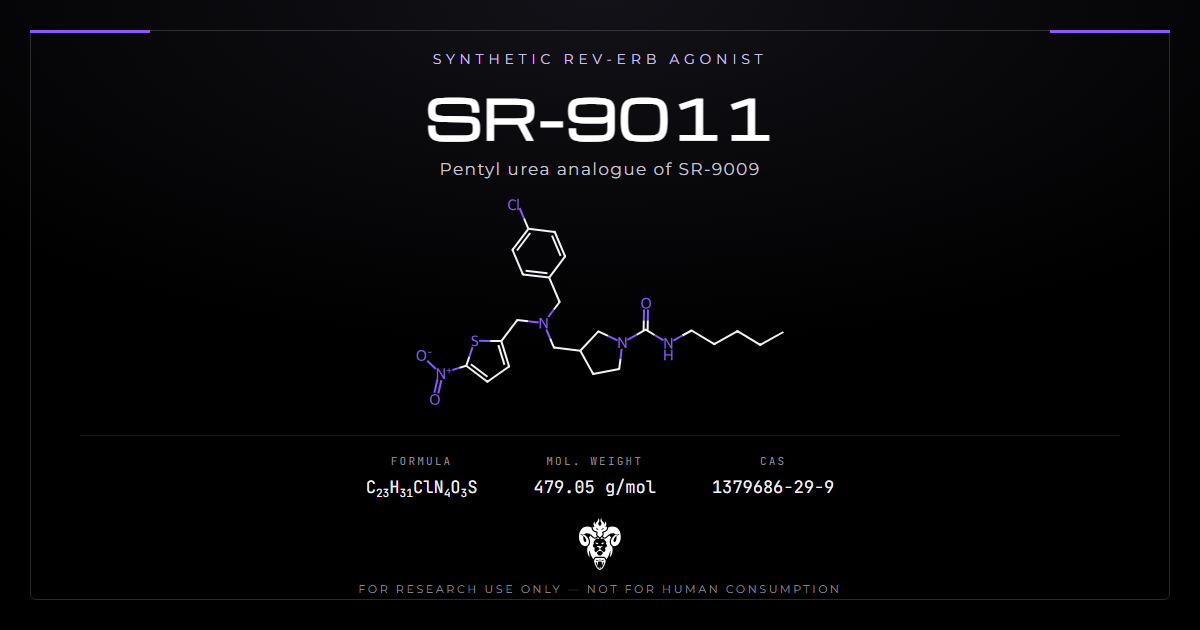
Two synthetic REV-ERB agonists entered the literature together in 2012 [1]. One of them, SR-9009, went on to collect hundreds of citations and a landmark contradiction. The other is SR-9011.
They differ at a single position. Everything else on the molecule is identical, and that similarity has done most of the work in how the second compound gets described. Papers routinely cite findings from one and apply them to the other, which is convenient and not always sound.
The gap matters most on the compound’s biggest open question. A 2019 study showed the twin still acts in cells lacking both REV-ERB proteins [2]. That experiment has never been repeated with this molecule.
Kimera supplies SR-9011 as a reference standard. Everything below reports findings from cells and animals. This material is for research use only, not for human or veterinary use.
What SR-9011 is
The scaffold is a nitrothiophene tertiary amine on a pyrrolidine ring. A 4-chlorobenzyl arm sits on one side of the amine and a 5-nitrothiophenylmethyl arm on the other. The pyrrolidine nitrogen carries a pentyl urea.
Identity and physical data
| Property | Value |
|---|---|
| Compound | SR-9011 |
| PubChem CID | 57394021 |
| CAS number | 1379686-29-9 |
| Molecular formula | C23H31ClN4O3S |
| Molecular weight | 479.0 g/mol |
| InChIKey | PPUYOYQTTWJTIU-UHFFFAOYSA-N |
| IUPAC name | 3-[[(4-chlorophenyl)methyl-[(5-nitrothiophen-2-yl)methyl]amino]methyl]-N-pentylpyrrolidine-1-carboxamide |
| Chemical class | Nitrothiophene tertiary amine, pyrrolidine urea |
The stereocentre nobody resolves
The pyrrolidine 3-position carries the aminomethyl arm, and that carbon is a stereocentre. The registry record specifies no configuration, and the InChIKey stereo block reads UHFFFAOYSA, so material described by that record is racemic. The same is true of the twin. No published study compares the enantiomers of either compound.
Where the scaffold came from
Both compounds descend from GSK4112, an earlier REV-ERB tool with poor exposure in animals. A 2013 medicinal chemistry paper documents the optimisation of that series for potency, selectivity over LXR-alpha, and bioavailability [3]. The series was built to fix pharmacokinetics, and reading it explains what the substituent at the pyrrolidine nitrogen is for.
Searching the record
Three spellings appear in the literature: SR-9011, SR9011 and SR 9011. PubMed indexes the hyphenated and unhyphenated strings separately, so a title-and-abstract search on one form returns a partial record.
The compound also hides inside class-level phrasing. Papers that write “REV-ERB agonists” in the title may have run SR-9011, its twin, or both, and only the methods section says which. Search the registry number when a name search looks thin, since 1379686-29-9 is unambiguous.
The pair, and what actually differs
One functional group separates them. The twin carries an ethyl carbamate on the pyrrolidine nitrogen; this compound carries an N-pentyl urea.
| Property | SR-9011 | SR-9009 |
|---|---|---|
| Formula | C23H31ClN4O3S | C20H24ClN3O4S |
| Molecular weight | 479.0 g/mol | 437.9 g/mol |
| Pyrrolidine substituent | N-pentyl urea | Ethyl carbamate |
| CAS number | 1379686-29-9 | 1379686-30-2 |
| Shared features | Nitrothiophene, 4-chlorobenzyl, tertiary amine, one stereocentre | Same |
What that substitution changes
The pentyl chain adds 41 mass units and a substantial amount of lipophilicity. A urea also hydrogen bonds differently from a carbamate and resists esterase hydrolysis, where a carbamate is the more obvious metabolic handle.
Those differences point at distribution and stability rather than at receptor binding. Two compounds can share a binding mode and behave differently in an animal, and this pair is a clean example of the principle.
What it does not change
The pharmacophore. The nitrothiophene and the tertiary amine are intact in both. Any activity running through that fragment is a property of the scaffold rather than of either compound. That cuts both ways in interpretation, and the next section is where it bites.
The 2012 paper that introduced both
The Nature paper reported potent synthetic REV-ERB agonists with activity in living animals [1]. Dosing altered circadian behaviour and core clock gene expression in mouse hypothalamus. Metabolic gene expression shifted in liver, skeletal muscle and adipose tissue, energy expenditure rose, and diet-induced obese mice lost fat mass [1].
Both compounds appear in that work. Each figure in it came from one compound or the other. The compound named in a figure legend is the compound that result belongs to. Citing the paper at abstract level loses that distinction.
Where this compound has been used in its own right
A useful amount of the literature does use it directly. These are the results that belong to this molecule rather than to its twin.
Cancer and oncogene-induced senescence
A 2018 Nature paper reported that both agonists were specifically lethal to cancer cells and to oncogene-induced senescent cells, while sparing normal cells and tissues [4]. Running both compounds was a deliberate design choice: two scaffold-mates agreeing is weaker evidence than two unrelated chemotypes agreeing, but it does rule out a per-compound artefact.
Immune and fibrotic models
A 2026 study examined modulation of TH17 cell activity by REV-ERB agonists in the context of canine meningoencephalitis of unknown origin [5]. In human lung fibroblasts, a 2023 study reported suppressed fibroblast-to-myofibroblast transition and a reduced pro-fibrotic phenotype [6]. A 2022 study reported reduced Th2 differentiation and lower GATA3 expression in an asthma model [7].
Proliferation and cell biology
Osteosarcoma proliferation and tumour growth fell in a 2023 study, through mTOR signalling [8]. Another 2023 study found circadian oscillation in primary cilium length under clock gene control, using agonist treatment as one of its tools [9].
Neural and haematopoietic work
A 2024 study examined Rev-erb-alpha in neurogenesis and dopaminergic neuron regeneration [10]. A separate 2024 study placed the receptor in fine-tuning of erythropoietin gene expression [11]. Both used agonist treatment alongside genetic manipulation, which is the design worth copying.
Delivery formulation
A 2025 study built a peptide hydrogel for sustained release of this compound and tested it in colitis, reporting promoted efferocytosis [12]. Formulation work of that kind is a signal that free-compound exposure is the limiting factor, which matches what the chemistry series was built to address [3].
The read-across problem
This is the part that distinguishes the two compounds in practice, and it has nothing to do with chemistry.
What was tested on the twin
A 2019 study generated mice allowing conditional deletion of both REV-ERB-alpha and REV-ERB-beta together. In hepatocytes and embryonic stem cells lacking both receptors, SR-9009 still cut viability, rewired metabolism and altered transcription [2]. Two later studies reached the same conclusion in heart and in prostate cancer cells, again with the twin [13][14].
What that means here
Three receptor-independence results exist, and all three were generated with the other compound (PubMed). None used this one. Two readings follow, and the honest answer is that both remain open.
The scaffold reading says the off-target activity lives in the shared nitrothiophene pharmacophore, in which case SR-9011 carries it too. The substituent reading says the off-target activity depends on the part that differs, in which case it may not. Nobody has run the experiment that decides between them.
The practical consequence
Treat receptor independence as untested rather than absent. A phenotype produced by this compound needs the same double-knockout control the twin’s phenotypes need. Citing the twin’s results as reassurance gets the logic backwards.
How the conflation happens in practice
Trace a citation chain and the pattern repeats. A review cites the 2012 paper for the pair. The next paper cites that review for one compound. By the third citation the mechanism has travelled but the compound identity has not.
The 2019 result makes that chain expensive (PubMed). A mechanistic claim inherited three citations deep may rest on an experiment that used a different molecule and a different control set. Check the primary source rather than the review.
What would settle it
One experiment. Run SR-9011 across a concentration series in double-knockout cells alongside wild-type, with viability and a transcriptional readout. The reagents already exist [2]. The result would either extend the receptor-independence finding to the whole scaffold or confine it to one substituent, and either answer improves the field.
What the receptor does, on genetic evidence
Separating receptor biology from ligand pharmacology needs genetics, and that work exists independently of either compound.
Muscle and lung
A 2013 study found REV-ERB-alpha highly expressed in oxidative skeletal muscle. Deficiency cut mitochondrial content, raised autophagy and compromised exercise capacity in mice [15]. A 2018 study established that the receptor controls homeostatic regulation of pulmonary inflammation [16].
Why those results are the durable ones
Neither depends on a ligand. Genetic results describe the receptor, and they stand whatever any small molecule turns out to do. Build the mechanistic frame from the genetics, then ask where a compound fits inside it.
Designing an experiment with SR-9011
Engagement readout first
REV-ERB represses transcription, so an agonist drives repression harder. Bmal1 and Npas2 transcript levels are the standard readout, and both should fall if the compound engaged the receptor in that system.
Controls that earn their place
A double-knockout or double-knockdown arm, because single deletion leaves the paralogue. A structurally unrelated REV-ERB agonist, because the twin shares this scaffold and cannot serve as an independent chemotype. And a vehicle matched across every well.
Run a concentration series, not a single dose
One concentration gives a yes or a no. A series gives a curve, and the shape of that curve carries information a single point cannot.
Two-component curves are the reason it matters here. A compound acting at a receptor and at a second site can produce a shallow or biphasic response, with the receptor arm dominating at low concentration and something else taking over higher up. A single high concentration hides exactly the feature worth seeing, and this scaffold is the case where somebody should look for it [2].
Timing is a variable
Clock gene expression oscillates, so identical treatment at two circadian times can give two answers. Report the circadian time of dosing and of harvest. Cultured cells need a synchronising serum shock or dexamethasone pulse first, since unsynchronised cells average across every phase and flatten the oscillation being measured.
Reporting that makes a result reusable
Name the compound, not the class. A methods line reading “REV-ERB agonist” is unusable at face value, because three chemotypes carry that label and they do not behave alike.
Give the supplier and the batch, the vehicle and its final concentration, and the circadian time. Four extra lines in a methods section decide whether anybody can build on the work, and this literature has a long record of leaving them out.
One experiment per question
Two questions get mixed in this field. What does REV-ERB do, and what does this molecule do. Genetics answers the first better than any ligand can. The second needs a concentration series and a clean readout, and it needs no receptor at all.
Deciding which question is on the bench settles the design in a sentence. Mixing them produces the papers that this article keeps flagging, where a clock gene readout stands in for an attribution argument it cannot make.
Physicochemical properties and handling
| Property | Detail |
|---|---|
| Appearance | Yellow to orange solid |
| Solubility | Soluble in DMSO; poorly water soluble |
| Recommended stock | DMSO, split into single-use aliquots |
| Storage, solid | Controlled room temperature, sealed, desiccated, protected from light |
| Storage, solution | Prepare fresh in single-use aliquots rather than holding stock |
| Stability note | Nitroaromatic and photosensitive; the urea resists esterase cleavage |
| Handling | Standard laboratory controls for a fine powder |
Storage guidance is a house recommendation. Analytical documentation is per-lot release testing.
The nitro group sets the handling rules
Nitrothiophenes absorb in the visible range, which is why the solid is yellow. Nitroaromatics also photodegrade, and they reduce stepwise to nitroso, hydroxylamine and amine species under reducing conditions. Thiol-containing media will do that slowly.
Two rules follow. Store dark, in amber glass or foil, and prepare working dilutions immediately before use rather than pre-diluting a plate in advance.
A stock-integrity check worth running
Read the absorbance of a diluted aliquot against a freshly prepared standard at the same nominal concentration. Nitroaromatic degradation shifts the visible spectrum, so a stock that has aged in the light reads differently.
The check takes minutes and settles a question that otherwise contaminates a whole experiment. A degraded stock produces a clean dose-response curve at the wrong concentration, which no downstream statistic will flag.
Lipophilicity affects the practical work
The pentyl chain makes this the more lipophilic of the pair. Expect stronger adsorption to plastics at low concentrations and a greater tendency to come out of solution when a DMSO stock meets aqueous buffer. Add the stock to well-mixed medium rather than the reverse, and inspect for precipitate before dosing.
Analytical characterization
Mass detection separates the pair cleanly
Positive-mode electrospray gives a protonated ion at m/z 479.2 for the C23H31ClN4O3S formula, against 438.1 for the twin. Forty-one mass units is a comfortable separation for any mass analyser, so co-identification is not the analytical risk here.
The chlorine isotope pattern gives a second confirmation channel on both compounds. The 37-chlorine peak sits at roughly a third the height of the 35-chlorine peak.
The published method covers both
Anti-doping laboratories developed a quantitative LC-MS/MS method that detects this compound and its twin simultaneously in equine plasma [17]. That method exists because both are controlled in sport, and it is the practical reference for anyone needing validated conditions for the pair. Batch documentation for catalogue material sits in the certificate of analysis database.
What a certificate should report
Assay purity with the detection wavelength stated, since a nitro chromophore biases area percent against colourless impurities. Water content, because a hygroscopic solid inflates every weighed concentration. An appearance note, because colour change in a nitroaromatic is a degradation signal. And explicit confirmation of which compound of the pair the batch contains, since the shared scaffold gives near-identical ultraviolet spectra.
Where SR-9011 sits among nuclear receptor tools
| Compound | Receptor target | Class |
|---|---|---|
| SR-9011 | REV-ERB agonist | Nitrothiophene, pyrrolidine urea |
| SR-9009 | REV-ERB agonist | Nitrothiophene, pyrrolidine carbamate |
| GW-0742 | PPAR-beta/delta agonist | Phenoxyacetic acid, thiazole |
| GW-501516 | PPAR-beta/delta agonist | Phenoxyacetic acid, thiazole |
Four compounds, two scaffolds, two receptor families, and one shared methodological lesson about attribution. Further reading sits in the metabolic research library.
What this literature does not establish
Receptor dependence, either way
No published experiment tests this compound in cells lacking both REV-ERB proteins. That is the single largest gap in its record, and it is a gap somebody could close with existing reagents [2].
Whether the pair are interchangeable
They are treated as interchangeable and have never been compared head to head across a concentration range in the same system. Their distribution differs on chemical grounds, so equivalence at the receptor would not imply equivalence in an animal.
How much formulation contributes
The hydrogel study reported an effect from sustained release rather than from free compound [12]. That design answers a delivery question, not a pharmacological one.
Comparing a sustained-release result against a bolus result therefore compares two exposure profiles as much as two biological conditions. Keep formulation in view when reading across studies, because this compound’s literature contains both.
Human data
Published work is preclinical. No controlled human trial results are indexed for this compound.
A head-to-head potency comparison
No study reports EC50 values for SR-9011 and its twin measured side by side in one assay on one day. Published potency figures come from different systems and different years, which makes them incomparable in the way that matters.
That gap is cheap to close and nobody has closed it. Until somebody does, treat any claim that one is more potent than the other as an inference rather than a measurement.
Enantiomer behaviour
The racemate is what every published study used. Whether the enantiomers differ at REV-ERB, at any off-target site, or in metabolism, is unknown for both members of the pair.
Frequently asked questions
How does SR-9011 differ from SR-9009?
One substituent on the pyrrolidine nitrogen. This compound carries an N-pentyl urea and the twin carries an ethyl carbamate, a difference of 41 mass units [17].
Does the receptor-independence finding apply to it?
Unknown. That work was done with the twin in cells lacking both receptors [2], and the experiment has not been repeated here.
Which findings were generated with this compound specifically?
The 2018 cancer and senescence work used both agonists [4], and several immune, fibrosis and cell biology studies used it directly [5][6][8][9][12].
What engagement readout should an experiment use?
Bmal1 and Npas2 repression. REV-ERB represses transcription, so successful engagement shows as those transcripts falling.
Which compound should a new experiment use?
Whichever one the comparison literature used, unless the question is about the pair itself. Mixing compounds across arms of one study makes the result uninterpretable.
Why is the powder yellow?
The 5-nitrothiophene group absorbs in the visible range. Nitroaromatics are also photosensitive, so store the solid dark and discard stocks that have changed colour.
Can the twin’s data be used as a substitute?
For chemistry, largely yes. For receptor attribution, no. The independence experiments used the twin [2][13][14], and no equivalent test exists for this molecule.
Why does the urea matter?
It changes lipophilicity and metabolic handling rather than binding. A urea resists esterase cleavage where the twin’s carbamate offers an obvious handle.
Is the material racemic?
Yes, unless a certificate states otherwise. The pyrrolidine 3-position is a stereocentre and the registry record carries no configuration.
References
- Solt LA, Wang Y, Banerjee S, et al. Regulation of circadian behaviour and metabolism by synthetic REV-ERB agonists. Nature. 2012;485(7396):62-8. PubMed DOI
- Dierickx P, Emmett MJ, Jiang C, et al. SR9009 has REV-ERB-independent effects on cell proliferation and metabolism. Proc Natl Acad Sci U S A. 2019;116(25):12147-12152. PubMed DOI
- Trump RP, Bresciani S, Cooper AW, et al. Optimized chemical probes for REV-ERBalpha. J Med Chem. 2013;56(11):4729-37. PubMed DOI
- Sulli G, Rommel A, Wang X, et al. Pharmacological activation of REV-ERBs is lethal in cancer and oncogene-induced senescence. Nature. 2018;553(7688):351-355. PubMed DOI
- Bailey A, Gibson R, Griffett K. Modulation of TH17 cell activity by REV-ERB agonists: path toward novel treatments for canine meningoencephalitis of unknown origin. npj Vet Sci. 2026;1(1):16. PubMed DOI
- Prasad C, Hahn K, Duraisamy SK, et al. Rev-erbalpha agonists suppresses TGFbeta1-induced fibroblast-to-myofibroblast transition and pro-fibrotic phenotype in human lung fibroblasts. Biochem Biophys Res Commun. 2023;669:120-127. PubMed DOI
- Tiwari D, Ahuja N, Kumar S, et al. Nuclear receptor Nr1d1 alleviates asthma by abating GATA3 gene expression and Th2 cell differentiation. Cell Mol Life Sci. 2022;79(6):308. PubMed DOI
- Yuan B, Shi K, Zha J, et al. Nuclear receptor modulators inhibit osteosarcoma cell proliferation and tumour growth by regulating the mTOR signaling pathway. Cell Death Dis. 2023;14(1):51. PubMed DOI
- Nakazato R, Matsuda Y, Ijaz F, et al. Circadian oscillation in primary cilium length by clock genes regulates fibroblast cell migration. EMBO Rep. 2023;24(12):e56870. PubMed DOI
- Gupta S, Ahuja N, Kumar S, et al. Rev-erbalpha regulate neurogenesis through suppression of Sox2 in neuronal cells to regenerate dopaminergic neurons and abates MPP+ induced neuroinflammation. Free Radic Biol Med. 2024;223:144-159. PubMed DOI
- Kumar S, Arora R, Gupta S, et al. Nuclear receptor Rev-erbalpha role in fine-tuning erythropoietin gene expression. Blood Adv. 2024;8(14):3705-3717. PubMed DOI
- Chen Y, Li J, Li J, et al. Andrias davidianus peptide hydrogel enables sustained SR9011 release to promote efferocytosis and alleviate colitis. Small. 2025;21(50):e09049. PubMed DOI
- Li H, Song S, Tien CL, et al. SR9009 improves heart function after pressure overload independent of cardiac REV-ERB. Front Cardiovasc Med. 2022;9:952114. PubMed DOI
- Xu H, Zhang J, Zheng X, et al. SR9009 inhibits lethal prostate cancer subtype 1 by regulating the LXRalpha/FOXM1 pathway independently of REV-ERBs. Cell Death Dis. 2022;13(11):949. PubMed DOI
- Woldt E, Sebti Y, Solt LA, et al. Rev-erb-alpha modulates skeletal muscle oxidative capacity by regulating mitochondrial biogenesis and autophagy. Nat Med. 2013;19(8):1039-46. PubMed DOI
- Pariollaud M, Gibbs JE, Hopwood TW, et al. Circadian clock component REV-ERBalpha controls homeostatic regulation of pulmonary inflammation. J Clin Invest. 2018;128(6):2281-2296. PubMed DOI
- Kwak YB, Yu J, Yoo HH. A quantitative method for the simultaneous detection of SR9009 and SR9011 in equine plasma using liquid chromatography-electrospray ionization-tandem mass spectrometry. Drug Test Anal. 2022;14(8):1532-1538. PubMed DOI