
In 2012 a Nature paper reported that two synthetic REV-ERB agonists changed circadian behaviour, altered clock gene expression in mouse hypothalamus, and raised energy expenditure in diet-induced obese mice [1]. One of those compounds was SR-9009.
Seven years later a different group built mice in which both REV-ERB proteins could be deleted together, then ran the compound in cells from those animals. It still decreased cell viability, rewired metabolism and altered transcription with neither receptor present [2].
Both results stand. Reading them together is what makes this compound worth stocking as a reference standard, and it is why every current experiment with it needs a genotype control. Kimera supplies SR-9009 for that work.
Everything below reports findings from cells and animals. This material is for research use only, not for human or veterinary use.
What SR-9009 is
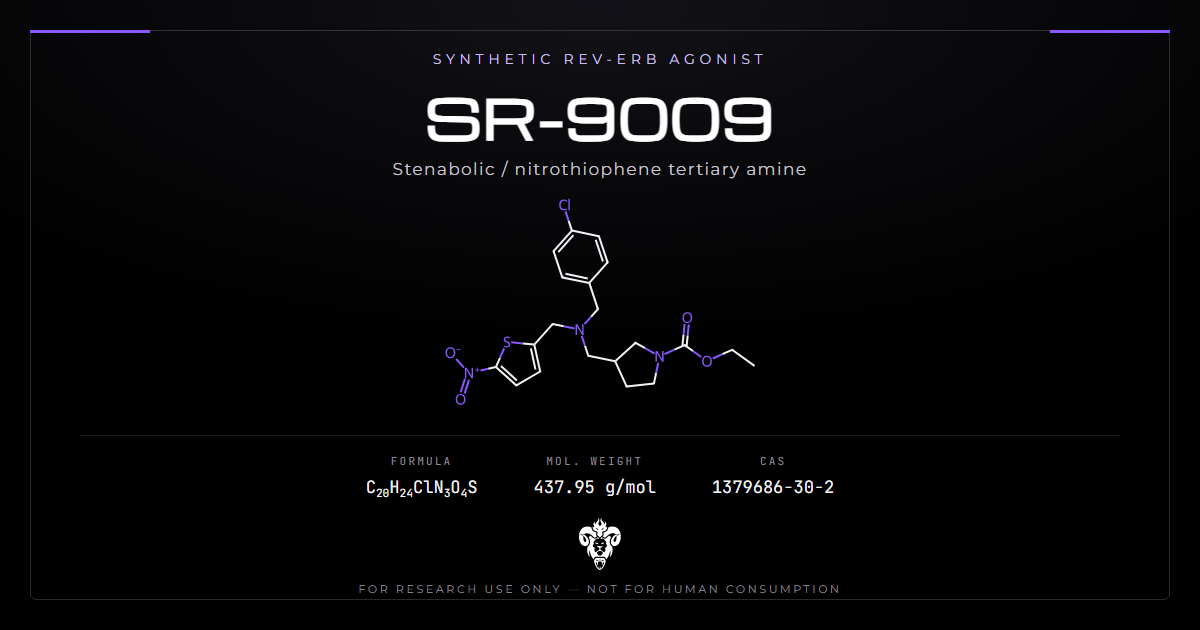
The molecule is a tertiary amine built on a pyrrolidine carbamate, carrying a 4-chlorobenzyl group and a 5-nitrothiophene. The nitrothiophene is the part that binds.
Identity and physical data
| Property | Value |
|---|---|
| Compound | SR-9009 |
| Synonym | Stenabolic |
| PubChem CID | 57394020 |
| CAS number | 1379686-30-2 |
| Molecular formula | C20H24ClN3O4S |
| Molecular weight | 437.9 g/mol |
| InChIKey | MMJJNHOIVCGAAP-UHFFFAOYSA-N |
| IUPAC name | ethyl 3-[[(4-chlorophenyl)methyl-[(5-nitrothiophen-2-yl)methyl]amino]methyl]pyrrolidine-1-carboxylate |
| Chemical class | Nitrothiophene tertiary amine, pyrrolidine carbamate |
The scaffold has a stereocentre
Position 3 of the pyrrolidine ring carries the aminomethyl arm, and that carbon is a stereocentre. The PubChem record specifies no configuration, and its InChIKey stereo block reads UHFFFAOYSA, so the registry entry describes the compound without one. Material supplied against that record is racemic unless a certificate says otherwise. No published work separates the enantiomers, which is a gap worth knowing about before designing anything that assumes a single stereoisomer.
Where the series came from
This compound is not a first-in-class molecule. It descends from GSK4112, an earlier REV-ERB tool compound with poor exposure in animals. A 2013 medicinal chemistry paper optimised that series for potency, selectivity over LXR-alpha and bioavailability [3]. Reading that paper first explains what the scaffold was built to fix, and what it never fixed.
The receptor it targets
REV-ERB-alpha and REV-ERB-beta, also written NR1D1 and NR1D2, are nuclear receptors that repress transcription rather than activate it. They sit inside the core circadian clock and suppress BMAL1, which is the readout most papers use. Heme is their natural ligand.
Repression is the mechanism
An agonist here drives repression harder. That inverts the usual expectation for a nuclear receptor agonist, and it means the primary readout of engagement is a gene going down, not up. Bmal1 and Npas2 transcript levels are the standard pair.
Two receptors, one drug
Alpha and beta overlap functionally. Deleting one leaves the other, which is exactly why the definitive attribution experiment needed both gone at once [2].
Heme is the natural ligand
REV-ERB binds heme in its ligand pocket, and heme availability ties receptor activity to cellular metabolic state. A synthetic agonist competes with that endogenous signal rather than acting on an empty pocket.
That has a practical consequence in cell work. Heme levels differ between cell types and between media formulations. A synthetic ligand entering an already-occupied pocket produces a response that depends on how occupied that pocket was, which is one reason potency figures for this class vary between laboratories.
The 2012 result
The Nature paper identified potent synthetic agonists with activity in living animals [1]. Administration altered circadian behaviour and the pattern of core clock gene expression in mouse hypothalamus. Metabolic gene expression shifted in liver, skeletal muscle and adipose tissue, and energy expenditure rose. Treatment of diet-induced obese mice reduced fat mass and improved several metabolic markers [1].
Why it landed hard
The result connected a clock protein to whole-body energy balance through a small molecule. That combination is rare, and the paper became the citation behind almost every later claim about this compound. Its findings have not been retracted or refuted. What changed is the interpretation of which protein produced them.
The 2019 result that complicated it
A group generated a mouse model allowing conditional deletion of both REV-ERB-alpha and REV-ERB-beta together [2]. Earlier work could not test the question properly, because no experiment had been run in the complete absence of both proteins.
What the double knockout showed
In hepatocytes and embryonic stem cells lacking both receptors, SR-9009 still decreased cell viability, still rewired cellular metabolism, and still altered gene transcription [2]. The effects did not need the target (PubMed).
Two independent confirmations
A 2022 cardiac study made the same kind of test. The group built cardiac-specific double knockout mice, confirmed that losing REV-ERB caused dilated cardiomyopathy after transverse aortic constriction, then found the compound’s protective effect did not require cardiac REV-ERB [4].
A 2022 cancer study found the compound lethal to prostate cancer cell lines and traced the mechanism to the LXR-alpha and FOXM1 pathway, again without REV-ERBs [5]. Three groups, three tissues, one conclusion about attribution.
What that does and does not mean
It does not mean the compound is inert or uninteresting. It means the label on the bottle describes a binding activity, not the mechanism of any given phenotype. Treat SR-9009 as a molecule with at least two pharmacologies, one at REV-ERB and one somewhere else that nobody has pinned down.
That reading also explains why the compound stays useful. A tool with two activities is a problem for a mechanistic claim and an opportunity for anyone studying the second activity, which remains unclaimed. The receptor-independent effects on viability and metabolism are themselves a phenotype somebody could chase to its source [2].
What the receptor genuinely does
Separating the receptor from the ligand needs genetic work, and that work exists.
Skeletal muscle
A 2013 study in Nature Medicine showed REV-ERB-alpha is highly expressed in oxidative skeletal muscle [6]. Deficiency reduced mitochondrial content and oxidative function, increased autophagy, and compromised exercise capacity in mice. The molecular route ran through Lkb1, AMPK, SIRT1 and PGC-1-alpha [6].
Lung and heart
A 2018 study established that REV-ERB-alpha controls homeostatic regulation of pulmonary inflammation [7]. A 2022 study found REV-ERB is essential to cardiac fibroblast homeostasis [8]. Both rest on genetics rather than on a ligand, which is what makes them durable.
Findings that used the compound as a probe
Each result below belongs to its model. Read the control section of any of these papers before citing it as receptor pharmacology.
Inflammation
A 2021 study reported suppressed IL-1-beta production in macrophages through BMAL1-dependent inhibition of the inflammasome [9]. In an asthma model, a 2022 study reported reduced Th2 differentiation and lower GATA3 expression [10]. A 2023 study connected NR1D1 to BNIP3-mediated mitophagy in ulcerative colitis [11].
Proliferation and senescence
A 2018 Nature paper reported that both this compound and its analogue were lethal to cancer cells and to oncogene-induced senescent cells, while sparing normal cells [12]. Osteosarcoma proliferation fell in a 2023 study, through mTOR signalling [13]. Given the 2019 double knockout result, the selective lethality in that first paper is one of the phenotypes most in need of a genotype control.
Other systems
A 2024 study examined Rev-erb-alpha in neurogenesis and dopaminergic neuron regeneration [14]. Later that year, a second group placed the receptor in fine-tuning of erythropoietin gene expression [15]. A 2023 study reported suppressed fibroblast-to-myofibroblast transition in human lung fibroblasts [16].
What these studies share
Look across the probe literature and a pattern appears. Most measure a phenotype, show that a clock gene moved, and conclude the receptor did the work. The clock gene readout proves engagement. It does not prove the phenotype came from that engagement, because a second target could move both.
The distinction sounds pedantic until you read the 2019 result [2], which found transcription altered without either receptor present. Gene expression changes are not, on their own, evidence of receptor mediation for this compound.
Designing an experiment with SR-9009
Start with the question, not the compound
Two different experiments get conflated here. One asks what REV-ERB does, and genetics answers it better than any ligand. The other asks what SR-9009 does, which is a question about a molecule and needs no receptor at all.
Deciding which one you are running settles the design. A receptor question needs a knockout; a compound question needs a concentration series and a clean readout, and mixing them produces the papers this article keeps flagging.
The control set
Three arms make a result attributable. A target gene readout, since Bmal1 and Npas2 repression shows engagement. A double-knockout or knockdown arm, because single deletion leaves the paralogue in place [2]. And a structurally distinct REV-ERB agonist, which tests whether the phenotype tracks the receptor or the chemotype.
The analogue comparison
SR-9011 shares the nitrothiophene core and differs at one position. Two compounds from the same scaffold agreeing tells you less than one compound from a different scaffold agreeing, so pair a scaffold-mate with something unrelated rather than treating the pair as independent evidence.
What belongs in the methods
Four items, and none of them costs anything: vehicle and its final concentration, circadian time of dosing and of harvest, the clock gene readout used for engagement, and the genotype of every cell line or animal in the comparison.
Papers that report all four can be reproduced. Papers on SR-9009 that report none of them cannot be compared against each other, which is most of what makes this literature hard to synthesise.
Timing is a variable, not a detail
This is a clock protein. Its expression oscillates across the day, so the same treatment applied at two circadian times can give two answers. Report the Zeitgeber or circadian time of both dosing and harvest.
Cultured cells need synchronisation before any of that means anything. A serum shock or dexamethasone pulse sets a common phase across the dish. Unsynchronised cells average over every phase at once, which flattens exactly the oscillation the experiment is asking about.
Selectivity worth checking
The optimisation paper tracked selectivity over LXR-alpha specifically [3], and the prostate cancer mechanism ran through LXR-alpha [5]. That is not a coincidence worth ignoring. Include an LXR readout when a phenotype looks metabolic.
Pharmacokinetics, and the limits they impose
The parent series had poor bioavailability, and improving it was an explicit goal of the 2013 chemistry work [3]. Exposure remains the practical constraint on interpreting in vivo results with this compound.
Why that matters for reading papers
A short-lived compound given once produces a transient exposure. Effects reported after such dosing may reflect a brief spike rather than sustained receptor occupancy. Check the dosing schedule against the reported endpoint before comparing two studies, since a chronic phenotype and an acute one are different experiments.
Reading this literature by year
The publication record splits cleanly into three periods, and knowing which one a paper sits in tells you what its controls are likely to be.
Before 2019
Papers in this window treat the compound as a REV-ERB agonist without qualification. The genetic tools to test that assumption did not exist yet. The findings are still data; the mechanistic attribution in the discussion is what to discount (PubMed).
2019, the pivot
In 2019 the double-knockout paper appeared and changed what a competent control set looks like [2]. Anything published after it without a genotype arm made a choice, rather than lacking a tool.
After 2019
Practice is mixed. Two groups ran the genetic test and reported receptor-independent effects in their systems [4][5]. Others carried on as before. Check the methods, not the date, since the date only tells you what was available.
A note on the name
Catalogues and papers write this compound four ways: SR-9009, SR9009, SR 9009 and Stenabolic. PubMed indexes the hyphenated and unhyphenated forms as separate strings, so a title-and-abstract search on one alone returns a partial record.
The trade name carries its own problem. Stenabolic appears mostly in non-scientific sources, and searching it returns material that has nothing to do with the primary literature. Search the registry number when a name search looks thin, since 1379686-30-2 is unambiguous.
Physicochemical properties and handling
| Property | Detail |
|---|---|
| Appearance | Yellow to orange crystalline solid |
| Solubility | Soluble in DMSO and ethanol; poorly water soluble |
| Recommended stock | DMSO, split into single-use aliquots |
| Storage, solid | Controlled room temperature, sealed, desiccated, protected from light |
| Storage, solution | Prepare fresh in single-use aliquots rather than holding stock |
| Stability note | Nitroaromatic and photosensitive; keep dark |
| Handling | Standard laboratory controls for a fine powder |
Storage guidance is a house recommendation. Analytical documentation is per-lot release testing.
The nitro group drives the colour and the care
Nitrothiophenes absorb strongly in the visible range, which is why the solid is yellow rather than white. Nitroaromatics also photodegrade. Amber vials and dark storage are not optional for this scaffold, and a stock that has lightened or darkened noticeably should be discarded rather than diluted further.
Colour is the first check
Look at the solid before weighing it. A fresh batch is yellow to orange and uniform. Darkening, clumping or a colour gradient through the vial all point at photodegradation or moisture uptake.
Neither costs anything to check, and both invalidate a concentration silently. Photograph a new batch under consistent light and keep the image with the certificate, so the next comparison has a reference point rather than a memory.
Reduction is the degradation route to watch
Nitro groups reduce to nitroso, hydroxylamine and amine species under reducing conditions. Cell culture media containing thiols will do this slowly. Prepare working dilutions immediately before use rather than pre-diluting a plate’s worth in the morning.
Analytical characterization
Mass detection
Electrospray in positive mode gives a protonated ion at m/z 438.1 for the C20H24ClN3O4S formula. The chlorine isotope pattern gives a second confirmation channel at no extra cost, since the 37-chlorine peak sits at roughly a third the height of the 35-chlorine peak.
Separating the pair
Anti-doping laboratories have published a quantitative LC-MS/MS method that detects this compound and SR-9011 simultaneously in equine plasma [17]. That method exists because both compounds are controlled in sport. It is also the practical reference for anyone resolving the two analytically, since they share the nitrothiophene chromophore and differ only in the pyrrolidine substituent. Batch documentation for catalogue material sits in the certificate of analysis database.
Purity checks specific to a nitroaromatic
Three things belong on a certificate for this scaffold. Assay purity by HPLC with the wavelength stated, because a nitro chromophore biases area percent against colourless impurities. Water content, since a hygroscopic solid inflates every weighed concentration. And an appearance note, because a colour shift in a nitroaromatic is a degradation signal that no chromatogram taken six months earlier can rule out.
Ultraviolet detection
The nitrothiophene chromophore absorbs strongly, which makes routine HPLC purity work straightforward. Watch for photodegradation products appearing as earlier-eluting peaks in a stock that has been left in the light.
Where SR-9009 sits among nuclear receptor tools
| Compound | Receptor target | Class |
|---|---|---|
| SR-9009 | REV-ERB agonist | Nitrothiophene tertiary amine |
| SR-9011 | REV-ERB agonist | Nitrothiophene tertiary amine |
| GW-0742 | PPAR-beta/delta agonist | Phenoxyacetic acid, thiazole |
| GW-501516 | PPAR-beta/delta agonist | Phenoxyacetic acid, thiazole |
Two scaffolds, two receptor families, and the same methodological problem in both. Further reading sits in the metabolic research library.
What this literature does not establish
Attribution, for most phenotypes
The double-knockout work covers hepatocytes and embryonic stem cells [2]. The cardiac and prostate work covers two more settings [4][5]. Every other phenotype in this article remains formally unattributed, including the 2012 metabolic findings.
The identity of the second target
Nobody has published what else this molecule binds. A compound with an unidentified second target is a compound whose dose-response curves may have two components, and that possibility is untestable until somebody names the other protein.
Human data
Published work is preclinical. No controlled human trial results are indexed for this compound.
Enantiomer behaviour
The racemate is what everyone has used. Whether the two enantiomers differ at REV-ERB, at the unidentified target, or at both, is unknown.
Frequently asked questions
Is SR-9009 a REV-ERB agonist?
It binds and activates REV-ERB, and it also produces effects in cells lacking both REV-ERB proteins [2]. Both statements are true and neither cancels the other.
Does that make the 2012 Nature results wrong?
No. The measurements stand [1]. What is unsettled is which protein produced them, and that question was not testable with the tools available in 2012.
What controls does a study need?
A Bmal1 or Npas2 readout for engagement, a double-knockout or double-knockdown arm, and a structurally unrelated REV-ERB agonist for comparison.
How does it differ from SR-9011?
One substituent on the pyrrolidine nitrogen. This compound carries an ethyl carbamate; SR-9011 carries a pentyl urea [17].
Why is the powder yellow?
The 5-nitrothiophene group. Nitroaromatics absorb in the visible range and are photosensitive, so store dark.
Does the compound cross into the brain?
The 2012 work reported altered clock gene expression in mouse hypothalamus after dosing, which implies central exposure in that model [1]. Exposure figures depend on formulation and route, so read them from the study you are reproducing.
Why does dosing time matter?
REV-ERB expression oscillates across the day. Treating at two circadian times can produce two different results, so the time of dosing and of harvest both belong in the methods.
Is the material racemic?
Yes, unless a certificate states otherwise. The pyrrolidine 3-position is a stereocentre and the registry record carries no configuration.
References
- Solt LA, Wang Y, Banerjee S, et al. Regulation of circadian behaviour and metabolism by synthetic REV-ERB agonists. Nature. 2012;485(7396):62-8. PubMed DOI
- Dierickx P, Emmett MJ, Jiang C, et al. SR9009 has REV-ERB-independent effects on cell proliferation and metabolism. Proc Natl Acad Sci U S A. 2019;116(25):12147-12152. PubMed DOI
- Trump RP, Bresciani S, Cooper AW, et al. Optimized chemical probes for REV-ERBalpha. J Med Chem. 2013;56(11):4729-37. PubMed DOI
- Li H, Song S, Tien CL, et al. SR9009 improves heart function after pressure overload independent of cardiac REV-ERB. Front Cardiovasc Med. 2022;9:952114. PubMed DOI
- Xu H, Zhang J, Zheng X, et al. SR9009 inhibits lethal prostate cancer subtype 1 by regulating the LXRalpha/FOXM1 pathway independently of REV-ERBs. Cell Death Dis. 2022;13(11):949. PubMed DOI
- Woldt E, Sebti Y, Solt LA, et al. Rev-erb-alpha modulates skeletal muscle oxidative capacity by regulating mitochondrial biogenesis and autophagy. Nat Med. 2013;19(8):1039-46. PubMed DOI
- Pariollaud M, Gibbs JE, Hopwood TW, et al. Circadian clock component REV-ERBalpha controls homeostatic regulation of pulmonary inflammation. J Clin Invest. 2018;128(6):2281-2296. PubMed DOI
- Luo X, Song S, Qi L, et al. REV-ERB is essential in cardiac fibroblasts homeostasis. Front Pharmacol. 2022;13:899628. PubMed DOI
- Hong H, Cheung YM, Cao X, et al. REV-ERBalpha agonist SR9009 suppresses IL-1beta production in macrophages through BMAL1-dependent inhibition of inflammasome. Biochem Pharmacol. 2021;192:114701. PubMed DOI
- Tiwari D, Ahuja N, Kumar S, et al. Nuclear receptor Nr1d1 alleviates asthma by abating GATA3 gene expression and Th2 cell differentiation. Cell Mol Life Sci. 2022;79(6):308. PubMed DOI
- Chen Y, Li J, Li S, et al. Uncovering the novel role of NR1D1 in regulating BNIP3-mediated mitophagy in ulcerative colitis. Int J Mol Sci. 2023;24(18):14222. PubMed DOI
- Sulli G, Rommel A, Wang X, et al. Pharmacological activation of REV-ERBs is lethal in cancer and oncogene-induced senescence. Nature. 2018;553(7688):351-355. PubMed DOI
- Yuan B, Shi K, Zha J, et al. Nuclear receptor modulators inhibit osteosarcoma cell proliferation and tumour growth by regulating the mTOR signaling pathway. Cell Death Dis. 2023;14(1):51. PubMed DOI
- Gupta S, Ahuja N, Kumar S, et al. Rev-erbalpha regulate neurogenesis through suppression of Sox2 in neuronal cells to regenerate dopaminergic neurons and abates MPP+ induced neuroinflammation. Free Radic Biol Med. 2024;223:144-159. PubMed DOI
- Kumar S, Arora R, Gupta S, et al. Nuclear receptor Rev-erbalpha role in fine-tuning erythropoietin gene expression. Blood Adv. 2024;8(14):3705-3717. PubMed DOI
- Prasad C, Hahn K, Duraisamy SK, et al. Rev-erbalpha agonists suppresses TGFbeta1-induced fibroblast-to-myofibroblast transition and pro-fibrotic phenotype in human lung fibroblasts. Biochem Biophys Res Commun. 2023;669:120-127. PubMed DOI
- Kwak YB, Yu J, Yoo HH. A quantitative method for the simultaneous detection of SR9009 and SR9011 in equine plasma using liquid chromatography-electrospray ionization-tandem mass spectrometry. Drug Test Anal. 2022;14(8):1532-1538. PubMed DOI