Glucagon raises blood glucose. GLP-1 agonists lower it. Putting both activities into one molecule sounds like a design error.
It is not, and the reason is a hormone the body already makes. Oxyntomodulin is a natural weak dual agonist at both receptors. Survodutide is an engineered version of that idea [1].
The trials have now run far enough to see something the marketing does not mention. Across two separate programmes, the benefit curve flattens with dose while the side-effect curve does not [5][15].
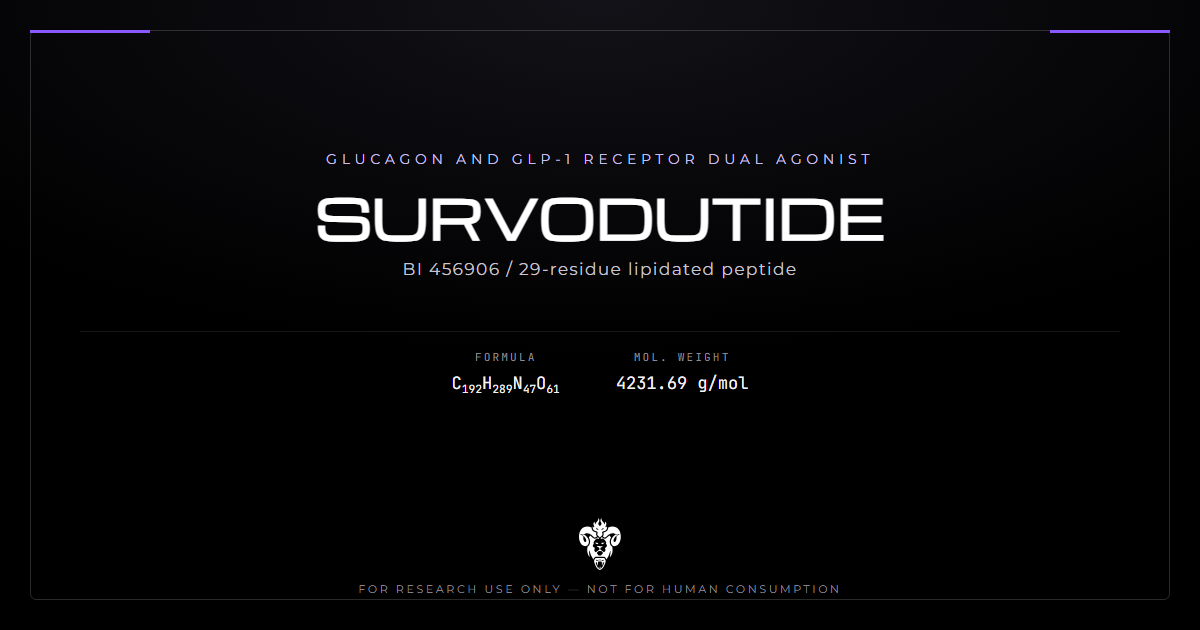
Chemical identity
A 29-residue peptide derived from glucagon, carrying a fatty diacid that binds albumin and stretches the half-life to once-weekly dosing.
| Property | Value |
|---|---|
| Development code | BI 456906 |
| Class | Glucagon receptor and GLP-1 receptor dual agonist |
| Residues | 29 |
| Molecular formula | C192H289N47O61 |
| Average mass | 4,232 Da |
| Monoisotopic mass | 4,229.0957 Da |
| PubChem CID | 168429725 |
| InChIKey | MEDXQFAHWBMVIM-YIUAJOCSSA-N |
| Parent hormone | Glucagon, with GLP-1 activity engineered in |
| Natural template | Oxyntomodulin |
| Half-life extension | C18 diacid, albumin binding |
| Route and schedule | Subcutaneous, once weekly |
| Originator | Boehringer Ingelheim with Zealand Pharma |
Reading the design
Three decisions turned a gut hormone into a weekly injectable.
The backbone starts from glucagon rather than from GLP-1. Potent GLP-1 activity was then built into that sequence. Survodutide is therefore a glucagon analogue that also hits the incretin receptor [1].
The C18 diacid is the pharmacokinetic half. It binds albumin, which slows clearance enough to support once-weekly subcutaneous dosing [1]. Semaglutide uses the same lipidation strategy on a different backbone.
The oxyntomodulin template
The dual-agonist idea is older than the drug, and it comes from physiology rather than medicinal chemistry.
Oxyntomodulin is released from the gut after a meal. It activates both the glucagon receptor and the GLP-1 receptor, weakly at each [1]. The body already runs this combination, which is the argument for building a potent mimic of it.
Survodutide is one of a class doing that. Tirzepatide pairs GLP-1 with GIP and retatrutide adds a third receptor. Mazdutide is the other glucagon and GLP-1 dual agonist in development [5].
The glucagon paradox
The obvious objection to this design deserves a direct answer, because the answer is what the whole programme rests on.
Why adding glucagon is not a mistake
Glucagon does raise hepatic glucose output. It also increases energy expenditure and drives hepatic fat oxidation. Those two effects are what the design is after [1].
The GLP-1 component covers the glycaemic side. Its insulinotropic and appetite-suppressing actions offset the hyperglycaemic tendency of glucagon receptor agonism. Survodutide therefore lowers glucose in practice rather than raising it [2].
The intended gain is arithmetic. GLP-1 agonism reduces intake, glucagon agonism raises expenditure, and acting on both sides of the balance should beat acting on one [1].
How the candidate was chosen
Boehringer screened 19 dual agonists before picking this one, and the selection method is worth knowing [4].
Potency at each receptor was measured in CHO-K1 cells expressing human GCGR and GLP-1R. In vivo engagement was then read out separately for each arm. Oral glucose tolerance covered the GLP-1 side, and hepatic NNMT messenger RNA plus plasma FGF21 covered the glucagon side [4].
Those glucagon biomarkers moved substantially. Hepatic NNMT expression rose 15 to 17 fold and plasma FGF21 up to sevenfold in lean mice [4]. Note the enzyme: NNMT is the same target that 5-amino-1MQ inhibits, approached here from the opposite direction.
Phase 2 in obesity
The dose-finding trial set the expectations that phase 3 later tested.
le Roux and colleagues randomised 387 adults with a BMI of 27 or above and without diabetes (PMID 38330987). Arms were four Survodutide doses or placebo, once weekly for 46 weeks.
Weight change at week 46 ran dose-ordered. It reached -6.2% at 0.6 mg, -12.5% at 2.4 mg, -13.2% at 3.6 mg and -14.9% at 4.8 mg, against -2.8% on placebo [3]. A later review quotes up to 18.7% from the sensitivity analysis based on dose actually received [11].
One number in that paper matters as much as the weight figures. Only 60.4% of participants completed the 46-week treatment period. Completion was almost identical on Survodutide and placebo, at 61% and 60% [3].
Phase 3 in obesity
The SYNCHRONIZE programme ran the confirmatory trials, and the first read out in 2026.
| Trial | Population | Doses | Key result |
|---|---|---|---|
| le Roux 2024 [3] | 387, obesity, phase 2 | 0.6 to 4.8 mg, 46 wk | -14.9% at top dose against -2.8% placebo |
| le Roux 2026 [15] | 725, obesity, phase 3 | 3.6 and 6.0 mg, 76 wk | -12.2% and -13.0% against -5.4% placebo |
| Sanyal 2024 [6] | 293, MASH, phase 2 | 2.4 to 6.0 mg, 48 wk | MASH improved in 62% at 4.8 mg against 14% |
| Kaplan 2026 [14] | 216, MASLD, phase 3 | 6.0 mg, 48 wk | Liver fat down 30% or more in 84.2% against 24.3% |
| Blüher 2024 [2] | 413, type 2 diabetes | Up to 2.7 mg qw | HbA1c matched semaglutide at low dose |
SYNCHRONIZE-1
The phase 3 obesity trial enrolled 725 adults with obesity and without diabetes, treated for 76 weeks (PMID 42253238).
Mean weight change by the treatment-regimen estimand was -12.2% at 3.6 mg and -13.0% at 6.0 mg, against -5.4% on placebo. Weight reduction of at least 5% was reached by 72.6%, 71.9% and 46.3% respectively. Both comparisons against placebo gave p below 0.001 [15].
No deaths were reported. Gastrointestinal symptoms, typically mild to moderate, occurred in 80.9% at 3.6 mg, 89.7% at 6.0 mg and 47.9% on placebo [15].
Where the dose-response flattens
Put the two active arms side by side and the trade becomes visible.
Doubling the Survodutide dose from 3.6 mg to 6.0 mg bought 0.8 percentage points of additional weight loss. It moved gastrointestinal adverse events from 80.9% to 89.7%. The proportion reaching 5% loss did not rise at all [15].
That is not an isolated observation. The phase 2 MASH trial fitted a quadratic dose-response as its best model. There, 4.8 mg outperformed both 2.4 mg and 6.0 mg on the primary histological endpoint [6].
Two independent programmes, two different endpoints, and the same shape. Benefit saturates while tolerability keeps degrading.
The liver programme
The strongest Survodutide results are hepatic, which is what the glucagon arm predicts.
Phase 2 in MASH
Sanyal and colleagues randomised 293 adults with biopsy-confirmed MASH and fibrosis stage F1 to F3 (PMID 38847460).
Histological improvement in MASH without worsening fibrosis reached 47% at 2.4 mg, 62% at 4.8 mg and 43% at 6.0 mg. Placebo reached 14% [6]. Liver fat fell by at least 30% in 63%, 67% and 57% of participants, against 14% on placebo.
Adverse events tracked the dose as usual. Nausea affected 66% against 23%, diarrhoea 49% against 23%, and vomiting 41% against 4%. Serious adverse events ran at 8% on Survodutide and 7% on placebo [6].
SYNCHRONIZE-MASLD
The phase 3 liver trial treated 216 adults with obesity and at-risk steatotic liver disease at 6.0 mg for 48 weeks [14].
Both co-primary endpoints were met. Liver fat fell by at least 30% in 84.2% of treated participants against 24.3% on placebo by the efficacy estimand, with p below 0.0001. Weight fell 12.2% against 1.0% on that same analysis [14].
The two estimands tell different stories, and both appear in the paper. The treatment-regimen estimand accounts for discontinuation. On that basis the same trial gives 68.5% against 28.6% for liver fat, and -8.7% against -1.4% for weight [14].
Fibrosis is the harder endpoint
Steatohepatitis and fibrosis did not respond to the same degree, and the gap is instructive.
In the phase 2 MASH trial, improvement in fibrosis by at least one stage reached 34%, 36% and 34% across the three Survodutide doses. Placebo reached 22% [6].
Set that against the MASH endpoint, where placebo managed 14% and the best dose reached 62%. The steatohepatitis signal is large and the fibrosis signal is narrow. A review restricted to histology-assessed trials places the whole class in the same position [10].
Against semaglutide
One trial compared the dual agonist directly with a GLP-1 mono-agonist, and its result frames the entire rationale.
Blüher and colleagues randomised 413 people with type 2 diabetes on metformin [2]. Arms were six Survodutide dose groups, placebo, or open-label semaglutide up to 1.0 mg, for 16 weeks.
Glucose control matched. HbA1c fell 1.46% on low-dose Survodutide and 1.47% on semaglutide. Weight separated instead, with 1.8 mg weekly and above beating semaglutide at -8.7% against -5.3% [2].
So did adverse events. They affected 77.8% of Survodutide recipients, against 52.0% on semaglutide and 52.5% on placebo [2]. Equal glycaemic effect, more weight loss, half again as many adverse events.
The wider phase 3 programme
Four confirmatory trials run under the SYNCHRONIZE name, not one, and their design choices repay reading together.
SYNCHRONIZE-1 covered obesity without diabetes and has reported [15]. SYNCHRONIZE-2 runs the same 76-week design in 752 people who have both obesity and type 2 diabetes, across 133 sites in 19 countries [12]. Its participants carry a heavier comorbidity load. Hypertension affects 69.0% and dyslipidaemia 67.6%, established atherosclerotic cardiovascular disease 10.9%, and 78.7% take metformin.
SYNCHRONIZE-JP addresses a population the Western trials underrepresent. It enrolled 274 Japanese adults at a mean BMI of 33.2, well below the 37.9 of SYNCHRONIZE-1, using entry criteria written around Japanese obesity disease definitions [13]. Liver fat and body composition are assessed in a subset.
SYNCHRONIZE-CVOT is the one that matters most, and it has not read out. The target is 4,935 participants with established cardiovascular disease, chronic kidney disease or multiple risk factors, and the primary endpoint is time to first five-point major adverse cardiovascular event [8].
Note what that means for the evidence as it stands. Every efficacy figure in this article is a weight, glucose or liver measurement. No cardiovascular outcome has been published for Survodutide.
Tolerability, and what it costs
Gastrointestinal effects are not a footnote in this programme. They shape the results.
Discontinuation was substantial from the start. The phase 2 obesity trial retained only 60.4% through 46 weeks [3]. Multiple-dose cirrhosis cohorts reported drug-related adverse events in 82.4% and 87.5% of participants over 28 weeks [7].
The estimand gap quantifies the consequence. SYNCHRONIZE-MASLD reported -12.2% weight change by efficacy estimand and -8.7% by treatment-regimen estimand [14]. Those are the same participants, and the difference is what happens when people stop.
A meta-analysis across 18 treatment arms and 1,029 participants pooled the effect at a weighted mean difference of -8.33 kg [9]. That is a useful anchor against percentage figures from individual trials.
Pharmacokinetics and special populations
The pharmacokinetic work has gone into the population most likely to receive the drug for liver disease.
Lawitz and colleagues studied single and multiple Survodutide dosing in people with Child-Pugh class A, B and C cirrhosis [7]. Healthy participants matched for age, sex and weight served as comparators. Area under the curve and maximum concentration were similar between cirrhosis and health, with confidence intervals spanning unity.
The practical conclusion is that hepatic impairment does not require a dose adjustment [7]. Liver fat, liver stiffness, liver volume and body weight all fell over 28 weeks in that open-label setting.
Nothing comparable has been published for renal impairment in this compound, and the cardiovascular outcome trial is still running [8].
How to read a Survodutide study
Four questions separate the papers, and the first two account for most of the confusion.
Which estimand?
Efficacy and treatment-regimen estimands differ by several percentage points in the same trial [14]. The first describes Survodutide taken as directed and the second includes people who stopped. A headline number without its estimand is ambiguous.
Which dose?
Benefit plateaus between 3.6 and 6.0 mg while adverse events keep climbing [15]. The MASH trial found the middle dose best [6]. Dose is not a proxy for effect size here.
Which endpoint in the liver?
Liver fat, steatohepatitis histology and fibrosis stage move by very different amounts [6][14]. A trial reporting liver fat by magnetic resonance imaging has demonstrated nothing about fibrosis.
Who is the comparator?
Placebo comparisons and the single semaglutide comparison give different impressions [2][3]. Only one trial has run the head-to-head. It lasted 16 weeks and used a semaglutide dose below the maximum.
Verifying research material
A 29-residue lipidated peptide of 4,232 Da has a specific and well-defined set of analytical questions.
Identity
Intact mass is the primary check, at 4,232 Da average and 4,229.10 monoisotopic. That resolution separates Survodutide cleanly from its relatives. Glucagon itself runs at 3,483 and semaglutide at 4,114.
The diacid is the feature to confirm. A peptide missing its C18 chain differs by a defined mass increment and would behave entirely differently. Intact mass alone distinguishes the lipidated product from unmodified backbone.
Peptide mapping confirms sequence. At 29 residues the tryptic map is short, and full sequence coverage by tandem mass spectrometry is routine rather than ambitious.
Purity and related substances
Deletion sequences are the expected impurity in any solid-phase synthesis of this length.
Each missing residue shifts intact mass by that residue. The shift is detectable but easy to miss in a broad peak, so reversed-phase chromatography with mass detection rather than ultraviolet alone is the assay that finds them.
Peptide content differs from chromatographic purity. Lyophilised material carries counterions and water, so a vial labelled 10 mg by weight holds less peptide than that. Acetate or trifluoroacetate content belongs on the certificate.
Handling
Store the lyophilised powder cold, dry and dark, and reconstitute close to the point of use.
The albumin-binding diacid makes Survodutide surface-active. Dilute solutions lose material to plastic, so aliquot on reconstitution rather than repeatedly sampling one vial. Carrier protein is worth considering for low-concentration work.
Freeze-thaw cycling is the avoidable loss. A lipidated peptide can aggregate on repeated cycling. Aggregation changes both the concentration and the species present without changing the label.
Kimera publishes third-party certificates of analysis for every lot in its COA database. Laboratories source Survodutide as a glucagon and GLP-1 receptor dual agonist reference. It appears alongside mazdutide, the other dual agonist in this class, and with AOD-9604 as a contrasting fragment approach. It also pairs with 5-amino-1MQ, which acts on the NNMT enzyme used as a glucagon target-engagement biomarker in this compound’s selection [4]. Related work appears in the peptides category.
Common questions about Survodutide
Why does Survodutide include glucagon receptor agonism at all? Glucagon raises energy expenditure and hepatic fat oxidation, and the GLP-1 arm offsets its glycaemic effect [1].
What did phase 3 show in obesity? Weight change of -12.2% at 3.6 mg and -13.0% at 6.0 mg against -5.4% on placebo, over 76 weeks in 725 adults [15].
Is the top dose better? Barely. The 6.0 mg arm added 0.8 percentage points of weight loss and 9 points of gastrointestinal adverse events [15].
How does it compare with semaglutide? Equal on HbA1c at low dose, better on weight above 1.8 mg, with adverse events in 77.8% against 52.0% [2].
What are the liver results? Liver fat fell at least 30% in 84.2% against 24.3% on placebo in phase 3 [14]. Fibrosis improvement was 34 to 36% against 22% in phase 2 [6].
Does cirrhosis change the pharmacokinetics? No. Exposure was similar to healthy participants across Child-Pugh classes, and no dose adjustment was indicated [7].
Summary of the evidence
Identity: 29 residues, C192H289N47O61, 4,232 Da, with a C18 diacid for albumin binding and once-weekly subcutaneous dosing [1].
Design: a glucagon backbone with GLP-1 activity engineered in, modelled on oxyntomodulin. Survodutide was selected from 19 candidates using hepatic NNMT and plasma FGF21 as glucagon engagement biomarkers [1][4].
Phase 2 obesity: -14.9% at 4.8 mg against -2.8% placebo over 46 weeks, with 60.4% completing [3].
Phase 3 obesity: -12.2% and -13.0% at 3.6 and 6.0 mg against -5.4% placebo over 76 weeks in 725 adults [15].
Dose ceiling: benefit flattens between 3.6 and 6.0 mg while gastrointestinal events rise from 80.9% to 89.7% [15], and the MASH trial fitted a quadratic dose-response with 4.8 mg best [6].
Liver: 62% MASH improvement without worsening fibrosis at 4.8 mg against 14% placebo [6]. Phase 3 gave 84.2% against 24.3% for a 30% liver fat reduction [14]. Fibrosis moved far less, at 34 to 36% against 22% [6].
Against semaglutide: matched on HbA1c at low dose, better on weight above 1.8 mg, with adverse events in 77.8% against 52.0% [2].
Limits: no cardiovascular outcome data yet [8], and only one short head-to-head comparison. An estimand gap of several percentage points is driven by discontinuation [14].
Status: supplied for laboratory research use only.
References
- Klein T, Augustin R, Hennige AM. Perspectives in weight control in diabetes: survodutide. Diabetes Res Clin Pract. 2024;207:110779. PMID 37330144. DOI
- Blüher M, Rosenstock J, Hoefler J, Manuel R, Hennige AM. Dose-response effects on HbA1c and bodyweight reduction of survodutide, a dual glucagon/GLP-1 receptor agonist, compared with placebo and open-label semaglutide in people with type 2 diabetes: a randomised clinical trial. Diabetologia. 2024;67(3):470-482. PMID 38095657. DOI
- le Roux CW, Steen O, Lucas KJ, Startseva E, Unseld A, Hennige AM. Glucagon and GLP-1 receptor dual agonist survodutide for obesity: a randomised, double-blind, placebo-controlled, dose-finding phase 2 trial. Lancet Diabetes Endocrinol. 2024;12(3):162-173. PMID 38330987. DOI
- Thomas L, Martel E, Rist W, Uphues I, Hamprecht D, Neubauer H, Augustin R. The dual GCGR/GLP-1R agonist survodutide: biomarkers and pharmacological profiling for clinical candidate selection. Diabetes Obes Metab. 2024;26(6):2368-2378. PMID 38560764. DOI
- Gogineni P, Melson E, Papamargaritis D, Davies M. Oral glucagon-like peptide-1 receptor agonists and combinations of entero-pancreatic hormones as treatments for adults with type 2 diabetes: where are we now? Expert Opin Pharmacother. 2024;25(7):801-818. PMID 38753454. DOI
- Sanyal AJ, Bedossa P, Fraessdorf M, Neff GW, Lawitz E, Bugianesi E, et al. A phase 2 randomized trial of survodutide in MASH and fibrosis. N Engl J Med. 2024;391(4):311-319. PMID 38847460. DOI
- Lawitz EJ, Fraessdorf M, Neff GW, Schattenberg JM, Noureddin M, Alkhouri N, et al. Efficacy, tolerability and pharmacokinetics of survodutide, a glucagon/glucagon-like peptide-1 receptor dual agonist, in cirrhosis. J Hepatol. 2024;81(5):837-846. PMID 38857788. DOI
- Kosiborod MN, Platz E, Wharton S, le Roux CW, Brueckmann M, Ajaz Hussain S, et al. Survodutide for the treatment of obesity: rationale and design of the SYNCHRONIZE cardiovascular outcomes trial. JACC Heart Fail. 2024;12(12):2101-2109. PMID 39453356. DOI
- Wan H, Xu N, Wang L, Liu Y, Fatahi S, Sohouli MH, Guimarães NS. Effect of survodutide, a glucagon and GLP-1 receptor dual agonist, on weight loss: a meta-analysis of randomized controlled trials. Diabetol Metab Syndr. 2024;16(1):264. PMID 39508238. DOI
- Zafer M, Tavaglione F, Romero-Gómez M, Loomba R. Review article: GLP-1 receptor agonists and glucagon/GIP/GLP-1 receptor dual or triple agonists in MASLD. Aliment Pharmacol Ther. 2025;61(12):1872-1888. PMID 40364529. DOI
- Arun AJ, Darji B, Baig M, Frishman WH, Aronow WS. Survodutide: a dual GLP-1/glucagon agonist reshaping cardiometabolic care. Cardiol Rev. 2025. PMID 40963161. DOI
- Wharton S, le Roux CW, Bozkurt B, Platz E, Bleckert G, Ajaz Hussain S, et al. Baseline characteristics in the SYNCHRONIZE-2 randomized phase 3 trial of survodutide, a glucagon receptor/GLP-1 receptor dual agonist, for obesity in people with type 2 diabetes. Diabetes Obes Metab. 2026;28(2):1490-1498. PMID 41216778. DOI
- Yokote K, Yamauchi T, Fukushima Y, Takatsuka Y, Kato M, Yan S, et al. Survodutide for the treatment of obesity disease in Japanese participants: rationale, design and baseline characteristics of the phase 3 SYNCHRONIZE-JP trial. Diabetes Obes Metab. 2026;28(8):6595-6606. PMID 42219222. DOI
- Kaplan LM, Startseva E, le Roux CW, Wharton S, Bozkurt B, Mazo DF, et al. Survodutide in adults with obesity and metabolic dysfunction-associated steatotic liver disease: SYNCHRONIZE-MASLD, a randomized, double-blind, placebo-controlled phase 3 trial. Nat Med. 2026;32(8):2948-2958. PMID 42252333. DOI
- le Roux CW, Wharton S, Startseva E, Kloer IM, Hussain SA, Unseld A, et al. Survodutide once weekly for the treatment of adults with obesity. N Engl J Med. 2026. PMID 42253238. DOI
Survodutide is sold for laboratory research use only. Not for human consumption, nor medical, veterinary, or household uses.
Literature retrieved from PubMed.