Skip to content

Mazdutide Research Standard
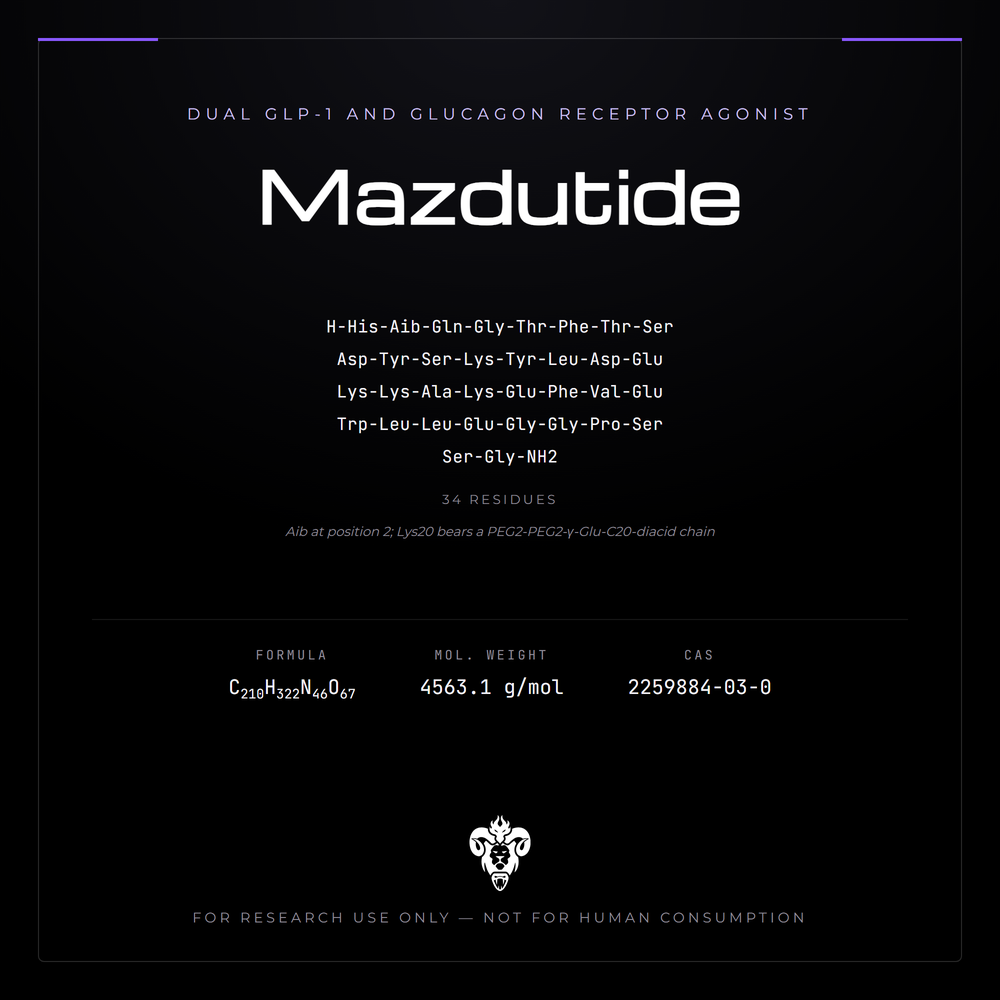
Mazdutide (CAS 2259884-03-0), also indexed as IBI362 and LY3305677, is a synthetic peptide dual agonist at the GLP-1 receptor and the glucagon receptor, supplied as a 10 mg lyophilized powder in a 3 mL vial. It belongs to the unimolecular multi-agonist class — single peptides engineered to engage more than one incretin-family receptor at a designed potency ratio.[1]
Mechanism of Action & Research Context
The molecular targets are the GLP-1 receptor (GLP-1R) and the glucagon receptor (GCGR), both class B GPCRs.
Two receptors, two contributions. The GLP-1 receptor arm supplies the anorectic and insulinotropic activity; the glucagon receptor arm supplies an energy expenditure effect. Work on unimolecular multi-agonists identifies GcgR activation as the differentiating factor between incretin mono- or dual-agonists and agents that add glucagon — it is what the second receptor is for.[1]
The potency ratio is a design parameter. These are not simply two agonists bolted together. Relative receptor potency is empirically optimised, and shifting the ratio changes the pharmacology rather than merely the strength — which is why one dual agonist is not a substitute for another in an experiment.[1]
Glucagon engagement is not monotonic. The most useful result for anyone designing a dose-response with this class: in a diet-induced obese mouse model, a long-acting GLP-1R/GCGR dual agonist produced its maximal benefit on hepatic endpoints at a middle dose. The highest dose drove further liver fat reduction and a large induction of oxidative phosphorylation genes, but also exaggerated body weight loss and downregulation of a co-expressed gene module covering steroid hormone biology, bile secretion and retinol metabolism. The authors describe the liver-health benefit of glucagon-receptor engagement as a bell-shaped curve. A design that only tests low and high doses can miss the optimum entirely.[2]
Dual agonism outperformed the GLP-1 mono-agonist at matched weight loss. In the same model the dual agonist reduced hepatic steatosis more than semaglutide at equal body weight loss, measured by three independent methods — so the additional effect is attributable to the glucagon arm rather than to weight change alone.[2]
Research Applications
Primary fields of in vitro and preclinical laboratory investigation include:
Receptor potency and selectivity assays at GLP-1R and GCGR, including potency-ratio characterisation.[1]
Signalling and functional assays in cell lines expressing recombinant or endogenous incretin receptors.[1]
Preclinical metabolic models, including diet-induced obese rodents with hepatic histology and transcriptome endpoints.[2]
Dose-response design across a range wide enough to detect a non-monotonic optimum.[2]
Comparative profiling against GLP-1R mono-agonists at matched body weight.[2]
Analytical Documentation
Purity and identity vary by manufacturing lot. Kimera Chems does not publish a single fixed purity figure for this item; refer to the batch-specific Certificate of Analysis (COA) issued for the lot received, which reflects third-party analytical testing for that lot.
References
- Knerr PJ, Mowery SA, Douros JD, et al. Next generation GLP-1/GIP/glucagon triple agonists normalize body weight in obese mice. Mol Metab. 2022;63:101533. doi:10.1016/j.molmet.2022.101533
- Monfeuga T, Norlin J, Bugge A, et al. Evaluation of long acting GLP1R/GCGR agonist in a DIO and biopsy-confirmed mouse model of NASH suggest a beneficial role of GLP-1/glucagon agonism in NASH patients. Mol Metab. 2024;79:101850. doi:10.1016/j.molmet.2023.101850
Storage & Handling
Store at controlled room temperature, sealed and protected from light.
Storage guidance is a house recommendation. Analytical documentation is per-lot release testing.