
Few research peptides carry a clinical literature this large. A database search for Thymosin Alpha-1 returns well over a hundred trials, reviews and protocols. They span sepsis, hepatitis, pancreatitis, oncology and critical care.
Volume of evidence is not the same as weight of evidence. A 2016 systematic review of sepsis trials opens by calling its own constituent studies small and poorly designed [1]. It then pools them and reports a mortality benefit.
The largest randomised trial in this literature enrolled 690 patients in hepatitis B related cirrhosis. It found no difference on its primary endpoint [2].
That combination has a name in evidence synthesis, and recognising it is the most useful thing a reader can take from this compound.
Chemical identity
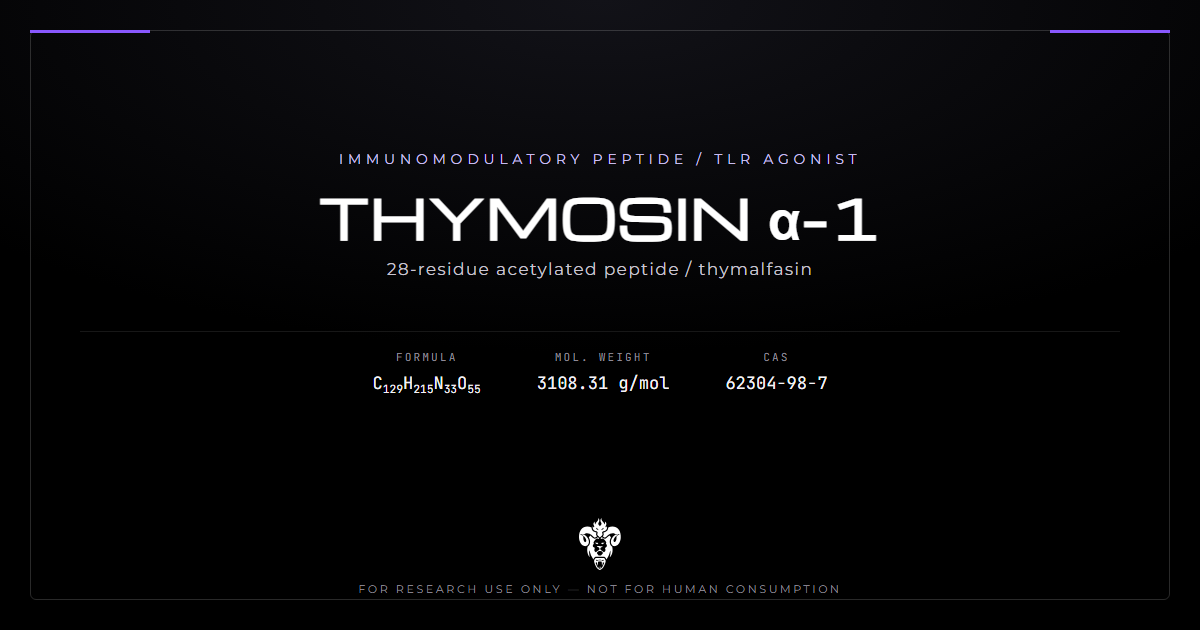
A 28-residue peptide, N-terminally acetylated, corresponding to the first 28 residues of prothymosin alpha.
| Property | Value |
|---|---|
| Common names | Thymosin Alpha-1, thymalfasin, Tα1, Zadaxin |
| Molecular formula | C129H215N33O55 |
| Molecular weight | 3108.3 |
| CAS | 62304-98-7 |
| PubChem CID | 16130571 |
| InChIKey | NZVYCXVTEHPMHE-ZSUJOUNUSA-N |
Kimera supplies the material as Thymosin Alpha-1.
Size changes what verification means
At 3108 daltons and 28 residues Thymosin Alpha-1 is a large peptide by catalogue standards. It carries roughly three times the mass of the melanocortin peptides, and four times that of the LL-37 fragments in common use.
Size matters for practical reasons rather than aesthetic ones. Synthesis at 28 residues accumulates deletion sequences. A peptide missing one internal residue differs from the target by that residue mass alone, on a molecule already above 3000. Proportionally that is a small shift on a large number.
The N-terminal acetyl is part of the molecule
Acetylation at the N-terminus is not a protecting group left over from synthesis. It is present in the native peptide, and a deacetylated preparation is a different compound 42 daltons lighter.
The name is accurate about its origin and misleading about its class
Investigators first isolated Thymosin Alpha-1 from thymic tissue, as the fraction that restored immune function in thymectomised mice [3].
It is not a thymic hormone in the usual sense
The name invites reading it as a hormone with a receptor and a feedback loop. The published mechanism does not look like that.
It acts through Toll-like receptors on myeloid and plasmacytoid dendritic cells, activating signalling pathways and initiating cytokine production [3]. That is innate immune stimulation, closer in character to an adjuvant than to a hormone.
Pleiotropic is the operative word
Reviews describe the mechanism as pleiotropic, affecting multiple immune cell subsets involved in immune suppression [3]. A compound that touches many subsets does not produce a single clean readout.
This matters when reading a trial. Any single cell-population outcome shows one facet of a broad effect. It does not predict what a different population will do.
The trial record, and how to weigh it
The evidence divides cleanly by size, and the division goes the wrong way.
| Study | n | Setting | Primary result |
|---|---|---|---|
| 2016 review [1] | 530 across 10 RCTs | Sepsis | Mortality RR 0.59 (0.45-0.77) |
| 2025 review [4] | 1,927 across 11 RCTs | Sepsis | 28-day mortality reduced |
| ACLF RCT [5] | 120 | HBV acute-on-chronic liver failure | 90-day transplant-free survival 75.0% vs 53.4% |
| Cirrhosis RCT [2] | 690 | HBV compensated cirrhosis | No difference in decompensation, HCC or death |
The sepsis meta-analyses
The 2016 review searched nine databases across four languages and found 19 randomised trials [1]. Ten of them reported mortality, covering 530 patients. Pooling gave a relative risk of 0.59, confidence interval 0.45 to 0.77.
The 2025 review was a more careful instrument [4]. From 3,003 identified studies it included 11 randomised trials, 967 patients on drug against 960 controls, and excluded combination-therapy studies. It reported a significant reduction in 28-day mortality.
Two features make the newer one worth more. It ran trial sequential analysis to test whether the pooled result was stable rather than a product of accumulating small studies. It also examined heterogeneity of treatment effects using individual patient data from two multicentre trials, with credibility assessed by a formal instrument.
The acute-on-chronic liver failure trial
An open-label randomised controlled trial enrolled 120 patients with hepatitis B related acute-on-chronic liver failure [5]. The treated group received subcutaneous dosing daily for a week, then twice weekly to week 12.
The 90-day liver transplantation free survival rate was 75.0% against 53.4%, with a p value of 0.030. That is a clean result on a hard endpoint in a population where mortality is high.
The large negative trial
This trial randomised 690 patients with hepatitis B related compensated cirrhosis. Arms took Thymosin Alpha-1 plus entecavir, or entecavir alone, for 52 weeks following an initial 26 weeks of entecavir [2]. Median follow-up ran 38.2 months.
Cumulative incidence of liver decompensation, hepatocellular carcinoma or death was similar between groups. Virologic, serologic and biochemical responses were similar too.
Why the size pattern matters
Small positive trials alongside a large null trial is the classic signature of small-study effects, and it has several possible causes.
The three ordinary explanations
Publication bias is the best known. Investigators write up null results from small trials less often, so the pooled small-trial estimate drifts positive.
Methodological quality is the second, and the 2016 review named it explicitly in its own abstract [1]. Smaller trials tend to have weaker allocation concealment and blinding, both of which inflate effect estimates.
Genuine population differences are the third and least discussed. The large negative trial studied compensated cirrhosis, a stable population. The positive trials studied sepsis and acute-on-chronic liver failure, where acute immune suppression is the norm. An immunostimulant might reasonably do more in the second setting.
Which explanation the data favours
The third has real support here, and it is not special pleading. Thymosin Alpha-1 stimulates an immune system that has already lost function [3]. A population retaining that function is not obviously the right test.
That reading survives the evidence rather than explaining it away. It also makes a prediction: the compound should perform better as acuity rises. The acute-on-chronic liver failure result [5] and the sepsis pooling [1][4] are consistent with that, and the compensated cirrhosis null [2] is too.
What would settle it
A large trial in an acutely immunosuppressed population, powered on mortality. The 2025 trial sequential analysis comes closest, and its authors built it precisely because the question remains open.
The regulatory picture
Several countries approve Thymosin Alpha-1 under the name thymalfasin, marketed as Zadaxin. It holds no US approval.
That split is worth stating carefully, because it is easy to read either as an endorsement or as a condemnation. It is neither. Different regulators weighed a heterogeneous evidence base differently, which is the expected outcome when the evidence looks like the table above.
Why approval status is weak evidence either way
Approval reflects a regulator’s judgement about a specific indication, in a specific population, on a specific dossier. It does not grade the underlying science, and it does not transfer across borders.
For laboratory purposes the regulatory question is close to irrelevant. What matters is whether the compound does what the mechanism says, and the mechanism has better support than the clinical endpoints do.
The manufacturing consequence
An approved Thymosin Alpha-1 product exists, which means pharmacopoeial-grade reference material exists. That is unusual for a catalogue peptide and it has a practical benefit: a supplier’s certificate can be compared against a real specification rather than against nothing.
Ask which specification a batch was assayed against. “Meets specification” without naming the specification says nothing.
What the mechanism predicts, and what it does not
The Toll-like receptor account [3] does useful work here, because it makes the trial pattern less surprising than it first looks.
An adjuvant needs something to adjuvant
Thymosin Alpha-1 amplifies an immune response already being mounted, through Toll-like receptor stimulation on dendritic cells. It does not create one from nothing.
In a patient with a functioning immune system and a controlled viral infection, there may be little to amplify. In sepsis or acute-on-chronic liver failure, where immune paralysis is part of the pathology, there is a great deal.
That framing predicts the direction of every result in the table above. It was not constructed after the fact to fit them, and it comes from the mechanistic literature rather than from the trials.
What it does not predict
The size of any effect, or its durability. Pleiotropic immune stimulation is not quantitatively predictable from a receptor mechanism, which is why the trials matter despite their unevenness.
It also says nothing about whether stimulation is desirable in a given setting. Amplifying an immune response is not automatically beneficial, and in conditions where inflammation drives the pathology it could plausibly run the other way.
Where the literature is heading
Recent work has moved toward oncology and critical care combinations rather than monotherapy.
Oncology combinations
Published work pairs the peptide with checkpoint inhibitors, radiotherapy and colony-stimulating factors in advanced disease [6][7]. Neoadjuvant use alongside immunochemotherapy in gastric cancer has a prospective trial [8].
These are combination studies. Attributing an outcome to any single component of a four-part regimen is not possible from them, and the papers do not claim otherwise.
The rationale behind the pairing is coherent, which is worth saying. Checkpoint inhibitors work better when antigen presentation is intact, and dendritic cell stimulation is exactly what Thymosin Alpha-1 does [3]. Combining them is a reasonable hypothesis rather than an arbitrary stack.
Reasonable hypotheses still need isolating experiments. Until a trial varies only this component, the oncology literature tells you about regimens rather than about the peptide.
Critical care and organ injury
A protocol exists for a trial in acute aortic dissection surgery [9]. A randomised trial addressed radiation pneumonitis in locally advanced non-small cell lung cancer [10]. Pancreatitis has both a trial protocol and a post hoc analysis [11][12].
The breadth reflects the mechanism. A pleiotropic immune stimulant is testable anywhere immune suppression contributes to an outcome, and that is a long list.
How to read a Thymosin Alpha-1 study
Five questions, and the first two do most of the work.
How large was it?
Given the pattern above, size is the first thing to check rather than the last. A positive result in 40 patients means something different here than it would for a compound without a large null trial behind it.
Was the population immunosuppressed?
The mechanism predicts that it matters, and the trial record is consistent with it mattering [2][5].
Monotherapy or combination?
Much of the recent oncology literature is combination work [6][7][8]. Those studies cannot isolate this compound’s contribution.
Which endpoint?
Mortality, transplant-free survival, cell subset counts and cytokine levels are not interchangeable. The immunological endpoints move more readily than the clinical ones.
Was it a review of reviews?
This literature has accumulated enough secondary sources that some publications summarise other summaries. Those inherit every weakness of the trials underneath without re-examining them.
The two sepsis reviews here went back to primary studies [1][4], and the 2025 one went further by using individual patient data. That distinction is worth checking before treating any review as evidence.
Was the trial registered and blinded?
The acute-on-chronic liver failure trial ran open-label and says so [5]. That limits a survival endpoint, though less than it would a subjective measure.
Verifying research material
Thymosin Alpha-1 is a defined chemical entity with published identifiers, so verification is arithmetic rather than judgement. Batch documentation sits on the certificates of analysis page.
Identity
Formula C129H215N33O55, molecular weight 3108.3, InChIKey NZVYCXVTEHPMHE-ZSUJOUNUSA-N. At this mass the practical mass spectrometry approach uses multiply charged ions rather than the singly charged species.
The acetylation check
Confirm the N-terminal acetyl on any Thymosin Alpha-1 batch. Its absence costs 42 daltons, which is a 1.35% shift at this mass and well within the resolving power of a modern instrument.
The check matters because a deacetylated peptide is a plausible synthesis outcome and is not the native molecule. Reported purity against a specification that does not name the acetylation state is answering a narrower question than it appears to.
Deletion sequences are the main purity risk
A 28-residue synthesis has 27 coupling steps, and incomplete coupling at any one produces a peptide short by one residue. These are chemically similar to the target and can co-elute.
Ask for a chromatographic trace rather than a single purity number. Deletion sequences show as shoulders, and a bare percentage hides them.
The arithmetic makes the point. At 99% purity per coupling step across 27 steps, the theoretical yield of full-length peptide is around 76%. Real syntheses do better than that through capping and purification, but the pressure is real and it scales with length.
This is why a 28-residue peptide and a 7-residue peptide at the same stated purity are not comparable products. The shorter one has six coupling steps to go wrong. This one has 27.
Reading a mass spectrum at this size
Singly charged ions above 3000 sit outside the comfortable range of many instruments. Practical analysis uses multiply charged species, and the charge envelope itself carries information.
A clean preparation gives a tidy series. A ragged envelope, or peaks that deconvolute to several nearby masses, points at deletion sequences or partial deacetylation rather than at instrument noise.
Handling
The sequence carries no cysteine, so disulfide scrambling is not a concern, which distinguishes it from many peptides of comparable size. Aspartate and glutamate content is high, and the usual aqueous instability applies.
Lyophilised, cold and dark, with reconstituted material treated as short-lived. Compare with ARA-290, a much shorter immunomodulatory peptide with a different stability profile.
Common questions about Thymosin Alpha-1
Identity and class
What is thymalfasin? The same compound. Thymalfasin is the international nonproprietary name; Zadaxin is a brand name.
Is it a hormone? Not in the usual sense. It was isolated from thymus and acts through Toll-like receptors on dendritic cells rather than a classical hormone receptor [3].
How large is it? 28 residues, 3108.3 daltons, N-terminally acetylated. It corresponds to the first 28 residues of prothymosin alpha.
Evidence
Does it reduce mortality in sepsis? Two meta-analyses report reductions [1][4]. The 2025 one is the stronger instrument, using trial sequential analysis and individual patient data.
Why does one big trial show nothing? The 690-patient trial studied compensated cirrhosis, a population that is not acutely immunosuppressed [2]. That may be the explanation, or the small trials may be inflated. Both readings are live.
Is it approved? In several countries as thymalfasin, not in the US.
Can the oncology results be attributed to it? Not from combination trials [6][7][8], which is most of that literature.
Why would an immune stimulant fail in cirrhosis and work in sepsis? Because an adjuvant amplifies a response rather than creating one. Compensated cirrhosis is not an immune-paralysed state; sepsis and acute-on-chronic liver failure are [2][5].
Is the mechanism actually settled? Better than the clinical endpoints are. Toll-like receptor action on myeloid and plasmacytoid dendritic cells is the published account [3], and it predicts the direction of the trial results.
Handling and verification
What is the main identity risk? Loss of the N-terminal acetyl, which costs 42 daltons.
What is the main purity risk? Deletion sequences. 28 residues means 27 coupling steps, and each is an opportunity to drop a residue.
Does it contain cysteine? No, so disulfide scrambling is not a concern, unlike many peptides of similar size.
Why ask which specification a batch met? Because an approved product exists, so a real pharmacopoeial specification exists to compare against. That is unusual for a catalogue peptide.
Summary of the evidence
Strongest evidence: the 2025 sepsis meta-analysis, 11 randomised trials and 1,927 patients, with trial sequential analysis and individual patient data on heterogeneity [4]. Alongside it, a 120-patient randomised trial in acute-on-chronic liver failure reporting 75.0% against 53.4% transplant-free survival at 90 days [5].
Weakest evidence: the oncology combination literature, which cannot isolate Thymosin Alpha-1 [6][7][8]. Alongside it, the many small single-centre trials whose quality the reviews themselves flag [1].
Most informative single result: the 690-patient null [2]. Large, long, and negative on a hard composite endpoint, it is the study that constrains how much the smaller positive ones can mean.
Worth noting what that trial does not show. It did not find harm, and it did not test an immune-paralysed population. A null result in the wrong population constrains interpretation without refuting the mechanism, which is a narrower conclusion than “it does not work” and a more defensible one.
Read plainly, Thymosin Alpha-1 is a well-characterised immune stimulant. Its effect appears to depend on whether the recipient started out immune-suppressed. The trial record runs unusually large and unusually uneven, and the unevenness is the part worth understanding.
The rest of the peptide literature sits in the peptides category.
Status: supplied for laboratory research use only.
References
- Liu F, Wang HM, Wang T, Zhang YM, Zhu X. The efficacy of thymosin α1 as immunomodulatory treatment for sepsis: a systematic review of randomized controlled trials. BMC Infect Dis. 2016;16:488. PMID 27633969. DOI
- Wu X, Shi Y, Zhou J, Sun Y, Piao H, Jiang W, Ma A, Chen Y, et al.. Combination of entecavir with thymosin alpha-1 in HBV-related compensated cirrhosis: a prospective multicenter randomized open-label study. Expert Opin Biol Ther. 2018;18(sup1):61-69. PMID 30063860. DOI
- King R, Tuthill C. Immune Modulation with Thymosin Alpha 1 Treatment. Vitam Horm. 2016;102:151-78. PMID 27450734. DOI
- Gu B, Zhou Y, Nie Y, Wang L, Liang L, Liao Z, Wen J, Guan X, et al.. Efficacy of thymosin α1 for sepsis: a systematic review and meta-analysis of randomized controlled trials. Front Cell Infect Microbiol. 2025;15:1673959. PMID 40969554. DOI
- Chen JF, Chen SR, Lei ZY, Cao HJ, Zhang SQ, Weng WZ, Xiong J, Lin DN, et al.. Safety and efficacy of Thymosin α1 in the treatment of hepatitis B virus-related acute-on-chronic liver failure: a randomized controlled trial. Hepatol Int. 2022;16(4):775-788. PMID 35616850. DOI
- Yu J, Yin L, Guo W, Wang Q, Liu J, Zhang L, Ye H, Xia J, et al.. Hypofractionated radiotherapy combined with a PD-1 inhibitor, granulocyte macrophage-colony stimulating factor, and thymosin-α1 in advanced metastatic solid tumors: a multicenter Phase II clinical trial. Cancer Immunol Immunother. 2025;74(3):98. PMID 39904914. DOI
- Liu F, Qiu B, Xi Y, Luo Y, Luo Q, Wu Y, Chen N, Zhou R, et al.. Efficacy of Thymosin α1 in Management of Radiation Pneumonitis in Patients With Locally Advanced Non-Small Cell Lung Cancer Treated With Concurrent Chemoradiotherapy: A Phase 2 Clinical Trial (GASTO-1043). Int J Radiat Oncol Biol Phys. 2022;114(3):433-443. PMID 35870709. DOI
- Xu H, Li F, Li B, Yang D, Liu T, Xia Y, Hua H, Li Q, et al.. Neoadjuvant immunochemotherapy plus thymalfasin in locally advanced gastric cancer: a prospective clinical trial. BMC Med. 2026;24(1). PMID 41749205. DOI
- Liu H, Qian SC, Zhang YY, Tang CB, Yue HH, Fan GL, Zhao X, Jiang YY, et al.. Effect of thymosin α1 on Immune response and organ function in acute aortic dissection surgery: PANDA II trial protocol. Future Cardiol. 2025;21(7):447-454. PMID 40367062. DOI
- Zhou J, Mao W, Ke L, Chen T, He W, Pan X, Chen M, He C, et al.. Thymosin alpha 1 in the prevention of infected pancreatic necrosis following acute necrotising pancreatitis (TRACE trial): protocol of a multicentre, randomised, double-blind, placebo-controlled, parallel-group trial. BMJ Open. 2020;10(9):e037231. PMID 32994239. DOI
- Huang X, Mao W, Hu X, Qin F, Zhao H, Zhang A, Wang X, Stoppe C, et al.. Immune-Enhancing Treatment among Acute Necrotizing Pancreatitis Patients with Metabolic Abnormalities: A Post Hoc Analysis of a Randomized Clinical Trial. Gut Liver. 2024;18(5):906-914. PMID 38356344. DOI
- Garaci E, Favalli C, Pica F, Sinibaldi Vallebona P, Palamara AT, Matteucci C, Pierimarchi P, Serafino A, et al.. Thymosin alpha 1: from bench to bedside. Ann N Y Acad Sci. 2007;1112:225-34. PMID 17600290. DOI
Thymosin Alpha-1 is sold for laboratory research use only. Not for human consumption, nor medical, veterinary, or household uses.