
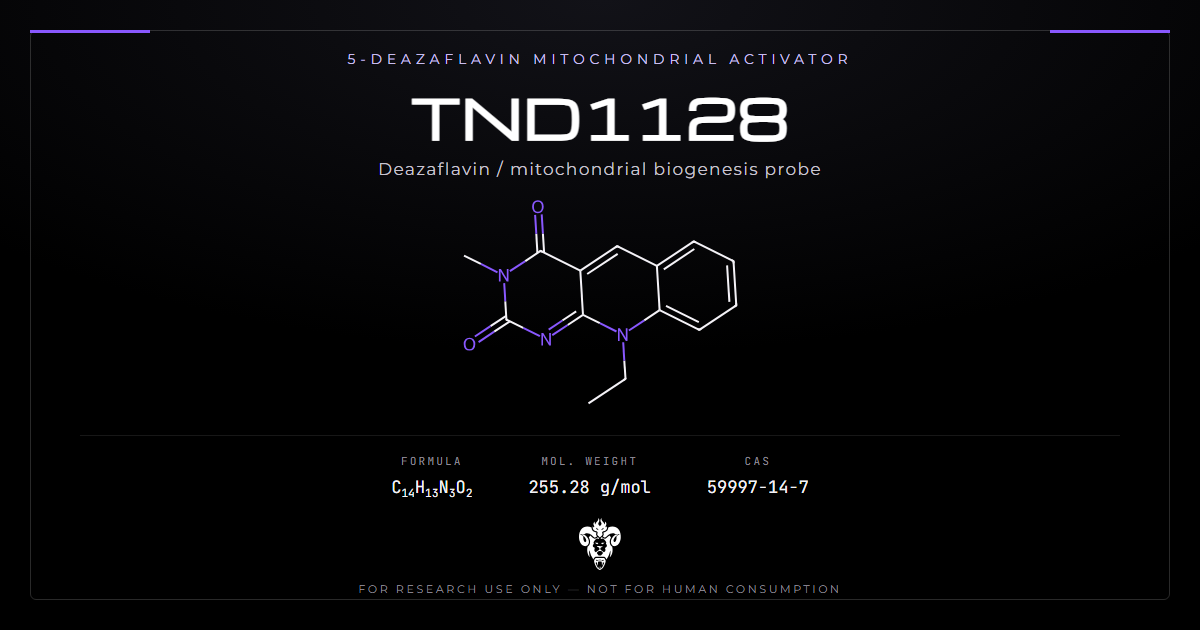
TND1128 is a synthetic 5-deazaflavin that a small group of Japanese pharmacology labs has studied as a direct activator of mitochondrial energy metabolism. It is not a new molecule. Its CAS registration dates to the 1970s, and it carries an NCI screening number from the same era. What is new is the biology: since 2021, four studies have examined how TND1128 affects neuronal morphology, calcium handling, mitochondrial membrane potential, and oxidative-stress survival — always with β-nicotinamide mononucleotide (β-NMN) as the comparator.
That comparison is also the source of most of the marketing noise around the compound. This profile separates the two. Below, we cover what TND1128 is chemically, why the 5-deaza substitution matters mechanistically, what each published study actually measured, where the evidence stops, and what identity and purity work a lab should expect before using the material.
What Is TND1128?
TND1128 is the research code for 10-ethyl-3-methylpyrimido[4,5-b]quinoline-2,4(3H,10H)-dione, more compactly written as 10-ethyl-3-methyl-5-deazaflavin. Suppliers also list it as 3-methyl-10-ethyl-deazaflavin or TND-1128.
| Property | Value |
|---|---|
| CAS number | 59997-14-7 |
| Molecular formula | C₁₄H₁₃N₃O₂ |
| Molecular weight | 255.28 g/mol |
| Monoisotopic mass | 255.1008 Da |
| Expected [M+H]⁺ | 256.1081 |
| InChIKey | XPADYKHELBQXCD-UHFFFAOYSA-N |
| Other identifiers | ChEMBL472210, NSC-278160, DTXSID20313886 |
| Class | Synthetic 5-deazaflavin (5-deazaisoalloxazine) |
| Stereocenters | None |
| Appearance | Yellow crystalline solid |
Structurally, TND1128 is a flat tricyclic heterocycle with no stereocenters and a single rotatable bond. That rigidity matters later, because it makes the compound unusually easy to characterize by NMR and unusually hard to confuse with a conformational impurity.
The Chemistry: Why One Nitrogen Changes Everything
To understand TND1128, start with riboflavin. Vitamin B2 and its cofactor forms — FMN and FAD — sit at the center of cellular redox metabolism. Their reactive core is the isoalloxazine ring, and the nitrogen at position 5 is where the chemistry happens.
A 5-deazaflavin replaces that N5 with a carbon-hydrogen unit. One atom changes. The consequences do not stay small.
Flavins Cycle Through Radicals; Deazaflavins Do Not
Flavins are promiscuous electron carriers. They can move one electron at a time, which means they pass through a semiquinone radical state, and that radical readily reacts with molecular oxygen to generate reactive oxygen species. Deazaflavins behave differently. They serve exclusively as two-electron carriers, behaving more like NAD(P)H than like flavins, and their fully reduced forms are considerably stable against oxidation by oxygen, which avoids ROS formation.
That distinction is the mechanistic heart of the TND1128 story. The molecule looks like a vitamin B2 derivative but acts like a nicotinamide cofactor — a clean hydride shuttle rather than a radical generator.
The F420 Precedent
The comparison is not speculative. Nature already runs this experiment. Coenzyme F420 is a naturally occurring 5-deazaflavin found in archaea and actinobacteria, and it has been characterized in detail. F420 is an obligate two-electron hydride carrier with a standard redox potential of −340 mV, which resembles that of nicotinamide cofactors (−320 mV) rather than that of flavins (−220 to −190 mV).
In other words, a 5-deazaflavin scaffold reliably produces NAD(P)H-like electrochemistry. When the TND1128 authors describe their compound as “self-redox” or “auto-redox,” they are describing this behavior: the molecule can accept and donate a hydride and cycle its own oxidation state without needing to sit in an enzyme active site as a bound prosthetic group.
That is a real, well-grounded chemical property. Whether it translates into the specific cellular mechanism the authors propose is a separate question, and the studies below address it only indirectly.
Where TND1128 Came From
TND1128 emerged from a Japanese deazaflavin chemistry lineage, not from a pharmaceutical discovery program. Fumio Yoneda’s group established much of the synthetic groundwork, and Tomohisa Nagamatsu — who is a co-author on every biological paper discussed here — published a general 5-deazaflavin synthesis in 1984 that made compounds of this class routinely accessible.
The compound sat largely unexamined for decades. Then Nagamatsu and Norio Akaike filed patent applications covering the use of these deazaflavins as “coenzyme factors” for activating ATP production, and the biological characterization began in earnest.
Two things follow from this history. First, TND1128 has no pharmaceutical development file behind it — no IND, no formal toxicology package, no clinical program. Second, the entire published biology comes from a small, overlapping set of authors, which is a normal situation for an early compound but does mean the findings have not yet been independently replicated by an unrelated group.
What the TND1128 Research Actually Shows
Four studies form the core record. Each one is worth reading on its own terms, because they measure different things.
Neuronal Morphology in Culture (2021)
Katsurabayashi and colleagues examined how TND1128 affected the morphological development of cultured mouse hippocampal neurons. TND1128 induced the branching of axons and dendrites, and increased the number of excitatory synapses. The team framed the compound as an NAD⁺-assisting substance and compared its effects directly against β-NMN.
This was the first biological paper on TND1128, and it established the template every subsequent study followed: a cultured or ex vivo neuronal preparation, a morphological or physiological readout, and β-NMN as the active control.
Calcium Handling Under Depolarizing Stress (2023)
Takahashi and colleagues moved to mouse brain slices. They pretreated animals for roughly 22 hours, then forced neurons into an energy crisis with repeated high-potassium depolarization and tracked calcium in both compartments using Fura-4F and X-Rhod-1.
TND1128 at 0.01, 0.1, and 1 mg/kg subcutaneously mitigated the dynamics of both cytosolic and mitochondrial calcium in a dose-dependent manner, while β-NMN at 10, 30, and 100 mg/kg subcutaneously showed significant dose-dependent effects on cytosolic calcium but no significant effect on mitochondrial calcium dynamics.
That asymmetry — TND1128 affecting the mitochondrial compartment where β-NMN did not — is the single most interesting result in the TND1128 literature. It is consistent with the compound actually reaching mitochondria rather than acting upstream. It is not proof that it does.
The authors themselves connected the result to lipophilicity. They noted that the compound is highly hydrophobic and therefore expected to transfer into the brain, and pointed to its effectiveness at doses below 1 mg/kg subcutaneously as support.
Membrane Potential and On-Demand ATP (2024)
The most recent peer-reviewed study used JC-1 to measure mitochondrial membrane potential (ΔΨm) directly. Mice received TND1128 at 0.1 to 10 mg/kg intraperitoneally; membrane potential rose significantly after 24-hour pretreatment at 10 mg/kg, and pretreated slices showed greater ΔΨm depolarization on exposure to 25 mM KCl along with significantly lower cytosolic and mitochondrial calcium. The authors concluded that TND1128 could be incorporated into the TCA cycle and electron transfer chains to facilitate ΔΨm polarization and activate on-demand ATP synthesis.
Read the methodology carefully, though. The team derived an “ATP synthesis index” from the inverse of the ΔΨm value rather than measuring ATP directly in the slice. Membrane potential is a legitimate and informative proxy — a more polarized mitochondrion has more capacity to make ATP when called on — but it is a proxy. Direct luciferin-luciferase ATP data exist for TND1128 in cultured glioma cells from earlier work, not for this brain-slice preparation.
Oxidative Stress and Structural Analogs (2024, preprint)
Kubota and colleagues tested TND1128 alongside four structural analogs — a pyridodipyrimidine (TNPP0819), a testosterone-deazaflavin hybrid (TNAD3028), and two cholesterol-deazaflavin hybrids (TNCD2611 and TNCD2618) — against hydrogen peroxide challenge. TND1128 and its analogs significantly improved cell viability against H₂O₂-induced oxidative stress injury, and the authors attributed the cytoprotective effect to mitochondrial activation.
One important caveat: this paper has been available as a bioRxiv preprint since May 2024 and has not, as of this writing, appeared in a peer-reviewed journal. Treat it as preliminary. The hybrid-analog program it describes is genuinely interesting, since it shows the group deliberately building more lipophilic deazaflavins to improve CNS transit — but preprint status is preprint status.
TND1128 vs. β-NMN: Reading the Comparison Correctly
Commercial listings routinely claim TND1128 is many times more potent than NMN. The peer-reviewed record does not support a specific multiplier, and no study was designed to establish one.
Here is what the record does support. Across the brain-slice work, TND1128 produced effects in the 0.01–1 mg/kg range while β-NMN required 10–100 mg/kg for comparable readouts. That is a genuine and repeatedly observed dose gap. However, a dose gap is not a potency ratio. The two compounds have different routes of entry, different distribution, and — critically — different physical chemistry.
| Computed property | TND1128 | β-NMN |
|---|---|---|
| Molecular weight | 255.28 | 334.22 |
| cLogP | +1.22 | −2.83 |
| Topological polar surface area | 56.9 Ų | 166.2 Ų |
| H-bond donors | 0 | 4 |
| Rotatable bonds | 1 | 5 |
| Charge state at pH 7.4 | Neutral | Zwitterionic |
Calculated descriptors (RDKit), not measured values.
The gap is roughly four log units of lipophilicity and a threefold difference in polar surface area. β-NMN is a charged nucleotide that crosses membranes poorly. TND1128 is a small, neutral, rigid heterocycle whose computed profile sits comfortably in the range usually associated with CNS penetration.
That is the honest version of the “TND1128 is better than NMN” claim: it is not that the molecule is intrinsically a more powerful redox cofactor, but that it is far better shaped to get where the redox chemistry is supposed to happen. Researchers studying brain energy metabolism have a real reason to prefer it as a tool compound.
One correction to the common framing, though. The literature calls TND1128 “highly hydrophobic,” and relative to β-NMN that is obviously true. In absolute terms a cLogP near 1.2 is moderate, not extreme. Anyone planning solubility or formulation work should design around the measured value for their lot rather than the adjective.
What the TND1128 Literature Does Not Establish
Being precise about the gaps is more useful than being enthusiastic about the findings. As of this writing, the published record on TND1128 contains:
- No pharmacokinetic data. No plasma concentrations, no half-life, no brain-to-plasma ratio. The blood-brain barrier argument rests on structure and on inference from effective dose, not on measured brain exposure.
- No metabolism or ADME work. Nothing on hepatic clearance, metabolite identity, or protein binding.
- No formal toxicology. No repeat-dose studies, no NOAEL, no genotoxicity panel.
- No direct target identification. The proposed mechanism — incorporation into the TCA cycle and electron transport chain — remains a hypothesis supported by downstream readouts (ΔΨm, calcium, viability). No study has demonstrated TND1128 in the mitochondrial matrix or identified an enzyme partner.
- No human data of any kind. No clinical trials are registered. TND1128 is not an approved drug in any jurisdiction, and it is not a recognized dietary ingredient in the United States.
- No independent replication. Every biological paper shares authors.
None of that makes TND1128 uninteresting. It makes it early. Compounds at this stage are exactly what research-grade material exists for — and exactly where analytical rigor matters most, because there is no regulatory apparatus checking anyone’s work.
Analytical Considerations for TND1128
This is the part most compound profiles skip. TND1128 has specific characterization requirements that a generic HPLC purity number will not satisfy.
Identity: UV Alone Is Not Sufficient
The deazaflavin chromophore absorbs strongly in the near-UV and edges into the visible, which is why the compound is yellow. That makes it convenient to detect and easy to over-trust. Every 5-deazaflavin in the family shares essentially the same chromophore, so a UV spectrum confirms compound class, not compound identity. Retention time plus UV will not distinguish TND1128 from a closely related analog or from a partially alkylated intermediate.
Mass spectrometry narrows it further — the expected protonated molecular ion is 256.1081 — but even that leaves regiochemistry unresolved.
The Regiochemistry Problem
TND1128 carries two alkyl groups: an ethyl at N10 and a methyl at N3. Both are placed during synthesis, and both can go elsewhere. An N1-alkylated isomer, a 5-deazaalloxazine rather than a 5-deazaisoalloxazine, or a transposed methyl/ethyl arrangement would all return the same molecular formula, the same exact mass, and a very similar UV trace.
Those isomers are not equivalent compounds. 5-Deazaalloxazines are roughly 300 mV stronger reducing agents in the ground state than 5-deazaflavins, and their absorption maximum is blue-shifted to around 350 nm. A regiochemical error would change the very property the compound is being purchased for.
¹H and ¹³C NMR resolve this cleanly. The N-CH₂CH₃ and N-CH₃ signals sit in distinct environments, and the aromatic pattern of the benzo ring plus the C5 vinyl proton gives an unambiguous fingerprint. For a rigid tricycle with one rotatable bond, NMR is not a nice-to-have — it is the only routine method that confirms the structure rather than the formula.
Photostability and Handling
Deazaflavins are photochemically active by design. The same excited-state behavior that makes them useful photoredox catalysts makes them vulnerable to light during storage. The parent 3,10-dimethyl deazaflavin — the direct methyl analog of TND1128 — has been shown to undergo photodimerization on excitation, with quantum efficiencies exceeding unity in the presence of oxalate.
Practical implications for a lab:
- Store solid material in amber glass or foil-wrapped vials, protected from light.
- Prepare stock solutions under reduced lighting, keep them dark, and prepare them close to the point of use rather than holding them.
- Include a light-protected retain if you plan to re-test the lot later; a purity number generated on receipt says nothing about a vial that sat on a bench under fluorescents.
- Treat any color change — fading, darkening, or a shift away from yellow — as a reason to re-run identity, not as a cosmetic issue.
Appearance deserves one more note. A conjugated tricyclic deazaflavin should present as a yellow solid. Appearance is a screening observation rather than an identity test, so a white or off-white powder does not by itself prove anything is wrong. It does warrant a hard look at the analytical package before the material goes into an experiment.
Grade Matters
TND1128 is sold internationally under several grades, including listings marketed as cosmetic and food grade. Those designations describe an intended commercial channel; they do not describe the orthogonal characterization a research lot requires. For a compound whose entire value rests on a specific redox behavior tied to a specific substitution pattern, identity confirmation by an independent method is not optional.
Sourcing TND1128 and COA Verification
Kimera supplies TND1128 as a research-grade reference material in powder and capsule formats, with third-party COA verification on every lot. Because deazaflavin regiochemistry cannot be settled by chromatography alone, orthogonal methods carry the weight here — chromatographic purity for the quantitative answer, and spectroscopic confirmation for the structural one.
Current and historical certificates are published openly in the COA archive, which reviewers can check before ordering rather than after. Researchers working in adjacent mitochondrial and bioenergetic areas often pair TND1128 with methylene blue, an alternative electron carrier with a very different mechanism of action, or with SLU-PP-332, which approaches mitochondrial capacity through transcriptional rather than redox routes. More compounds in this space are profiled under metabolic compounds.
Frequently Asked Questions
What is TND1128?
TND1128 is a synthetic 5-deazaflavin — 10-ethyl-3-methylpyrimido[4,5-b]quinoline-2,4(3H,10H)-dione, CAS 59997-14-7. Researchers study it in cultured cells and rodent brain tissue as a hydride-transfer cofactor that may support mitochondrial energy metabolism.
How does TND1128 work?
Its 5-deaza substitution gives it NAD(P)H-like electrochemistry: it transfers two electrons as a hydride rather than cycling through radical intermediates the way flavins do. Published studies propose that it enters the TCA cycle and electron transport chain to help polarize the mitochondrial membrane potential. That mechanism is inferred from downstream measurements, not directly demonstrated.
Is TND1128 more potent than NMN?
Published studies used β-NMN as an active control and did not measure a potency ratio. TND1128 produced effects at roughly 100-fold lower doses in rodent brain-slice work, but the two compounds differ enormously in lipophilicity and membrane permeability, so that gap most likely reflects distribution rather than intrinsic redox potency. Specific “X times stronger than NMN” figures come from commercial marketing.
Does TND1128 cross the blood-brain barrier?
No study has measured brain concentrations. Its computed profile — molecular weight 255, cLogP near 1.2, polar surface area 57 Ų, no hydrogen-bond donors — sits well within ranges associated with CNS penetration, and its efficacy at sub-milligram-per-kilogram doses is consistent with brain entry. That remains inference.
What is TND1128’s molecular weight?
TND1128 has the molecular formula C₁₄H₁₃N₃O₂ and a molecular weight of 255.28 g/mol, with a monoisotopic mass of 255.1008 Da.
How should TND1128 be stored?
Protect it from light. Deazaflavins are photochemically reactive, and the closest structural analog is documented to photodimerize on irradiation. Amber or foil-wrapped containers, dark storage at controlled room temperature, and light-protected retains are appropriate for a compound in this class. Storage guidance is a house recommendation. Analytical documentation is per-lot release testing.
Kimera supplies TND1128 for laboratory and research use only. Not for human consumption, nor for medical, veterinary, or household use. No statement here should be read as a health claim; TND1128 has no regulatory approval in any jurisdiction and no human safety or efficacy data.
References
Primary TND1128 literature
- Katsurabayashi S, Oyabu K, Kubota K, et al. The novel mitochondria activator, 10-ethyl-3-methylpyrimido[4,5-b]quinoline-2,4(3H,10H)-dione (TND1128), promotes the development of hippocampal neuronal morphology. Biochem Biophys Res Commun. 2021;560:146–151. doi:10.1016/j.bbrc.2021.04.132. https://pubmed.ncbi.nlm.nih.gov/33989906/
- Takahashi N, Akaike N, Nagamatsu T, Uchino H, Kudo Y. Effects of TND1128 (a 5-deazaflavin derivative), with self-redox ability, as a mitochondria activator on the mouse brain slice and its comparison with β-NMN. J Pharmacol Sci. 2023;151(2):93–109. doi:10.1016/j.jphs.2022.11.005. https://pubmed.ncbi.nlm.nih.gov/36707184/
- Takahashi N, Nagamatsu T, Akaike N, Kudo Y. TND1128, a 5-deazaflavin derivative with auto-redox ability, facilitates polarization of mitochondrial membrane potential (ΔΨm) and on-demand ATP synthesis in mice brain slices. J Pharmacol Sci. 2024;156(4):218–229. doi:10.1016/j.jphs.2024.10.001. https://pubmed.ncbi.nlm.nih.gov/39608846/
- Kubota K, Katsurabayashi S, Watanabe T, Iwasaki K, Nagamatsu T, Akaike N. 5-Deazaflavin (TND1128) and its hybrid analogs are cytoprotective against hydrogen peroxide (H₂O₂)-induced oxidative stress. bioRxiv. 2024. doi:10.1101/2024.05.07.592882. (Preprint — not peer reviewed.) https://www.biorxiv.org/content/10.1101/2024.05.07.592882v1
- Nagamatsu T, Hashiguchi Y, Yoneda F. A new, general, and convenient synthesis of 5-deazaflavins (5-deazaisoalloxazines) and bis-(5-deazaflavin-10-yl)alkanes. J Chem Soc Perkin Trans 1. 1984:561–565. doi:10.1039/P19840000561
- Nagamatsu T, Akaike N. Use of coenzyme factor for activation of ATP production. PCT/JP2019/003860; WO2019/151516A1; US20200246340A1.
Supporting chemistry and background
- Meyer F, Frey A, Mihiret YE, et al. Deazaflavin reductive photocatalysis involves excited semiquinone radicals. Nat Commun. 2020;11:3149. doi:10.1038/s41467-020-16909-y. https://www.nature.com/articles/s41467-020-16909-y
- Mascotti ML, Kumar H, Nguyen QT, Ayub MJ, Fraaije MW. On the diversity of F420-dependent oxidoreductases: a sequence- and structure-based classification. Proteins. 2021. https://pmc.ncbi.nlm.nih.gov/articles/PMC8518648/
- Ferrari M, Cibulka R, et al. Deazaalloxazines — flavin derivatives that provide reductive photoredox catalysis with inert substrates. Chemistry — A European Journal. 2025. doi:10.1002/chem.202502897
- TND1128 chemical identifiers: CAS 59997-14-7; ChEMBL472210; NSC-278160; DTXSID20313886; InChIKey XPADYKHELBQXCD-UHFFFAOYSA-N.