
Everything below reports findings from cell cultures, isolated tissue and animals. This material is for research use only, not for human or veterinary use.
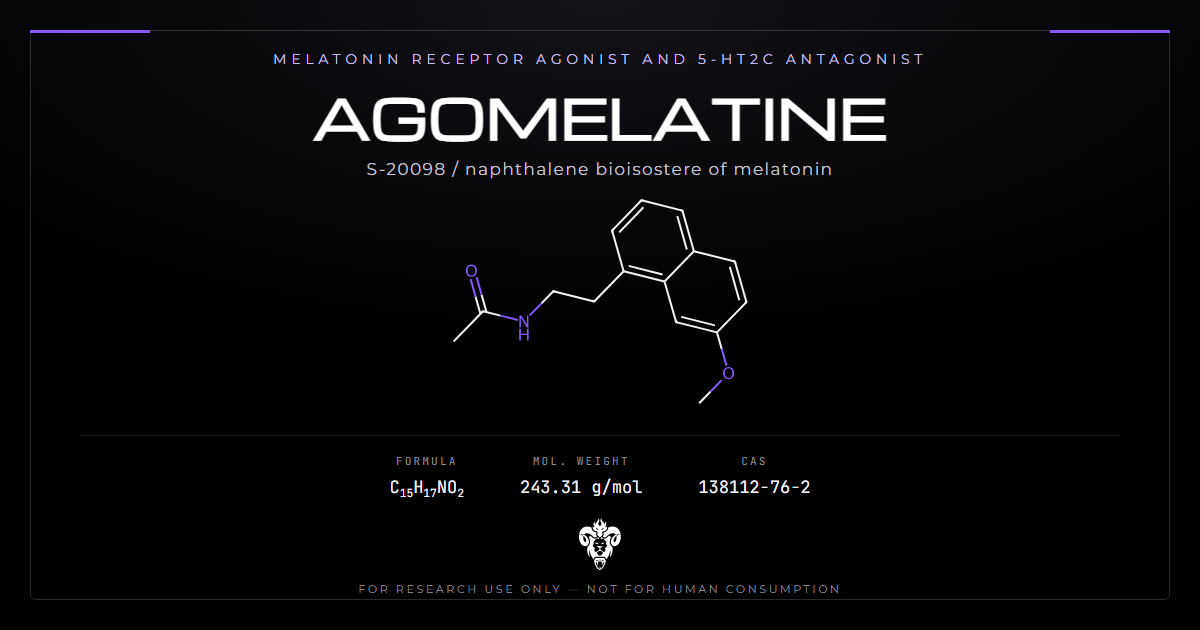
Agomelatine is a small naphthalene acetamide. Servier coded it S-20098. The chain copies melatonin. The ring does not.
Melatonin is an indole. Agomelatine swaps that indole for a 7-methoxynaphthalene. The methoxy and the ethylacetamide stay. The indole nitrogen leaves. That single swap changes clearance and receptor mix.
The useful laboratory questions are identity, receptor logic, and what animal systems actually measured. A development programme and several indexed clinical papers exist. Those human endpoints sit outside the scope of this profile.
Chemical identity of Agomelatine
Agomelatine is N-[2-(7-methoxynaphthalen-1-yl)ethyl]acetamide. PubChem lists CID 82148.
| Property | Value |
|---|---|
| Common names | Agomelatine, S-20098, S20098 |
| Systematic | N-[2-(7-methoxynaphthalen-1-yl)ethyl]acetamide |
| Molecular formula | C15H17NO2 |
| Molecular weight | 243.30 g/mol |
| Monoisotopic mass | 243.1259 Da |
| CAS | 138112-76-2 |
| PubChem CID | 82148 |
| InChIKey | YJYPHIXNFHFHND-UHFFFAOYSA-N |
| Class | Naphthalene bioisostere of melatonin |
| Stereocentres | None |
| UV handle | Methoxynaphthalene chromophore |
The catalogue carries it as Agomelatine.
A naphthalene where melatonin has an indole
Melatonin is C13H16N2O2 at 232.28 g/mol. Agomelatine is C15H17NO2 at 243.30 g/mol. Eleven daltons and one nitrogen separate them.
Both molecules carry a methoxy on a fused aromatic system. Both terminate the side chain as an acetamide. The rings differ. Melatonin keeps an indole nitrogen. Agomelatine does not.
That nitrogen is the site where monoamine oxidase and other indole-metabolising enzymes clip melatonin. Remove it and those routes lose their handle. The molecule still fits melatonin receptors. Clearance slows relative to the hormone.
The SMILES string CC(=O)NCCC1=CC=CC2=C1C=C(C=C2)OC encodes that story in one line. Acetamide, two-carbon linker, 1,7-disubstituted naphthalene. A certificate that quotes a different connectivity is not this lot.
No stereocentres
The molecule is achiral. The UHFFFAOYSA block in its InChIKey is the correct record, not a stripped one.
That fact removes chiral chromatography from the identity list. Few compounds on this shelf allow that sentence. Purity on an achiral column answers the stereochemistry axis completely.
Racemisation is not a degradation route here. Oxidation of the methoxyarene and hydrolysis of the acetamide still are.
Melatonin receptor chemistry
MT1 and MT2 are Gi/o-coupled receptors. Native melatonin hits both. Agomelatine does the same, by design.
Affinity at cloned human receptors
Audinot and colleagues measured 2-[125I]-iodomelatonin binding on human MT1 and MT2 in CHO and HEK membranes (PMID 12764576). Agomelatine bound both subtypes in the sub-nanomolar band.
Reported Ki values sit near 0.1 nM at CHO-hMT1 and 0.12 nM at CHO-hMT2. HEK membranes gave 0.06 nM and 0.27 nM on the same pair. Cell background moved the number. The rank order did not.
A [35S]-GTPgammaS assay on those membranes read the compound as an agonist. Partial, full, and antagonist ligands all appeared in that screen. Agomelatine sat on the agonist side. Inverse agonism did not appear for the set they tested.
Treat those Ki figures as assay numbers, not as a certificate. A laboratory that wants the pair for a given vial runs the cells.
What the two subtypes do in tissue
MT1 and MT2 are not interchangeable labels. They differ in tissue map and in coupling detail. Both restrain cAMP through Gi/o. Downstream transcription and ion-channel effects then diverge by cell type.
A lot that is potent at one subtype and silent at the other is a different reagent. Agomelatine was built to fire both. Melatonin does the same. The naphthalene does not create a new subtype map. It copies the hormone’s dual occupancy with a slower clearance.
Seltorexant sits in an adjacent sleep-chemistry conversation and hits a different receptor class. Do not treat that orexin ligand as a melatonin-receptor control.
5-HT2C antagonism
The second half of the profile is serotonin, not melatonin. Millan and colleagues established the 5-HT2C numbers (PMID 12750432, DOI).
Binding and functional block
Agomelatine displayed pKi 6.2 at cloned human 5-HT2C receptors and pKi 6.4 at native porcine 5-HT2C receptors. It also bound human 5-HT2B at pKi 6.6.
Affinity at 5-HT2A and 5-HT1A sat at pKi below 5.3. Other 5-HT subtypes sat below 5.0. The 5-HT2C / 5-HT2B pair is the serotonin handle. The rest of the 5-HT panel is not.
Antibody-capture assays showed competitive block of h5-HT2C coupling to Gq/11 and Gi3. pA2 values were 6.0 and 6.1. Phospholipase C readouts gave a pKB of 6.1 at h5-HT2C and 6.6 at h5-HT2B.
Later work classed the 5-HT2C action as a neutral antagonist, not an inverse agonist. That distinction matters in cells with constitutive 5-HT2C tone. A neutral antagonist blocks agonist-driven signal. It does not suppress basal coupling the way an inverse agonist does.
What 5-HT2C block does in animals
Millan also read extracellular dopamine and noradrenaline in rat frontal cortex. Agomelatine raised both. Nucleus accumbens and striatum did not move. A melatonin-receptor antagonist did not cancel the cortical rise. A 5-HT2C agonist, Ro60-0175, suppressed ventral tegmental firing. Agomelatine blocked that suppression.
Those dialysis and firing results assign the monoamine rise to 5-HT2C block, not to MT1/MT2 agonism. They are rat measurements. They do not transfer to a human score.
Anhedonia reviews list the compound among agents with a published 5-HT2C story [10]. That is a narrative map, not a bench assay.
Two receptors in one molecule
Every dose that has ever been given carries both actions at once. Nobody has run Agomelatine against a pure MT1/MT2 agonist and a pure 5-HT2C antagonist in one trial. The share of each half remains an argument.
Why the mix is hard to unpick
Melatonin itself lacks 5-HT2C antagonism. A melatonin-only arm is available in principle. A 5-HT2C-only arm is available in principle. The published Agomelatine file did not run that three-way comparison.
Polysomnography papers exist in the indexed set [5]. Human sleep architecture sits outside this profile. The chemistry still predicts a test. If the melatonergic half drove objective sleep change, a pure MT agonist should copy it. If the 5-HT2C half drove a different readout, a pure 5-HT2C antagonist should copy that. Those are experiments a laboratory can still build.
Heteromer talk is not a certificate
Reviews describe MT1 / 5-HT2C and MT2 / 5-HT2C heteromers in cells. That literature tries to explain synergy from one ligand. Heteromer westerns and BRET traces are cell-system results. They do not identify an unknown vial.
A methods section that names Agomelatine and then quotes only a melatonin-receptor EC50 has measured one arm. Dual profile is a pair of potencies. Write both.
Animal and cell readouts
Rodent work is where the receptor pair becomes a measurable phenotype.
Hippocampal neurogenesis in rats
Banasr, Soumier and colleagues gave rats Agomelatine at 40 mg/kg intraperitoneal. Chronic courses of about three weeks raised BrdU-positive cells in the ventral dentate gyrus. Acute and one-week courses did not.
Survival of new neurons rose when treatment ran longer. Dorsal and ventral dentate did not move in lockstep. The ventral blade carried more of the proliferation change.
Soumier later used 40 mg/kg Agomelatine against 40 mg/kg melatonin and against 5-HT2C tools. Melatonin alone did not copy the full neurogenic pattern. An MT1/MT2 antagonist given before Agomelatine cut part of the effect. 5-HT2C antagonists contributed another part. The paper treats both receptors as necessary.
A 2025 meta-analysis of monoaminergic neurogenesis work found a small consistent effect across the class after bias correction (PMID 40495440) [12]. Break that pool by compound and the Agomelatine subset is thin. The authors state that the number of studies was insufficient for a firm compound-level claim. Nearly 30% of the pool carried a low risk of bias. The rest sat unclear. That is the usual state of rodent neurogenesis files.
A successor analogue in animals
Medicinal chemistry produced GW117 as a dual-mechanism analogue. Gao and colleagues published its acute toxicity and genotoxicity package (PMID 36915542) [9].
Maximum tolerated dose was 2,000 mg/kg. Bacterial reverse mutation, chromosome aberration, and mouse micronucleus tests did not flag a signal. Those are animal and cell genotoxicity assays. They describe GW117, not Agomelatine.
A successor built on the same receptor pair is useful as a matched chemical control. It is not a substitute lot. Mass and formula differ. Run both on the same intact-mass method before treating them as equivalents.
| Study | System | Exposure | Readout |
|---|---|---|---|
| Audinot 2003 | CHO/HEK hMT1, hMT2 | Binding | Sub-nanomolar Ki, agonist in GTPgammaS |
| Millan 2003 | Cloned h5-HT2C, rat cortex | Binding plus dialysis | pKi 6.2; cortical DA and NA rise |
| Banasr 2006 | Adult rat dentate | 40 mg/kg i.p., 3 weeks | Ventral proliferation up |
| Soumier 2009 | Adult rat dentate | 40 mg/kg i.p., 8-21 days | Both receptors needed |
| Sampedro-Piquero 2025 [12] | Rodent neurogenesis pool | Mixed | Class effect small; Agomelatine subset thin |
| Gao 2023 [9] | Mouse, Ames, cells | GW117, 2,000 mg/kg | No genotoxicity flag |
Metabolism and the CYP1A2 handle
CYP1A2 is the main enzyme that oxidises Agomelatine. That fact is chemistry. It is also the usual starting point for metabolite hunts.
What the enzyme does to the molecule
The naphthalene and the methoxy are the oxidation sites a CYP1A2 screen will hit first. Demethylation of the 7-methoxy yields a phenol. Aryl hydroxylation adds mass in 16 Da steps. The acetamide can hydrolyse to the primary amine. Each product is a different species on a chromatogram.
Wang and colleagues discussed CYP1A2 variation in an indexed case report (PMID 34766583) [7]. They flag the rs762551 polymorphism as a hypothesis. One case does not establish a rule. The enzyme assignment still matches the rest of the metabolism literature.
A lot that names Agomelatine and then shows a demethylated mass as the major peak has a metabolite or a synthetic impurity in the vial. Intact mass of the parent is 243.13 Da monoisotopic. The phenol sits 14 Da lighter. Write both numbers on the method.
Why FAERS is the wrong first database
Jiang and colleagues searched the US Food and Drug Administration Adverse Event Reporting System for antidepressant liver injury (PMID 38715707) [8]. Agomelatine barely appears. The authors give the reason. Few reports exist for drugs that database does not cover.
A spontaneous reporting system records the jurisdiction that built it. Absence there is a coverage fact, not an identity result. Anyone who treats a blank FAERS row as a clean lot has asked the wrong question.
Indexed safety and efficacy papers remain in the reference list so a reader can find them. This profile does not quote their human scores.
Limits of the published record
Four gaps sit between the published record and the claims that circulate around it.
Population and certainty
The large efficacy and acceptability analyses ran in people. A 2026 network meta-analysis reprint sits in the list [2]. Adolescent and maintenance pools sit there too [3][4]. Human endpoints are outside the scope of this profile. The papers stay cited so they can be found.
A registered protocol covers newer-generation agents in children and adolescents and lists Agomelatine among 19 drugs [11]. That analysis has not reported. A protocol is not a result.
Which receptor is being credited
Cortical dialysis points at 5-HT2C [Millan, above]. Circadian and binding work points at MT1/MT2. Neurogenesis work says both. A paper that names “the melatonin agonist” and then reports a 5-HT2C-typical dialysis pattern has mislabelled the arm.
Which molecule was in the vial
Melatonin is 232.28 Da. Agomelatine is 243.30 Da. Both are white solids. Both carry a methoxy and an acetamide. A label is not a mass. A UV trace that does not separate them is not an identity method.
What this profile will not do
It will not quote human dose ladders, human adverse-event rates, or approval labels. Those sentences turn a research article into a use document. Physiological side-effect network papers exist [6]. Sleep-architecture papers exist [5]. They stay in the list. They do not set the tone here.
Four questions to ask of any Agomelatine result
Most disagreement about this compound traces to comparing figures that were never comparable.
Which structure was measured?
Formula C15H17NO2, mass 243.30 Da, CAS 138112-76-2, CID 82148, InChIKey YJYPHIXNFHFHND-UHFFFAOYSA-N. A lot that fails those checks is not Agomelatine.
Which receptor assay?
State the cell line, the species of the receptor, and whether MT1, MT2, and 5-HT2C were all read. Dual profile is a measured trio, not a class nickname.
Which animal model?
Ventral dentate BrdU after 40 mg/kg i.p. is one system [12]. Cortical microdialysis is another. GW117 genotoxicity is a third [9]. Read-across between them is a claim that needs its own experiment.
Is the comparator the same backbone?
Melatonin shares the side chain and not the ring. GW117 shares the receptor story and not the mass. A result that names “a melatonergic agent” without naming the lot is not usable.
Verifying research material
A 243 Da naphthalene acetamide has a short analytical list. Batch documentation sits on the certificates of analysis page.
Identity
Formula C15H17NO2, molecular weight 243.30, CAS 138112-76-2, InChIKey YJYPHIXNFHFHND-UHFFFAOYSA-N.
The molecule is small and unhalogenated, so there is no isotope pattern to exploit. The methoxynaphthalene core gives a distinctive ultraviolet absorbance. That absorbance is the cheapest identity check after mass.
Electrospray in positive mode should return [M+H]+ near 244.13. A peak at 233.13 is the melatonin mass plus a proton. That is the wrong compound.
The melatonin comparison is a check, not a confusion
Eleven daltons apart, one nitrogen different, and both are methoxy-substituted bicyclics carrying an ethylacetamide. Neither difference is large enough to catch by eye on a certificate.
Check that a method separates them rather than assuming it does. Melatonin is cheap and widely available. A reversed-phase method that co-elutes the pair will pass a bad vial.
Purity and related substances
Expected impurities are the 7-phenol from demethylation, the primary amine from acetamide hydrolysis, and regioisomers of the methoxy. Each has a defined mass offset.
Reversed-phase chromatography with diode-array detection finds them. A single area-percent on a poor column does not. Peptide-style mapping does not apply. This is a small molecule.
Handling
Store the lyophilised or crystalline solid cold, dry and dark. Reconstitute close to the point of use.
Storage guidance is a house recommendation. Analytical documentation is per-lot release testing.
The acetamide is the hydrolysis site in water. Aqueous stocks age. Fresh solutions and week-old solutions are not equivalent inputs. Shield the naphthalene from strong light. The chromophore that makes UV identity easy also invites photochemistry.
Related sleep-chemistry and nootropic reagents in this catalogue are not substitutes. Seltorexant is an orexin-2 antagonist. Citicoline and Noopept sit in adjacent cognitive-research space and share no receptor map with Agomelatine. Keep the names on separate labels.
Laboratories source Agomelatine as an MT1/MT2 agonist and 5-HT2C antagonist reference. Related work appears in the nootropics category.
Common questions about Agomelatine
What is Agomelatine? A naphthalene acetamide, C15H17NO2, 243.30 Da, CAS 138112-76-2. It is an MT1 and MT2 agonist and a 5-HT2C antagonist.
How does it differ from melatonin? Naphthalene in place of indole. Melatonin is C13H16N2O2 at 232.28 Da. Agomelatine keeps the methoxy and the ethylacetamide and loses the indole nitrogen.
What are the binding numbers? Sub-nanomolar Ki at cloned human MT1 and MT2 (PMID 12764576). pKi 6.2 at cloned human 5-HT2C (PMID 12750432).
Does this page report human outcomes? No. Indexed clinical papers are listed so they can be found. This profile stops at chemistry, receptor logic and animal systems.
What did the rat dentate work measure? Chronic 40 mg/kg intraperitoneal courses raised ventral dentate proliferation. Melatonin alone did not copy the full pattern. Both receptor arms contributed [12].
Why does CYP1A2 matter in the lab? It is the main oxidative enzyme. Demethylation and aryl hydroxylation are the first metabolites to hunt [7].
Is there a successor compound? GW117 carries the same dual mechanism. Gao published a 2,000 mg/kg animal and genotoxicity package for that analogue [9].
Is it a melatonin substitute in an assay? Not if the assay can see 5-HT2C. Melatonin does not carry that antagonism. Run both receptors before treating the two solids as equivalents.
Summary of the evidence
Write the name, the mass and the three receptors on the first line of a notebook page. Everything else in this profile is a check on those facts.
Identity: C15H17NO2, 243.30 Da, CAS 138112-76-2, CID 82148, InChIKey YJYPHIXNFHFHND-UHFFFAOYSA-N. A certificate that omits intact mass is not finished.
Agomelatine is the long name for that lot. S-20098 and S20098 are the same chain under a development code. Do not treat a code as a second compound.
Design: a naphthalene bioisostere of melatonin that adds 5-HT2C antagonism. Audinot supplies the melatonin-receptor pair. Millan supplies the 5-HT2C pair and the cortical dialysis.
Animal evidence: ventral dentate neurogenesis at 40 mg/kg i.p. in rats, with both receptors implicated, and a thin compound-level subset in a later neurogenesis meta-analysis [12]. GW117 is a related analogue with a published animal genotoxicity file [9].
Limits: human efficacy, human dose and human adverse-event figures are out of scope here. Those papers remain in the reference list [1].
Status: supplied for laboratory research use only.
References
- Maddukuri RK, Hema C, Sri Tejaswi K, Venkata Mounika M, Vegesana BP. Antidepressant efficacy of agomelatine: meta-analysis of placebo controlled and active comparator studies. Asian J Psychiatr. 2021;65:102866. PMID 34592623. DOI
- Cipriani A, Furukawa TA, Salanti G, Chaimani A, Atkinson LZ, Ogawa Y, et al. Comparative efficacy and acceptability of 21 antidepressant drugs for the acute treatment of adults with major depressive disorder: a systematic review and network meta-analysis. Focus (Am Psychiatr Publ). 2026. PMID 42538894. DOI
- Kishi T, Ikuta T, Sakuma K, Okuya M, Hatano M, Matsuda Y, Iwata N. Antidepressants for the treatment of adults with major depressive disorder in the maintenance phase: a systematic review and network meta-analysis. Mol Psychiatry. 2023;28(1):402-409. PMID 36253442. DOI
- Wu T, Song F, Cao W, Liu C, Jia S. Comparative efficacy of antidepressant medication for adolescent depression: a network meta-analysis and systematic review. BMC Psychiatry. 2025;25(1):471. PMID 40349006. DOI
- Zhang X, Chen Y, Deng R, Tao S, Zou M, Wang Q. Management of insomnia symptoms in depressed patients treated with agomelatine, mirtazapine and trazodone: a systematic review and meta-analysis. J Affect Disord. 2026;402:121378. PMID 41679391. DOI
- Taylor RW, et al. The effects of antidepressants on cardiometabolic and other physiological parameters: a systematic review and network meta-analysis. Lancet. 2025. PMID 41135546. DOI
- Wang S, Xu Q, Qu K, Wang J, Zhou Z. CYP1A2 polymorphism may contribute to agomelatine-induced acute liver injury: case report and review of the literature. Medicine (Baltimore). 2021;100(45):e27736. PMID 34766583. DOI
- Jiang A, Wei C, Zhu W, Wu F, Wu B. Adverse event profiles of drug-induced liver injury caused by antidepressant drugs: a disproportionality analysis. Ther Adv Drug Saf. 2024;15:20420986241244585. PMID 38715707. DOI
- Gao M, Ma H, Liu T, Cao C, Zheng Z, Tang L, Gu W, Zhang D, Sun H. Acute toxicity and genotoxicity studies on new melatonergic antidepressant GW117. Heliyon. 2023;9(3):e14026. PMID 36915542. DOI
- Serretti A. Anhedonia: current and future treatments. PCN Rep. 2025;4(1):e70088. PMID 40129874. DOI
- Turkmen C, Sacu S, Furukawa Y, de Cates AN, Schoevers RA, Kamphuis J, et al. Side effect profile and comparative tolerability of newer generation antidepressants in the acute treatment of major depressive disorder in children and adolescents: protocol for a systematic review and network meta-analysis. BMJ Open. 2025;15(10):e102696. PMID 41062142. DOI
- Sampedro-Piquero P, et al. Dissecting the pro-neurogenic effects of monoaminergic medications used to treat depression: a systematic review and meta-analysis. J Psychopharmacol. 2025. PMID 40495440. DOI
Agomelatine is sold for laboratory research use only. Not for human consumption, nor medical, veterinary, or household uses.
Literature retrieved from PubMed.