
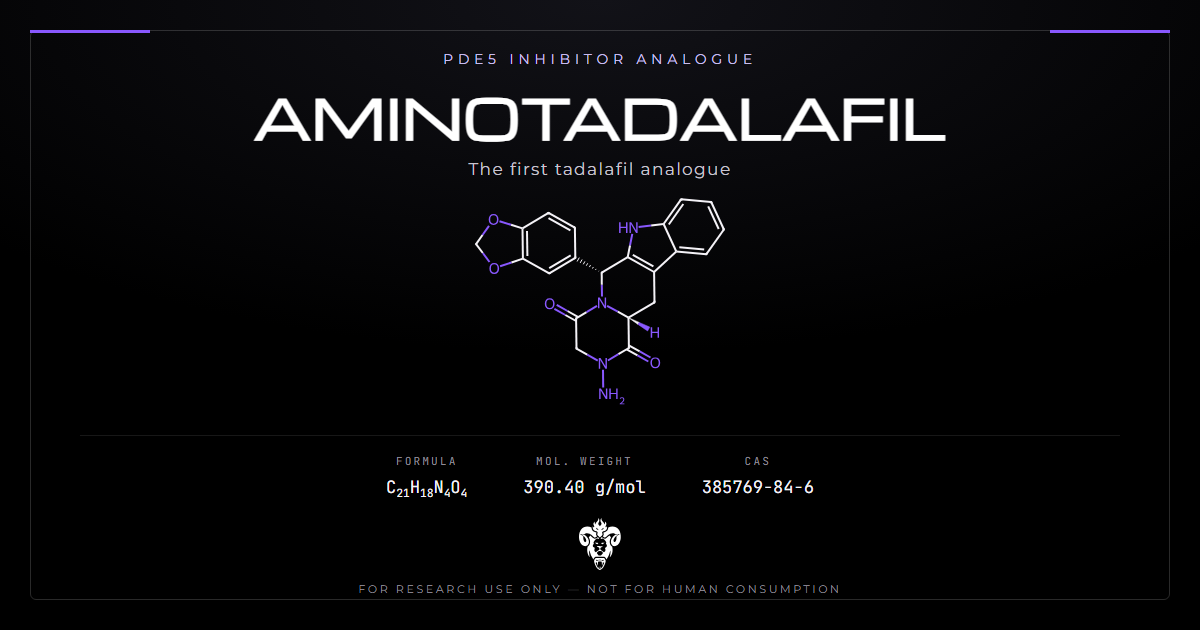
Most research compounds arrive from a patent estate or an academic synthesis program. Aminotadalafil arrived from a seized capsule.
In 2006, a team at the National University of Singapore and the Health Sciences Authority pulled an unknown compound out of an herbal product marketed for erectile dysfunction, purified it by column chromatography, and worked out its structure by LC-UV, high-resolution mass spectrometry, ESI-MS/MS, IR, and NMR. What they found was a tadalafil skeleton with one substitution changed. It was the first tadalafil analog ever reported as a supplement adulterant, and it opened a category that now runs to more than two dozen compounds.
That origin story is why aminotadalafil matters to a laboratory today. It is not a drug candidate and never was one. Its enduring function is as an analytical reference standard — the material a lab needs on hand to say with confidence that a given peak is, or is not, this specific compound. And as it happens, aminotadalafil is unusually good at hiding.
Chemical identity
Aminotadalafil is a tetracyclic tetrahydro-β-carboline bearing a piperazine-2,5-dione (diketopiperazine) ring and a 1,3-benzodioxol-5-yl substituent — the same architecture that makes tadalafil a highly selective PDE5 inhibitor.
| Property | Value |
|---|---|
| CAS Number | 385769-84-6 |
| Molecular formula | C₂₁H₁₈N₄O₄ |
| Molecular weight | 390.39 g/mol |
| Monoisotopic mass | 390.1328 Da |
| UNII | FY501QO030 |
| Stereochemistry | (6R,12aR) |
| Appearance | White to off-white crystalline solid |
| Solubility | Soluble in DMSO and DMF; poorly water-soluble |
The IUPAC name is (6R,12aR)-2-amino-6-(1,3-benzodioxol-5-yl)-2,3,6,7,12,12a-hexahydropyrazino[1′,2′:1,6]pyrido[3,4-b]indole-1,4-dione.
The N-amino distinction
The single structural difference between aminotadalafil and tadalafil is at position N2 of the piperazinedione ring. Tadalafil carries a methyl group there. Aminotadalafil carries an amino group — bonded nitrogen-to-nitrogen.
This detail gets stated loosely almost everywhere, and the loose version is wrong in a way that matters. Aminotadalafil does not have “a primary amine on the scaffold” in the ordinary sense of an amine hanging off a carbon. It has an N–N bond. The N2 nitrogen of a cyclic imide bearing an exocyclic NH₂ is a hydrazide, and hydrazides behave nothing like alkylamines. They are nucleophilic at the terminal nitrogen, they condense readily with aldehydes and ketones, and they are considerably more reactive than the methyl group they replace.
Everything interesting about this compound follows from that one bond.
Note also the direction of the change. Aminotadalafil is not tadalafil “minus a group.” Replacing –CH₃ (15 Da) with –NH₂ (16 Da) adds one nominal mass unit and swaps a carbon for a nitrogen: C₂₂H₁₉N₃O₄ (389.41) becomes C₂₁H₁₈N₄O₄ (390.39). That +1 Da shift is the source of the analytical problem discussed below.
Discovery and the analog cascade
Zou and colleagues published the structural elucidation in Food Additives and Contaminants in 2006, isolating the compound alongside hydroxyhomosildenafil from a single herbal product. Their paper closed with a recommendation that has aged well: this compound should be added to the target list when screening herbal products for adulterants. A companion paper the same year in Rapid Communications in Mass Spectrometry worked out the electrospray tandem MS behaviour of tadalafil and the new analog side by side.
Aminotadalafil was the opening entry in what became a long series. The most recent comprehensive review, covering 2003 through July 2023, catalogues 112 unapproved PDE-5 inhibitors found as adulterants, of which 26 — roughly a quarter — are tadalafil analogs. Related structures have followed a predictable logic of substitution at the same N2 position: N-ethyl (homotadalafil), N-isopropyl, N-cyclopentyl nortadalafil, and 2-hydroxyethylnortadalafil among them. Kimera stocks N-ethyl Tadalafil and N-Isopropyl Tadalafil alongside Aminotadalafil for exactly this reason — an N2-substitution series is far more useful to a method development chemist than any single member of it.
A further wrinkle appeared in 2013, when a Korean group identified acetaminotadalafil — the N-acetylated derivative — in bulk powder destined for supplement manufacture. That compound is, structurally, an acylated aminotadalafil, which means aminotadalafil is not only an adulterant target in its own right but a synthetic precursor to others.
The patent that never was
Tadalafil’s structure–activity work is public. The GlaxoSmithKline and Lilly ICOS programs published extensively on the piperazinedione series, and the 2003 Journal of Medicinal Chemistry paper documenting tadalafil’s discovery shows systematic optimization of the substituent on that ring, with the cis-(6R,12aR) configuration emerging as the most potent.
Aminotadalafil is conspicuously absent from that body of work. The Dutch RIVM group that surveyed counterfeit PDE5 inhibitors in 2007 offered a hypothesis for the gap: the medicinal chemists may have deliberately skipped the N-amino analog because of the hydrazide’s reactivity. Reactive functional groups are a well-known liability in drug development, and a compound that can form covalent adducts is generally a compound a development team walks away from.
If that reading is correct, aminotadalafil exists in commerce not despite having been passed over by professional medicinal chemists, but in ignorance of the fact that they passed it over. It was easy to make — tadalafil analogs are accessible in a four-step linear synthesis from tryptophan — and it was not on any regulator’s screening list. Those were the selection criteria.
Pharmacology, and the data that does not exist
Aminotadalafil is a PDE5 inhibitor. That much is not seriously in dispute: it retains the fused-ring system that π-stacks against Phe820 in the PDE5 active site and the carbonyl groups that hydrogen-bond to Gln817 and Tyr612, which are the interactions that govern binding in this chemotype.
Beyond that, the honest answer is that the record is thin to the point of being absent.
New Zealand’s Medicines Classification Committee assembled the available in vitro data on PDE5 inhibitor analogs in 2009 and published a comparison table. Sildenafil, vardenafil, tadalafil, benzamidenafil, thiosildenafil, homosildenafil, acetildenafil, and several others have measured IC₅₀ values in it. Aminotadalafil does not. No published IC₅₀ against PDE5. No selectivity ratios against PDE6 or PDE3. No pharmacokinetic parameters. No toxicology studies of any kind. No clinical data. The committee’s own summary of the analog class was blunt: biological activity data are limited to in vitro PDE5 and PDE6 inhibition studies, and because these compounds have never been through regulatory assessment, safety pharmacology and toxicology data simply do not exist.
Anyone citing a specific potency figure for aminotadalafil should be asked for the primary source. In our reading of the literature, there isn’t one.
The irreversible inhibition hypothesis
The most substantive pharmacological claim in the literature is a prediction rather than a measurement. Because the hydrazide can in principle form a covalent bond within the enzyme’s active site, aminotadalafil has been hypothesized to act as an irreversible PDE5 inhibitor — which, if true, would mean a duration of effect uncoupled from plasma clearance and therefore unlike any characterized PDE5 inhibitor.
This has not been demonstrated experimentally. It remains a structural inference. It is also, in practical terms, the single most interesting open question about the compound, and it is a tractable one: a standard jump-dilution or dialysis-recovery experiment against recombinant PDE5A would settle it. That the experiment has apparently never been published is itself informative about how little formal attention this molecule has received.
Detection: why aminotadalafil hides
Here is the analytical problem, and it is a real one.
Aminotadalafil’s protonated molecule sits at m/z 391.1401. Tadalafil’s protonated molecule sits at m/z 390.1449 — and tadalafil’s naturally occurring ¹³C isotopologue therefore appears at m/z 391.1482.
The gap between them is 0.0082 Da, about 20.8 ppm at that mass. Resolving the two requires a resolving power near 48,000.
The practical consequences:
- On a unit-resolution instrument — a single quadrupole, or a triple quad running full scan — aminotadalafil’s molecular ion is indistinguishable from the M+1 isotope peak of tadalafil. A sample containing tadalafil alone produces a signal at nominal m/z 391 no matter what.
- On a modest-resolution TOF, the two are close enough that peak assignment depends on careful mass calibration and adequate signal.
- On an Orbitrap or FT-ICR platform, they separate cleanly. Accurate-mass measurement by FT-ICR MS has been used specifically for structure elucidation of designer sildenafil, vardenafil, and tadalafil analogs in herbal and pharmaceutical matrices.
Chromatographic separation resolves the ambiguity too, since aminotadalafil and tadalafil have different retention behaviour — but only if the method was developed with the analog in the target list, and only if a reference standard was available to establish the retention time. That is the entire argument for keeping characterized analog standards on the shelf.
Orthogonal confirmation
Mass spectrometry alone will not distinguish aminotadalafil from a hypothetical isomer of identical formula, and it says nothing about stereochemistry. The structural elucidation literature for this compound consistently pairs MS with NMR for connectivity, IR for the hydrazide and carbonyl signatures, and circular dichroism to establish the (6R,12aR) configuration — the isomer that carries the activity in this series. Kimera’s multi-lab approach applies the same principle: orthogonal methods, independent laboratories, and published results in the COA archive rather than a single-technique purity claim.
Adulteration record and regulatory status
Aminotadalafil is not a controlled substance. It is, in the United States, an unapproved new drug — the category that makes any consumer product containing it adulterated and subject to recall. Canada treats such products as unauthorized. New Zealand responded to the analog wave by scheduling “tadalafil and its analogues” as prescription medicines outright, closing the loophole by class rather than by compound.
The enforcement record is substantial. Hong Kong’s Department of Health issued public advisories in 2008 for products found to contain aminotadalafil. New Zealand border seizures in 2007 turned up a capsule product containing 29.5 mg per capsule — against a maximum recommended daily dose of 20 mg for approved tadalafil, and manufactured under conditions with no pharmaceutical quality control whatsoever. It has since been reported in dietary supplements across Asia, Europe, and, first in 2015, Latin America. FDA’s tainted sexual enhancement products database now runs past 400 entries; an analysis of FDA warnings from 2007 to 2016 identified unapproved pharmaceutical ingredients in 776 supplements.
The class risk is the reason regulators care. PDE5 inhibitors potentiate the hypotensive effect of nitrates, a contraindication that matters most for exactly the population most likely to seek out an ED product — men with diabetes, hypertension, high cholesterol, or cardiac disease. Consumers taking an undeclared analog have no way to know they are taking a PDE5 inhibitor at all. With aminotadalafil specifically, no dose–response relationship has ever been characterized, so the quantity present in an adulterated product bears no defined relationship to any effect.
None of that describes a hazard to a laboratory handling a characterized reference standard under normal controls. It does describe why the compound is worth being able to detect.
Handling and verification
Aminotadalafil is a dry crystalline solid with no ester and no obvious hydrolytic route. Store dry and dark at controlled room temperature, sealed. Stock solutions are typically prepared in DMSO given the poor aqueous solubility. Storage guidance is a house recommendation. Analytical documentation is per-lot release testing.
The hydrazide functionality warrants one specific precaution that ordinary tadalafil analogs do not: avoid contact with aldehyde- or ketone-containing solvents and reagents, including acetone. Hydrazides condense with carbonyls to form hydrazones, and acetone is the most common way this happens by accident in a laboratory. Use DMSO, DMF, or acetonitrile for stock preparation and rinse glassware accordingly.
For identity and purity, the meaningful questions are whether the material is the (6R,12aR) isomer, whether residual tadalafil is present, and whether any acylated derivative such as acetaminotadalafil has carried through. HPLC purity alone answers none of those. Orthogonal confirmation does.
Aminotadalafil sits in the Kimera catalog as an analytical reagent rather than a pharmacological tool compound, which is the honest placement for a molecule whose documented value is identification rather than activity. Every lot is verified by independent third-party laboratories with results published rather than summarized, and additional compound profiles are catalogued under PDE5 inhibitors.
The short version
Aminotadalafil is a structurally minor and analytically significant compound. One bond separates it from an approved drug, and that bond changes its reactivity, its mass, and its regulatory standing. It has been in commerce for two decades with essentially no pharmacological characterization behind it — no IC₅₀, no toxicology, no clinical record — and its most-cited property is a prediction nobody has tested.
For a laboratory, that combination is the whole point. This is a compound you need a verified standard for precisely because the literature on it is thin and the instrument on your bench probably cannot tell it apart from tadalafil.
Aminotadalafil is supplied for laboratory research use only. It is not a dietary supplement, drug, or medical product, is not approved for any therapeutic use in any jurisdiction, and is not intended for human or veterinary consumption. Please review our Terms and Conditions prior to ordering.
REFERENCES
- Zou P, Hou P, Low MY, Koh HL. Structural elucidation of a tadalafil analogue found as an adulterant of a herbal product. Food Additives and Contaminants. 2006;23(5):446–451. doi:10.1080/02652030500479690. PMID: 16644591.
- Zou P, Hou P, Oh SS, Low MY, Koh HL. Electrospray tandem mass spectrometric investigations of tadalafil and its analogue. Rapid Communications in Mass Spectrometry. 2006;20(22):3488–3490. doi:10.1002/rcm.2752.
- Kee CL, Ge X, Low MY, Gilard V, Malet-Martino M. Analytical methods for the detection and characterization of unapproved phosphodiesterase type 5 inhibitors (PDE-5i) used in adulteration of dietary supplements — a review. Food Additives and Contaminants Part A. 2023;40(12):1495–1530. doi:10.1080/19440049.2023.2279567. PMID: 38011602.
- Kee CL, Ge X, Gilard V, Malet-Martino M, Low MY. A review of synthetic phosphodiesterase type 5 inhibitors (PDE-5i) found as adulterants in dietary supplements. Journal of Pharmaceutical and Biomedical Analysis. 2018;147:250–277. doi:10.1016/j.jpba.2017.07.031. PMID: 28903860.
- Patel DN, Li L, Kee CL, Ge X, Low MY, Koh HL. Screening of synthetic PDE-5 inhibitors and their analogues as adulterants: analytical techniques and challenges. Journal of Pharmaceutical and Biomedical Analysis. 2014;87:176–190. doi:10.1016/j.jpba.2013.04.037. PMID: 23721687.
- Medsafe (New Zealand Medicines and Medical Devices Safety Authority). Classification of Analogues of Sildenafil, Vardenafil and Tadalafil. Report prepared for the 41st Medicines Classification Committee meeting, February 2009. https://www.medsafe.govt.nz/profs/class/Agendas/agen41-PDE5inhibitors.pdf
- Venhuis BJ, Barends DM, Zwaagstra ME, de Kaste D. Recent Developments in Counterfeits and Imitations of Viagra, Cialis and Levitra. RIVM Report 370030001/2007. National Institute for Public Health and the Environment, The Netherlands; 2007.
- Daugan A, Grondin P, Ruault C, et al. The discovery of tadalafil: a novel and highly selective PDE5 inhibitor. 2: 2,3,6,7,12,12a-hexahydropyrazino[1′,2′:1,6]pyrido[3,4-b]indole-1,4-dione analogues. Journal of Medicinal Chemistry. 2003;46(21):4533–4542. doi:10.1021/jm0300577.
- Orme MW, Sawyer JS, Schulze LM. Tetracyclic compounds as PDE5 inhibitors. PCT International Application WO 02/098428 A1; 2002.
- Lee ES, Kim JW, Lee JH, Han KM, Cho S, Hwang I, Han SY, Chae K, Kim J. Identification of a new tadalafil analogue found in a dietary supplement (acetaminotadalafil). Food Additives and Contaminants Part A. 2013;30(4):621–626. doi:10.1080/19440049.2013.766766.
- Ulloa J, Sambrotta L, Redko F, Mazza ON, Garrido G, Becher EF, Muschietti L. Detection of a tadalafil analogue as an adulterant in a dietary supplement for erectile dysfunction. Journal of Sexual Medicine. 2015;12(1):152–157. doi:10.1111/jsm.12759. PMID: 25402198.
- Tagami T, Aoyama A, Takeda A, Asada A, Doi T, Kajimura K, Sawabe Y. Simultaneous identification of 18 illegal adulterants in dietary supplements by high-performance liquid chromatography–mass spectrometry. Shokuhin Eiseigaku Zasshi. 2014;55(1):34–40. PMID: 24598225.
- Gratz SR, Flurer RA, Gamble BM. Accurate mass measurement using Fourier transform ion cyclotron resonance mass spectrometry for structure elucidation of designer drug analogs of tadalafil, vardenafil and sildenafil in herbal and pharmaceutical matrices. Rapid Communications in Mass Spectrometry.
- Antunes JE, Freitas MP, da Cunha EFF, Ramalho TC, Rittner R. In silico prediction of novel phosphodiesterase type-5 inhibitors derived from sildenafil, vardenafil and tadalafil. Bioorganic and Medicinal Chemistry. 2008;16:7599–7606.
- Sáenz de Tejada I, Angulo J, Cuevas P, et al. The phosphodiesterase inhibitory selectivity and the in vitro and in vivo potency of the new PDE5 inhibitor vardenafil. International Journal of Impotence Research. 2001;13(5):282–290. doi:10.1038/sj.ijir.3900726.
- Tucker J, Fischer T, Upjohn L, Mazzera D, Kumar M. Unapproved pharmaceutical ingredients included in dietary supplements associated with US Food and Drug Administration warnings. JAMA Network Open. 2018;1(6):e183337. doi:10.1001/jamanetworkopen.2018.3337.
- NCATS Inxight Drugs. Aminotadalafil (UNII: FY501QO030). National Center for Advancing Translational Sciences. https://drugs.ncats.io/drug/FY501QO030
- U.S. Food and Drug Administration. Tainted Sexual Enhancement Products. Health Fraud Product Database, CDER.