
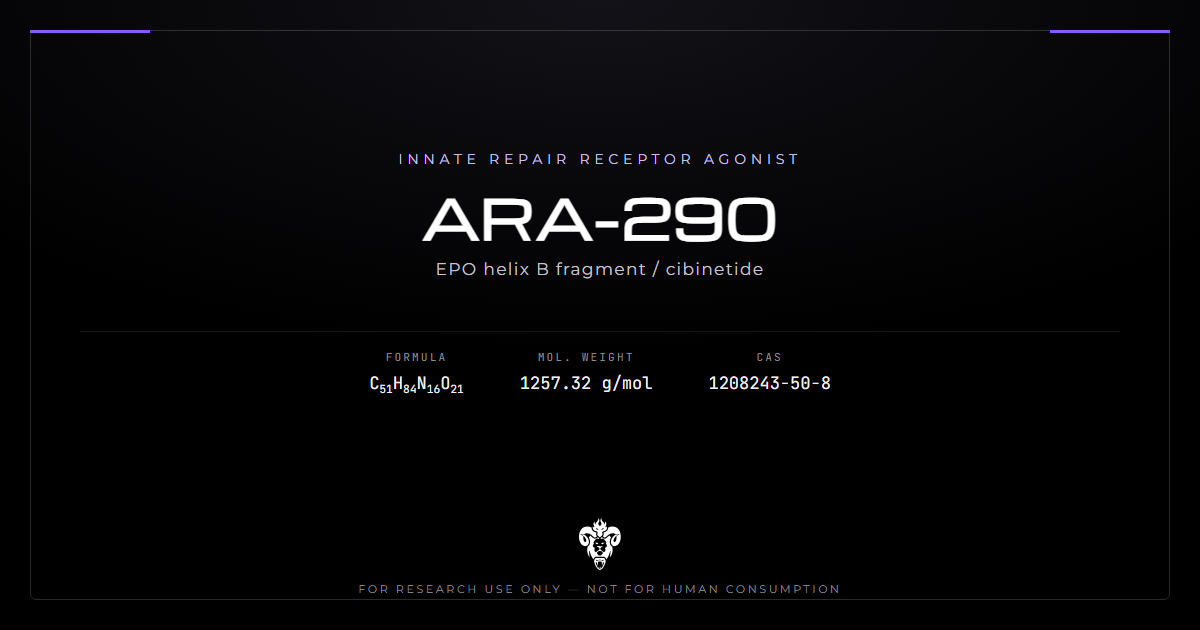
Everything below reports findings from cell cultures, isolated tissue and animals. This material is for research use only, not for human or veterinary use. ARA-290 is the peptide name this profile uses.
Erythropoietin engages more than one receptor assembly. The classical homodimer drives red-cell production. A different pairing, the erythropoietin receptor plus the beta-common receptor, is the innate repair receptor.
ARA-290 is the attempt to keep the second assembly and discard the first. It is an eleven-residue peptide taken from the helix B surface of erythropoietin [1]. Indexed clinical papers exist [1][3] and [4]. Those human endpoints sit outside this profile.
The useful laboratory questions are the excerpt, the pyroglutamate, receptor selectivity, and what animal systems measured.
Chemical identity
Eleven residues, an unusually explicit fragment of a much larger protein.
| Property | Value |
|---|---|
| Common names | ARA-290, cibinetide, pHBSP, PH-BSP |
| Molecular formula | C51H84N16O21 |
| Molecular weight | 1257.3 |
| CAS | 1208243-50-8 |
| PubChem CID | 91810664 |
| InChIKey | WZTIQQBMSJTRBR-WYKNNRPVSA-N |
Kimera supplies the material as ARA-290.
What pHBSP stands for, and why it matters
Pyroglutamate helix B surface peptide. Every word is load-bearing.
Helix B names the region of erythropoietin it comes from. Surface narrows that to the solvent-facing face, the part available to touch a receptor. Pyroglutamate is a modification at the N-terminus, a cyclised glutamine that blocks aminopeptidase attack.
So the name is a design specification rather than a label. Chemists reasoned this molecule into existence rather than finding it, and the name records that.
A fragment, not an analogue
Most engineered peptides in this catalogue modify a natural sequence. This one excerpts it: a surface patch lifted out of a 165-residue glycoprotein.
That distinction predicts the pharmacology. A fragment cannot reproduce interactions that depend on the whole fold, which is precisely the point when one of those interactions is the one you want to lose.
Why eleven residues is a verification gift
At this length tandem mass spectrometry covers the chain in one run. Deletion sequences shift mass by a whole residue. The pyroglutamate is a 17-dalton check against the open glutamine form.
A 165-residue glycoprotein does not give those gifts. ARA-290 does, because the designers cut it down to a surface peptide.
How pyroglutamate forms and why it stays
Glutamine at the N-terminus can cyclise to pyroglutamate, losing ammonia. The mass drop is 17 Da. Solid-phase synthesis can install the residue already cyclised, or leave an open glutamine that cyclises later in storage.
An open-glutamine lot is a different reagent. Aminopeptidases clip it. The published work used the blocked form. Intact mass is the check that the block is present.
Two other residues on the short chain need watching. Asparagine can deamidate. The C-terminus is a free acid on this peptide, unlike many catalogue amides, so a failed amidation is not the first failure mode here. The first failure mode is the missing ring.
Two receptors, and the whole design rests on the difference
Erythropoietin signals through more than one receptor arrangement, and they do different jobs.
The homodimer makes red cells
The classical erythropoietin receptor works as a homodimer, and that assembly drives erythropoiesis. Engaging it raises haematocrit in systems that still have that axis. The homodimer is also what the fragment was built to miss.
The heterodimer is the intended contact
Tissue-protection papers assign the second job to a different assembly, pairing the erythropoietin receptor with the beta-common receptor. That pairing forms the innate repair receptor, and ARA-290 targets it selectively [1].
A 2024 mouse study made the dependence explicit, examining neuroprotection after middle cerebral artery occlusion and measuring both receptors by western blot [2]. It attributes the brain tissue protection to the beta-common receptor.
Why selectivity is the entire design
If ARA-290 engaged the homodimer, it would have no reason to exist as a separate reagent. Erythropoietin already does that job, more potently.
Read every study with that in mind. Blood parameters are not an incidental measurement here. They are the test of whether the design premise holds.
Indexed papers and what they do not decide
Indexed clinical papers exist for ARA-290 [1][3] and [4]. Human endpoints from those papers sit outside the scope of this profile.
What the citations are for
The diabetes programme report is [1]. The sarcoidosis programme report is [3]. Macular-edema work sits at [4]. Use those citations to find the record. Do not use this page as a use document.
A development programme and those indexed papers do not turn a helix B fragment into a laboratory dosing recipe. Identity, receptor assembly and animal systems remain the useful questions.
What a laboratory can take from the paper trail
The papers confirm that a defined eleven-mer entered formal study under more than one name. They do not prove that a research-grade lot matches any historical clinical lot. They do not replace a haematocrit check in an animal system that still has an erythropoietic axis.
The preclinical range
Published work covers an unusually wide set of tissues, all consistent in direction.
| System | Model | What moved |
|---|---|---|
| Brain | Mouse MCAO | Tissue protection via beta-common receptor [2] |
| Retina | Ischaemic retina, ECFCs | Vasoreparative potential up [5] |
| Nerve | Review of EPO-derived peptides | Peripheral-injury literature [6] |
| Immune | Lupus mice | Disease readouts down [7] |
| Kidney / HUS | Mouse HUS | Innate-repair-receptor axis [8] |
| Heart | Ageing / inflammation models | Cardiac inflammation down [9] |
| Islets | Isolated human islets | Stress survival and engraftment [10] |
| Bone | In vitro osteoclasts; mice | Osteoclastogenesis down, BMD up [11] |
| Vasculature | Rat preeclampsia | Endothelial dysfunction corrected [12] |
Neurological and vascular
Stroke, through the beta-common receptor [2]. Retinal repair, where the peptide enhanced the vasoreparative potential of endothelial colony-forming cells in ischaemic retina [5]. Peripheral nerve injury, reviewed alongside other erythropoietin-derived peptides [6].
Immune and metabolic
Systemic lupus erythematosus in mice [7]. Haemolytic-uraemic syndrome, targeting the same receptor axis [8]. Cardiac inflammation and age-associated decline in heart function [9].
Other tissues
Isolated human islets under stress, with improved engraftment in the context of intraportal transplantation [10]. Osteoclastogenesis inhibited in vitro with increased bone mineral density in mice [11]. Endothelial dysfunction corrected in a rat preeclampsia model [12].
Reading that breadth
The same caution applies as to any compound with this pattern: uniform benefit across unrelated models is either a receptor that matters everywhere or a literature that publishes positives. Here the receptor argument carries more weight than usual, because the innate repair receptor really is widely distributed and the designers specified the mechanism before anyone ran the models.
It is still worth noting that no published model reports harm on the erythropoietic axis the designers set out to miss.
The islet result is the one to watch
Of the preclinical set, the islet transplantation work has the clearest bounded exposure [10]. Isolated human islets die in transit and during engraftment. That loss is a known bottleneck in transplantation rather than a hypothesis.
A tissue-protective agent applied to isolated tissue, before it enters a recipient, also bounds the experiment. The exposure is on the isolated preparation. The endpoint is countable.
Bone is the least expected
Inhibiting osteoclastogenesis in vitro and raising bone mineral density in mice [11] sits furthest from anything the design anticipated. Osteoclasts derive from the same myeloid lineage the innate repair receptor sits on, so a mechanism exists, but nobody set out to find it.
Unexpected findings from a specified mechanism are worth more than expected ones. They are harder to produce by looking for what you hoped to see.
What the animal file actually constrains
The stroke paper measured both receptor proteins by western blot [2]. That is the cleanest target-dependence result in the set. The retinal paper used endothelial colony-forming cells in ischaemic retina [5]. That is a cell-plus-tissue system, not a whole-animal behaviour score.
Lupus and HUS papers put the same receptor axis in immune and renal injury [7][8]. Cardiac ageing work adds a time-on-study variable [9]. None of those papers substitutes for a haematocrit line in the methods.
The bone paper is the odd one out because nobody designed ARA-290 for osteoclasts [11]. Myeloid lineage expression of the innate repair receptor is the post-hoc route. Treat it as a hypothesis generator, not as a second indication.
Preeclampsia work in rats is endothelial [12]. Islet work is isolated tissue [10]. Keep those labels on the notebook page. Mixing them into one “repair” sentence is how this literature gets over-read.
Why the parent hormone is a poor substitute
The compound only makes sense against the protein it came from, and that history is worth stating as chemistry.
The tissue-protection observation was real
Erythropoietin protects tissue in a long list of injury models. That observation drove later fragment work, because a hormone already manufactured looked like a shortcut to a selective reagent.
The homodimer is the problem the fragment solves
Raising red-cell mass is an on-target effect of the classical receptor. Nothing needs to contaminate the preparation. No off-target receptor needs to be involved. The intact hormone simply does two things.
Two options existed. Dose the parent low enough to miss erythropoiesis, which no one could make reliable. Or build something that engages one receptor assembly and not the other.
ARA-290 is the second option. Reading it as “a small EPO” misses the point entirely: the smallness is incidental, and the selectivity is the entire product.
What a fragment can and cannot inherit
Excerpting eleven residues from a 165-residue glycoprotein has consequences that run in both directions.
What it keeps
Enough of the helix B surface to engage the beta-common receptor pairing [2]. That is the one interaction the design needed, and the published receptor work supports it.
What it loses
Everything requiring the intact fold, the glycosylation, or the parts of the surface that assemble the erythropoietic homodimer. Losing that last one is the objective rather than a compromise.
It also loses the protein’s glycan-slowed clearance. An eleven-residue peptide has none of that. Indexed papers that mention people used daily schedules [1][3] and [4]. Those schedules are not a laboratory recipe.
What that means for a bench comparison
Running erythropoietin and ARA-290 side by side is a reasonable experiment and an easy one to misread. They differ in receptor selectivity, in half-life, and in molar potency at once.
A dose that matches on one axis will mismatch on the others. Any comparison needs to state which axis it matched.
One study proposes a mechanism distinct from tissue repair: relief of pathophysiological pain by targeting the TRPV1 channel, framed as an integration between immune signalling and nociception [13].
If correct, that would give the compound two routes rather than one, and they would be separable experimentally. Nobody appears to have separated them.
A tissue-repair mechanism predicts structural recovery that outlasts exposure. A channel-level mechanism predicts a readout that stops when exposure stops. Animal designs can separate those. This profile does not quote human endpoints from the papers that tried [1][3].
How to read an ARA-290 study
Four questions, and the first is specific to this compound.
Were blood parameters measured?
The entire premise is tissue protection without erythropoiesis. A study that does not report haematocrit or red cell indices has not tested the premise, whatever else it measured. The stroke study did measure them [2].
Which receptor assembly?
Effects attributed to the innate repair receptor need the beta-common receptor demonstrated, not assumed [2].
Which species and tissue?
Stroke brain [2], ischaemic retina [5], lupus mice [7], islets [10] and bone [11] are different systems. Read-across between them is a claim that needs its own experiment.
Was the pyroglutamate confirmed?
An uncyclised batch weighs 1274.3 and is not ARA-290. A paper that names the peptide without a mass has not closed identity.
Verifying research material
ARA-290 is a defined chemical entity with published identifiers, so verification is arithmetic rather than judgement. Batch documentation sits on the certificates of analysis page.
Identity
Formula C51H84N16O21, molecular weight 1257.3, InChIKey WZTIQQBMSJTRBR-WYKNNRPVSA-N. The name lookup in PubChem resolves to a stereo-defined record here, which is not true of every peptide in this catalogue.
The pyroglutamate is the check to insist on
The N-terminal pyroglutamate is a cyclised glutamine, and cyclisation costs 17 daltons against the uncyclised form. A preparation that failed to cyclise weighs 1274.3 and is not ARA-290.
High-resolution instruments resolve that difference easily. Nominal-mass instruments miss it. It also matters functionally rather than cosmetically: the modification exists to resist aminopeptidase, so an uncyclised batch has a different stability profile from the one every published study used.
Handling
Eleven residues with no cysteine, so disulfide scrambling is not a concern. Ordinary peptide practice applies.
Store the lyophilised powder cold, dry and dark, and reconstitute close to the point of use.
Storage guidance is a house recommendation. Analytical documentation is per-lot release testing.
Compare with Thymosin Alpha-1, a much larger immunomodulatory peptide, and LL-37, where the residue composition creates different problems.
At eleven residues the synthesis is short enough that deletion sequences are a minor worry rather than the dominant one. Ten coupling steps leaves far less room for accumulation than the twenty-seven a 28-residue peptide requires, so a stated purity figure means more here than it does at that length.
Peptide content still differs from HPLC area percent. Lyophilised material carries water and counterion. Acetate and trifluoroacetate both appear on research lots. Trifluoroacetate can move cell readouts at high residual levels, so the salt form belongs on the certificate next to the free-base mass.
Related helix-family reagents are not substitutes. Erythropoietin is the 165-residue glycoprotein. ARA-290 is the surface excerpt. A vial labelled with the parent mass is not this peptide. Related work on short immunomodulatory chains sits beside Thymosin Alpha-1 and LL-37, which fail by different routes.
A second identity trap is the synonym list. Cibinetide, pHBSP and PH-BSP all point at the same eleven-mer. A search on one string misses papers filed under another. Run all four names before calling the literature thin. The PubChem record is the shortest way to lock the structure once the names diverge. Write the mass 1257.3 next to the lot number before the first assay. That one line keeps an uncyclised 1274.3 contaminant from inheriting every later notebook entry.
Common questions about ARA-290
Identity and design
What is cibinetide? The same compound. Cibinetide is the international nonproprietary name; pHBSP and ARA-290 both appear in the literature.
What does pHBSP mean? Pyroglutamate helix B surface peptide, which is a design description: the solvent-facing surface of erythropoietin’s helix B, with a cyclised N-terminal glutamine.
Is it an erythropoietin analogue? A fragment rather than an analogue. It excerpts a surface region from the 165-residue protein instead of modifying the whole thing.
Does it raise haematocrit? Not by design. Selectivity for the innate repair receptor over the erythropoietic homodimer is the reason the compound exists [1].
Evidence
Does this page report human outcomes? No. Indexed clinical papers are listed so they can be found [1][3] and [4]. This profile stops at identity, receptor chemistry and animal systems.
What does it do in animals? Preclinical work spans stroke, retina, lupus, cardiac ageing, islet transplantation, bone and preeclampsia.
Why not just use erythropoietin? Because the homodimer and the heterodimer are different assemblies. The fragment exists to miss the first.
Is there a second mechanism? One study proposes TRPV1 involvement [13], separable in principle from tissue repair. Nobody has separated them.
Handling and verification
What mass should a batch return? 1257.3. A result near 1274.3 indicates a failed N-terminal cyclisation, which is a different compound with a different stability profile.
Why does the pyroglutamate matter functionally? It blocks aminopeptidase attack. An uncyclised batch degrades on a different timescale from the material every published study used.
Does it need disulfide handling? No cysteine in the sequence, so scrambling is not a concern.
Does PubChem resolve it correctly by name? Yes, unusually. The name lookup returns a stereo-defined record, which is not true across this catalogue.
How many residues? Eleven, excerpted from a 165-residue glycoprotein rather than modified from it.
Summary of the evidence
Identity: eleven residues, C51H84N16O21, 1257.3 Da, pyroglutamate at the N-terminus, CAS 1208243-50-8.
Design: a helix B surface excerpt built to engage the innate repair receptor and miss the erythropoietic homodimer [1].
Receptor: mouse stroke work attributes tissue protection to the beta-common receptor [2]. Haematocrit remains the premise check in any system that still has an erythropoietic axis.
Animal range: stroke, retina, lupus, HUS, cardiac ageing, islets, bone and a rat preeclampsia model.
Second mechanism: one TRPV1 paper exists [13]. Nobody has separated that route from receptor-assembly work.
Indexed record: clinical papers are listed so they can be found [1][3] and [4]. This profile does not quote human endpoints from them.
The rest of the peptide literature sits in the peptides category.
Status: supplied for laboratory research use only.
References
- Brines M, Dunne AN, van Velzen M, Proto PL, Ostenson CG, Kirk RI, Petropoulos IN, Javed S, et al. ARA 290, a nonerythropoietic peptide engineered from erythropoietin, improves metabolic control and neuropathic symptoms in patients with type 2 diabetes. Mol Med. 2015;20(1):658-66. PMID 25387363. DOI
- Wang RL, Yang ZH, Huang YY, Hu Y, Wang YL, Yan F, Zheng YM, Han ZP, et al. Erythropoietin-derived peptide ARA290 mediates brain tissue protection through the β-common receptor in mice with cerebral ischemic stroke. CNS Neurosci Ther. 2024;30(3):e14676. PMID 38488446. DOI
- Culver DA, Dahan A, Bajorunas D, Jeziorska M, van Velzen M, Aarts LPHJ, Tavee J, Tannemaat MR, et al. Cibinetide Improves Corneal Nerve Fiber Abundance in Patients With Sarcoidosis-Associated Small Nerve Fiber Loss and Neuropathic Pain. Invest Ophthalmol Vis Sci. 2017;58(6):BIO52-BIO60. PMID 28475703. DOI
- Lois N, Gardner E, McFarland M, Armstrong D, McNally C, Lavery NJ, Campbell C, Kirk RI, et al. A Phase 2 Clinical Trial on the Use of Cibinetide for the Treatment of Diabetic Macular Edema. J Clin Med. 2020;9(7). PMID 32674280. DOI
- O’Leary OE, Canning P, Reid E, Bertelli PM, McKeown S, Brines M, Cerami A, Du X, et al. The vasoreparative potential of endothelial colony-forming cells in the ischemic retina is enhanced by cibinetide, a non-hematopoietic erythropoietin mimetic. Exp Eye Res. 2019;182:144-155. PMID 30876881. DOI
- Liu G, Liang J, Li W, Jiang S, Song M, Xu S, Du Q, Wang L, et al. The protective effect of erythropoietin and its novel derived peptides in peripheral nerve injury. Int Immunopharmacol. 2024;138:112452. PMID 38943972. DOI
- Huang B, Jiang J, Luo B, Zhu W, Liu Y, Wang Z, Zhang Z. Non-erythropoietic erythropoietin-derived peptide protects mice from systemic lupus erythematosus. J Cell Mol Med. 2018;22(7):3330-3339. PMID 29570934. DOI
- Dennhardt S, Pirschel W, Wissuwa B, Imhof D, Daniel C, Kielstein JT, Hennig-Pauka I, Amann K, et al. Targeting the innate repair receptor axis via erythropoietin or pyroglutamate helix B surface peptide attenuates hemolytic-uremic syndrome in mice. Front Immunol. 2022;13:1010882. PMID 36211426. DOI
- Winicki NM, Nanavati AP, Morrell CH, Moen JM, Axsom JE, Krawczyk M, Petrashevskaya NN, Beyman MG, et al. A small erythropoietin derived non-hematopoietic peptide reduces cardiac inflammation, attenuates age associated declines in heart function and prolongs healthspan. Front Cardiovasc Med. 2022;9:1096887. PMID 36741836. DOI
- Yao M, Domogatskaya A, Ågren N, Watanabe M, Tokodai K, Brines M, Cerami A, Ericzon BG, et al. Cibinetide Protects Isolated Human Islets in a Stressful Environment and Improves Engraftment in the Perspective of Intra Portal Islet Transplantation. Cell Transplant. 2021;30:9636897211039739. PMID 34498509. DOI
- Awida Z, Bachar A, Saed H, Gorodov A, Ben-Califa N, Ibrahim M, Kolomansky A, Iden JA, et al. The Non-Erythropoietic EPO Analogue Cibinetide Inhibits Osteoclastogenesis In Vitro and Increases Bone Mineral Density in Mice. Int J Mol Sci. 2021;23(1). PMID 35008482. DOI
- Korokin M, Gureev V, Gudyrev O, Golubev I, Korokina L, Peresypkina A, Pokrovskaia T, Lazareva G, et al. Erythropoietin Mimetic Peptide (pHBSP) Corrects Endothelial Dysfunction in a Rat Model of Preeclampsia. Int J Mol Sci. 2020;21(18). PMID 32942669. DOI
- Zhang W, Yu G, Zhang M. ARA 290 relieves pathophysiological pain by targeting TRPV1 channel: Integration between immune system and nociception. Peptides. 2016;76:73-9. PMID 26774587. DOI
ARA-290 is sold for laboratory research use only. Not for human consumption, nor medical, veterinary, or household uses.