
Most research compounds arrive with a thin literature and a hopeful mechanism. Bemethyl arrives with the opposite problem: roughly fifty years of documented use — cosmonauts, Olympic team preparation, army deployments, disaster response — and almost none of it readable outside Russian. A 2021 systematic search of PubMed returned 94 records for the compound, of which 14 were in English, and zero were randomized controlled trials [1].
That asymmetry is the single most important thing to understand before working with the material. It is not an obscure molecule. It is a well-characterized molecule whose characterization sits largely in a literature most reviewers cannot read or independently appraise. This profile covers what bemethyl is, the mechanism the primary literature actually proposes, what its metabolism looks like, where the evidence is genuinely thin, and the analytical problems specific to this scaffold — useful grounding for anyone working in the broader nootropics research space.
What Is Bemethyl?
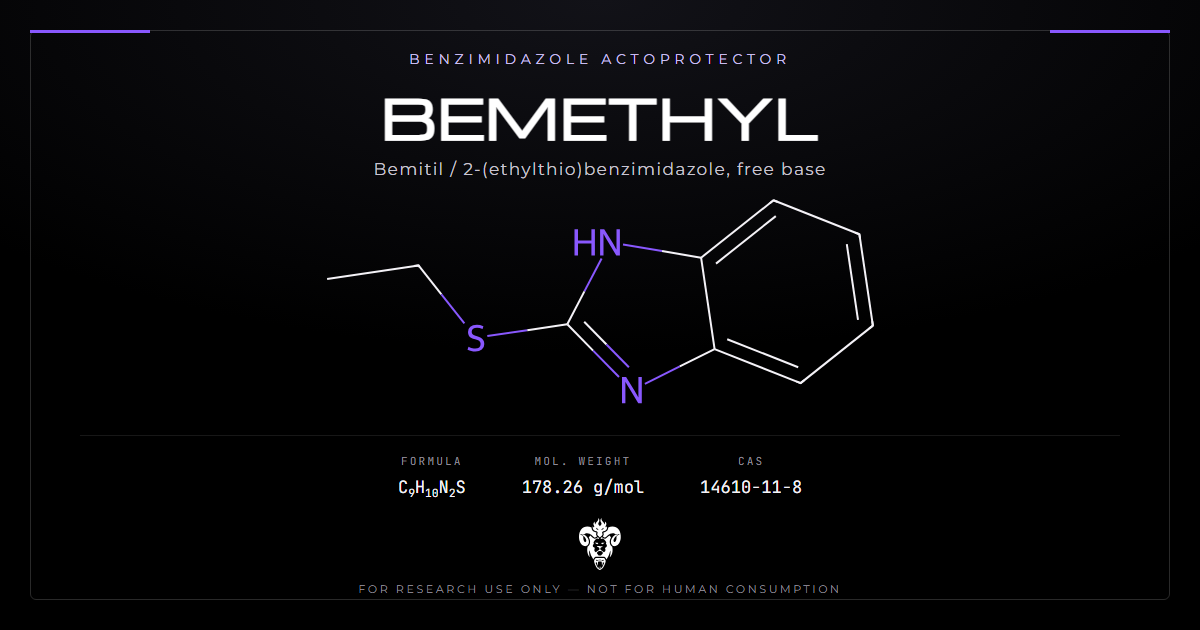
Bemethyl is 2-(ethylsulfanyl)-1H-benzimidazole — a benzimidazole core carrying an ethylthio group at the 2-position. It appears in the literature under an unusually large number of names: bemitil, bemithyl, bemithil, bemythyl, metaprot, bemactor, and the Ukrainian supplement designation Antihot.
The identifiers depend on which form you mean, and this matters more than it usually does:
| Form | Formula | Molar mass | CAS | PubChem |
|---|---|---|---|---|
| Free base | C₉H₁₀N₂S | 178.26 g/mol | 14610-11-8 | CID 720878 |
| Hydrobromide (anhydrous) | C₉H₁₁BrN₂S | 259.17 g/mol | 109628-14-0 | CID 9816609 |
| Hydrobromide monohydrate | C₉H₁₃BrN₂OS | 277.19 g/mol | — | — |
The pharmaceutical substance described in the Russian literature is the hydrobromide monohydrate. Suppliers, meanwhile, quote all three interchangeably, and some list CAS 63513-71-3 for the salt as well. The section on analytical verification below returns to why this is not a pedantic point.
The compound was developed through the 1970s under Professor Vladimir Vinogradov in the Department of Pharmacology at the Military Medical Academy in Leningrad, work that earned the team a State Prize of the USSR [2]. Its first recipients were Soviet cosmonauts. It was subsequently used in preparing the USSR national team for the 1980 Moscow Olympics, deployed across the Soviet and later Russian armed forces through the 1990s, and issued to rescue and cleanup workers after the Chernobyl catastrophe in 1986, the Armenian earthquake of 1988, and the Bashkiria rail disaster of 1989 [2]. Official manufacture lapsed with the dissolution of the USSR in 1991 and later resumed in Ukraine. Kimera supplies research-grade bemethyl in powder and capsule formats for laboratory investigation.
What “Actoprotector” Actually Means
Bemethyl is the reference compound for a pharmacological class that has no clean English-language equivalent. Actoprotectors are defined as preparations that increase the body’s stability against physical loads without increasing oxygen consumption or heat production [2]. Oliynyk and Oh render the shorter definition as “synthetic adaptogens with a significant capacity to increase physical performance.”
The negative definitions are more useful than the positive one:
- Not psychostimulants. Caffeine, modafinil, and sydnocarb are agents of exhaustive action — they draw on reserves. Under hypoxia or heat, their benefit under normal conditions can invert into a deficit because they raise heat production and oxygen consumption. Actoprotectors are described as non-exhaustive by design.
- Not nootropics. Nootropics act primarily on mental work capacity. Actoprotectors are claimed to act on both, but primarily on physical.
- Not quite adaptogens. The class boundary here is genuinely contested. The review authors concede that the separation was driven by the practical requirements of military medicine rather than clean theory, and note that related benzimidazoles — dibazol, levamisole, afobazole — are adaptogens whose effect on physical work capacity is absent or minimal, and therefore do not qualify.
The class is grouped by chemistry: benzimidazole derivatives (bemitil, ethomersol), adamantane derivatives (bromantane, chlodantane, ademol), and a scattered third group including thiazoloindoles, 3-hydroxypyridines, and several natural products.
One characteristic of the class is worth flagging for experimental design: the effect is reported to be largest in subjects with low or middle resistance to the extreme condition being studied, and close to absent in high-resistance subjects [2]. Baseline stratification is therefore not optional in a model built around this compound.
Bemethyl Mechanism of Action
The proposed mechanism is unusual in that it is not receptor-mediated. Bemethyl has minimal conventional pharmacological activity, which is precisely why the class was difficult to place.
Genome Activation and Protein Synthesis
The central claim is that bemethyl activates the cell genome and exerts a positive modulating effect on protein synthesis — amplifying expression of RNA and proteins, particularly enzymes of gluconeogenesis and oxidative phosphorylation [2][3]. The structural rationale offered is that benzimidazole actoprotectors resemble the purine bases adenine and guanine.
The load-bearing experiment is a negative one: administration of the transcription inhibitor actinomycin D abolishes the protective effect of bemethyl under both normal and hypoxic conditions [2]. Notably, the review authors are careful to state that bemethyl probably does not induce RNA and protein synthesis by itself, but modulates naturally occurring synthesis — and that the concrete mechanism of that modulation remains unknown. That caveat has stood for over a decade and has not been closed.
The effect is described as first expressed in organs with short-lived, rapidly renewable protein pools: liver, kidney, and alimentary tract.
Gluconeogenesis and Lactate Handling
Under heavy physical load, the reported signature is a modest fall in liver and muscle glycogen and blood glucose, lower lactate accumulation in tissue and blood, and smaller rises in heat production and oxygen consumption — followed by accelerated recovery, with some parameters overshooting into supercompensation [2].
The proposed link is glucose resynthesis from lactate and pyruvate, from glycerol, and from amino acids, occurring chiefly in liver and kidney cortex and coupled to the Cori and glucose-alanine cycles. Here too the pivotal evidence is inhibitor-based: the gluconeogenesis inhibitor tryptophan cancels the actoprotective effect.
Direct enzyme-level work exists in an indexed English-language journal. In CCl₄-induced cirrhotic rat liver, total hepatocyte glycogen rose roughly threefold and its stable fraction 7.5-fold, while glucose-6-phosphatase activity fell to 25% of normal. Bemithyl reduced total glycogen content, decreased glycogen synthase activity, and increased both glucose-6-phosphatase and glycogen phosphorylase activity [4]. That is a coherent pattern — pushing hepatic carbohydrate handling toward output rather than storage.
Mitochondrial Capacity and Antihypoxic Activity
Enhanced synthesis of mitochondrial enzymes and structural proteins is proposed to raise energy production and preserve coupling between oxidation and phosphorylation. Maintaining ATP synthesis under oxygen deficit is the stated basis of the antihypoxic and anti-ischemic activity [2]. Researchers working with mitochondrial-support tool compounds will recognize the measurement logic.
Indirect, Not Direct, Antioxidant Action
This distinction is frequently mangled in secondary write-ups. Bemethyl has no direct antiradical properties. Its antioxidant action is attributed entirely to induced synthesis of antioxidant enzymes — superoxide dismutase, catalase, glutathione-metabolizing enzymes [2].
The cleanest demonstration used a pressure-chamber hypoxia model. Rats were “elevated” to a simulated altitude of 8,000–11,000 m for 30 minutes; bemithyl at 25 mg/kg i.p., given 30 minutes beforehand, prevented the fall in reduced glutathione and SH group content and blunted the drop in glutathione reductase and glutathione peroxidase activity. Inhibition analysis with actinomycin D established that the protective action depended on enhanced synthesis of those antioxidant enzymes rather than on the compound scavenging anything itself [5].
If a protocol is designed around a radical-scavenging assay, bemethyl will look inert. The claimed effect requires an intact transcriptional and translational apparatus and a time course long enough for enzyme induction.
The Fatigue-Phase Signature
The most useful single result for anyone designing an experiment comes from a multifactorial mouse work-capacity method. Comparing bemitil against the psychostimulant sydnocarb, the psychostimulant raised work capacity across all measured criteria by roughly 10–20%. Bemitil did something structurally different: it decreased the starting intensity of work, left work volume unchanged until intensity had fallen to 50% of control, then increased maximal work volume performed by about 33% and resistance to fatigue by about 60% [2][6].
In other words, the maximum effect appears in the considerable-fatigue phase. A study designed around fresh, unfatigued animals and short exertion windows is measuring the part of the curve where bemethyl looks worst. This also explains a second reported feature: under course administration, the effect builds over the first 3–5 days and then plateaus, rather than presenting acutely.
Bemethyl vs Bromantane
The two compounds are routinely mentioned in the same breath as the only actoprotectors that reached practical administration. They are not interchangeable.
| Bemethyl (bemitil) | Bromantane | |
|---|---|---|
| Chemical class | Benzimidazole | Adamantane |
| Proposed primary mechanism | Genome activation; gluconeogenesis and mitochondrial enzyme synthesis | Dopaminergic activation; GABAergic modulation |
| Onset profile | Builds over 3–5 days of course dosing | Single-dose effects reported |
| Elimination | Rapid; parent is a minor urinary species | Slow; metabolites reported in urine at ~2 weeks |
| Anti-doping status | Monitoring Program — not prohibited | Prohibited in sport since the late 1990s |
The pharmacokinetic contrast is the practically important one. Bromantane is highly lipophilic and deposits in adipose tissue, which is why its detection window is measured in weeks [2]. Bemethyl clears fast.
Pharmacokinetics and Metabolism
Bemethyl is fully absorbed from the alimentary tract — absorption is accelerated by carbohydrate-rich food — and crosses the blood-brain barrier [2][7]. Rat work found biexponential elimination after both intravenous and oral administration, with maximum concentration reached within one hour [8].
Three numbers define the analytical problem this compound poses:
- Unchanged bemethyl accounted for only 0.56% of total excreted drug in rats [8].
- In human volunteers, unchanged drug exceeded 4 ng/mL in plasma for no longer than 10 hours after a single dose [3].
- Doping-control work detected parent bemethyl in volunteer urine to 58 hours and its glucuronide to 78 hours [9].
A 2021 study closed much of the metabolic gap. Working with 24-hour rat urine after a single 330 mg/kg intragastric dose — deliberately far above therapeutic exposure, chosen to surface detoxification products rather than to model pharmacokinetics — investigators identified nine metabolites across six molecular formulas by LC–MS/HRMS combined with in silico prediction [3].
The findings that matter for anyone characterizing this material:
The most abundant metabolite was a benzimidazole–N-acetylcysteine conjugate. That is the classic mercapturic acid pathway, associated with xenobiotic detoxification rather than with pharmacological activity.
S-oxidation is the gateway. Molecular docking into glutathione S-transferase alpha 1 showed that bemethyl itself sits 5.72 Å from the glutathione sulfur — too far for nucleophilic attack at C2. The sulfoxide (3.65 Å) and sulfone (3.83 Å) sit close enough, stabilized by a hydrogen bond to Arg15. Oxidation of the sulfur therefore appears to be a prerequisite for phase II conjugation. Sequence alignment indicated the rat findings extrapolate to the human enzyme.
Multiple CYPs are involved. BioTransformer implicated CYP1A2, CYP2A6, CYP2B6, CYP2C9, CYP2C19, and CYP3A4 across the oxidation steps — a broad, non-selective profile with obvious implications for co-administration studies.
Metabolite M1 is 2-thiobenzimidazole, present as a thione/thiol tautomer pair. Hold that thought.
The authors also propose that bemethyl’s antioxidant potential is most likely tied to its own sequential oxidation to sulfoxide and sulfone under oxidative-stress conditions — a mechanism distinct from, and additional to, the enzyme-induction account in the older literature.
What the Bemethyl Literature Does Not Show
Honest sourcing means stating the gaps plainly, and here they are structural rather than incidental.
There are no randomized controlled trials. A 2021 systematic search found 94 PubMed records, 14 in English, four matching sports-performance keywords, one narrative review, zero meta-analyses or systematic reviews, and zero RCTs [1].
The performance literature is largely unappraisable. Performance enhancement has been demonstrated in animal studies [6][10]. The human claims trace to publications in Russian which the reviewing authors characterized as containing serious methodological flaws and not complying with modern scientific practice standards [1]. This is not a language-snobbery objection — it is that the studies cannot be independently evaluated by most readers and, where they can, do not hold up.
Detection methods are newer than the compound’s reputation. Validated LC-MS/MS urinary detection was published only in 2018 [9], which is why claims about prevalence of use rest on unofficial reporting rather than data.
Adverse-effect characterization is thin and dated. The reported profile is dyspeptic disturbance — nausea, particularly on an empty stomach — psychoactivation effects including irritability and shortened or degraded sleep, headache, and facial hyperemia. Allergic reactions attributable to the bromide counterion are noted as not excludable, and the compound is listed as contraindicated under hypoglycemia and with barbiturates [2]. None of this comes from a modern safety database.
The antimutagenicity data are interesting but old. Bemitil failed to induce recessive lethals in Drosophila, dominant lethals in mammalian germ cells, or chromosomal damage in murine bone marrow and human peripheral blood cultures, and produced a roughly twofold reduction in aberrant cells induced by alkylating agents [11]. Anticlastogenic activity against chrysotile-asbestos and zeolite dusts was reported separately. These are 1980s–1990s findings that have not been replicated with contemporary methods.
Regulatory and Anti-Doping Status
Bemethyl has no FDA approval and no marketing authorization in the United States. It is unscheduled. In Russia it has held over-the-counter status, with manufacturer indications covering fatigue, asthenic conditions, and recovery after stroke and traumatic brain injury [1]. In Ukraine it is certified as a dietary supplement rather than a drug.
For sport, bemethyl sits on WADA’s Monitoring Program, not the Prohibited List. The distinction is substantive: monitored substances are not prohibited and carry no sanction, but WADA tests for them across collected samples to detect patterns of misuse, and the data may inform future listing decisions. Sources differ on the entry year — the metabolism literature states 2018 [3], while the anti-doping review states 2019 [1]. The Monitoring Program is reissued annually, so current-year status should be checked against WADA’s published document rather than assumed from any secondary source, including this one.
The precedent that makes this category worth watching is meldonium, which moved from the Monitoring Program to the Prohibited List after a single year of monitoring. Whether bemethyl follows is unresolved; the same review argues the evidentiary basis for several such moves has been weak.
Analytical Verification and Handling
This scaffold carries three specific verification problems that a generic purity number does not address.
The Mass-Basis Problem
Bemethyl is supplied as a free base, an anhydrous hydrobromide, or a hydrobromide monohydrate. The free base accounts for 68.8% of the mass of the anhydrous salt and 64.3% of the monohydrate. A material sold on a salt basis and a material sold on a free-base basis differ by nearly a third in active content, and the two salt hydrates differ from each other by 4.5 percentage points.
An HPLC purity figure does not resolve this, because chromatographic purity says nothing about counterion stoichiometry or water content. The orthogonal checks are straightforward: bromide should constitute 30.8% of the mass of the anhydrous salt, which ion chromatography or argentometric titration can confirm directly, while Karl Fischer titration resolves the hydrate question. Elemental analysis settles both at once. Any documentation that quotes a molecular weight without naming the form should be treated as incomplete.
For reference on what “high purity” realistically means for this compound: the pharmacopeial substance used in the 2021 metabolism study (FS 42-2525-88) was characterized at 97% main substance by NMR [3].
The Precursor Problem
Bemethyl is made by S-alkylation of 2-mercaptobenzimidazole. An incomplete reaction therefore leaves residual 2-mercaptobenzimidazole — which is also, independently, metabolite M1 of bemethyl itself [3].
This residue is not pharmacologically inert. 2-Mercaptobenzimidazole is a thioureylene compound with documented antithyroid activity; in a 14-day rat gavage comparison measuring serum T3, T4, TSH, and thyroid weight, its antithyroid effect was more potent than either thiourea or ethylenethiourea, both established antithyroid agents [12]. Repeated-dose and inhalation studies report increased thyroid weight and follicular cell hyperplasia [12].
There is a further wrinkle worth noting for anyone designing antioxidant-endpoint work. Bemethyl’s proposed antioxidant action runs through induction of superoxide dismutase and catalase. 2-Mercaptobenzimidazole has been reported to bind and inhibit both catalase and Cu/Zn superoxide dismutase in vitro [13]. Nobody has reconciled the parent’s indirect induction with the desethyl species’ direct inhibition. A lot carrying appreciable residual precursor may therefore not behave like a clean lot on exactly the endpoint the compound is best known for.
The practical consequence: a purity assay for this compound needs to specifically resolve and quantify 2-mercaptobenzimidazole, not fold it into a generic “total impurities” figure.
The Oxidation Problem
The metabolic route to sulfoxide and sulfone is also an air-oxidation route. Thioethers oxidize on storage, and the same two species that appear as metabolites are the expected degradants. A stability-indicating method — one that separates parent from sulfoxide and sulfone — is the right specification here, and dry, well-sealed storage at controlled room temperature with minimal headspace is the sensible default. Storage guidance is a house recommendation. Analytical documentation is per-lot release testing. Bemethyl’s poor water solubility, incidentally, is the reason the water-soluble analog ethomersol was developed in the late 1980s for parenteral use [2]; it should inform solvent selection.
Every Kimera lot ships with third-party COA verification, and results are published openly in our public COA archive. Reviewers can check identity and purity data for the current lot before ordering bemethyl.
Frequently Asked Questions
What is bemethyl? Bemethyl, also called bemitil, is 2-(ethylsulfanyl)-1H-benzimidazole — a synthetic benzimidazole classified as an actoprotector, antihypoxant, and moderate psychostimulant. The free base has formula C₉H₁₀N₂S and molar mass 178.26 g/mol; it is usually supplied as the hydrobromide salt.
What is an actoprotector? A compound that increases resistance to physical loads without raising oxygen consumption or heat production. The class was defined in Soviet military and space medicine, and bemethyl is its reference member.
How does bemethyl differ from a stimulant? Stimulants raise output across the whole work curve. In the mouse comparison against sydnocarb, bemethyl lowered starting work intensity and produced its largest effect during the fatigue phase, raising maximal work volume and fatigue resistance rather than initial output.
Is bemethyl banned in sport? No. It sits on WADA’s Monitoring Program, which tracks substances that are not prohibited in order to detect patterns of misuse. Monitored status carries no sanction. Because the program is republished annually, current status should be verified against WADA’s own document.
Has bemethyl been tested in randomized controlled trials? No. A 2021 systematic search found no RCTs, no meta-analyses, and no systematic reviews in English-language indexed literature.
Why does bemethyl salt form matter analytically? The free base is 68.8% of the anhydrous hydrobromide by mass and 64.3% of the monohydrate. A chromatographic purity figure cannot distinguish these forms, so bromide quantitation, Karl Fischer titration, or elemental analysis is needed to establish what a stated mass actually contains.
What is the main impurity of concern? 2-Mercaptobenzimidazole — simultaneously the synthetic precursor and a metabolite. It carries documented antithyroid activity in rodent studies and warrants specific quantitation rather than inclusion in a total-impurities figure.
Kimera sells bemethyl for laboratory and research use only. Not for human consumption, nor for medical, veterinary, or household use.
References
- Bezuglov E, Talibov O, Butovskiy M, Khaitin V, Achkasov E, Waśkiewicz Z, Lazarev A. The inclusion in WADA prohibited list is not always supported by scientific evidence: a narrative review. Asian J Sports Med. 2021;12(2):e110753. https://doi.org/10.5812/asjsm.110753
- Oliynyk S, Oh S. The pharmacology of actoprotectors: practical application for improvement of mental and physical performance. Biomol Ther (Seoul). 2012;20(5):446–456. https://doi.org/10.4062/biomolther.2012.20.5.446
- Belinskaia DA, Savelieva EI, Karakashev GV, Orlova OI, Leninskii MA, Khlebnikova NS, Shestakova NN, Kiskina AR. Investigation of bemethyl biotransformation pathways by combination of LC–MS/HRMS and in silico methods. Int J Mol Sci. 2021;22(16):9021. https://doi.org/10.3390/ijms22169021
- Kudryavtseva MV, Bezborodkina NN, Okovity SV, Kudryavtsev BN. Effects of the 2-ethylthiobenzimidazole hydrobromide (bemithyl) on carbohydrate metabolism in cirrhotic rat liver. Exp Toxicol Pathol. 2003;54(4). https://www.sciencedirect.com/science/article/abs/pii/S0940299304701141
- Zarubina IV, Mironova OP. Effect of bemethyl on the glutathione system in the rat liver in acute hypoxia. Eksp Klin Farmakol. 2002;65(3):28–30. https://pubmed.ncbi.nlm.nih.gov/12227091/
- Dubovik BV, Bogomazov SD. Multifactorial method for assessing the physical work capacity of mice. Farmakol Toksikol. 1987;50(2):116–121. https://pubmed.ncbi.nlm.nih.gov/3582626/
- Boĭko SS, Bobkov IuG, Dobrokhotova TA, Kniazeva NA, Neznamov GG. Experimental and clinical data on the ability of bemetil to penetrate the hemato-encephalic barrier. Farmakol Toksikol. 1987;50(4):79–81. https://pubmed.ncbi.nlm.nih.gov/3609285/
- Boĭko SS, Bobkov IuG, Zherdev VP, Dvorianinov AA. Bemetil pharmacokinetics in an experiment on rats. Farmakol Toksikol. 1987;50(5):54–56. https://pubmed.ncbi.nlm.nih.gov/3691781/
- Kwiatkowska D, Kowalczyk K, Grucza K, Szutowski M, Bulska E, Wicka M. Detection of bemitil and its metabolite in urine by means of LC-MS/MS in view of doping control analysis. Drug Test Anal. 2018;10(11–12):1682–1688. https://doi.org/10.1002/dta.2524
- Syrov VN, Shakhmurova GA, Khushbaktova ZA. Effects of phytoecdysteroids and bemithyl on functional, metabolic, and immunobiological parameters of working capacity in experimental animals. Eksp Klin Farmakol. 2008;71(5):40–43. https://pubmed.ncbi.nlm.nih.gov/19093371/
- Seredenin SB, Bobkov IuG, Durnev AD, Dubovskaia OIu. Mutagenic and antimutagenic properties of bemitil. Biull Eksp Biol Med. 1986;102(7):76–79. https://pubmed.ncbi.nlm.nih.gov/3089347/
- Kawasaki Y, Umemura T, Saito M, Momma J, Matsushima Y, Sakemi K, et al. Toxicity study of a rubber antioxidant, 2-mercaptobenzimidazole, by repeated oral administration to rats. J Toxicol Sci. 1998;23(1):53–68. https://pubmed.ncbi.nlm.nih.gov/9513921/
- Wang Y, Zhang G, Yan J, Gong D. Molecular interaction mechanism between 2-mercaptobenzimidazole and copper-zinc superoxide dismutase. PLoS One. 2014;9(8):e106003. https://doi.org/10.1371/journal.pone.0106003
- Bemethyl (hydrobromide), PubChem CID 9816609. https://pubchem.ncbi.nlm.nih.gov/compound/9816609
- 2-(Ethylthio)-1H-benzimidazole, PubChem CID 720878. https://pubchem.ncbi.nlm.nih.gov/compound/720878