
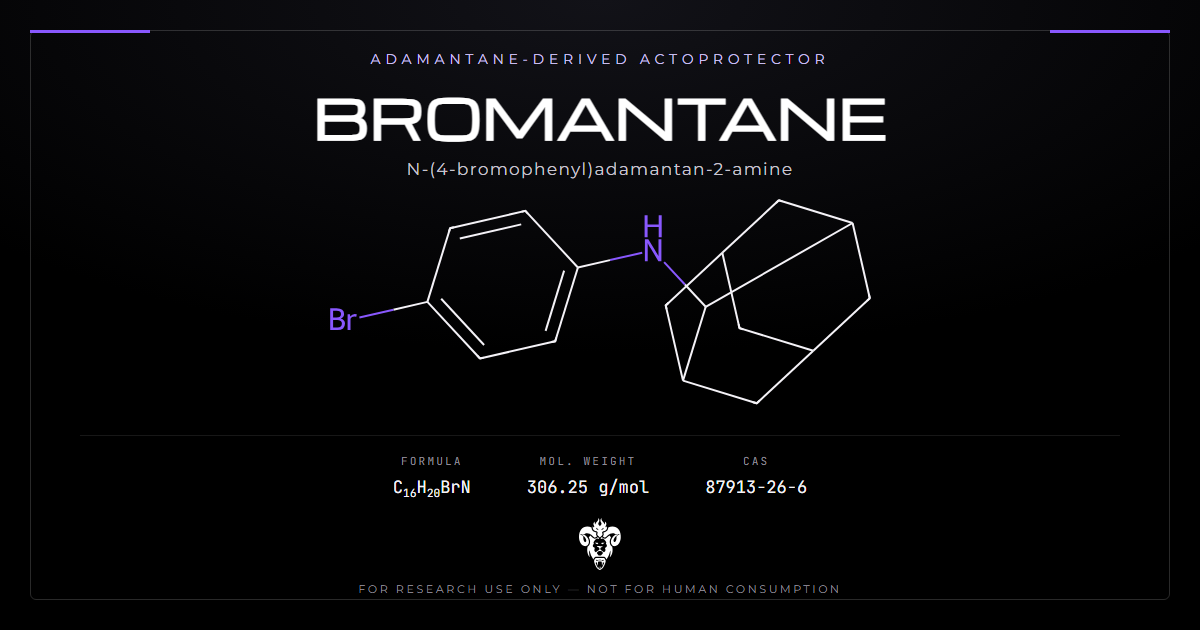
Bromantane is one of the few research compounds whose mechanism genuinely breaks the mold. Most stimulants push existing neurotransmitter pools around. Bromantane, by contrast, appears to work upstream — at the level of gene expression — by increasing the cell’s capacity to make dopamine in the first place. That distinction drives nearly all of the scientific interest in the molecule, and it also explains its unusual pharmacological profile within the broader nootropic compound space.
This guide covers what bromantane is, what the published literature actually reports, how anti-doping laboratories detect it, and — critically — the one synthesis-derived impurity that separates a well-characterized lot from a poorly purified one.
What Is Bromantane?
Bromantane is a synthetic adamantane derivative developed at the Zakusov Institute of Pharmacology in Moscow during the late 1980s. Structurally, it pairs an adamantane cage with a 4-bromoaniline group. Therefore it shares a scaffold with amantadine and memantine, though its pharmacology diverges sharply from both.
Russian pharmacology classifies bromantane as an actoprotector. In that literature, the term describes a synthetic adaptogen reported to improve stability under physical load without raising oxygen consumption. Russia approves it under the brand name Ladasten for asthenia and neurasthenia. Outside Russia, however, it holds no regulatory approval anywhere, so it circulates strictly as a research chemical.
Identity and Physical Data
| Property | Value |
|---|---|
| IUPAC name | N-(4-bromophenyl)adamantan-2-amine |
| Synonyms | Ladasten, Bromantan, ADK-709, Bromontan |
| CAS Number | 87913-26-6 |
| Molecular formula | C₁₆H₂₀BrN |
| Molar mass | 306.25 g/mol |
| Monoisotopic mass | 305.08 Da |
| InChIKey | LWJALJDRFBXHKX-UHFFFAOYSA-N |
| PubChem CID | 4660557 |
| UV λmax | 262 nm, 310 nm |
| Appearance | Crystalline solid |
The bromine atom matters more than it might appear. Because bromine has two near-equal natural isotopes (⁷⁹Br and ⁸¹Br, roughly 1:1), every bromantane-derived species produces a distinctive doublet in mass spectrometry. Consequently, MS becomes an unusually powerful tool for confirming that a given peak actually belongs to the bromantane family rather than to an unrelated contaminant.
Kimera stocks research-grade bromantane in powder, capsule, and solution formats for laboratory study.
How Bromantane Works: Synthesis, Not Reuptake
Classical psychostimulants act on the dopamine transporter. Amphetamine forces release; methylphenidate blocks reuptake. Both redistribute dopamine that already exists. Bromantane follows a different route entirely in the studied models — and that route is transcriptional.
Tyrosine Hydroxylase Upregulation
Tyrosine hydroxylase (TH) catalyzes the conversion of L-tyrosine to L-DOPA. It is the rate-limiting step in catecholamine biosynthesis, so anything that raises TH expression raises the ceiling on dopamine production.
Vakhitova and colleagues reported more than a twofold increase in TH mRNA in rat hypothalamus roughly 1.5 to 2 hours after a single administration of ladasten (Vakhitova et al., 2006). Rodent work has described increases of approximately 2 to 2.5 times in TH and in aromatic L-amino acid decarboxylase (AAAD), the terminal enzyme that converts L-DOPA into dopamine. In effect, bromantane appears to upregulate both ends of the synthesis pathway simultaneously.
Epigenetic Evidence at the TH Promoter
This is where the mechanism gets genuinely interesting. Rather than stopping at “TH mRNA went up,” the same group asked why. Using bisulfite sequencing, they examined the methylation status of CpG islands in the TH gene’s 5′-flanking region.
<cite index=”9-1″>Ladasten increased the frequency of cytosine demethylation at transcription-factor binding sites and neighboring motifs, and the authors proposed that the resulting rise in TH transcriptional activity was linked to that demethylation</cite>. In other words, the compound appears to loosen epigenetic suppression at a specific promoter. That is a meaningfully different claim from ordinary receptor pharmacology, and it fits the long duration of effect reported downstream.
Regional Dopamine and L-DOPA Effects
Mikhaylova and colleagues mapped where these changes actually occur. After a single 50 mg/kg oral dose in rats, they found that <cite index=”13-1″>ladasten differentially regulates tyrosine hydroxylase mRNA and protein along with dopamine and L-DOPA content</cite> across the ventral tegmental area, nucleus accumbens, hypothalamus, striatum, and hippocampus (Mikhaylova et al., 2007).
Notably, <cite index=”14-1″>the rise in TH mRNA in the VTA tracked well with increased L-DOPA and dopamine content in the nucleus accumbens</cite>. That is exactly the pattern a synthesis-driven mechanism should produce: enzyme expression rises in the cell bodies, and product accumulates in the projection targets.
Hippocampal Synaptic Plasticity
The same paper added a second finding that is easy to overlook. <cite index=”14-1″>Applying 10 µM ladasten converted short-term potentiation of synaptic transmission into a long-lasting form. Anisomycin, a protein-synthesis inhibitor, blocked that reinforcement, and the D1/D5 antagonist SCH23390 attenuated it</cite>.
Two inhibitors, two clean answers. The effect therefore depends on both new protein synthesis and D1/D5 dopamine receptor signaling. That result ties the transcriptional story to an actual functional readout in hippocampal tissue.
The GABAergic Arm
Bromantane also carries an anxiolytic component, which is unusual for anything with stimulant-like activity. The proposed basis is GABAergic.
In one behavioral study, <cite index=”33-1″>ladasten produced an anxiolytic effect in MR rats but not in MNRA animals. Stress disrupted the regulation of ³H-diazepam binding at the benzodiazepine site of the GABA-A receptor in MR rats, and ladasten given at the anxiolytic dose prevented those stress-induced changes</cite> (Iarkova et al., 2005). The 2012 actoprotector review adds that <cite index=”37-1″>bromantane strengthens GABAergic mediation by reducing expression of genes governing GABA transporter synthesis</cite>.
That combination — dopaminergic activation plus GABAergic stabilization — is the core reason the compound keeps drawing research attention. Most stimulants raise anxiety in tested models. This one reportedly does not.
Pharmacokinetics and Metabolism
Human data indicate an elimination half-life of roughly 10 to 12 hours, with about 11 hours commonly cited. Rodent half-life runs shorter, near 7 hours. Because of that, reported functional effects in the literature typically span 8 to 12 hours per dose.
Metabolism is hepatic, but the elimination route is unusual. <cite index=”25-1″>Bromantane metabolism proceeds mainly by hydroxylation at the 6-position of the adamantane cage, and all identified metabolites remain detectable in urine as long as two weeks after administration — a point the authors flag specifically for doping control</cite> (Oliynyk & Oh, 2012).
The review also notes broader systemic effects. <cite index=”37-1″>Bromantane stimulates cytochrome P-450 synthesis, which supports hepatic detoxification, and it raises immune markers including B-cell levels and circulating immune complexes even after a single dose</cite>. Researchers designing multi-compound protocols should therefore account for possible CYP-mediated interactions.
Clinical Research on Bromantane
Human data on bromantane exist, and there is more of it than most gray-market compounds can claim. Still, it sits almost entirely in Russian-language journals, which constrains how far the findings travel.
The 728-Patient Multicenter Study
The most-cited dataset comes from a multicenter Russian study. <cite index=”17-1″>Conducted across 28 clinical centers, it analyzed data from 728 patients with psychoautonomic syndrome, all of whom presented with asthenic disorders. Treatment ran 28 days at daily doses between 50 and 100 mg, with assessments at baseline and on days 3, 7, 14, and 28, plus a follow-up one month after treatment ended</cite> (Voznesenskaia et al., 2010).
<cite index=”17-1″>Responder rates reached 76.0% on the CGI-S and 90.8% on the CGI-I. The anti-asthenic effect appeared by day 3 and persisted through the month following withdrawal. Adverse effects occurred in only 3% of patients, therapy was discontinued in 0.8%, and no serious adverse effects were reported</cite>.
The persistence detail deserves emphasis. An effect that survives a month past discontinuation is difficult to explain through receptor occupancy. It is much easier to explain through durable changes in enzyme expression — which is precisely what the preclinical work describes.
The Placebo-Controlled Neurasthenia Trial
A separate randomized blind study compared ladasten against placebo in neurasthenia patients over 28 days, followed by a one-week placebo washout. <cite index=”23-1″>Ladasten proved superior to placebo in both the rate and the degree of reduction in core asthenic symptoms, and the authors reported no withdrawal syndrome after discontinuation, which they interpreted as evidence against addictive potential</cite> (Voronina et al., 2009).
How to Read This Evidence
Three caveats apply, and they matter.
- Language and access. Most primary work is Russian-language, and several foundational citations are difficult to obtain in full text. Independent verification outside Russia remains limited.
- Methodology. Sample sizes in the preclinical work are often small, and blinding is inconsistent across the clinical literature.
- Publication concentration. A large share of the corpus originates from two laboratory groups. That is not disqualifying, but it does limit independent replication.
Dose figures above are reported trial parameters from published literature. They are not guidance, and they carry no implication of use outside a controlled research setting.
Anti-Doping Status and Detection
Bromantane entered global awareness abruptly. At the 1996 Atlanta Olympics, several Russian athletes tested positive for the compound. The IOC banned it shortly afterward, and WADA has maintained the prohibition since. It currently sits under class S6.A (Non-Specified Stimulants) and is prohibited in competition.
For analytical laboratories, the two-week metabolite detection window is the operationally important fact. Hydroxylated adamantane metabolites persist in urine far longer than the parent compound’s ~11-hour half-life would suggest. Any sports-science protocol therefore needs to account for a detection tail that substantially outlasts pharmacological activity.
This is also why bromantane appears in catalogs as a certified analytical reference standard. Doping-control labs need well-characterized material to develop, validate, and calibrate detection methods — and reference-standard work is far less forgiving of impurities than most applications.
The Bromantane Purity Problem: N-Formyl Carryover
Here is the part almost no bromantane page covers, and it is the single most consequential thing a researcher should check before trusting a lot.
Bromantane is commonly synthesized by reductive amination of 2-adamantanone with 4-bromoaniline. Several viable routes exist. However, Leuckart-Wallach-type conditions use formic acid or formamide as the reductant, and that chemistry proceeds through an N-formyl intermediate that must be hydrolyzed off in workup. DMF used as a process solvent can cause the same outcome by a different path.
When that hydrolysis runs incomplete, the lot retains N-formyl bromantane — N-(4-bromophenyl)-N-(adamantan-2-yl)formamide.
What the Impurity Looks Like Analytically
This impurity has a clean, unambiguous fingerprint across orthogonal methods:
| Method | Signature |
|---|---|
| Mass spectrometry | m/z 333.07 monoisotopic (C₁₇H₂₀BrNO) — exactly parent + 27.99, the mass of CO. Retains the 1:1 bromine isotope doublet. |
| ¹H NMR | A formyl proton appearing as a rotamer pair near 8.1 and 8.6 ppm. Restricted amide-bond rotation splits what would otherwise be one singlet into two. |
| ¹H NMR (aromatic) | Acylation withdraws electron density from the ring. Parent doublets near 6.5 and 7.2 ppm shift downfield to roughly 7.1 and 7.5 ppm. |
| ¹³C NMR | A formamide carbonyl pair near 162 and 164 ppm — also rotamer-split. Absent in clean parent material. |
| HPLC | The polar formamide typically elutes ahead of the lipophilic parent amine. |
The rotamer pair is the tell. Nothing in clean bromantane resonates that far downfield, and a doubled peak at that shift is very hard to explain any other way.
Each method answers a different question. HPLC resolves the impurity chromatographically and quantifies it by area. MS confirms its identity through the mass shift and the retained bromine doublet. NMR names the functional group outright. A lot characterized across all three leaves very little ambiguity about what is in the vial.
Sourcing Bromantane with COA Verification
No regulatory body oversees bromantane manufacture outside Russia. As a result, gray-market synthesis supplies most of the global market, and batch-to-batch variance runs wide. For any serious analytical or preclinical work, documentation matters far more than price.
A defensible bromantane COA package should include:
- Identity confirmation by MS, with the bromine isotope doublet visible
- Chromatographic purity by HPLC with a method that resolves polar amide impurities from the parent
- Structural confirmation by ¹H and ¹³C NMR, ideally in DMSO-d₆ for a clear aromatic window
- Absolute quantification by qNMR or elemental analysis, not just area percentage
- Residual solvent and water content — Karl Fischer, GC headspace, and loss on drying should roughly reconcile with one another
Every Kimera lot ships with third-party COA verification, and results publish openly in our public COA archive. Before ordering bromantane, reviewers can pull the current documentation and check identity, purity, and impurity data against their own acceptance criteria.
Researchers building comparative fatigue or cognition protocols often pair bromantane with mechanistically distinct compounds — for example, the melanocortin-family peptide Semax or the racetam derivative RGPU-95. Because those act through unrelated pathways, they make useful contrasts when isolating a transcriptional mechanism from a receptor-mediated one.
Handling and Storage
Bromantane is a halogenated adamantane derivative, and it is reasonably robust. A few handling conditions still apply:
- Store at controlled room temperature, dry and tightly closed
- Keep containers tightly sealed and protected from atmospheric moisture
- Protect from prolonged light exposure, as with any aryl bromide
- Bromantane is highly lipophilic and dissolves readily in ethanol and other organic solvents, but poorly in water — account for that in vehicle selection
Storage guidance is a house recommendation. Analytical documentation is per-lot release testing.
Frequently Asked Questions
Is bromantane a stimulant or an anxiolytic? The literature describes both. Studies report stimulant-like dopaminergic activity alongside anxiolytic effects attributed to GABAergic mechanisms in tested models.
How does bromantane differ from amphetamine mechanistically? Amphetamine acts on the dopamine transporter to redistribute existing dopamine. Bromantane instead upregulates the enzymes that synthesize it, so the effect builds over hours rather than minutes.
Why do anti-doping agencies ban bromantane? WADA has prohibited it since the late 1990s, following the 1996 Atlanta positives. It currently falls under class S6.A, non-specified stimulants.
How long do bromantane metabolites remain detectable? Published work reports detection of hydroxylated metabolites in urine up to roughly two weeks after administration — considerably longer than the parent compound’s half-life.
What is bromantane’s molecular weight? Its formula is C₁₆H₂₀BrN, and its molar mass is 306.25 g/mol. Monoisotopic mass is 305.08 Da.
What impurity should a bromantane COA rule out? N-formyl bromantane (C₁₇H₂₀BrNO, m/z 333.07), a synthesis carryover from formylating conditions. Look for a rotamer-split formyl proton pair near 8.1 and 8.6 ppm in the ¹H NMR.
Kimera Chems supplies bromantane for laboratory and research use only. Not for human consumption, nor for medical, veterinary, or household use. Dose figures cited in this article are reported parameters from published clinical literature and are not guidance of any kind.
References
- Voznesenskaia TG, Fokina NM, Iakhno NN. Treatment of asthenic disorders in patients with psychoautonomic syndrome: results of a multicenter study on efficacy and safety of ladasten. Zh Nevrol Psikhiatr Im S S Korsakova. 2010;110(5 Suppl 1):17–26. https://pubmed.ncbi.nlm.nih.gov/20559263/
- Voronina TA, et al. Ladasten, the new drug with psychostimulant and anxiolytic actions in treatment of neurasthenia (results of the comparative clinical study with placebo). Zh Nevrol Psikhiatr Im S S Korsakova. 2009. https://pubmed.ncbi.nlm.nih.gov/19491814/
- Mikhaylova M, Vakhitova JV, Yamidanov RS, Salimgareeva MKh, Seredenin SB, Behnisch T. The effects of ladasten on dopaminergic neurotransmission and hippocampal synaptic plasticity in rats. Neuropharmacology. 2007;53(5):601–608. https://doi.org/10.1016/j.neuropharm.2007.07.001
- Vakhitova IuV, Sadovnikov SV, Iamidanov RS, Seredenin SB. Cytosine demethylation in the tyrosine hydroxylase gene promoter in the hypothalamus cells of the rat brain under the action of an aminoadamantane derivative Ladasten. Genetika. 2006;42(7). https://pubmed.ncbi.nlm.nih.gov/16915929/
- Iarkova MA, Voronin MV, Seredenin SB. Studying the mechanisms of ladasten action. Eksp Klin Farmakol. 2005. https://pubmed.ncbi.nlm.nih.gov/16047669/
- Oliynyk S, Oh S. The pharmacology of actoprotectors: practical application for improvement of mental and physical performance. Biomol Ther (Seoul). 2012;20(5):446–456. https://pmc.ncbi.nlm.nih.gov/articles/PMC3762282/
- Salimgareeva MKh, Yamidanov RS, Vakhitova YV, Seredenin SB. Mechanism of action of ladasten: activation of gene expression for neurotrophins and mitogen-activated kinases. Bull Exp Biol Med. 2012;152(3):313–317. https://doi.org/10.1007/s10517-012-1516-z
- Grekhova TV, Gainetdinov RR, Sotnikova TD, et al. The effect of bromantane on release and metabolism of dopamine in the dorsal striatum of freely moving rats: a microdialysis study. Bull Exp Biol Med. 1995;119(3):302–304. https://doi.org/10.1007/BF02445840
- Bromantane, PubChem Compound Summary CID 4660557. National Center for Biotechnology Information. https://pubchem.ncbi.nlm.nih.gov/compound/4660557
- World Anti-Doping Agency. Prohibited List — Class S6 Stimulants. https://www.wada-ama.org/en/prohibited-list