
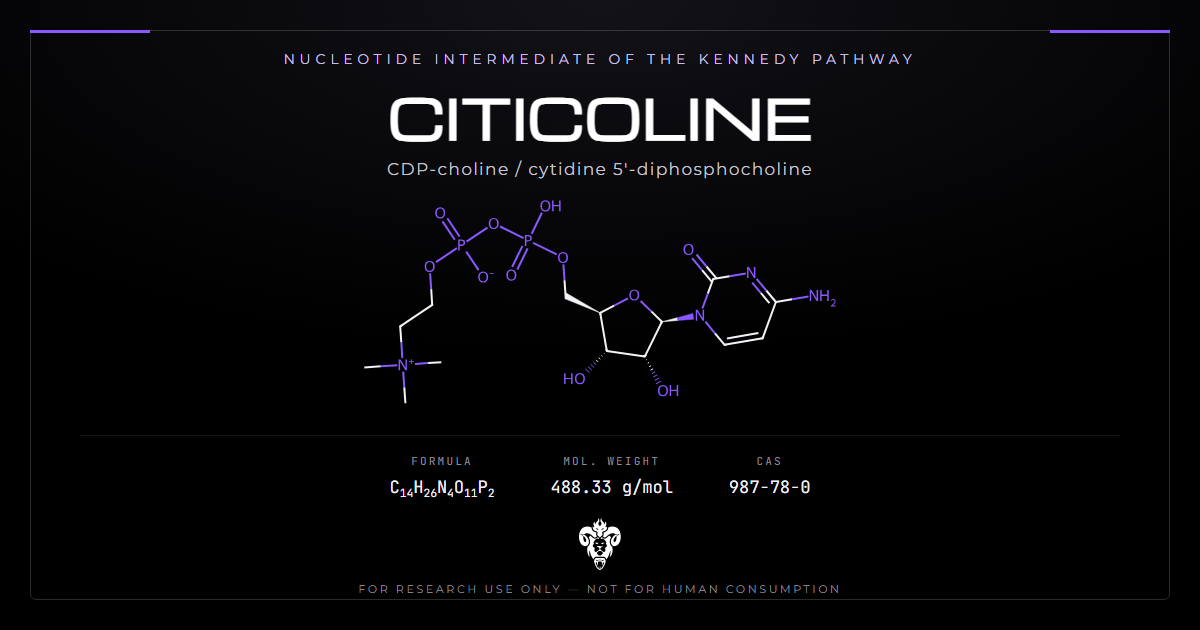
Everything below reports findings from cell cultures, isolated tissue and animals. This material is for research use only, not for human or veterinary use.
Almost every compound in this catalogue suffers from the same shortage. One paper, or three, usually in rodents, and any statement about people is inference.
Citicoline has the opposite problem. Roughly 1,440 papers carry its name. Among them sit two large indexed trials, a Cochrane review, and meta-analyses in several fields. Those human endpoints sit outside the scope of this profile. The useful laboratory questions are identity, the Kennedy pathway, salt form, and what animal systems actually measured.
Chemical identity
| Property | Value |
|---|---|
| Common names | Citicoline, CDP-choline |
| Systematic | Cytidine 5-diphosphocholine |
| Molecular formula | C14H26N4O11P2 |
| Molecular weight | 488.32 g/mol |
| CAS | 987-78-0 |
| PubChem CID | 13804 |
| InChIKey | RZZPDXZPRHQOCG-OJAKKHQRSA-N |
| Class | Nucleotide, inner salt |
| Endogenous | Yes |
| Sodium salt mass | 510.30 g/mol |
The catalogue carries it as CDP-Choline.
An endogenous intermediate, not a xenobiotic
This is the feature that separates the compound from everything else on this shelf. Citicoline is not a designed molecule. It is a normal metabolic intermediate that every nucleated cell already makes.
It sits in the Kennedy pathway, the route cells use to build phosphatidylcholine, the most abundant phospholipid in cell membranes. Choline is phosphorylated, then coupled to cytidine triphosphate to give CDP-choline, and that intermediate donates its choline head group to diacylglycerol. The step that makes it is rate-limiting for the whole pathway.
So the laboratory argument writes itself: supply more of a rate-limiting intermediate and membrane synthesis should increase in a dish. That argument is chemically sound. A plausible mechanism is not a demonstrated organism-level effect.
Charges and solubility
The molecule carries a permanent positive charge on its trimethylammonium group and a negative charge on the diphosphate, making it an inner salt. It is freely soluble in water and sparingly soluble in ethanol.
Four stereocentres sit on the ribose ring in the (2R,3S,4R,5R) configuration, inherited from cytidine. That is a consequence of the starting material rather than a synthetic choice to verify. The compound is normally made from natural nucleosides. A certificate that claims a different ribose configuration is claiming a different nucleotide.
InChIKey RZZPDXZPRHQOCG-OJAKKHQRSA-N encodes that ribose. PubChem CID 13804 is the free inner salt. The sodium salt is a different formula line.
What the molecule delivers
Taken into an assay system, citicoline does not always remain intact. Hydrolases clip the diphosphate. The useful account of it is as a delivery vehicle for two things at once: a choline moiety and a cytidine moiety.
That dual delivery is the reason the compound shows up in so many unrelated files. Choline feeds acetylcholine synthesis and membrane phospholipid production. Cytidine feeds the nucleotide pool. Two substrates, many pathways, and a correspondingly broad set of claims.
A methods section that treats Citicoline as “just choline” has dropped half the reagent. A methods section that treats it as “just a nucleotide” has dropped the other half. Write both pieces on the tube.
Choline versus cytidine after the split
Free choline from a hydrolysed lot is the same choline that Alpha GPC donates. The cytidine is not. Cytidine kinase can push that nucleoside toward CTP. CTP is the other substrate of the cytidylyltransferase that makes CDP-choline in the first place.
So a hydrolysed vial can still feed the pathway, just from the two ends rather than from the intact intermediate. That is a feature in some assays and a confound in others. If the experiment needs the intact diphosphate, assay the lot for free choline before the run.
Kennedy pathway chemistry
Three enzymatic steps build phosphatidylcholine from choline in the Kennedy path.
| Step | Enzyme | Input | Output |
|---|---|---|---|
| 1 | Choline kinase | Choline + ATP | Phosphocholine |
| 2 | CTP:phosphocholine cytidylyltransferase | Phosphocholine + CTP | CDP-choline |
| 3 | Cholinephosphotransferase | CDP-choline + diacylglycerol | Phosphatidylcholine |
Why step two is the bottleneck
Cytidylyltransferase is the committed, rate-limiting step. Cells hold little CDP-choline. They hold more phosphocholine. Supplying the intermediate skips the bottleneck in a cell-free or permeabilised system. Intact cells may still hydrolyse the feed before it reaches the transferase.
That is why intact-mass identity and a hydrolysis panel both belong on the certificate. The name Citicoline describes the intermediate. The vial may hold the two halves.
Diacylglycerol is the other substrate
Step three needs a diacylglycerol. A choline feed without DAG cannot make phosphatidylcholine. Membrane composition, lipase activity and the fatty-acyl pattern of the DAG pool all change the product. A paper that reports “more phospholipid” without naming the DAG source has reported a mixture.
Citicoline does not choose the acyl chains. The cell does. Two lots of the same nucleotide can feed two different phosphatidylcholine species if the DAG pools differ.
What this path is not
This path is not the phosphatidylethanolamine N-methylation route that liver uses to make some phosphatidylcholine from PE. A hepatocyte experiment that ignores PEMT has ignored a parallel source. Citicoline feeds Kennedy, not PEMT.
The path is also not a receptor. There is no citicoline receptor in the usual sense. Downstream readouts run through choline, cytidine, and the membranes those substrates build.
Cytidine kinase and the CTP pool
Cytidine from a hydrolysed feed meets cytidine kinase. That enzyme makes CMP, then the cell climbs back to CDP and CTP. CTP is the nucleotide that step two of the Kennedy path consumes.
A flask that already holds ample CTP will not show a cytidine-side effect. A flask that is CTP-poor might. That is why a Citicoline experiment needs a nucleotide-pool control, not only a choline control. Alpha GPC cannot supply that control. It has no ribose.
Uridine sits next to this pool. Cells interconvert uridine and cytidine nucleotides. A paper that reports “nucleotide rescue” without naming UTP versus CTP has named a family, not a species.
Rodent work that is in scope
Work continues in animals, and that is where this profile stays.
Costa and colleagues showed that vaporised cannabis exposure impairs spatial pattern separation in rats at three ages (PMID 41905714) [13]. Citicoline rescued that deficit, particularly when given during memory encoding and consolidation. Vehicle-exposed animals were unaffected by citicoline, which is the control that makes the result interesting.
A 2026 mouse study reports that citicoline reversed behavioural and hippocampal abnormalities after single prolonged stress (PMID 42320748) [14]. The markers were endoplasmic reticulum stress, mitophagy through PINK1 and parkin, lipid peroxidation and caspase-3.
Both are rodent studies. The cannabis paper is a rescue against a defined exposure. The stress paper is a marker panel in hippocampus. Neither one licenses a claim about people. Both are usable as methods: name the exposure, name the window, name the marker.
Reading those two together
Costa’s control arm matters. Citicoline did nothing to vehicle-exposed rats [13]. A reagent that only moves a disrupted system is a different tool from a reagent that shifts a baseline. Write that distinction into the notebook before treating Citicoline as a general “cognition chemical.”
Fahmy’s panel is molecular rather than a single behavioural score [14]. ER stress, PINK1/parkin mitophagy, lipid peroxidation and caspase-3 are four different measurements. A mouse study that reports one of them has not reported the others.
What a methods section should copy from those papers
Costa named the vapour exposure, the age bands, and the encoding versus consolidation window [13]. Copy that level of detail. A sentence that says “rats got citicoline” has not described an experiment.
Fahmy named the stress protocol and the hippocampal markers [14]. Copy the marker list if you claim a replication. Lipid peroxidation is not mitophagy. Caspase-3 is not ER stress. Citicoline in that paper is a reagent against a named insult, not a general hippocampal tonic.
Neither paper replaces intact-mass identity. A rodent result on a mis-weighed sodium salt is a different exposure from the one the authors wrote down.
Analytical signatures
A nucleotide this polar has a short list of useful checks.
NMR
Proton NMR of Citicoline shows the cytidine nucleobase, the ribose, and the choline trimethyl singlet. That singlet near 3.2 ppm integrates for nine protons and is the fastest way to see free choline grow as the diphosphate breaks.
Phosphorus NMR should show two phosphate environments in the intact diphosphate. A single phosphate line is a warning. It can mean hydrolysis to CMP plus phosphocholine, or a different nucleotide entirely.
Carbon NMR counts fourteen carbons in the free inner salt. Extra lines can be residual solvent, acetate, or a cytidine starting material that never coupled.
Mass spectrometry
Intact mass 488.32 (average) separates the free acid from the sodium salt at 510.30. Electrospray in negative mode often shows the [M-H]- of the inner salt. Positive mode shows the quaternary ammonium.
Fragmentation should lose choline or cytidine in a pattern that matches a reference lot. A peak at the free-choline mass without the parent mass is a hydrolysed vial.
Unit-resolution LC-MS can miss a sodium-count error if the analyst reads the wrong adduct. Read the certificate and the spectrum against the same form.
Hydrolysis as a time course, not a binary
Citicoline in water does not snap from intact to destroyed. The diphosphate opens over hours to days, faster with heat, residual phosphatase, or high pH. A fresh stock and a week-old stock are different reagents.
Assay free choline at preparation and at use. If the choline peak has grown, the experiment is no longer an intact-intermediate experiment. It is a choline-plus-cytidine experiment that still uses the name Citicoline on the tube.
Indexed human papers
A long indexed file exists. Davalos and colleagues pooled earlier stroke papers [1]. ICTUS and COBRIT then tested large cohorts [2][3]. Cochrane reviewed the stroke file [4]. A later recanalisation-timing paper sat downstream [5]. Cognition, glaucoma, psychiatry and mixed neuroprotection reviews fill the rest of the list.
This profile does not quote their recovery odds, their milligram-per-day figures, or their adverse-event lines. Those sentences turn a research article into a use document.
The bibliographic fact still matters. Citicoline has been tested at a scale that most catalogue entries never reach. A reader who wants that file can open the PMIDs. This page will not become a protocol by quoting them.
Jasielski and colleagues surveyed neurological applications in review form [9]. Network and specialty reviews kept the name in circulation [8][11] and [12]. A 2025 head-to-head paper compared citicoline with amantadine in a trauma file [10]. All of those stay in the list. None of them identify a vial.
How to read this literature
Reading order decides the answer
Approach the compound through narrative reviews and you meet an endogenous intermediate with a long applied file [9]. Approach it through the two largest indexed trials and the Cochrane review and you meet a compound whose flagship tests sit in that file [2][3] and [4].
Both accounts cite real papers. What separates them is weighting. This profile weights chemistry, salt form and animal systems. It leaves the human endpoints unread.
The laboratory rule is simpler: find the intact mass and the salt form before reading anything else. For citicoline that is 488.32 for the free inner salt and 510.30 for the sodium salt.
Who searched what
The second habit is checking the sampling frame. The 2002 pooling analysis searched a manufacturer’s bibliography alongside the public databases [1]. Cochrane later rated bias risk across the stroke set [4].
None of that means a result is wrong. It means the positive literature and the sponsor overlap in that file, and that a laboratory identity claim cannot rest on either.
Verifying research material
Batch documentation sits on the certificates of analysis page.
Identity
Formula C14H26N4O11P2, molecular weight 488.32, CAS 987-78-0, InChIKey RZZPDXZPRHQOCG-OJAKKHQRSA-N.
Four stereocentres sit on the ribose ring in the (2R,3S,4R,5R) configuration, inherited from cytidine. That is a consequence of the starting material rather than a synthetic choice to verify.
Intact mass is the first check. A lot that quotes 510.30 may be the sodium salt. A lot that quotes 488.32 may be the free acid. Mixing those two figures by 4.5 percent is a unit error, not a purity failure.
Free acid against sodium salt
This is the practical trap. Citicoline is supplied both as the free acid at 488.32 and as the sodium salt at 510.30. Casual writing treats the two as interchangeable.
A concentration prepared by mass from one while quoting the other is off by about 4.5%. Confirm which form a certificate describes before converting anything.
| Form | Formula cue | Mass | What to write on the tube |
|---|---|---|---|
| Free inner salt | C14H26N4O11P2 | 488.32 | Citicoline, free acid |
| Sodium salt | Extra Na | 510.30 | Citicoline sodium |
| Hydrolysed mix | Free choline + CMP | Split masses | Not intact CDP-choline |
| Hydrate | Extra water | Mass plus water | Assay water |
Water content
The compound is freely water soluble and hygroscopic. Material equilibrated with room air carries water that a purity figure by chromatographic area will not report.
Ask whether the certificate includes a water determination, by Karl Fischer or loss on drying. On a hygroscopic solid, that number changes the molar amount in a weighed sample more than typical impurity levels do.
Keep the solid dry and dark. Aliquot on receipt. Let a cold jar warm before opening so condensation does not form inside.
Storage guidance is a house recommendation. Analytical documentation is per-lot release testing.
Free choline and cytidine monophosphate are the expected hydrolysis products. Name them on the certificate. A single HPLC area percent can hide both inside a broad peak.
Related donors are not substitutes
Alpha GPC donates choline on a glycerol. Citicoline donates choline on a nucleotide. Phosphatidylcholine donates choline inside a lipid. Those three share a trimethylammonium and do not share a mass, a hydrolase profile, or a second substrate.
A notebook that writes “choline donor” without the name has lost the reagent. Run Citicoline against Alpha GPC only when the question is the extra cytidine. Run either against phosphatidylcholine only when the question is the matrix.
Noopept and aniracetam sit in the same catalogue aisle and do not donate choline at all. They are not controls for this pathway.
Solution stocks need a date. Citicoline in water is a timed reagent. Freeze-thaw of a concentrated stock can split the diphosphate faster than a chemist expects. Prepare a working dilution once. Discard it when the free-choline peak grows.
Kimera publishes third-party certificates of analysis for every lot. Laboratories source Citicoline as a Kennedy-pathway intermediate. Related work appears next to other choline-handling reagents in the same library aisle.
Common questions about citicoline
What is Citicoline? Cytidine 5-diphosphocholine, C14H26N4O11P2, 488.32 g/mol, CAS 987-78-0. An endogenous Kennedy-pathway intermediate.
Is CDP-choline the same thing? Yes. That is the catalogue name and the biochemical name. Citicoline is the same chain.
Does this page report human trial outcomes? No. Indexed papers remain in the list. This profile stops at chemistry, salt form and rodent systems.
What did animal papers actually measure? A rat cannabis-exposure rescue on pattern separation [13], and a mouse stress panel on hippocampal ER stress, mitophagy, lipid peroxidation and caspase-3 [14].
Free acid or sodium salt? Both are sold. The free acid is 488.32 and the sodium salt 510.30, so a mass prepared against the wrong figure is out by roughly 4.5%.
What is it actually doing in a cell? Delivering choline and cytidine into pathways that use them, or sitting as the intact CDP-choline intermediate if hydrolases have not clipped it.
Why does water matter so much? The solid is hygroscopic. Area-percent purity does not report water. Karl Fischer does.
Summary of the evidence
Identity: C14H26N4O11P2, 488.32 g/mol, CAS 987-78-0. Inner salt. Ribose configuration inherited from cytidine. PubChem CID 13804.
Function: Kennedy-pathway intermediate between phosphocholine plus CTP and phosphatidylcholine. Dual delivery of choline and cytidine after hydrolysis.
Salt form: free acid 488.32 versus sodium salt 510.30. A 4.5 percent mass error follows from mixing those lines. Write the salt on the same line as the mass.
Animal readouts: rat pattern-separation rescue after cannabis vapour [13]; mouse hippocampal marker panel after single prolonged stress [14].
Indexed human papers exist at unusual scale and stay in the reference list [6][7]. This page does not quote their endpoints.
More of this literature sits in the nootropics category, alongside Alpha GPC, Noopept and Aniracetam.
Write the name, the mass and the salt form on the first line of a notebook page. Everything else in this profile is a check on those three facts. A certificate that omits intact mass is not finished. A stock that omits a free-choline check is not intact CDP-choline. If a methods section names Citicoline and then quotes 510.30 while the notebook used 488.32, stop. The rest of that run used a different weigh-out than the paper.
Status: supplied for laboratory research use only.
References
- Dávalos A, Castillo J, Alvarez-Sabín J, Secades JJ, Mercadal J, López S, Cobo E, Warach S, Sherman D, Clark WM, Lozano R. Oral citicoline in acute ischemic stroke: an individual patient data pooling analysis of clinical trials. Stroke. 2002;33(12):2850-2857. PMID 12468781. DOI
- Dávalos A, Alvarez-Sabín J, Castillo J, Díez-Tejedor E, Ferro J, Martínez-Vila E, et al. Citicoline in the treatment of acute ischaemic stroke: an international, randomised, multicentre, placebo-controlled study (ICTUS trial). Lancet. 2012;380(9839):349-357. PMID 22691567. DOI
- Zafonte RD, Bagiella E, Ansel BM, Novack TA, Friedewald WT, Hesdorffer DC, et al. Effect of citicoline on functional and cognitive status among patients with traumatic brain injury: Citicoline Brain Injury Treatment Trial (COBRIT). JAMA. 2012;308(19):1993-2000. PMID 23168823. DOI
- Martí-Carvajal AJ, Valli C, Martí-Amarista CE, Solà I, Martí-Fàbregas J, Bonfill Cosp X. Citicoline for treating people with acute ischemic stroke. Cochrane Database Syst Rev. 2020;8(8):CD013066. PMID 32860632. DOI
- Agarwal A, Vishnu VY, Sharma J, Bhatia R, Garg A, Dwivedi S, et al. Citicoline in acute ischemic stroke: a randomized controlled trial. PLoS One. 2022;17(5):e0269224. PMID 35639720. DOI
- Bonvicini M, Travaglini S, Lelli D, Antonelli Incalzi R, Pedone C. Is citicoline effective in preventing and slowing down dementia? A systematic review and a meta-analysis. Nutrients. 2023;15(2):386. PMID 36678257. DOI
- Prinz J, Prokosch V, Liu H, Walter P, Fuest M, Migliorini F. Efficacy of citicoline as a supplement in glaucoma patients: a systematic review. PLoS One. 2023;18(9):e0291836. PMID 37768938. DOI
- Li M, Huo X, Chang Q, Liu X, Zhang J, Mao Z. Efficacy analysis of neuroprotective drugs in patients with acute ischemic stroke based on network meta-analysis. Front Pharmacol. 2024;15:1475021. PMID 39575393. DOI
- Jasielski P, Piędel F, Piwek M, Rocka A, Petit V, Rejdak K. Application of citicoline in neurological disorders: a systematic review. Nutrients. 2020;12(10):3113. PMID 33053828. DOI
- Badre DSEM, Elbeialy MAK, Fathy M. Citicoline-amantadine trial in traumatic brain injury: a prospective randomized study. J Neurotrauma. 2025;43(1-2):68-77. PMID 41027417. DOI
- Balanzá-Martínez V, Galdámez-Huertas A, Sánchez-Ortí JV, Kapczinski F, De Boni RB, Pomarol-Clotet E, Van Rheenen TE. Lifestyle-based interventions targeting neurocognition in bipolar disorders: a systematic review of randomized controlled trials. Psychiatry Res. 2025;351:116618. PMID 40639301. DOI
- Kucuksahin NG, Kaya TT, Halac E, Sut E, Ciray RO. The impact of citicoline/phosphatidylserine supplementation on cognitive performance and executive functions in mental disorders: a systematic review of controlled trials. Hum Psychopharmacol. 2026;41(5):e70058. PMID 42538853. DOI
- Costa CC, Weiss AS, Limbaker CM, Kirkland AE, Squeglia LM, Reichel CM, Penrod RD, Carter JS. Prior cannabis vapor exposure impairs pattern separation in rodents of multiple ages but is rescued by citicoline administration. Neuroscience. 2026;603:214-227. PMID 41905714. DOI
- Fahmy NG, Kamel NM, Hedya SA, Abd El-Latif AM. Repurposing citicoline for single prolonged stress-induced behavioral and hippocampal molecular abnormalities in male mice. Neuropharmacology. 2026;298:111082. PMID 42320748. DOI
CDP-Choline is sold for laboratory research use only. Not for human consumption, nor medical, veterinary, or household uses.
Literature retrieved from PubMed.