
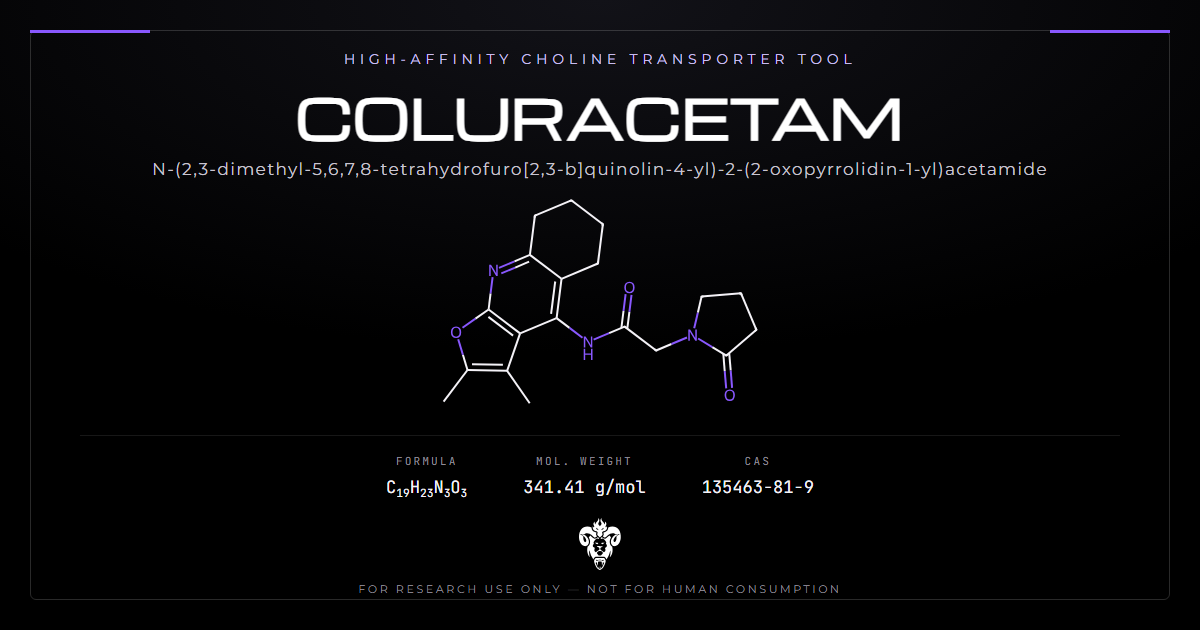
Coluracetam has a smaller literature than any other compound in the racetam series, and a more coherent one. Roughly a dozen primary papers exist. They agree with each other, and together they describe something unusual. This compound does nothing to healthy tissue. It does nothing on acute administration. And it continues working after it has cleared the brain entirely.
Each of those three properties is a way to get a false negative. An experiment dosing once, or using unlesioned animals, or sampling at peak plasma concentration will report coluracetam as inactive. All three have a single explanation, and it sits at the choline transporter.
All information here describes laboratory research findings. This material is supplied for research use only and is not for human or veterinary use.
What coluracetam is
Mitsubishi Chemical developed the compound as MKC-231. It later carried the code BCI-540 under different ownership. Structurally it is the outlier of the series, sharing only the 2-oxopyrrolidinyl acetamide fragment with piracetam and carrying a tetrahydrofuro[2,3-b]quinoline system that no other racetam has.
Identity and physical data
| Property | Value |
|---|---|
| Compound | Coluracetam |
| Development codes | MKC-231, BCI-540 |
| PubChem CID | 214346 |
| CAS number | 135463-81-9 |
| Molecular formula | C19H23N3O3 |
| Molecular weight | 341.4 g/mol |
| InChIKey | PSPGQHXMUKWNDI-UHFFFAOYSA-N |
| Systematic name | N-(2,3-dimethyl-5,6,7,8-tetrahydrofuro[2,3-b]quinolin-4-yl)-2-(2-oxopyrrolidin-1-yl)acetamide |
| Chemical class | Furoquinoline acetamide |
It is barely a racetam
At 341.4 g/mol the compound is more than twice the mass of piracetam. The fused tricyclic system dominates the structure, and the pyrrolidinone that names the class is a substituent on it rather than the core.
Classification here follows nomenclature rather than chemistry or pharmacology. That is worth stating, because grouping this compound with piracetam implies a shared mechanism that does not exist. Its mechanism is specific, identified, and shared with none of them.
The mechanism is transporter trafficking
High-affinity choline uptake is the rate-limiting step in acetylcholine synthesis. Coluracetam increases it, and the way it does so is the interesting part.
It moves transporters rather than activating them
Work at Mitsubishi Tanabe resolved the mode of action in 2008 [1]. In hippocampal synaptosomes from lesioned rats, treatment raised the Vmax of high-affinity choline uptake 1.6-fold. It raised the Bmax of hemicholinium-3 binding 1.7-fold in parallel.
Those two numbers moving together is the finding. Vmax reflects transport capacity and Bmax reflects the number of binding sites. Both rising by a similar factor indicates more transporters rather than faster ones. Binding studies confirmed affinity for cloned CHT1, and the authors concluded that the compound affects CHT1 trafficking and increases transporter numbers at the synaptic membrane (DOI).
Why that explains the delay
Trafficking a transporter to a membrane takes time and outlasts the signal that triggered it. A compound acting this way should show little acute effect and a persistent one after repeated dosing. That is exactly what the behavioural work found.
Downstream consequences
Enhanced uptake feeds acetylcholine synthesis and release. In lesioned rats, treatment reversed reductions in both high-affinity choline uptake and potassium-evoked acetylcholine release in hippocampal synaptosomes [2]. Microdialysis in living animals showed the same reversal of basal acetylcholine concentrations, measured without a cholinesterase inhibitor in the perfusate.
That last methodological detail matters. Measuring acetylcholine with a cholinesterase inhibitor present inflates the signal and can mask whether synthesis actually changed.
Activity depends on prior damage
The selectivity here is sharper than for any other compound in this series.
The synaptosome experiment
A 1996 study incubated the compound with hippocampal synaptosomes from two sources: rats treated with the cholinotoxin AF64A, and normal rats [3]. Across concentrations from 0.1 nanomolar to 1 micromolar, high-affinity choline uptake rose significantly in the lesioned preparation. It did not rise in the normal one.
A compound that raises a transport rate only where that rate has been reduced is not behaving like a stimulant of the transporter. It is behaving like something that restores a regulatory set point.
What it does not touch
The same study found no effect on acetylcholinesterase activity, on quinuclidinyl benzilate binding, or on pirenzepine binding [3]. So the mechanism runs through neither enzyme inhibition nor muscarinic receptors. Tacrine was tested alongside as an acetylcholinesterase inhibitor. It failed to improve the learning deficits that coluracetam improved. It also produced tremor, salivation and hypothermia at higher doses, where coluracetam produced none.
Selectivity in a second model
A phencyclidine exposure model gave a similar pattern of partial effects [4]. Subchronic treatment antagonised the cognitive deficits in novel object recognition and reversed the loss of choline acetyltransferase positive cells in medial septum. It did not antagonise the altered locomotor response to phencyclidine itself, and it did not change ventrostriatal dynorphin A expression.
Reversing some consequences of an insult while leaving others untouched is more informative than a global effect, and it points back at the cholinergic compartment.
Acute dosing reports nothing
The single most reproducible way to miss this compound’s activity is to give it once.
The mouse comparison
A 1994 study tested acute and chronic administration against two reference compounds in lesioned mice [5]. Acutely, coluracetam had no significant effect on working memory deficits at 0.3, 1.0 or 3.0 mg/kg. Tacrine also failed. Linopirdine improved the deficit acutely at 1.0 mg/kg.
Chronically, over 11 days, the picture inverted. Coluracetam improved the deficit at every dose tested. Linopirdine worked only at the highest dose. Tacrine did not work at any dose. On hippocampal acetylcholine content, coluracetam reversed the depletion at 0.3 and 1.0 mg/kg, while linopirdine further decreased acetylcholine and tacrine did nothing.
One compound therefore ranks last on acute testing and first on chronic testing in the same laboratory, in the same model, against the same comparators.
The effect outlasts the compound
An eight-day repeated dosing study measured water maze performance at 1, 24, 48 and 72 hours after the final dose [6]. Cognitive improvement persisted for 24 hours. Concentration measurements found no detectable compound in brain at that time point.
High-affinity choline uptake followed the same time course as the behavioural effect. Those authors proposed that the compound induces long-lasting effects by changing the choline transporter regulation system rather than by occupying anything.
The design implication
Three conventional choices each produce a false negative here. Single-dose administration, healthy animals, and sampling at peak plasma concentration. A protocol should use repeated dosing, a model with cholinergic damage, and a measurement window extending well past clearance. Pharmacokinetic and pharmacodynamic time courses come apart for this compound, and treating them as aligned is the error.
Other pharmacological findings
Protection against glutamate cytotoxicity
In cultured fetal rat cortical neurons, exposure for 12 to 24 hours reduced glutamate cytotoxicity [7]. The compound also reduced cytotoxicity from ionomycin, a calcium ionophore. It did not affect cytotoxicity from S-nitrosocysteine, a nitric oxide donor.
That dissociation places the action upstream of nitric oxide rather than on it. Suppressing nitric oxide formation triggered by calcium influx fits both results, since a donor bypasses the formation step entirely.
Note the exposure time again. Twelve to twenty four hours, not minutes.
A negative result worth having
Intracerebroventricular administration produced hyperglycemia far below that caused by neostigmine [8]. Those authors described the potency for peripheral hyperglycemia as pharmacologically negligible. For a compound acting on cholinergic transmission, the absence of a strong peripheral cholinergic effect is useful information.
Current use as a CHT1 tool compound
The compound’s research life has moved away from cognition entirely, and this is where most recent citations come from.
Work outside the brain
Three studies between 2018 and 2023 used coluracetam as a pharmacological enhancer of CHT1 in models of stress-induced visceral pain and colonic dysmotility [9][10] and [11]. In a chronic water avoidance stress model, administration relieved visceral hyperalgesia by upregulating CHT1 protein and raising acetylcholine production [9]. A companion study found enhanced colonic motility through the same route [10].
A 2023 study delivered the compound intrathecally and reported reduced hyperalgesia through spinal CHT1, alongside suppression of microglial activation [11]. Hemicholinium-3, a CHT1 inhibitor, produced the opposite effect in the same preparation, which is the control that makes the transporter assignment credible.
What that shift means for sourcing
A laboratory buying this compound today is more likely to be probing choline transporter function in gut, spinal cord or immune tissue than studying memory. That use depends on the same property as the original work: the compound raises transporter numbers where transporter capacity is limiting.
The reference standard ships against batch documentation, and the same lesion-dependence caveat applies. A tissue with unimpaired choline transport is a poor test system.
The depression programme
A 2014 review of glutamate-related antidepressants lists coluracetam among compounds examined for major depressive disorder [12]. No positive controlled result appears in the indexed literature, and the mechanism above does not obviously predict an antidepressant effect. Treat the listing as a record that the programme existed.
Physicochemical properties and handling
| Parameter | Detail |
|---|---|
| Solubility | Soluble in DMSO; poorly soluble in water |
| Storage | Sealed, dry, protected from light |
| Stability | Stable as a dry solid at ambient conditions |
| Stock solutions | Prepare in DMSO; aliquot and avoid freeze-thaw |
The fused tricyclic system makes this the least water-soluble compound in the series. Prepare concentrated stocks in DMSO and dilute into buffer immediately before use.
Working concentrations are low
In vitro activity appears from 0.1 nanomolar upward [3], and synaptosome work used 10 nanomolar to 100 nanomolar [2]. At those concentrations the carrier percentage from a DMSO stock can exceed the pharmacology under test unless the stock is concentrated enough. Calculate the final carrier fraction explicitly and run a matched vehicle control.
Choline in the buffer is a variable, not a constant
For any experiment measuring choline uptake, the choline concentration in the medium sets the baseline the compound acts against. Artificial cerebrospinal fluid formulations differ on this point, and some omit choline entirely. A preparation with no choline available cannot show a transport increase regardless of how many transporters reach the membrane.
The hippocampal slice work here superfused with choline-containing fluid deliberately [2]. Check the composition before comparing an uptake result against a published one, since two studies using different buffers are measuring against different baselines.
Protect against light
The extended conjugated system absorbs strongly in the ultraviolet and near-visible range. Store in amber glass or foil-wrapped containers, and avoid leaving working solutions on an open bench under fluorescent light for extended periods.
Analytical characterization
Identity confirmation
Mass spectrometry against the expected 341.4 confirms identity. The aromatic quinoline system gives a strong chromophore, so ultraviolet detection is sensitive, which is a practical advantage over the aliphatic racetams. Proton NMR resolves the two aromatic methyl groups and the four methylene environments of the saturated ring.
What a certificate should show
Purity by HPLC with the method named, identity by mass spectrometry or NMR, and residual solvent. No chiral method is needed, since the structure has no stereocentre and the InChIKey stereo block reflects that. Batch documentation for catalogue material sits in the certificate of analysis database.
Watch the tetrahydro ring
The saturated ring of the furoquinoline is the oxidation-sensitive part of the molecule. Aromatised impurities differ from the parent by two mass units per lost hydrogen pair and are readily distinguished by mass spectrometry. They are also more strongly conjugated, so a sample developing colour warrants a check even when the purity number holds.
Coluracetam among the other racetams
| Compound | Molecular weight | Identified target | Acute activity |
|---|---|---|---|
| Piracetam | 142.16 | None | Yes |
| Oxiracetam | 158.16 | None | Yes |
| Pramiracetam | 269.38 | None | Yes |
| Nefiracetam | 246.30 | Nicotinic receptors | Yes |
| Coluracetam | 341.4 | CHT1 transporter | No |
Broad receptor screening across the classical racetams found no measurable affinity at the sites tested [13]. Coluracetam sits outside that generalisation, and outside it differently from nefiracetam. Where nefiracetam potentiates receptors already present, this compound changes how many transporters a membrane carries.
Comparing the two on a single acute assay will rank them in a way that reverses under chronic dosing. Further reading across the series sits in the nootropics research library.
Open questions and how to read this literature
Almost all of it comes from one company
The mechanistic and behavioural work originated at Mitsubishi Chemical and Mitsubishi Tanabe [1][2] and [3][6]. Independent groups produced the phencyclidine study, the cytotoxicity work and the recent CHT1 papers [4][7] and [9]. The core claim about transporter trafficking rests on the originator’s data and has not been reproduced elsewhere.
The literature is small enough to read completely
Roughly a dozen primary papers exist. That is unusual and worth exploiting. Rather than relying on a review, a researcher can read the entire primary record in an afternoon, which removes the citation-inheritance problem that affects the older racetams.
The lesion dependence has not been mapped
Activity appears in AF64A-lesioned tissue and not in normal tissue [3]. Where the boundary sits between those two states is unknown. No study has titrated the degree of cholinergic damage required, so whether partial impairment gives partial response remains open.
The transporter is regulated, and that regulation is the target
CHT1 does not sit permanently at the synaptic membrane. Most of the transporter pool is held in intracellular vesicles and moves to the surface on demand. That is what makes transporter number a regulated quantity rather than a fixed one. A compound acting on that trafficking step is acting on a control system rather than on a protein’s catalytic rate.
That framing explains the lesion dependence without extra assumptions. A healthy terminal already matches transporter number to demand, so there is no deficit to correct and nothing to observe. A terminal with reduced uptake capacity has a set point that the compound can shift. Whether it acts by increasing delivery to the membrane, slowing retrieval from it, or altering the signal that governs both, the published work does not distinguish (DOI).
The 24-hour window has not been extended
The longest reported measurement after final dosing is 72 hours, with effects present at 24 and absent by the later points [6]. Nobody has mapped the decay curve between those measurements, so the duration of the trafficking change is known only to lie somewhere between one and three days. For protocol design that gap matters, since it sets how often repeated dosing needs to occur.
The class reviews do not cover it
Surveys of piracetam-like drugs predate or omit this compound [13][14]. Anyone approaching coluracetam through the racetam literature will find its mechanism absent from the generalisations those reviews draw, because it does not share one.
Frequently asked questions
Why does acute dosing show no effect?
The mechanism is transporter trafficking, which takes time and persists after clearance [1][6]. Repeated dosing is necessary, and effects have been measured 24 hours after the last dose with no detectable compound in brain.
Does it work in healthy animals?
Not in the assay where this was tested directly. High-affinity choline uptake rose in synaptosomes from lesioned rats and not from normal rats [3].
What is CHT1?
The high-affinity choline transporter that carries choline into cholinergic terminals. It sets the rate-limiting step of acetylcholine synthesis, and coluracetam increases the number present at the membrane [1].
Is it chemically similar to piracetam?
Only in part. The two share a 2-oxopyrrolidinyl acetamide fragment. Coluracetam adds a tetrahydrofuroquinoline system and is more than twice the molecular weight.
Does it inhibit acetylcholinesterase?
No. It showed no effect on acetylcholinesterase activity or on muscarinic binding [3]. Tacrine, an acetylcholinesterase inhibitor tested alongside, behaved differently in every respect.
What is it used for in current research?
Mostly as a CHT1 tool compound outside the brain, in models of visceral pain and gut motility [9][10] and [11].
How long should a dosing course run?
Published behavioural work used 8 to 11 days of repeated administration before measuring [5][6]. Shorter courses have not been characterised, so eight days is the shortest interval with supporting evidence rather than a demonstrated minimum.
Why measure acetylcholine without a cholinesterase inhibitor?
Because the inhibitor inflates the measured concentration and obscures whether synthesis changed. The microdialysis work here omitted it deliberately, which makes its reversal of the basal acetylcholine deficit a stronger result [2].
Does it have a stereocentre?
No. Its InChIKey carries an undefined stereo block because the molecule has no stereochemistry. A single achiral purity method characterises it fully.
Why does the compound protect against glutamate toxicity?
The evidence points to suppression of nitric oxide formation downstream of calcium influx [7]. It reduced toxicity from a calcium ionophore and did not reduce toxicity from a nitric oxide donor, which places the action before nitric oxide appears.
Is the tetrahydrofuroquinoline ring stable?
As a dry solid under normal storage, yes. The saturated ring is the oxidation-sensitive region, so protect from light and air, and investigate any colour change even when the purity figure still passes.
References
- Takashina K, Bessho T, Mori R, et al. MKC-231, a choline uptake enhancer: (3) Mode of action of MKC-231 in the enhancement of high-affinity choline uptake. J Neural Transm (Vienna). 2008;115(7):1037-46. PubMed DOI
- Takashina K, Bessho T, Mori R, et al. MKC-231, a choline uptake enhancer: (2) Effect on synthesis and release of acetylcholine in AF64A-treated rats. J Neural Transm (Vienna). 2008;115(7):1027-35. PubMed DOI
- Bessho T, Takashina K, Tabata R, et al. Effect of the novel high affinity choline uptake enhancer MKC-231 on deficits of water maze learning in rats. Arzneimittelforschung. 1996;46(4):369-73. PubMed
- Shirayama Y, Yamamoto A, Nishimura T, et al. Subsequent exposure to the choline uptake enhancer MKC-231 antagonizes phencyclidine-induced behavioral deficits and reduction in septal cholinergic neurons in rats. Eur Neuropsychopharmacol. 2007;17(9):616-26. PubMed DOI
- Murai S, Saito H, Abe E, et al. MKC-231, a choline uptake enhancer, ameliorates working memory deficits and decreased hippocampal acetylcholine induced by ethylcholine aziridinium ion in mice. J Neural Transm Gen Sect. 1994;98(1):1-13. PubMed DOI
- Bessho T, Takashina K, Eguchi J, et al. MKC-231, a choline-uptake enhancer: (1) long-lasting cognitive improvement after repeated administration in AF64A-treated rats. J Neural Transm (Vienna). 2008;115(7):1019-25. PubMed DOI
- Akaike A, Maeda T, Kaneko S, Tamura Y. Protective effect of MKC-231, a novel high affinity choline uptake enhancer, on glutamate cytotoxicity in cultured cortical neurons. Jpn J Pharmacol. 1998;76(2):219-22. PubMed DOI
- Uemura K, Yoshioka S, Surina-Baumgartner DM, et al. Central nervous system-mediated hyperglycemic effects of NIK-247 and MKC-231 in rats. Jpn J Pharmacol. 1999;79(1):113-5. PubMed DOI
- Lin MJ, Yu BP. Upregulation of the high-affinity choline transporter in colon relieves stress-induced hyperalgesia. J Pain Res. 2018;11:1971-1982. PubMed DOI
- Lin MJ, Yu BP. Role of High-affinity Choline Transporter 1 in Colonic Hypermotility in a Rat Model of Irritable Bowel Syndrome. J Neurogastroenterol Motil. 2018;24(4):643-655. PubMed DOI
- Lin M, Hu G, Wang Z, et al. Activation of the High-Affinity Choline Transporter 1 in the Spinal Cord Relieves Stress-Induced Hyperalgesia. Dig Dis Sci. 2023;68(6):2414-2426. PubMed DOI
- Dutta A, McKie S, Deakin JFW. Ketamine and other potential glutamate antidepressants. Psychiatry Res. 2014;225(1-2):1-13. PubMed DOI
- Gouliaev AH, Senning A. Piracetam and other structurally related nootropics. Brain Res Brain Res Rev. 1994;19(2):180-222. PubMed DOI
- Malykh AG, Sadaie MR. Piracetam and piracetam-like drugs: from basic science to novel clinical applications to CNS disorders. Drugs. 2010;70(3):287-312. PubMed DOI