
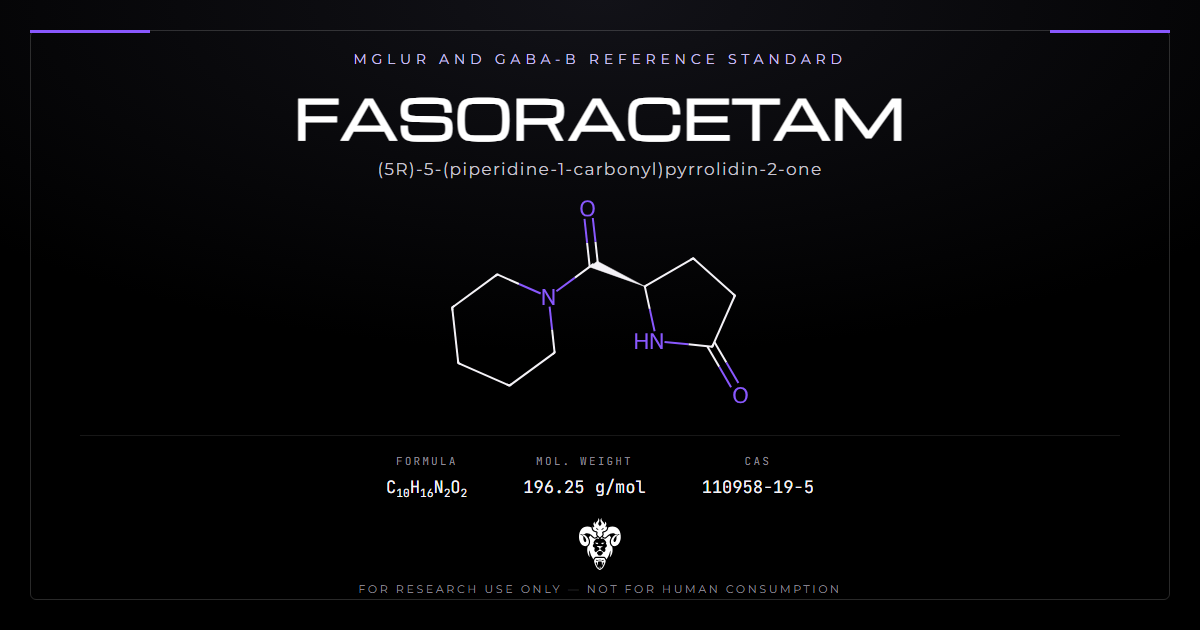
Fasoracetam breaks the pattern of its class in three separate ways. It is supplied as a single defined enantiomer where oxiracetam is a racemate. It has an identified receptor family where most racetams have none. And its solid form melts at 57 degrees Celsius [2].
That melting point is low enough for a summer shipment to arrive as a liquid. The compound exists in three crystalline forms with different water content. Indexed papers on a genotype-selected programme exist [1][10]. Those human endpoints sit outside the scope of this profile.
All information here describes laboratory research findings. This material is supplied for research use only and is not for human or veterinary use.
What fasoracetam is
Nippon Shinyaku developed the compound as NS-105 for cognitive disorders. It later carried the codes LAM-105, NFC-1 and AEVI-001 [3]. The structure is a pyrrolidinone bearing a piperidine amide, built on D-pyroglutamic acid.
Identity and physical data
| Property | Value |
|---|---|
| Compound | Fasoracetam |
| Development codes | NS-105, LAM-105, NFC-1, AEVI-001 |
| PubChem CID | 198695 |
| CAS number | 110958-19-5 |
| Molecular formula | C10H16N2O2 |
| Molecular weight | 196.25 g/mol |
| InChIKey | GOWRRBABHQUJMX-MRVPVSSYSA-N |
| Systematic name | (5R)-5-(piperidine-1-carbonyl)pyrrolidin-2-one |
| Stereochemistry | Single (5R) enantiomer |
The stereo block tells you this is not a racemate
The InChIKey ends MRVPVSSYSA rather than UHFFFAOYSA. That second block encodes stereochemistry, and a defined block means the record describes one enantiomer rather than a mixture. The systematic name carries the same information in the 5R designation, and the older literature writes it as the D-proline derivative.
This matters for anyone working across the class. Oxiracetam requires a chiral method to characterise fully. Fasoracetam does not, because it is manufactured as a single enantiomer. An achiral purity assay answers the composition question, provided the synthesis started from resolved material.
The D-pyroglutamic acid origin is the reason that last proviso exists. If the route started from racemic pyroglutamate and never resolved it, the vial is a different reagent from the PubChem record. The InChIKey would then be wrong, even if the formula still reads C10H16N2O2. Ask for the starting material, not only the area percent.
Hydrate forms and the melting point problem
A 2017 solid state study found three crystalline forms: two hydrates and one anhydrous [2]. Under ambient conditions hydrate form I is the most stable.
Why 57 degrees is a practical constraint
Hydrate form I melts at 57 degrees Celsius (DOI). Those authors noted directly that this low melting point, combined with possible water loss, causes formulation problems and constrains storage.
Consider what that means in transit. A parcel in a vehicle in direct sun exceeds 57 degrees routinely. A solid that melts and resolidifies has not decomposed, and it will still assay as pure. It may no longer be the same crystalline form, and its water content may have changed.
What to check on receipt
Inspect for evidence of melting: fused mass, glassy appearance, or material that has flowed and reset against the container wall. None of these makes the compound unusable for most purposes. All of them mean the solid form is no longer the one that shipped.
For quantitative work where water content affects the mass calculation, determine it directly rather than assuming the hydrate stoichiometry. Karl Fischer titration answers this. The difference between anhydrous and monohydrate for this structure is roughly 8 percent of mass, which propagates straight into any concentration derived by weighing.
Storage that respects the polymorphism
Store the solid cool and sealed with desiccant. Avoid cycling between warm and cold, since repeated water uptake and loss can convert between forms. A stable cold room beats a fridge that is opened twenty times a day. Where a specific solid form matters, characterise it by differential scanning calorimetry or powder X-ray diffraction rather than inferring it from the label.
Storage guidance is a house recommendation. Analytical documentation is per-lot release testing.
The piperidine amide is the polar handle. It is also the bond that opens in the dog oxidative metabolite that accounts for about 20 percent of urinary radioactivity [8]. Rats and monkeys make the hydroxylated piperidine species at 1 to 6 percent and stop there. A lot that has sat warm and wet can pick up the same ring-opened mass increment without ever seeing a liver. Intact mass against 196.25 is the first check after a melted shipment, not a purity area percent alone.
Metabotropic glutamate receptor pharmacology
The mechanistic literature centres on mGluR modulation, and the finding is bidirectional in an unusual way.
Opposite effects on adenylyl cyclase through different subclasses
In cultured mouse cortical neurons, fasoracetam inhibited forskolin-stimulated cyclic AMP formation at 0.1 and 1 micromolar [4]. That inhibition depended on pertussis-toxin-sensitive G proteins. After pertussis toxin pretreatment, the same compound enhanced cyclic AMP formation instead, and cholera toxin reversed that enhancement.
Antisense work assigned the two directions to different receptor groups [5]. Group II and group III mGluR subclasses carried the inhibitory action. Group I carried the facilitatory one. Selective antagonists gave the same answer in cerebrocortical membranes.
It antagonises where it does not activate
The same 1997 work found that fasoracetam did not enhance phosphoinositide hydrolysis, while a reference mGluR agonist did [4]. More than that, it attenuated the agonist-induced increase. So the compound behaves as an activator at cyclase-coupled subclasses and as an antagonist at the phosphoinositide-linked ones.
A mixed profile of this kind makes it a poor choice as a general mGluR agonist control. It also makes it interesting, because the direction of effect depends on which subclasses a preparation expresses.
GABA-B receptor upregulation
A second mechanism separates this compound from every other racetam.
The baclofen experiments
Fasoracetam reversed the inhibition of cyclic AMP formation induced by baclofen, a GABA-B agonist [6]. Repeated administration then increased the number of GABA-B receptors in rat cerebral cortex, with no change to beta-adrenoceptor or 5-HT2 binding properties.
Receptor upregulation after repeated dosing is a different kind of claim from an acute binding effect. It implies an adaptive change rather than direct occupancy, and it requires repeated administration to appear.
The comparison that isolates it
A 1999 study tested fasoracetam against aniracetam, bifemelane, idebenone and indeloxazine across several amnesia models [7]. Aniracetam improved scopolamine-induced disruption, and the other three references did not. On baclofen-induced memory disruption, fasoracetam reversed the deficit and every reference compound failed.
That single comparison is the strongest evidence that the GABA-B action is specific to this molecule rather than general to nootropics. The same study reported increased acetylcholine release in cerebral cortex and enhanced high-affinity choline uptake in both cortex and hippocampus, with no change in choline acetyltransferase activity.
Pharmacokinetics across species
Disposition was characterised thoroughly during the original development programme.
Absorption and elimination
Radiolabelled studies in rats, dogs and monkeys found near-complete absorption from the small intestine with very limited first-pass metabolism [8]. Systemic availability came to 97 percent in rats, 90 percent in dogs and 79 percent in monkeys. Intravenous elimination half-lives ran 0.67, 2.1 and 1.3 hours respectively.
Unchanged compound accounted for most plasma radioactivity in every species. Renal excretion dominated elimination, with roughly 90 percent of a dose recovered unchanged in urine for rats and monkeys and 60 percent for dogs. Serum protein binding measured below 3.3 percent across all species tested, including human material.
Very low protein binding simplifies free-concentration calculations considerably. It also means displacement interactions are unlikely to matter.
Distribution and repeated dosing
Tissue radioactivity peaked within 30 minutes of oral administration, indicating rapid absorption and distribution [9]. Kidney and stomach carried the highest concentrations, white fat the lowest. Concentrations fell with plasma and approached detection limits by 24 hours.
Repeated administration produced no marked accumulation, with steady state reached inside a week. Hepatic drug-metabolising enzyme activities did not change after repeated dosing at 10 mg/kg. In pregnant rats, fetal concentration reached 66 percent of maternal plasma, and milk concentration approximated plasma.
Metabolites worth knowing
Dog urine contained four metabolites, the largest being an oxidative product with cleavage of the piperidine ring at 20 percent of urinary radioactivity [8]. Hydroxylated piperidine metabolites accounted for smaller fractions. Rats and monkeys produced the same two hydroxylated species at 1 to 6 percent and did not produce the others.
Behavioural findings by model
Findings stay bound to the model that produced them.
Amnesia reversal across cholinergic lesions
Fasoracetam reversed memory disruption in passive avoidance and radial arm maze tasks after scopolamine, electrolytic lesion of the nucleus basalis magnocellularis, AF64A, cerebral ischaemia and electroconvulsive shock [7]. Breadth across mechanistically distinct insults suggests action on a shared downstream step.
The forced swimming and learned helplessness work
Oral doses from 1 to 100 mg/kg decreased immobility time in the forced swimming test [6]. Repeated administration reversed escape failure in a shuttle box after inescapable footshock.
The mechanistic control here is the informative part. Fasoracetam did not inhibit monoamine uptake in vitro, and it did not change monoamine concentrations in brain tissue or extracellular fluid. Whatever produced the behavioural result, it was not the mechanism that conventional antidepressants use.
Indexed papers and the genotype story
Indexed papers on a genotype-selected programme exist [1][10]. Human endpoints from those papers sit outside this profile.
What those papers are
Elia and colleagues published a short open-label study in adolescents who carried mutations in mGluR network genes [1]. A later review placed that paper among programmes that selected subgroups by pathway rather than by diagnosis alone [10]. Mutation status was double-blinded in the primary paper. That is a design fact, not a use claim.
What this profile will not quote
It will not quote human milligram ladders, symptom scores, or adverse-event comparisons [1]. Those sentences turn a research article into a use document. The papers remain cited so a reader can find them.
Why the genetics still matter in the laboratory
Selecting a preparation by variants in the receptor family the compound acts on is a coherent bench idea. The published human record does not settle whether that idea works in people. Independent replication of the GABA-B upregulation would answer a mechanistic question the trial never asked [6].
Analytical characterization
Identity work is straightforward. Solid form work is not.
Routine identity and purity
Reversed-phase HPLC with ultraviolet detection resolves the compound and process impurities. Detection sensitivity is modest, since the structure has no aromatic ring. Mass spectrometry against 196.25 confirms identity, and proton NMR resolves the piperidine ring protons against the pyrrolidinone.
What a standard certificate will not report
Two things. Water content, which varies with the crystalline form and changes the effective mass. And solid form itself, which needs calorimetry or diffraction rather than chromatography [2]. Neither appears on a routine purity panel, and both matter more here than for the other racetams. Batch documentation for catalogue material sits in the certificate of analysis database.
Differential scanning calorimetry is the useful extra test
For a compound with three solid forms and a 57 degree melting point, calorimetry answers more questions per run than any chromatographic method. A single scan reports the melting endotherm, any dehydration event preceding it, and whether a second form is present as a shoulder or a separate peak.
Run the scan slowly enough to separate dehydration from melting. The two events sit close together for hydrate form I, and a fast ramp merges them into one broad feature that reports neither cleanly. Pair the scan with thermogravimetric analysis where water content is the question, since mass loss on heating quantifies it directly and confirms whether the endotherm was dehydration or melting.
Chiral purity is a synthesis question
Because the compound is made from resolved starting material rather than resolved at the end, enantiomeric purity depends on the route rather than on a final purification step. Where it matters, ask what the starting material was.
Fasoracetam among the other racetams
| Compound | Identified target | Supplied as | Analytical watch point |
|---|---|---|---|
| Piracetam | None | Free base | Standard purity |
| Oxiracetam | None | Racemate | Chiral ratio |
| Pramiracetam | None | Often sulfate | Counter-ion |
| Nefiracetam | Nicotinic receptors | Free base | Aryl isomers |
| Fasoracetam | mGluR, GABA-B | Hydrate | Water and solid form |
Broad receptor screening across the classical racetams returned no measurable affinity at the sites tested [11]. Fasoracetam and nefiracetam are the two members that sit outside that generalisation, and they sit outside it in different directions. Further reading across the series sits in the nootropics research library, and the reference standard ships against batch documentation.
Open questions and how to read this literature
The mechanistic work has one origin
Nearly all the receptor-level studies came from Nippon Shinyaku laboratories in Kyoto [4][5] and [6][7]. That is expected for a compound characterised by its originator. It also means the mGluR and GABA-B findings lack independent replication, and the strongest claims rest on one institution’s assays.
The disease switch was not driven by new preclinical work
Development later pointed at a genotype-defined population without a published preclinical programme in that model [1][10]. The rationale came from human genetics rather than from animal data. That is a legitimate route. It also means the animal literature above was not designed to support that later programme.
Solid form is undercharacterised in the biology
The 2017 solid state work postdates almost all the pharmacology [2]. Earlier studies did not report which crystalline form they used or its water content. For dissolved-compound experiments this changes little. For anything depending on accurate weighing, it introduces an unquantified error into the older record.
The class reviews predate the repurposing
A 2010 survey of piracetam-like drugs placed the compounds of this family into three subgroups and tracked their clinical fates (DOI). Fasoracetam does not feature in its main analysis, because the later genotype-selected papers had not appeared yet [12]. Reviews of the racetams written before 2018 therefore describe a different set of compounds from the current one.
That has a practical consequence for literature searching. A review is a snapshot, and this compound moved indication, sponsor and development code after most of the class reviews were written. Searching on the review’s terminology will miss the recent work, and searching on the recent terminology will miss the Nippon Shinyaku pharmacology. Both halves need separate queries.
Search the codes, not the name
The name change history makes this compound unusually hard to find completely. Work published before roughly 2000 uses NS-105 almost exclusively. The Drugs in R&D profile adds LAM-105 [3]. The later programme used NFC-1 and later AEVI-001 [1]. A single search on the current INN returns a fraction of the record.
One further hazard applies to automated searching. The string NFC matches unrelated literature in materials science, where it abbreviates nanofiber composite. A query built on that code alone returns papers on hydrogels and electrospinning alongside the pharmacology. Filter on the compound name or the CAS number rather than trusting the code.
What would settle the open questions
Independent replication of the GABA-B upregulation would answer the mechanistic question [6]. An adequately controlled study in a genotype-selected population would answer a different question. Neither has appeared. This profile does not treat the missing study as a use gap.
Frequently asked questions
Is fasoracetam a racemate?
No. It is the single (5R) enantiomer, and the defined stereo block in its InChIKey reflects that.
Why does it melt so easily?
The stable hydrate melts at 57 degrees Celsius [2]. Store cool, and inspect for signs of melting on receipt.
What receptors does it act on?
Metabotropic glutamate receptors, with opposite effects on adenylyl cyclase through different subclasses [4][5]. Repeated administration also upregulates GABA-B receptors [6].
Is it the same compound as nefiracetam?
No. The development codes look similar and the compounds are different. Fasoracetam is NS-105 and NFC-1, CAS 110958-19-5. Nefiracetam is DM-9384.
Does this page report human outcomes?
No. Indexed papers on a genotype-selected programme are listed so they can be found [1][10]. This profile stops at chemistry, receptor logic and animal systems.
How is it eliminated?
Renally, and largely unchanged. Roughly 90 percent of a dose appears unmetabolised in rat and monkey urine [8].
Does it need a chiral purity method?
Not in the way oxiracetam does. The compound is built from resolved starting material rather than resolved at the end, so enantiomeric purity follows from the synthetic route. Ask what the starting material was where the answer matters.
Why does protein binding get mentioned so often?
Because it is unusually low, below 3.3 percent across every species tested [8]. Free concentration therefore approximates total concentration, which removes a correction that most compounds require. It also makes displacement interactions with other bound compounds unlikely.
Should the water content be measured before weighing?
For quantitative work, yes. Three crystalline forms exist with different water content, and the difference between anhydrous and monohydrate runs to roughly 8 percent of mass [2]. That error passes directly into any concentration calculated by weighing.
What happened to the original indication?
Nippon Shinyaku developed it under the code NS-105 [3]. The compound later reappeared under different sponsorship and different codes [1]. Search both halves of that history.
References
- Elia J, Ungal G, Kao C, et al. Fasoracetam in adolescents with ADHD and glutamatergic gene network variants disrupting mGluR neurotransmitter signaling. Nat Commun. 2018;9(1):4. PubMed DOI
- Harmsen B, Robeyns K, Wouters J, Leyssens T. A Study of Fasoracetam’s Solid State Forms. J Pharm Sci. 2017;106(5):1317-1321. PubMed DOI
- Fasoracetam. LAM 105, NS 105. Drugs R D. 1999;2(2):135-6. PubMed DOI
- Oka M, Itoh Y, Tatsumi S, et al. A novel cognition enhancer NS-105 modulates adenylate cyclase activity through metabotropic glutamate receptors in primary neuronal culture. Naunyn Schmiedebergs Arch Pharmacol. 1997;356(2):189-96. PubMed DOI
- Hirouchi M, Oka M, Itoh Y, et al. Role of metabotropic glutamate receptor subclasses in modulation of adenylyl cyclase activity by a nootropic NS-105. Eur J Pharmacol. 2000;387(1):9-17. PubMed DOI
- Shimidzu T, Itoh Y, Oka M, et al. Effect of a novel cognition enhancer NS-105 on learned helplessness in rats: possible involvement of GABA(B) receptor up-regulation after repeated treatment. Eur J Pharmacol. 1997;338(3):225-32. PubMed DOI
- Ogasawara T, Itoh Y, Tamura M, et al. Involvement of cholinergic and GABAergic systems in the reversal of memory disruption by NS-105, a cognition enhancer. Pharmacol Biochem Behav. 1999;64(1):41-52. PubMed DOI
- Mukai H, Sugimoto T, Ago M, Morino A. Pharmacokinetics of NS-105, a novel cognition enhancer. 1st communication. Arzneimittelforschung. 1999;49(11):881-90. PubMed DOI
- Mukai H, Sugimoto T, Ago M, et al. Pharmacokinetics of NS-105, a novel cognition enhancer. 2nd communication. Arzneimittelforschung. 1999;49(12):977-85. PubMed
- Nageye F, Cortese S. Beyond stimulants: a systematic review of randomised controlled trials assessing novel compounds for ADHD. Expert Rev Neurother. 2019;19(7):707-717. PubMed DOI
- Gouliaev AH, Senning A. Piracetam and other structurally related nootropics. Brain Res Brain Res Rev. 1994;19(2):180-222. PubMed DOI
- Malykh AG, Sadaie MR. Piracetam and piracetam-like drugs: from basic science to novel clinical applications to CNS disorders. Drugs. 2010;70(3):287-312. PubMed DOI