
Most of the compounds that pass through a research catalog have a shallow paper trail — a handful of abstracts, a patent, and a lot of secondhand summary. GB-115 is the opposite problem. It has close to two decades of continuous investigation behind it, a completed Phase 3 program, and a registered follow-up study, and almost none of that record is written in English. What circulates instead is a compressed version that flattens the interesting parts.
This article rebuilds the record from primary sources: how the molecule was designed, what its receptor pharmacology actually looks like in the published data, what the behavioral work established, and where the evidence base is genuinely thin. Kimera Chems supplies GB-115 as research-use-only material, and this review is written as literature context for investigators, not as guidance for any other application.
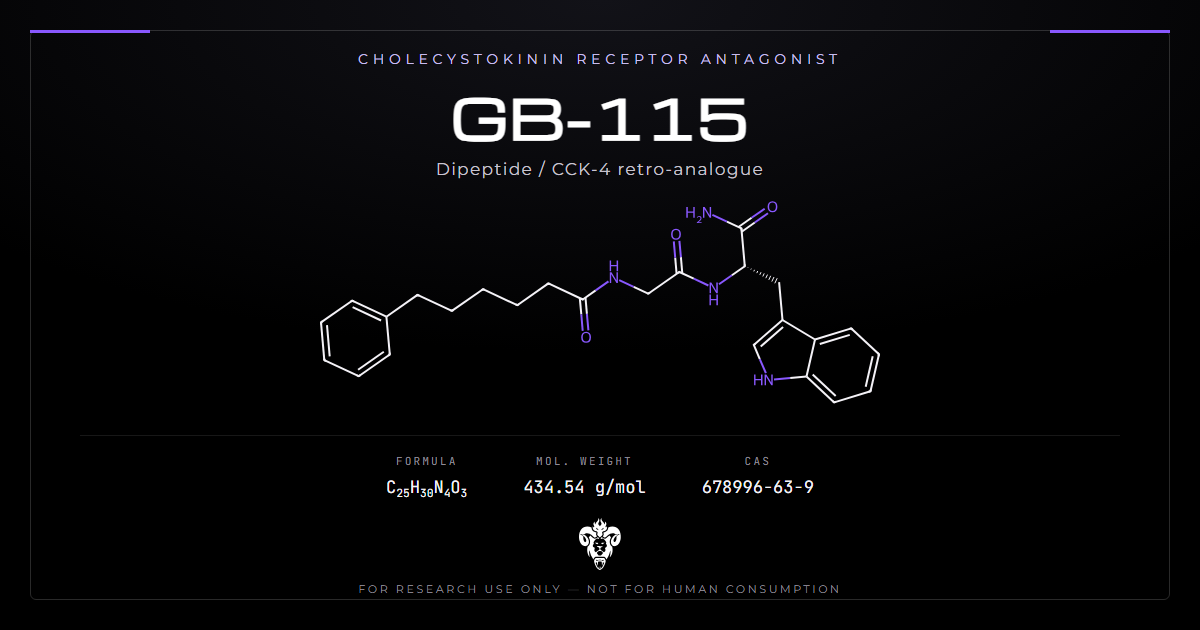
Chemical Identity
| Property | Value |
|---|---|
| Common designation | GB-115 |
| Systematic name | N-(6-phenylhexanoyl)glycyl-L-tryptophanamide |
| IUPAC name | N-[2-[[(2S)-1-amino-3-(1H-indol-3-yl)-1-oxopropan-2-yl]amino]-2-oxoethyl]-6-phenylhexanamide |
| Shorthand | Ph(CH₂)₅CO-Gly-L-Trp-NH₂ |
| CAS registry number | 678996-63-9 |
| Molecular formula | C₂₅H₃₀N₄O₃ |
| Molecular weight | 434.54 g/mol |
| PubChem CID | 11281948 |
| Pharmaceutical designation | Ranquilon (1 mg tablet, Russian Federation) |
| Classification | Synthetic dipeptide amide |
The molecule is small by peptide standards. A six-carbon phenylhexanoyl chain caps the N-terminus, a glycine spacer sits in the middle, and L-tryptophanamide closes the C-terminus. Two internal amide bonds, one terminal primary amide, one indole, one phenyl. That is the entire structure — and the simplicity is the point, as the design history makes clear.
Design Origin: A Retro-Analog, Not a Fragment
GB-115 came out of the V. V. Zakusov Research Institute of Pharmacology in Moscow, from the medicinal chemistry group led by T. A. Gudasheva. This is the same program that produced Noopept, and the underlying philosophy is identical: take an endogenous regulatory peptide, identify the minimal pharmacophore, and rebuild it as a drug-like dipeptide.
The starting point was cholecystokinin-4 (CCK-4), the C-terminal tetrapeptide fragment of cholecystokinin and one of the most reliable anxiogenic agents in experimental pharmacology. Gudasheva’s group applied the topochemical Shemyakin–Ovchinnikov–Ivanov principle to generate a series of dipeptide analogs with the general formula Ph(CH₂)ₙCO-NH(CH₂)ₘCO-Trp-NH₂ (n = 1, 3–5; m = 1–3).
Two findings from that series are worth holding onto:
- Stereochemistry flipped the sign of the effect. The L-tryptophan derivatives were anxiolytic. The D-tryptophan derivatives were anxiogenic. Same scaffold, opposite behavioral direction.
- Chain length mattered. Of the whole series, Ph(CH₂)₅CO-Gly-L-Trp-NH₂ — the n=5, m=1 member — was selected for development on the basis of activity in rats in the 0.05–0.2 mg/kg range by both oral and intraperitoneal routes.
The term retro-analog is doing real work here. GB-115 is not a truncated piece of CCK-4. The peptide backbone runs in the reverse direction relative to the parent sequence, which is what makes it an antagonist rather than a weaker agonist, and what gives it resistance to the peptidases that would shred a native fragment. This design logic — retro-inverso and retro topology as a route to protease stability — recurs across the modern research-peptide space, including in compounds like MID-35 built on the same principle for entirely different targets.
The Active Conformation
A follow-up conformational study using ¹H NMR in solution, combined with SAR across sterically restricted analogs, identified the bioactive conformation. Compounds capable of adopting a β-turn were active; those constrained into γ-turn geometry were not. Nuclear Overhauser effect data narrowed it further to a β-II turn. This is one of the more useful facts about GB-115 for anyone doing docking or analog work, and it is buried in a Russian-language 2013 paper that almost never gets cited in secondary summaries.
Receptor Pharmacology: The Part That Isn’t Settled
Here the literature deserves more care than it usually gets.
GB-115 was designed against a CCK-4 template, and CCK-4 acts principally at the CCK-2 (CCK-B) receptor. The early Zakusov publications describe the GB series simply as “peptide antagonists of central cholecystokinin receptors” without committing to a subtype. A 2012 study then established the functional relationship directly: GB-115 prevented CCK-4-induced anxiety in C57Bl/6 mice and outbred rats, and the authors concluded that CCK-4 and GB-115 share a common pharmacological target.
Yet the later clinical and primate literature consistently labels GB-115 a CCK-1 receptor antagonist. The 2019 clinical report characterizes it as a low-affinity blocker of central cholecystokinin receptors. And a 2011 conference abstract from the same group is titled, plainly, “Dipeptide anxiolytic GB-115: new receptor targets.”
Three things follow from reading these together:
- The subtype assignment shifted over time and the published rationale for the shift is not fully accessible in English. Any statement that GB-115 is a “selective CCK-1 antagonist” is repeating a label, not a binding constant.
- Affinity is described as low by the developers themselves. That is unusual language for a group promoting its own compound, and it should be taken at face value.
- The group’s own abstract points to targets beyond CCK. Secondary summaries circulating online assign GB-115 activity at bombesin BRS3 and kappa-opioid receptors. Those claims trace back to sources far weaker than the primary pharmacology papers and should not be treated as established.
Separately, a 2007 study examined GB-115’s antinociceptive and anxiolytic properties specifically through the lens of cholecystokinin–opioid system interaction. That framing is well-grounded independent of GB-115: CCK is a canonical anti-opioid peptide, and CCK receptor blockade is a known route to modulating opioid antinociception. It remains one of the more mechanistically interesting open threads on this molecule.
The Preclinical Behavioral Record
The behavioral work is the deepest part of the file, and it has one consistent feature that distinguishes GB-115 from conventional anxiolytics.
Effects are phenotype-dependent. Across studies, GB-115 acted in animals with a high-anxiety emotional stress phenotype and did substantially less in low-anxiety phenotypes. In BALB/c mice it increased locomotor activity in the open field; in C57Bl/6 mice, nothing. In MR rats it produced anxiolytic effects in the elevated plus-maze and conflict tests; in MNRA rats it did not. The developers describe this as anxioselectivity — the compound normalizes rather than sedates, which is also why sedation and myorelaxation are absent from the reported profile.
Pharmacological challenge studies. GB-115 blocked CCK-4-induced anxiety in both rats and C57Bl/6 mice. Notably, the α2-adrenoceptor antagonist yohimbine did not modulate GB-115’s effects in BALB/c mice, arguing against a noradrenergic mechanism.
Route-dependent potency. This is a practical detail with real experimental consequences. The intraperitoneal active range was reported as 0.006–0.100 mg/kg. Orally, the range shifted to 0.1–5.0 mg/kg — roughly one to two orders of magnitude. In the oral study, GB-115 increased time in open arms at 0.5–0.7 mg/kg in outbred rats and at 0.1 mg/kg in BALB/c mice. Anyone designing a study around published figures needs to match the route, or the numbers will not transfer.
Non-human primates. A more recent study ran GB-115 against phenazepam in four male rhesus macaques under individual-housing stress. Both compounds reduced time spent in the upper cage region, a behavioral stress index. GB-115 also lowered the serum cortisol/DHEA-S ratio — a biomarker-level readout rather than a purely observational one.
Chronic administration. Long-term dosing studies compared GB-115 with diazepam during and after withdrawal. The reported result is retained efficacy without tolerance development and without a withdrawal syndrome on discontinuation. For a compound in the anxiolytic space this is the headline claim, and it is the one most in need of independent replication.
Other reported activities. Published work also covers anti-inflammatory effects and immunocorrecting properties. These are peripheral to the main program, are individually thin, and are best treated as leads rather than characterized properties.
The Clinical Program
Unlike most compounds that reach research-chemical catalogs, GB-115 has a real clinical file.
An early pilot in generalized anxiety disorder enrolled 31 patients (22 women, 9 men, ages 22–53) with an ICD-10 F41.1 diagnosis over 21 days, using the Hamilton Anxiety Rating Scale, Spielberger State-Anxiety Inventory, MFI-20, CGI, and a computerized cognitive battery. A post-hoc analysis of 25 evaluable patients reported HARS totals declining from a median of 22 at baseline to 5 by day 21, with MFI-20 fatigue scores falling in parallel. The authors characterized the effect as anxiolytic with mild psychostimulant properties, and reported no stimulation-related adverse events.
That work fed into a double-blind, randomized, placebo-controlled, multicenter Phase 3 trial of Ranquilon (Valenta Pharm, Russian Federation) in 220 patients with anxiety secondary to neurasthenia or adjustment disorder, registered as NCT05586789 and completed in January 2023. Entry required a HARS score of 18–24, MFI-20 above 50, and CGI-S of at least 4. A Phase IV open-label comparative study against afobazole is registered as NCT06843044.
Two caveats belong alongside those results. First, essentially the entire body of work — preclinical and clinical — originates from one institute and its commercial partner. There is no independent replication in the international literature. Second, GB-115 has no approval outside the Russian Federation and no FDA review of any kind. Specific human regimens from the clinical papers are deliberately not reproduced here; they are available in the cited primary sources for investigators who need them.
Practical Notes for Research Handling
Three points come up repeatedly with this compound:
Identity confirmation matters more than usual. GB-115 is structurally adjacent to a whole synthesized series — the same scaffold with different chain lengths, different spacers, and critically the D-Trp epimer that produces the opposite behavioral effect. Chromatographic purity alone does not resolve that. Identity work capable of confirming stereochemistry is the relevant question for this molecule, not a purity percentage in isolation.
Solubility follows the structure. Two aromatic systems and a six-carbon aliphatic chain against a short peptide backbone make this a poorly water-soluble molecule, which is consistent with the appearance of oil-based and encapsulated formats alongside neat powder.
Route determines the numbers. As above — the published oral and intraperitoneal ranges differ by one to two orders of magnitude. Protocol design that ignores this will not reproduce the literature.
Every Kimera lot ships against third-party COA verification, and batch documentation is available in the COA archive. Researchers working across the Zakusov-lineage dipeptides may also want Noopept, which came out of the same institute and the same design philosophy, or Bromantane as a mechanistically unrelated comparator from the same broader Russian pharmacological program.
Where the Evidence Actually Stands
GB-115 is a well-characterized molecule with a poorly distributed evidence base. The chemistry is solid and reproducible. The design rationale is elegant and documented. The behavioral pharmacology is internally consistent across roughly twenty years and multiple species, including primates. A Phase 3 trial was completed and a Phase IV study is registered.
Against that: single-source concentration, a language barrier that has kept the work out of the international conversation, receptor pharmacology that is described as low-affinity by the developers and has never been pinned to a subtype with public binding data, and zero independent replication of the central tolerance and withdrawal claims.
That combination — genuinely deep primary literature, genuinely absent external validation — is exactly the profile that makes a compound interesting to work on and easy to overstate. The references below are the primary sources; they are worth reading directly.
References
- Gudasheva TA, Kir’yanova EP, Kolik LG, Konstantinopol’skii MA, Seredenin SB. Design and synthesis of cholecystokinin-4 dipeptide analogues with anxiolytic and anxiogenic activities. Russian Journal of Bioorganic Chemistry. 2007;33(4):383–389. doi:10.1134/S1068162007040036. PMID 17886432
- Gudasheva TA, Lezina VP, Kir’yanova EP, Deeva OA, Kolik LG, Seredenin SB. The study of biologically active conformation of cholecystokinin-4 dipeptide analog GB-115. Bioorganicheskaia Khimiia. 2013;39(3):293–302. doi:10.1134/S1068162013030060. PMID 24397028
- Kolik LG, Gudasheva TA, Seredenin SB. Role of the cholecystokinin system in anxiolytic activity of dipeptide GB-115. Bulletin of Experimental Biology and Medicine. 2012;153(6):852–855. doi:10.1007/s10517-012-1842-1. PMID 23113301
- Kolik LG, Konstantinopolsky MA, Ryibina IV, Povarnina PY, Gudasheva TA, Seredenin SB. Anxiolytic activity of dipeptide GB-115 after oral administration. Bulletin of Experimental Biology and Medicine. 2013;155(2):200–203. doi:10.1007/s10517-013-2112-6. PMID 24130989
- Kolik LG, Gudasheva TA, Seredenin SB. P.4.004 Dipeptide anxiolytic GB-115: new receptor targets. European Neuropsychopharmacology. 2011;21:S146–S147. doi:10.1016/S0924-977X(11)70177-8
- Kolik LG, Zhukov VN, Seredenin SB. Manifestations of the antinociceptive and anxiolytic properties of the compound GB-115: interactions of cholecystokinin and opioid systems. Eksperimental’naia i Klinicheskaia Farmakologiia. 2007;70(2):8–11.
- Neznamov GG, Dorofeeva OA, Metlina MV, Syunyakov TS, Minaev SV, Ivashkina NY, Martyanov VA, Seredenin SB. Results of a clinical study of a new anxiolytic, a blocker of central cholecystokinin receptors. Zhurnal Nevrologii i Psikhiatrii im. S.S. Korsakova. 2019;119(8):53–60. doi:10.17116/jnevro201911908153. PMID 31626171
- Dorofeeva O, Syunyakov T, Metlina M, Ivashkina N. Clinical effects of central antagonist of cholecystokinin-1 receptors GB-115 in patients with Generalized Anxiety Disorder. European Psychiatry. 2022;65(S1):S388. doi:10.1192/j.eurpsy.2022.981. PMC9564032
- Influence of Retrodipeptide Analogue of Cholecystokinin Tetrapeptide (GB-115) and Phenazepam on the Behavior of Rhesus Monkeys under Isolation Conditions. Doklady Biochemistry and Biophysics. 2024. doi:10.1134/S1607672924701254
- Karavayeva TA, Krupitsky EM, Barinov AN, Kolik LG, Khacheva KK. Efficacy and safety of Ranquilon® in the therapy of patients with anxiety associated with neurasthenia and adjustment disorder: results of the double-blind, randomized, placebo-controlled, multicenter phase 3 clinical trial. 2024.
- ClinicalTrials.gov. A Study of the Efficacy and Safety of Ranquilon Tablets in Patients With Anxiety in Neurasthenia and Adjustment Disorders. Identifier NCT05586789. Sponsor: Valenta Pharm JSC. Completed January 2023.
- ClinicalTrials.gov. Efficacy and Safety of Ranquilon in Patients With Anxiety Disorders Due to Neurasthenia and Adjustment Disorders. Identifier NCT06843044. Phase IV, open-label, comparative vs. afobazole.
- PubChem Compound Summary. L-Tryptophanamide, N-(1-oxo-6-phenylhexyl)glycyl-, CID 11281948. National Center for Biotechnology Information.
Research Use Only. GB-115 is supplied by Kimera Chems for laboratory research use only. It is not a dietary supplement, drug, or medical device, and it is not for human or veterinary consumption or any household application. It has not been evaluated or approved by the U.S. Food and Drug Administration for any use. All literature described above is reported for scientific context and does not constitute a recommendation, protocol, or guidance for any application. Purchasers are responsible for compliance with all applicable regulations and for obtaining institutional approval where required. See our Terms and Conditions prior to ordering.