
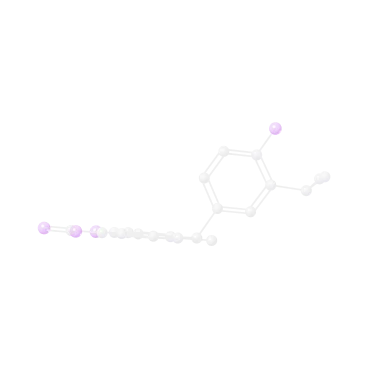
Calculated reference model · not an experimental or batch-certified structure. All 24 atoms shown.
Model data & sources
- Heavy atoms only; hydrogens are omitted from the reference display.
- Source-defined stereochemistry is checked against the calculated coordinates; no energy-minimum, crystal or solution-structure claim is made.
- Reference molecular species only; batch identity, purity, counterions and excipients are not certified.
- Formula
- C20H24O4
- Method
- RDKit ETKDGv3 / MMFF94s calculated reference conformer
GC-1 Sobetirome
GC-1 (Sobetirome)
GC-1 (Sobetirome) is a highly selective, non-iodinated thyromimetic agent designed as a small-molecule agonist of the thyroid hormone receptor beta (TRβ) isoform. By demonstrating high selectivity for TRβ over TRα, GC-1 is extensively studied as a tool compound for investigating the uncoupling of beneficial metabolic pathways—such as cholesterol regulation and lipid catabolism—from the traditional thyrotoxic side effects typically induced by systemic thyroid hormone receptor activation in cardiac and skeletal tissues.
Structural Attributes to Note: The chemical structure consists of a diarylmethane scaffold with a substituted phenoxyacetic acid side chain. This arrangement allows for deep, selective binding within the ligand-binding pocket of the TRβ isoform. Unlike native thyroid hormones (T3/T4), GC-1 lacks iodine atoms, which alters its metabolic profile and receptor affinity, making it an essential reference ligand for mapping the transcriptional pathways associated with hepatic lipid homeostasis.
Physical & Handling Properties
| Property | Specification |
|---|---|
| Physical Appearance | White to off-white crystalline solid |
Research Applications & Mechanism of Interest
The utility of GC-1 within metabolic and endocrinological research focuses on its ability to mimic specific thyroid hormone functions while avoiding systemic hyperthyroid-like cascades.
Primary fields of in vitro and preclinical laboratory investigation include:
-
TRβ Selective Signaling: Mapping the transcriptional pathways recruited upon selective binding to TRβ1. Researchers utilize GC-1 to isolate hepatic metabolic responses from those modulated by the alpha-isoform (TRα1), which is predominantly expressed in the heart and skeletal muscle.
-
Lipid & Cholesterol Homeostasis: Evaluating the upregulation of genes involved in bile acid synthesis, cholesterol efflux (e.g., SR-B1), and triglyceride catabolism within hepatic cell models.
-
Metabolic Energy Expenditure: Investigating the compound's capacity to stimulate localized energy expenditure and mitochondrial respiration pathways in diet-induced obesity models without increasing heart rate or systemic oxygen consumption.
-
Regenerative Signaling: Studying the role of TRβ-mediated Wnt/β-catenin signaling in promoting hepatocyte regeneration and proliferation in chronic liver damage models.
Storage & Handling Guidelines
Store at controlled room temperature. Do not refrigerate or freeze. Cold storage may cause the solution to cloud or precipitate. If this occurs, return to room temperature and mix until clear.
Storage guidance is a house recommendation. Analytical documentation is per-lot release testing.
Related Research Compounds
Further reading: GC-1 Sobetirome research overview
Research Use Only Disclaimer: This product is labeled and sold "For Research Use Only — NOT FOR HUMAN CONSUMPTION." It is not a drug, dietary supplement, food, cosmetic, or medical device, and it is not approved by the FDA or any other regulator for human or veterinary use. It is supplied to approved account holders as a research chemical for laboratory use and must be handled in accordance with applicable law.
