
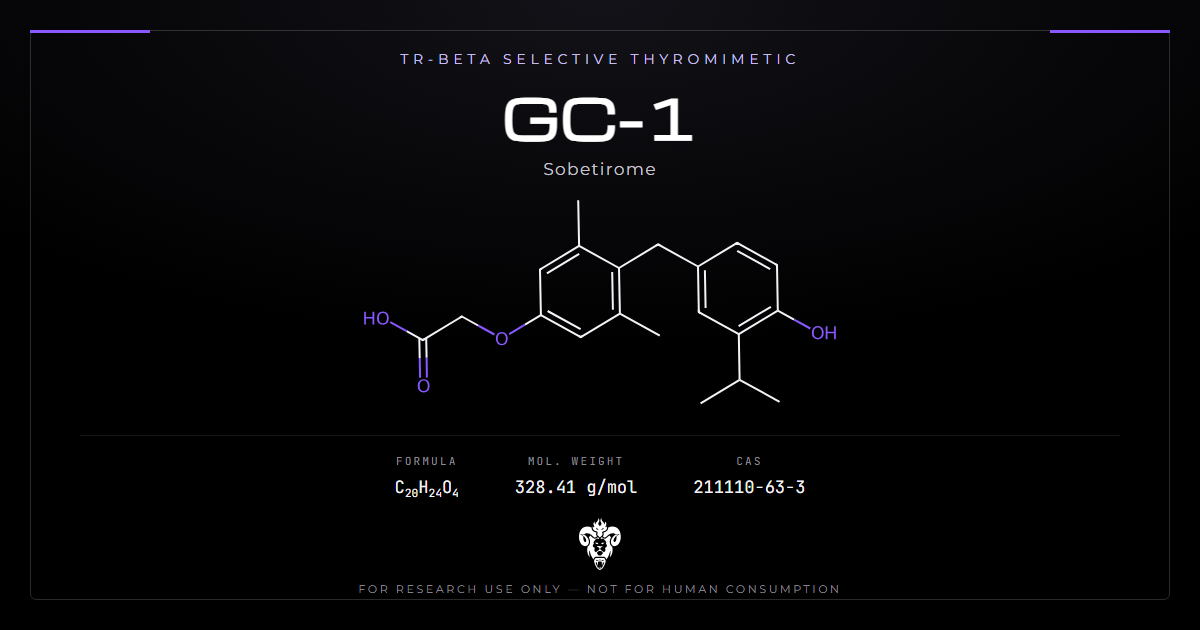
Thyroid hormone does a great deal that drug developers want and a great deal they do not. It lowers LDL cholesterol, drives hepatic lipid clearance, raises energy expenditure, and supports myelination. It also accelerates the heart, thins bone, and wastes skeletal muscle. For decades the field treated that bundle as inseparable. GC-1 sobetirome was the compound that argued otherwise.
Designed in Thomas Scanlan’s laboratory at UCSF in the mid-1990s and first reported in 1998, GC-1 (sobetirome) is an iodine-free synthetic analog of triiodothyronine (T3) that binds and activates thyroid hormone receptor β preferentially over TRα.¹ It has since travelled an unusual path: from a cholesterol-lowering candidate through Phase 1 human trials, into orphan-designated rare disease work, and finally into a chemistry lineage now producing positive Phase 2 psychiatric data. This reference covers its chemistry, its two independent layers of selectivity, what the preclinical literature actually shows, and how to verify identity and purity on receipt.
GC-1 Sobetirome is supplied strictly for laboratory research use. It is not approved for human or veterinary use in any jurisdiction, and nothing below should be read as guidance for administration.
Chemical Profile and Identifiers
| Property | Value |
|---|---|
| Compound name | GC-1; sobetirome; QRX-431 |
| Chemical name | 2-[4-[(4-Hydroxy-3-propan-2-ylphenyl)methyl]-3,5-dimethylphenoxy]acetic acid |
| CAS number | 211110-63-3 |
| Molecular formula | C₂₀H₂₄O₄ |
| Molecular weight | 328.41 g/mol |
| Monoisotopic mass | 328.1675 Da |
| InChIKey | QNAZTOHXCZPOSA-UHFFFAOYSA-N |
| PubChem CID | 9862248 |
| UNII | XQ31741E9Q |
| ChEMBL | CHEMBL107400 |
| DrugBank | DB07425 |
| Compound class | Halogen-free diarylmethane thyromimetic; aryloxyacetic acid |
| Receptor target | Thyroid hormone receptor β (TRβ1), partial selectivity over TRα1 |
| Calculated logP / TPSA | 4.19 / 66.8 Ų |
Four structural features govern both the pharmacology and the analytical behaviour: a free phenol, a carboxylic acid on an oxyacetic side chain, a methylene bridge in place of the biaryl ether, and complete absence of iodine. Each is a deliberate departure from T3.
The Design Logic Behind GC-1 Sobetirome
T3 is a synthetic nuisance. Three iodine atoms make it expensive to prepare, awkward to handle, and prone to deiodination chemistry that complicates analog work. Chiellini and colleagues set out to build a thyromimetic that avoided all of this, and made three coordinated substitutions relative to the natural hormone:¹
- Iodines replaced by alkyl groups. Two methyls on the inner ring and an isopropyl on the outer ring occupy the halogen pockets sterically without the halogen chemistry.
- Biaryl ether replaced by a methylene bridge. A simple CH₂ linker, dramatically easier to construct.
- Amino acid side chain replaced by oxyacetic acid. The alanine-derived side chain of T3 becomes a plain OCH₂COOH.
The intent was synthetic accessibility. The selectivity was, in the authors’ framing, a bonus — and it turned out to be the more consequential result. They closed the paper by suggesting the compound might serve as an in vivo probe for distinguishing the physiological roles of the two receptor isoforms.¹ That is more or less what happened.
Later crystallographic and molecular dynamics work examined why the selectivity exists at all, given how similar the two ligand-binding pockets are. Structures of both isoforms bound to GC-1 pointed to differing behaviour at a single divergent residue — Arg228 in TRα, which adopts multiple conformations, versus its TRβ counterpart — as a contributor to the discrimination.²
Receptor Selectivity: Read the Numbers Carefully
This is where a great deal of secondary coverage goes wrong, so it is worth being precise.
Sobetirome binds TRβ1 with roughly the same affinity as T3 does, while binding TRα1 with approximately ten-fold lower affinity than T3.¹ Commercial characterisation commonly cites dissociation constants near 0.1 nM at TRβ against 1.8 nM at TRα. Either way, the honest summary is a selectivity margin of about one order of magnitude in binding — meaningful, exploitable, and nowhere near absolute.
Functional potency figures are messier still. Published and vendor-quoted EC₅₀ values for GC-1 sobetirome range from single-digit nanomolar in some reporter constructs to roughly 0.16 µM in others. That spread reflects assay format, cell line, receptor construct, and readout — not disagreement about the molecule. Researchers should treat those numbers as non-interchangeable and anchor comparisons to a single assay system rather than pooling across sources.
The practical consequence of partial selectivity is that GC-1 sobetirome is a TRβ-preferring agonist, not a TRβ-exclusive one. At sufficient exposure, TRα engagement returns. Dose-response design matters accordingly.
Two Layers of Selectivity, Not One
The more interesting property is that receptor selectivity is only half the story. Sobetirome also distributes preferentially to the liver.³
Thyroid hormone does not diffuse freely into cells; it requires transporters including MCT8, MCT10, OATPs, and L-type amino acid transporters, whose expression varies by tissue. Hepatocytes predominantly express TRβ, while cardiomyocytes and osteoblasts predominantly express TRα. Sobetirome’s tissue distribution stacks a pharmacokinetic bias on top of its receptor bias, and the two together — not receptor selectivity alone — produce the liver-weighted profile observed in vivo.
Understanding this matters when interpreting results. A finding attributed to “TRβ selectivity” may in fact reflect where the compound went rather than which receptor it preferred once it arrived. The two mechanisms are separable in principle and frequently conflated in practice.
Preclinical Record
Lipids and Reverse Cholesterol Transport
The foundational in vivo comparison came in 2000. In hypothyroid mice dosed at equimolar levels against T3, GC-1 produced better triglyceride lowering and comparable cholesterol lowering. T3 raised heart rate and elevated mRNA for the HCN2 pacemaker channel; GC-1 did neither.⁴ That dissociation — lipid effect retained, cardiac effect absent — is the single result the entire thyromimetic field was built on.
Subsequent work in euthyroid mice showed the compound stimulated multiple steps of reverse cholesterol transport, raising hepatic SR-B1 and increasing markers of bile acid synthesis alongside reductions in serum cholesterol and triglycerides.⁵
Energy Expenditure and Body Composition
In adult rats treated for six weeks, sobetirome increased energy expenditure and prevented fat mass accumulation. At a twenty-fold dose, fat mass fell roughly 20% without reduced food intake or loss of lean mass.⁶ This is frequently the finding that draws non-specialist attention, and it is also the one most often stripped of its dosing context.
Hepatocyte Proliferation — A Caveat Worth Flagging
GC-1 is mitogenic in rodent liver. It induces hepatocyte and pancreatic acinar cell proliferation, acting through a β-catenin–dependent pathway, and recapitulates the proliferative effects of T3 after partial hepatectomy.⁷ For regenerative medicine research this is the point. For long-term or toxicology-adjacent study design it is a variable that must be controlled rather than assumed away.
A related caution appears in cholestasis models, where dietary GC-1 altered bile acid transporter expression — suppressing NTCP, Slco1b2, MRP2, and MRP3 — in a pattern associated with hepatic retention of toxic bile.⁸ Selectivity does not mean the absence of liability; it means a different liability profile.
The CNS Pivot: Prodrugs, Myelin, and X-ALD
The most significant chapter in sobetirome’s history began when investigators asked whether a thyromimetic could reach the brain.
The carboxylate is the obstacle. At physiological pH it is ionised, and charged molecules cross the blood–brain barrier poorly. Scanlan’s group at OHSU solved this with a prodrug campaign: mask the charge, let the neutral molecule partition into the CNS, then let endogenous brain enzymes unmask it.⁹ ˡ⁰ The optimised product, Sob-AM2, is an amide derivative that increases CNS distribution of sobetirome roughly ten-fold and improves the brain-to-serum ratio by approximately sixty-fold, while simultaneously lowering peripheral exposure.¹¹
That combination — more drug where you want it, less where you do not — is what made the rare disease programme viable.
X-Linked Adrenoleukodystrophy
X-ALD stems from mutations in ABCD1, a peroxisomal transporter for very long chain fatty acids (VLCFAs). VLCFAs accumulate, myelin degrades, neurological function declines. Sobetirome induces expression of ABCD2, a closely related transporter that can partially compensate for the defective one — a strategy the investigators termed pharmacological complementation.¹² In Abcd1 knockout mice, twelve weeks of Sob-AM2 produced up to 40% lowering of C26-LPC and 15–20% lowering of the C26/C22 ratio in the CNS, with no weight loss and better tolerability than sobetirome itself.¹³
Myelin Repair
The 2019 remyelination study is the most striking result in the compound’s file, and the reason is a control arm. Using gliotoxin models plus a genetic demyelination model with motor testing, histology, and MRI, chronic sobetirome or Sob-AM2 treatment improved both clinical signs and remyelination. Chronic thyroid hormone treatment in the same model inhibited endogenous myelin repair and made the disease worse.¹⁴
Selective agonism did not merely reduce side effects relative to the native hormone. It reversed the direction of the outcome. That result is the strongest published argument for why selective thyromimetics are studied at all.
MCT8 Deficiency
Because sobetirome enters cells independently of MCT8, it has been examined in Allan–Herndon–Dudley syndrome models, where MCT8 loss produces cerebral hypothyroidism alongside peripheral hyperthyroidism. In pregnant Mct8/Dio2 knockout dams, Sob-AM2 crossed placental and brain barriers and exerted thyromimetic effects in fetal tissue. Sobetirome itself, at the doses tested, led to spontaneous abortion.¹⁵ Investigators designing reproductive or developmental models should treat that finding as directly relevant.
Human Clinical Record and What Came After
Sobetirome reached the clinic as a lipid drug. QuatRx Pharmaceuticals ran two randomised, double-blind, placebo-controlled Phase 1 studies in healthy volunteers not enriched for elevated LDL. In the single-dose study of 32 subjects, LDL cholesterol fell up to 22% at doses up to 450 µg against 2% on placebo, with the largest reductions at 72 hours. In a multiple-dose study of 24 subjects over two weeks, LDL cholesterol fell up to 41% at 100 µg daily. The compound was reported as generally well tolerated, without significant change in heart rate or the thyroid axis.¹⁶ ˡ⁷
Phase 2 never followed. The programme did not advance, and sobetirome was later repositioned toward rare demyelinating disease via NeuroVia, which secured FDA orphan drug designation for X-ALD.¹⁸ A registered OHSU safety and pharmacodynamic study in X-ALD (NCT01787578) was withdrawn before enrolment pending protocol revision.¹⁹
The lineage continued through different molecules. Autobahn Therapeutics, co-founded by Scanlan, built a brain-targeting prodrug platform on this chemistry. Its lead asset elunetirom (ABX-002) — a CNS-penetrating prodrug delivering the TRβ agonist LL-340001, not sobetirome itself — received FDA orphan drug designation for X-ALD in 2021,²⁰ then pivoted to psychiatry. In June 2026 the company reported positive topline Phase 2 data in bipolar depression: a 16.8-point mean reduction in HAMD-17 at week 6 (p<0.001), with significance across all key secondary endpoints, following FDA Fast Track designation in May 2026.²¹ Topline data from the Phase 2 AMPLIFY trial in major depressive disorder (NCT06633016) are expected in Q3 2026.
Two qualifications belong on that result. AMPLIFY-BD was open-label and single-arm with 21 participants, a design that cannot separate drug effect from expectancy and regression to the mean; the MDD readout is the more informative test. And elunetirom is a distinct chemical entity. What it validates is the CNS-thyromimetic hypothesis that sobetirome established — not sobetirome.
Meanwhile the peripheral half of the thesis was confirmed elsewhere. Resmetirom (Rezdiffra), a structurally unrelated liver-directed TRβ agonist, received FDA accelerated approval in March 2024 for MASH with F2–F3 fibrosis — the first approved drug in the class.²² Twenty-six years after GC-1, the design premise holds.
GC-1 Sobetirome in Context
| GC-1 (sobetirome) | T3 (liothyronine) | Resmetirom | |
|---|---|---|---|
| Class | Halogen-free diarylmethane | Endogenous iodothyronine | Pyridazinone–triazine |
| Iodine content | None | Three | None (dichlorophenyl) |
| TRβ selectivity | ~10-fold over TRα | None | High |
| Tissue bias | Liver-preferring | None | Liver-directed |
| CNS penetration | Limited (parent); improved via Sob-AM2 prodrug | Transporter-dependent | Minimal by design |
| Regulatory status | Investigational; RUO only | Approved hormone therapy | FDA approved (accelerated), MASH |
| Furthest clinical stage | Phase 1 | — | Phase 3 / marketed |
The table makes the design trade-off visible. Resmetirom optimised hard for hepatic confinement and got approved. Sobetirome’s chemistry proved more useful when pushed the opposite direction — out of the periphery and into the brain.
Handling, Solubility, and Storage
- Storage: Store the solid sealed at controlled room temperature, protected from light and moisture. Prepare stock solutions close to use rather than holding them.
- Solubility: DMSO is the standard vehicle for in vitro work. Published in vivo preparations include dilution of concentrated DMSO stocks into saline to a final 20% DMSO, and preparation in dilute sodium hydroxide/saline.¹²
- Phenol oxidation: The free phenol is the most vulnerable feature in the molecule. Prolonged exposure to light, air, or elevated pH can generate quinone-type oxidation products. Aliquot rather than repeatedly opening a single container.
- Acid/base behaviour: With a carboxylic acid and a phenol, apparent solubility and chromatographic retention both shift sharply with pH. Buffer conditions must be reported for any solubility or stability figure to mean anything.
Follow standard practice for fine research powders. Storage guidance is a house recommendation. Analytical documentation is per-lot release testing.
Analytical Verification
The functional groups that shape the pharmacology also shape the analysis, which makes GC-1 sobetirome relatively straightforward to characterise well.
- HPLC-UV for purity and impurity profiling. Reversed-phase with an acidified mobile phase suppresses carboxylate ionisation and sharpens peak shape; the two aromatic rings give a usable chromophore.
- Mass spectrometry for molecular ion confirmation. The carboxylic acid ionises efficiently in negative-mode ESI, and [M−H]⁻ at m/z 327.2 is the practical confirmation ion. The published bioanalytical protocol for quantifying sobetirome in tissue by LC-MS/MS is a useful method reference.²³
- NMR for structural confirmation. The scaffold produces a diagnostic ¹H pattern: an isopropyl septet and doublet, two aromatic methyl singlets, the bridging methylene singlet, and the distinctive OCH₂ of the oxyacetic side chain. Absent or shifted signals here are the fastest way to catch a substituted analog masquerading as the parent.
- Elemental analysis where mass balance needs an independent anchor. With no nitrogen and no halogen, carbon and hydrogen percentages must land tightly against theoretical (C 73.15%, H 7.37%) — a stringent test that chromatographic purity alone cannot provide.
That last point deserves emphasis. Halogen-free, nitrogen-free scaffolds are an unforgiving case for identity work: several plausible impurities and des-methyl or des-isopropyl analogs are close enough in mass and retention to slip past a single-method release. Orthogonal confirmation is not ceremonial here.
Every lot is released only after third-party COA verification. Batch documentation is published in the Kimera COA archive, and adjacent tool compounds are catalogued under metabolic compounds. Laboratories running comparative nuclear receptor or mitochondrial energetics work often pair thyromimetic experiments with reference materials such as SLU-PP-332 or 5-Amino-1MQ.
Regulatory and Anti-Doping Status
GC-1 sobetirome is investigational. No regulatory authority has approved it for human or veterinary use anywhere, and it is supplied for laboratory research only.
Anti-doping status warrants direct attention. Sobetirome is not individually named on the WADA Prohibited List, but the List does not require individual naming. Category S0 (Non-Approved Substances) captures any pharmacological substance not currently approved by any governmental regulatory health authority for human therapeutic use, and S4 (Hormone and Metabolic Modulators) covers substances with comparable chemical structure or biological effect to listed entries.²⁴ A compound with documented effects on energy expenditure, body composition, and serum lipids, which no authority has approved, sits squarely inside that framework. Any research programme touching sport or human performance testing should proceed on that basis.
Frequently Asked Questions
What is GC-1 sobetirome? A synthetic, iodine-free analog of thyroid hormone that activates thyroid hormone receptor β preferentially over TRα. It is used as a research tool for studying thyroid hormone signalling, hepatic lipid metabolism, energy expenditure, and — via CNS-penetrating prodrugs — myelination.
How selective is it for TRβ? Roughly one order of magnitude in binding affinity. It is TRβ-preferring, not TRβ-exclusive, and TRα engagement returns at higher exposure.
Why is sobetirome described as liver-selective? Two separate mechanisms stack: hepatocytes predominantly express TRβ, and the compound distributes preferentially to liver tissue. Receptor selectivity and tissue distribution are independent contributors and are often conflated.
What is Sob-AM2? An amide prodrug of sobetirome that masks the carboxylate charge to improve blood–brain barrier penetration. It raises CNS delivery about ten-fold and the brain-to-serum ratio about sixty-fold while reducing peripheral exposure.¹¹
Has GC-1 sobetirome been tested in humans? Yes — in Phase 1 only. Two placebo-controlled studies in healthy volunteers reported LDL cholesterol reductions up to 41% at 100 µg daily over two weeks without significant heart rate change.¹⁶ ˡ⁷ No Phase 2 or Phase 3 trial has been completed.
Is sobetirome the same as resmetirom? No. Both are TRβ-selective thyromimetics, but they are unrelated scaffolds from different programmes. Resmetirom is FDA-approved for MASH; sobetirome is investigational and unapproved.
Is GC-1 sobetirome approved for human use? No. It is an investigational research compound supplied strictly for laboratory use, not for human or veterinary application.
References
- Chiellini G, Apriletti JW, Yoshihara HA, Baxter JD, Ribeiro RCJ, Scanlan TS. A high-affinity subtype-selective agonist ligand for the thyroid hormone receptor. Chemistry & Biology. 1998;5(6):299–306. doi:10.1016/S1074-5521(98)90168-5 · PMID: 9653548
- Bleicher L, Aparicio R, Nunes FM, et al. Structural basis of GC-1 selectivity for thyroid hormone receptor isoforms. BMC Structural Biology. 2008;8:8. doi:10.1186/1472-6807-8-8
- National Center for Advancing Translational Sciences. Inxight Drugs: Sobetirome (UNII XQ31741E9Q). https://drugs.ncats.io/drug/XQ31741E9Q
- Trost SU, Swanson E, Gloss B, et al. The thyroid hormone receptor-β-selective agonist GC-1 differentially affects plasma lipids and cardiac activity. Endocrinology. 2000;141(9):3057–3064. doi:10.1210/endo.141.9.7681 · PMID: 10965874
- Johansson C, Vennström B, Grover GJ, et al. Selective thyroid receptor modulation by GC-1 reduces serum lipids and stimulates steps of reverse cholesterol transport in euthyroid mice. PNAS. 2005;102(29):10297–10302. PMID: 16006512
- Villicev CM, Freitas FRS, Aoki MS, et al. Thyroid hormone receptor β-specific agonist GC-1 increases energy expenditure and prevents fat-mass accumulation in rats. Journal of Endocrinology. 2007;193(1):21–29. doi:10.1677/joe.1.07066
- Columbano A, Pibiri M, Deidda M, et al. The thyroid hormone receptor-β agonist GC-1 induces cell proliferation in rat liver and pancreas. Endocrinology. 2006;147(7):3211–3218. PMID: 16574785
- Manka P, Coombes JD, Boosman R, et al. The thyromimetic sobetirome (GC-1) alters bile acid metabolism in a mouse model of hepatic cholestasis. American Journal of Pathology. 2020;190(5):1006–1017. PMID: 32205094
- Placzek AT, Ferrara SJ, Hartley MD, Sanford-Crane HS, Meinig JM, Scanlan TS. Sobetirome prodrug esters with enhanced blood-brain barrier permeability. Bioorganic & Medicinal Chemistry. 2016;24(22):5842–5854. PMID: 27707627
- Ferrara SJ, Meinig JM, Placzek AT, et al. Ester-to-amide rearrangement of ethanolamine-derived prodrugs of sobetirome with increased blood-brain barrier penetration. Bioorganic & Medicinal Chemistry. 2017;25(10):2743–2753. PMID: 28385597
- Meinig JM, Ferrara SJ, Banerji T, et al. Targeting fatty-acid amide hydrolase with prodrugs for CNS-selective therapy. ACS Chemical Neuroscience. 2017;8(11):2468–2476.
- Hartley MD, Kirkemo LL, Banerji T, Scanlan TS. A thyroid hormone-based strategy for correcting the biochemical abnormality in X-linked adrenoleukodystrophy. Endocrinology. 2017;158(5):1328–1338. doi:10.1210/en.2016-1842
- Hartley MD, Shokat MD, DeBell MJ, Banerji T, Kirkemo LL, Scanlan TS. Pharmacological complementation remedies an inborn error of lipid metabolism. Cell Chemical Biology. 2020;27(5):551–559.e4. doi:10.1016/j.chembiol.2020.03.002
- Hartley MD, Banerji T, Tagge IJ, et al. Myelin repair stimulated by CNS-selective thyroid hormone action. JCI Insight. 2019;4(8):e126329. PMID: 30996143
- Valcárcel-Hernández V, Guillén-Yunta M, Scanlan TS, Bárez-López S, Guadaño-Ferraz A. Maternal administration of the CNS-selective sobetirome prodrug Sob-AM2 exerts thyromimetic effects in murine MCT8-deficient fetuses. Thyroid. 2023;33(6):632–640. doi:10.1089/thy.2022.0612
- QuatRx Pharmaceuticals. Phase 1 studies show promise of QuatRx Pharmaceuticals’ novel compound, sobetirome, for lowering LDL cholesterol levels. Press release, 29 January 2008.
- Lin VH, Klepp HM, Hanley RM. Sobetirome is a TRβ- and liver-selective thyromimetic that can effect substantial LDL-C lowering without significant changes in heart rate or the thyroid axis in euthyroid men. Endocrine Society Annual Meeting (ENDO 08), San Francisco, 2008.
- Scanlan TS. Sobetirome: a case history of bench-to-clinic drug discovery and development. Heart Failure Reviews. 2010;15(2):177–182. doi:10.1007/s10741-008-9122-x
- Oregon Health & Science University. A prospective safety, tolerance, pharmacodynamics and pharmacokinetics study of sobetirome in male subjects diagnosed with X-linked adrenoleukodystrophy. ClinicalTrials.gov identifier NCT01787578 (withdrawn).
- Autobahn Therapeutics. Orphan drug designation granted to ABX-002 for the treatment of X-linked adrenoleukodystrophy. Press release, 2 August 2021.
- Autobahn Therapeutics. Positive Phase 2 topline data for elunetirom in bipolar depression. Press release, 4 June 2026. Trial identifier NCT06869187.
- Keam SJ. Resmetirom: first approval. Drugs. 2024;84(6):729–735. PMID: 38771485
- Devereaux J, Ferrara SJ, Scanlan TS. Quantification of thyromimetic sobetirome concentration in biological tissue samples. Methods in Molecular Biology. 2018;1801:193–207. PMID: 29892826
- World Anti-Doping Agency. World Anti-Doping Code International Standard: Prohibited List 2026. Effective 1 January 2026. https://www.wada-ama.org/en/prohibited-list
- National Center for Biotechnology Information. PubChem Compound Summary for CID 9862248, Sobetirome. https://pubchem.ncbi.nlm.nih.gov/compound/9862248
GC-1 Sobetirome is sold for laboratory research use only. It is not a drug, supplement, food, or cosmetic, and is not intended for human or veterinary use, ingestion, injection, or topical application. Terms of sale apply. Access full specifications and batch COA data by logging in or creating a research account.