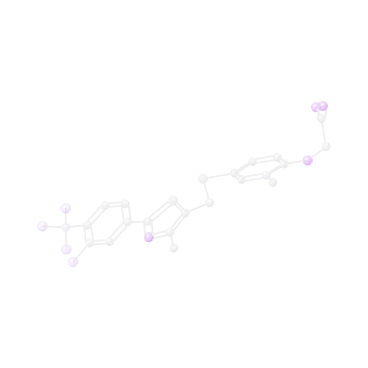
Calculated reference model · not an experimental or batch-certified structure. All 31 atoms shown.
Model data & sources
- Heavy atoms only; hydrogens are omitted from the reference display.
- Source-defined stereochemistry is checked against the calculated coordinates; no energy-minimum, crystal or solution-structure claim is made.
- Reference molecular species only; batch identity, purity, counterions and excipients are not certified.
- Formula
- C21H17F4NO3S2
- Method
- RDKit ETKDGv3 / MMFF94s calculated reference conformer
GW-0742
GW-0742 Research Standard
GW-0742 (CAS 317318-84-6) is a thiazole phenoxyacetic acid derivative and a selective agonist at PPARβ/δ, closely related in structure to GW-501516. It is supplied as a reference standard for nuclear receptor pharmacology. Its particular value as a research tool is awkward and worth stating plainly: several of its best-documented cellular effects turn out not to run through the receptor it was designed to hit, which makes it a useful cautionary probe when designing receptor-attribution experiments.
Mechanism of Action & Research Context
-
Receptor-independent vasorelaxation. In tissue from genetically modified mice, the dilator effects of GW-0742 were independent of both PPARβ/δ itself and cell-surface prostacyclin receptors. In aortic tissue the relaxation was not associated with increases in cGMP or cAMP, nor with hyperpolarisation, and was instead attributed to inhibition of RhoA activity.[2]
-
A non-genomic redox mechanism. In cardiac myocytes GW-0742 attenuated agonist-stimulated ERK1/2 and Akt phosphorylation. That effect was not reversed by the selective PPARβ/δ antagonist GSK0660, but was blocked by vanadate, a protein tyrosine phosphatase inhibitor — and GW-0742 prevented the oxidation and inactivation of PTEN. It also abolished agonist-induced reactive oxygen species generation independently of PPARβ/δ.[1]
-
Why the antagonist control matters. Both findings above rest on the same experimental move: applying a selective antagonist or a receptor-null background and observing that the effect survives. Any study attributing a GW-0742 result to PPARβ/δ without one of those controls has not established receptor dependence.[1,2]
-
Genuine PPARβ/δ agonism. Where the receptor is engaged, the transcriptional programme is that of the subtype: lipid catabolism, β-oxidation, cholesterol efflux and energy uncoupling in skeletal muscle, distinct from the PPARα and PPARγ programmes.[3]
Research Applications
Primary fields of in vitro and preclinical laboratory investigation include:
-
Receptor-attribution controls using GSK0660 antagonism or PPARβ/δ-null tissue to test whether an effect is receptor-mediated.[1,2]
-
Redox and phosphatase signalling including PTEN oxidation state and ROS quantification.[1]
-
MAPK and PI3K/Akt profiling under growth-promoting agonist stimulation.[1]
-
Vascular tissue pharmacology including RhoA activity and myography in isolated vessels.[2]
-
Comparative PPAR subtype profiling against GW-501516 and PPARα/γ agonists.[3]
Analytical Documentation
Purity and identity vary by manufacturing lot. Kimera Chems does not publish a single fixed purity figure for this item; refer to the batch-specific Certificate of Analysis (COA) issued for the lot received, which reflects third-party analytical testing for that lot.
References
- Galatou E, Kelly T, Lazou A. The PPARβ/δ agonist GW0742 modulates signaling pathways associated with cardiac myocyte growth via a non-genomic redox mechanism. Mol Cell Biochem. 2014;395(1–2):145–154. doi:10.1007/s11010-014-2120-5
- Harrington LS, Moreno L, Reed A, et al. The PPARbeta/delta agonist GW0742 relaxes pulmonary vessels and limits right heart hypertrophy in rats with hypoxia-induced pulmonary hypertension. PLoS One. 2010;5(3):e9526. doi:10.1371/journal.pone.0009526
- Dressel U, Allen TL, Pippal JB, Rohde PR, Lau P, Muscat GEO. The peroxisome proliferator-activated receptor beta/delta agonist, GW501516, regulates the expression of genes involved in lipid catabolism and energy uncoupling in skeletal muscle cells. Mol Endocrinol. 2003;17(12):2477–2493. doi:10.1210/me.2003-0151
Storage & Handling
Store at controlled room temperature. Keep tightly closed. Liquid formats: do not refrigerate or freeze. Cold storage may cause the solution to cloud or precipitate. If this occurs, return to room temperature and mix until clear.
Storage guidance is a house recommendation. Analytical documentation is per-lot release testing.
Related Research Compounds
Research Use Only Disclaimer: This product is labeled and sold "For Research Use Only - NOT FOR HUMAN CONSUMPTION." It is not a drug, dietary supplement, food, cosmetic, or medical device, and it is not approved by the FDA or any other regulator for human or veterinary use. It is supplied to approved account holders as a research chemical for laboratory use and must be handled in accordance with applicable law.