
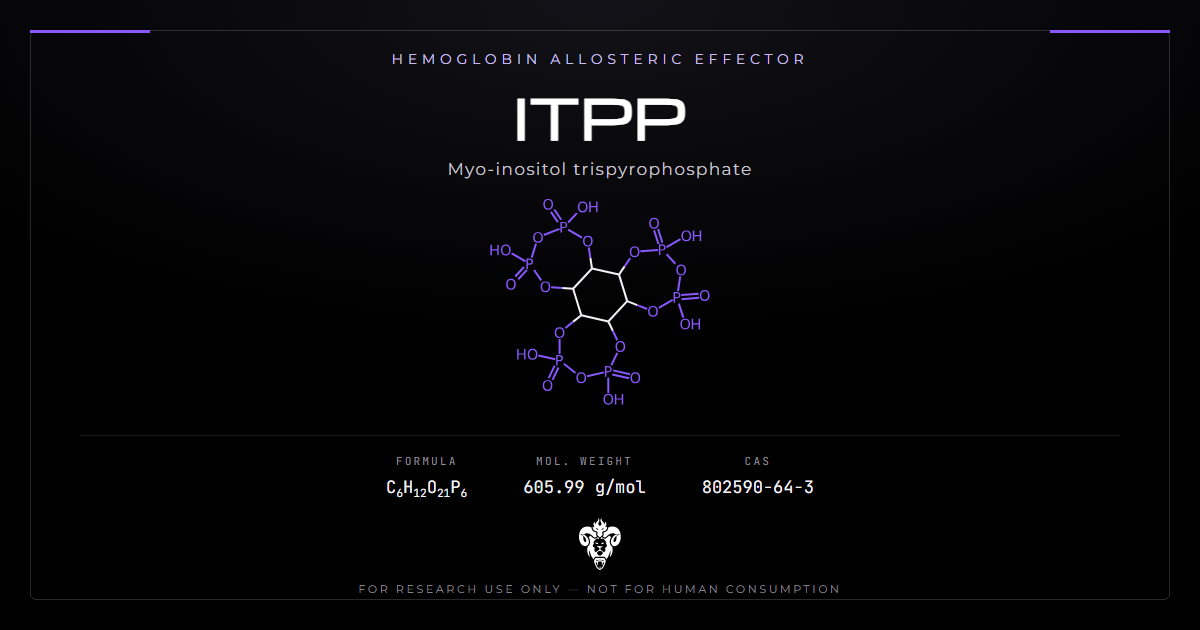
ITPP is a synthetic polyphosphate that binds hemoglobin’s allosteric pocket and lowers its affinity for oxygen, shifting the oxyhemoglobin dissociation curve to the right so that more oxygen unloads into tissue. It came out of a collaboration between Claude Nicolau’s group and Nobel laureate Jean-Marie Lehn, entered human trials under the code OXY111A, and is one of a small number of compounds named individually on the World Anti-Doping Agency Prohibited List. This reference covers its chemistry, mechanism, preclinical record, clinical data, and — most importantly for anyone sourcing it — the analytical problems that make ITPP unusually easy to misidentify.
ITPP is supplied strictly for laboratory research use. It is not approved for human or veterinary use anywhere, and nothing below should be read as guidance for administration.
Chemical Profile and Identifiers
| Property | Value |
|---|---|
| Compound name | ITPP (myo-inositol trispyrophosphate) |
| Development code | OXY111A |
| Chemical name | myo-Inositol cyclic 1,2:3,4:5,6-tris(P,P′-dihydrogen diphosphate) |
| CAS number | 623552-11-4 (also listed as 802590-64-3; hexasodium salt 23103-35-7) |
| Molecular formula | C₆H₁₂O₂₁P₆ |
| Molecular weight | 605.98 g/mol (free acid) |
| Monoisotopic mass | 605.8297 |
| InChIKey | HEDKSUBRULAYNO-UHFFFAOYSA-N |
| PubChem CID | 10439981 |
| UNII | 116EYZ0PPX |
| Compound class | Cyclic inositol pyrophosphate; hexavalent polyanion |
| Molecular target | Hemoglobin (2,3-BPG allosteric site) |
| Physical form | White solid, freely water-soluble, strongly hygroscopic |
Structurally, ITPP is phytic acid with three intramolecular dehydrations. Take myo-inositol hexakisphosphate (IP₆, C₆H₁₈O₂₄P₆, 660.04 g/mol), condense adjacent phosphate pairs into three pyrophosphate bridges, and you lose 3 H₂O — exactly the 54.06 g/mol that separates IP₆ from ITPP.¹ Those three bridges lock the molecule into a rigid tricyclic cage and, critically, redistribute its charge.
What ITPP Actually Does
Hemoglobin’s oxygen affinity is not fixed. Inside the red blood cell, 2,3-bisphosphoglycerate (2,3-BPG) binds a positively charged cleft between the two β-subunits of deoxyhemoglobin, stabilizing the low-affinity T state and promoting oxygen release. ITPP occupies that same pocket.²
The functional consequence is a rightward shift of the oxygen dissociation curve and an increase in P₅₀ — the partial pressure at which hemoglobin is half-saturated. Higher P₅₀ means oxygen comes off the carrier more readily at any given tissue oxygen tension. The total oxygen-carrying capacity of the blood is unchanged; what changes is how willingly that oxygen is surrendered. Because the effect is steepest where oxygen tension is lowest, the extra unloading is concentrated in hypoxic tissue rather than distributed evenly.
Why Membrane Permeability Is the Whole Story
Polyanions that bind free hemoglobin are not rare. IP₆ is a considerably more potent allosteric effector than 2,3-BPG in a cuvette. The problem is that IP₆ cannot cross an intact erythrocyte membrane — its charge distribution keeps it out — so historical attempts to exploit it required loading red cells ex vivo and transfusing them back.¹
The pyrophosphate bridges solve that. By tying up six of the twelve ionizable protons into internal ring structures, ITPP presents a far less repulsive charge profile at physiological pH while retaining the geometry needed to bind the 2,3-BPG site. Duarte and colleagues characterized this selectivity directly, showing ITPP crosses the red cell plasma membrane with high permeation selectivity — that is, it enters erythrocytes preferentially over other cell types.² Uptake has been attributed to the band 3 anion transporter.³ This single property is what converted a benchtop curiosity into a systemically administrable compound.
Preclinical Research Findings
Exercise Capacity and Heart Failure
The defining preclinical study appeared in PNAS in 2009. Biolo and colleagues gave normal mice ITPP intraperitoneally across a 0.5–3 g/kg range and observed a dose-related rise in hemoglobin P₅₀ reaching a maximum increase of 31%. In parallel treadmill experiments, maximal exercise capacity rose in a dose-dependent fashion, with a maximum increase of 57 ± 13% (P = 0.002).⁴
In transgenic mice with severe heart failure driven by cardiac-specific Gαq overexpression, intraperitoneal ITPP increased exercise capacity by up to 63 ± 7% (P = 0.005) — a larger effect than in healthy animals, consistent with the idea that the compound does more where oxygen delivery is already the limiting factor. Oral administration in drinking water also raised P₅₀ and maximal exercise capacity (+34 ± 10%; P < 0.002) in both normal and failing mice, and myocardial HIF-1α mRNA expression fell, which the authors read as evidence of improved tissue oxygen availability.⁴
The oral result is worth flagging precisely because it is so often overstated. It was obtained by dissolving the compound in drinking water at high concentration and allowing ad libitum consumption over days. It establishes that a hexavalent polyanion of this size can produce a measurable systemic effect by the enteral route in a mouse. It does not establish an oral bioavailability figure, and no such figure has been published.
Tumor Hypoxia and Vessel Normalization
The larger body of ITPP literature is oncological, and it turns on a specific mechanism: hypoxia stabilizes hypoxia-inducible factors, HIF drives VEGF overproduction, and VEGF overproduction builds the chaotic, leaky vasculature that characterizes solid tumors and obstructs drug delivery. Reverse the hypoxia and the angiogenic signal falls.
- Hepatoma (rats). Aprahamian and colleagues reported HIF-1α suppression and eradication of early hepatoma tumors.⁵
- Colon cancer. Derbal-Wolfrom and colleagues found reduced growth alongside modulation of the intestinal homeobox gene Cdx2.⁶
- Vessel normalization. Kieda and colleagues documented stable tumor vessel normalization with a measured pO₂ increase and endothelial PTEN activation — the mechanistic centerpiece of the whole program.⁷
- Pancreatic cancer. Raykov and colleagues showed hypoxia reversion in rodents that enhanced gemcitabine efficacy.⁸
- Colorectal liver metastasis. Limani and colleagues demonstrated antihypoxic potentiation of standard therapy, with the normalization effect persisting long enough to open a therapeutic window.⁹
The Radiotherapy Result That Cuts the Other Way
Tran and colleagues used 1.2 GHz electron paramagnetic resonance oximetry to measure tumor pO₂ directly across six rodent tumor models.¹⁰ ITPP at 2 g/kg once daily for two days produced reoxygenation lasting at least four days in all six. It also reduced the oxygen consumption rate in six cell lines, suggesting reoxygenation is not purely a delivery phenomenon. But the radiosensitization endpoint was mixed: combining ITPP with radiotherapy produced no improvement in rhabdomyosarcoma, and in 9L-glioma some tumors were cured while others saw no benefit.
Secondary coverage of ITPP tends to skip this paper. It should not be skipped. Consistent reoxygenation across models with inconsistent therapeutic benefit is exactly the kind of result that constrains how the mechanism should be interpreted.
The Human Clinical Record: OXY111A
ITPP reached patients. The phase Ib dose-escalation study (NCT02528526) ran at University Hospital Zurich between 2015 and 2018 and enrolled 28 patients with advanced hepatopancreatobiliary malignancies or colorectal liver metastases. Participants received nine eight-hour intravenous infusions over three weeks across eight dose cohorts, followed by standard chemotherapy.¹¹
The findings that matter most for anyone characterizing this compound:
- Maximum tolerated dose: 12,390 mg/m² per infusion, established when dose-limiting toxicity appeared in the cohort above it.
- Dominant toxicity: hypercalcemia of free ionized calcium, in 67.9% of patients. The investigators attributed this to the calcium chloride deliberately co-administered at a 1:0.75 molar ratio — required because ITPP is a potent calcium chelator and unbuffered administration risks hypocalcemia.
- Pharmacokinetics: plasma half-life of 1.3–3.3 h across cohorts, with trough concentrations consistently below the detection threshold before each infusion. No systemic accumulation.
- Efficacy signals: 52% of patients showed morphological disease stabilization under monotherapy; after subsequent chemotherapy, 10% partial responses and 60% stable disease. Angiogenic markers fell in roughly 60% of patients.
The calcium-chelation finding is the one with practical reach beyond oncology. A hexavalent polyanion that binds divalent cations avidly enough to require stoichiometric calcium co-administration in a clinical protocol will also chelate calcium and magnesium in any buffer, medium, or assay it is added to. That is a real experimental design constraint, not a clinical footnote.
ITPP Compared to Other Oxygen-Affinity Modifiers
| ITPP | Efaproxiral (RSR13) | Voxelotor | |
|---|---|---|---|
| Chemical class | Cyclic inositol pyrophosphate | Substituted phenoxy-propionic acid | Benzaldehyde derivative |
| Binding site | 2,3-BPG allosteric pocket | Central water cavity, α-cleft | N-terminal valine of α-globin (covalent, reversible) |
| Effect on P₅₀ | Increases (right shift) | Increases (right shift) | Decreases (left shift) |
| Approval status | Investigational | Not approved | Approved for sickle cell disease |
| WADA status | Named under M1.2 | Named under M1.2 | Named under M1.2 |
The direction of the shift differs — voxelotor increases oxygen affinity, the opposite of ITPP — yet all three appear in the same prohibited category. The listing is defined by manipulation of oxygen transport, not by which way the curve moves.
Handling, Solubility, and Storage
- Hygroscopicity. ITPP takes up atmospheric moisture aggressively. Weigh quickly, keep containers sealed, and store desiccated. Water uptake inflates apparent mass and is a common source of unexplained potency loss in gravimetric work.
- Solubility. Freely soluble in water; effectively insoluble in the organic solvents used for most small-molecule stocks. DMSO stock protocols developed for other compounds do not transfer.
- pH. Solutions of the free acid are strongly acidic and require adjustment for most biological work; the clinical program worked at approximately neutral pH.
- Chelation. Assume divalent cation binding. Calcium- and magnesium-containing media will be depleted.
- Hydrolytic stability. Better than the pyrophosphate motif suggests. ³¹P NMR monitoring of ITPP salt solutions showed no detectable change over three days at pH 8.66, 10.20, or 12.05; only at pH 13.30 did roughly 7% hydrolysis appear, rising to 19% after 22 h at 60 °C. But concentrating the strongly alkaline sample to dryness converted it completely to the open form — phytic acid.¹² Strong base plus evaporation is the failure mode.
- Storage. Store the dry solid sealed at controlled room temperature, protected from moisture.
Follow standard practice for fine research powders. Storage guidance is a house recommendation. Analytical documentation is per-lot release testing.
Analytical Verification: Where ITPP Gets Difficult
This is the section that matters. ITPP defeats the default analytical workflow used across the research compound market, and the failure is silent.
There is no UV chromophore. ITPP has no aromatic ring, no conjugated system, no absorbing group at all. A reversed-phase HPLC-UV run — the standard purity method for most catalog compounds — will produce a chromatogram that looks clean because the analyte is invisible, not because it is pure. Worse, the compound’s extreme hydrophilicity means it barely retains on C18 in the first place. A COA reporting “99.5% by HPLC-UV” for ITPP should be treated as a red flag rather than a credential. Doping-control laboratories reached the same conclusion and built their assays on hydrophilic interaction chromatography or ion chromatography instead.¹³ ¹⁴
Salt form determines the mass basis. ITPP is commonly supplied as the hexasodium salt (C₆H₆Na₆O₂₁P₆, 737.87 g/mol) rather than the free acid (605.98 g/mol). One gram of the hexasodium salt contains roughly 821 mg of ITPP on a free-acid basis — an 18% difference that no purity assay will surface unless counterion content is measured. Two lots of identical purity can differ by nearly a fifth in molar content depending on salt form.
Three separate name collisions. ITPP is not myo-inositol (C₆H₁₂O₆, 180.16 g/mol, CAS 87-89-8), the inexpensive carbohydrate; catalog listings sometimes carry inositol’s identifiers alongside the ITPP name. It is not inosine triphosphate, which shares the ITP abbreviation and nothing else. And it is not phytic acid, which is both its synthetic precursor and its hydrolytic degradation product. All three are cheaper. Two of the three would produce no allosteric effect whatsoever.
Registry number ambiguity. More than one CAS number circulates for ITPP, and the hexasodium salt carries its own. A CAS match alone does not confirm identity here.
Meaningful verification for this compound requires orthogonal methods rather than a single chromatographic trace:
- ³¹P NMR — the single most informative technique available. The tricyclic cage produces a distinctive phosphorus signature that immediately distinguishes the pyrophosphate-bridged structure from open-chain phytic acid or free phosphate. It is also quantitative, which makes it useful for both identity and hydrolytic degradation.
- Ion chromatography or HILIC — for chromatographic purity, since reversed-phase retention is inadequate and conductivity or MS detection is required in the absence of a chromophore.
- Negative-mode ESI mass spectrometry — for molecular confirmation, with the polyanionic character producing characteristic multiply charged species.
- Elemental analysis — for phosphorus and sodium content, which anchors both mass balance and salt stoichiometry independently of any chromatographic assumption.
Every lot is released only after third-party COA verification. Batch documentation is published in the Kimera COA archive, and additional compounds in this space are catalogued under metabolic compounds. Researchers working adjacent questions in mitochondrial oxygen handling frequently pair oxygen-delivery work with reference materials such as MOTS-c or methylene blue.
Regulatory and Anti-Doping Status
ITPP is investigational. No regulatory authority has approved it for human or veterinary use.
Its anti-doping position is unambiguous and worth stating plainly. ITPP is named explicitly on the WADA Prohibited List under M1.2, “Artificially enhancing the uptake, transport or delivery of oxygen,” alongside perfluorochemicals, efaproxiral, voxelotor, and modified hemoglobin products. The listing names both the chemical name and the OXY111A code. M1 is prohibited at all times, in and out of competition. This is not a category-S0 inference from structural similarity — the compound is on the list by name.
Validated detection methods exist and have for over a decade. Görgens and colleagues published a dilute-and-inject HILIC high-resolution mass spectrometry method for human urine with a lower limit of detection of 15 ng/mL for screening and 1 ng/mL for confirmation, and demonstrated that ITPP remains stable in urine under mandatory doping-control storage conditions.¹³
Equine sport is a parallel and equally active front. ITPP is prohibited under the rules of racing, and detection work in horses dates to at least 2012.¹⁵ Lam and colleagues administered 200 mg intravenously to a Standardbred mare and tracked plasma and urine for 120 hours.¹⁶ More recently, Hong Kong Jockey Club laboratory scientists published a simultaneous ion chromatography–mass spectrometry screen covering ITPP and ten bisphosphonates in equine plasma, noting that ITPP had by then been detected in racehorses and in confiscated material.¹⁴
Any research program touching human or animal sport should treat ITPP accordingly.
Frequently Asked Questions
What is ITPP? Myo-inositol trispyrophosphate, a synthetic cyclic inositol pyrophosphate that binds the 2,3-BPG allosteric pocket of hemoglobin and lowers its oxygen affinity, increasing oxygen release to tissue.
How does ITPP differ from myo-inositol? Entirely. Myo-inositol is a simple carbohydrate (C₆H₁₂O₆, 180.16 g/mol) with no hemoglobin activity. ITPP is a hexaphosphorylated derivative more than three times its mass, built from phytic acid by intramolecular dehydration.
Is ITPP orally active? Oral administration in drinking water raised P₅₀ and exercise capacity in mice.⁴ No oral bioavailability figure has been published, and all human trial work used intravenous infusion.
Has ITPP been tested in humans? Yes. A phase Ib dose-escalation trial in 28 patients with hepatopancreatobiliary tumors established a maximum tolerated dose of 12,390 mg/m² and reported the compound was well tolerated, with hypercalcemia — attributed to co-administered calcium chloride — the dominant toxicity.¹¹
Why is HPLC-UV inadequate for ITPP? The molecule has no UV chromophore and almost no reversed-phase retention. A UV chromatogram cannot see it. Identity and purity require ³¹P NMR, ion chromatography or HILIC, and mass spectrometry.
Is ITPP banned in sport? Yes. It is named individually on the WADA Prohibited List under M1.2 and is prohibited at all times. It is also prohibited under the rules of horse racing.
Is ITPP approved for human use? No. It is an investigational research compound supplied strictly for laboratory use.
References
- National Center for Biotechnology Information. PubChem Compound Summary for CID 10439981, myo-Inositol trispyrophosphate. https://pubchem.ncbi.nlm.nih.gov/compound/10439981
- Duarte CD, Greferath R, Nicolau C, Lehn JM. myo-Inositol trispyrophosphate: a novel allosteric effector of hemoglobin with high permeation selectivity across the red blood cell plasma membrane. ChemBioChem. 2010;11(18):2543–2548. doi:10.1002/cbic.201000499
- National Center for Advancing Translational Sciences. Inxight Drugs: Myo-inositol trispyrophosphate. https://drugs.ncats.io/drug/116EYZ0PPX
- Biolo A, Greferath R, Siwik DA, Qin F, Valsky E, Fylaktakidou KC, Pothukanuri S, Duarte CD, Schwarz RP, Lehn JM, Nicolau C, Colucci WS. Enhanced exercise capacity in mice with severe heart failure treated with an allosteric effector of hemoglobin, myo-inositol trispyrophosphate. Proc Natl Acad Sci USA. 2009;106(6):1926–1929. doi:10.1073/pnas.0812381106
- Aprahamian M, Bour G, Akladios CY, Fylaktakidou K, Greferath R, Soler L, Marescaux J, Egly JM, Lehn JM, Nicolau C. Myo-InositolTrisPyroPhosphate treatment leads to HIF-1α suppression and eradication of early hepatoma tumors in rats. ChemBioChem. 2011;12(5):777–783. doi:10.1002/cbic.201000619
- Derbal-Wolfrom L, Pencreach E, Saandi T, et al. Increasing the oxygen load by treatment with myo-inositol trispyrophosphate reduces growth of colon cancer and modulates the intestine homeobox gene Cdx2. Oncogene. 2013;32(36):4313–4318. doi:10.1038/onc.2012.445
- Kieda C, El Hafny-Rahbi B, Collet G, et al. Stable tumor vessel normalization with pO2 increase and endothelial PTEN activation by inositol trispyrophosphate brings novel tumor treatment. J Mol Med. 2013;91(7):883–899. doi:10.1007/s00109-013-0992-6
- Raykov Z, Grekova SP, Bour G, et al. Myo-inositol trispyrophosphate-mediated hypoxia reversion controls pancreatic cancer in rodents and enhances gemcitabine efficacy. Int J Cancer. 2014;134(11):2572–2582. doi:10.1002/ijc.28597
- Limani P, Linecker M, Kachaylo E, et al. Antihypoxic potentiation of standard therapy for experimental colorectal liver metastasis through myo-inositol trispyrophosphate. Clin Cancer Res. 2016;22(23):5887–5897. doi:10.1158/1078-0432.CCR-15-3112
- Tran LBA, Cao-Pham TT, Jordan BF, Deschoemaeker S, Heyerick A, Gallez B. Impact of myo-inositol trispyrophosphate (ITPP) on tumour oxygenation and response to irradiation in rodent tumour models. J Cell Mol Med. 2019;23(3):1908–1916. doi:10.1111/jcmm.14092
- Schneider MA, Linecker M, Fritsch R, Muehlematter UJ, Stocker D, Pestalozzi B, Samaras P, Jetter A, Kron P, Petrowsky H, Nicolau C, Lehn JM, Humar B, Graf R, Clavien PA, Limani P. Phase Ib dose-escalation study of the hypoxia-modifier myo-inositol trispyrophosphate in patients with hepatopancreatobiliary tumors. Nat Commun. 2021;12(1):3807. doi:10.1038/s41467-021-24069-w
- Nicolau C, Lehn JM, Greferath R, Fylaktakidou KC. Inositol pyrophosphates, and methods of use thereof. US Patent 7,648,970. 2010. https://patents.google.com/patent/US7648970B2/en
- Görgens C, Guddat S, Schänzer W, Thevis M. Screening and confirmation of myo-inositol trispyrophosphate (ITPP) in human urine by hydrophilic interaction liquid chromatography high resolution/high accuracy mass spectrometry for doping control purposes. Drug Test Anal. 2014;6(11–12):1102–1107. doi:10.1002/dta.1700
- Wong ASY, Yuen BPN, Wong COL, Kong FKW, So YM, Kwok WH, Brooks L, Wan TSM, Ho ENM. Doping control analysis of myo-inositol trispyrophosphate and 10 bisphosphonates in equine plasma by ion chromatography–mass spectrometry and its application to clodronic acid horse administration. Drug Test Anal. 2025;17(1). doi:10.1002/dta.3753
- Wong ASY, Ho ENM, Wan TSM. Detection of myo-inositol trispyrophosphate in equine urine and plasma by hydrophilic interaction chromatography-tandem mass spectrometry. Drug Test Anal. 2012;4(5):355–361. doi:10.1002/dta.397
- Lam G, Zhao S, Sandhu J, Yi R, Loganathan D, Morrissey B. Detection of myo-inositol tris pyrophosphate (ITPP) in equine following an administration of ITPP. Drug Test Anal. 2014;6(3):268–276. doi:10.1002/dta.1473
- Fylaktakidou KC, Lehn JM, Greferath R, Nicolau C. Inositol tripyrophosphate: a new membrane permeant allosteric effector of haemoglobin. Bioorg Med Chem Lett. 2005;15(6):1605–1608. doi:10.1016/j.bmcl.2005.01.064
- Oknińska M, Zambrowska Z, Zajda K, et al. New potential treatment for cardiovascular disease through modulation of haemoglobin oxygen binding curve: myo-inositol trispyrophosphate (ITPP), from cancer to cardiovascular disease. Biomed Pharmacother. 2022;154:113544. doi:10.1016/j.biopha.2022.113544
- World Anti-Doping Agency. The Prohibited List — M1: Manipulation of Blood and Blood Components. https://www.wada-ama.org/en/prohibited-list
ITPP is sold for laboratory research use only. It is not a drug, supplement, food, or cosmetic, and is not intended for human or veterinary use, ingestion, injection, or topical application. Access full specifications and batch COA data by logging in or creating a research account.