
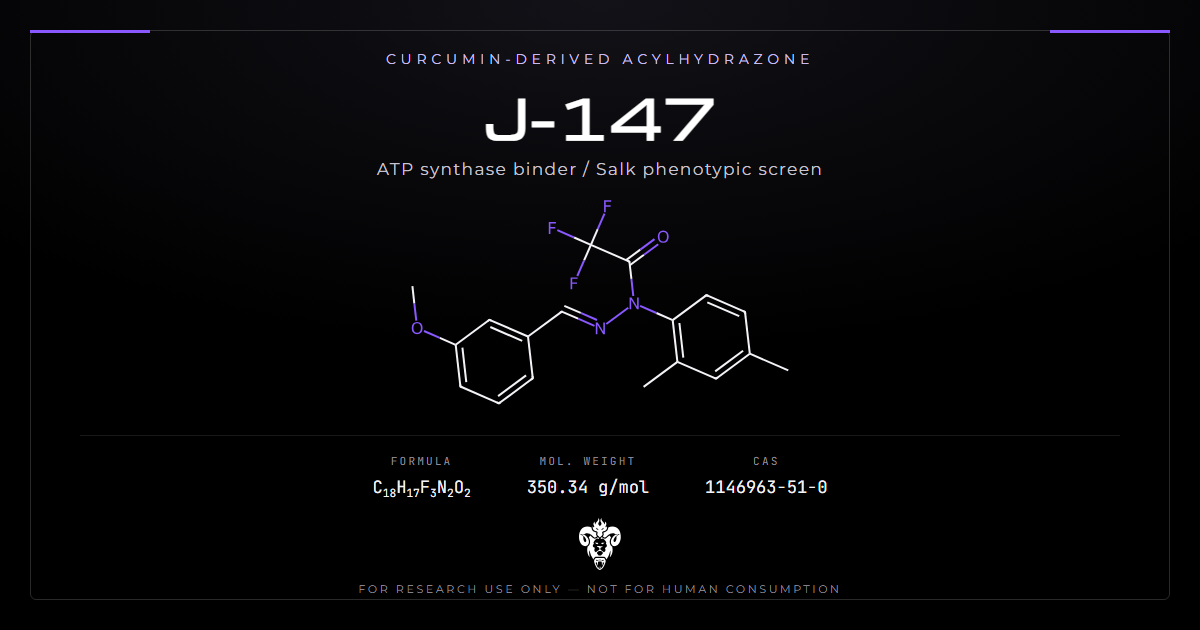
Most drug candidates start from a target. A protein is chosen, a binding assay is built, and chemistry optimises affinity for that protein. J-147 came from the opposite direction. A Salk Institute group screened compounds against cell culture models of old-age brain toxicity. They kept whatever protected neurons. The resulting molecule reached print in 2011 with no target attached [1].
The target arrived seven years later, and it was not an amyloid enzyme. It was the mitochondrial ATP synthase [2].
That sequence makes this compound useful as a laboratory tool rather than a curiosity. Its mechanism was reconstructed after the fact, by researchers who already held a decade of phenotype data to explain. Kimera supplies J-147 as research material for that kind of work.
All findings below describe laboratory models. This material is for research use only, not for human or veterinary use.
What J-147 is
J-147 is a trifluoromethyl phenyl hydrazide built from the curcumin scaffold. Curcumin itself performs poorly as a research probe: it degrades in solution, it hits many targets weakly, and its oral bioavailability is low. The Salk chemistry programme replaced the diketone bridge with a hydrazide and added a trifluoroacetyl group. That molecule survives plasma and reaches brain tissue [1].
Identity and physical data
| Property | Value |
|---|---|
| Compound | J-147 |
| Synonym | J147, written unhyphenated in most primary literature |
| PubChem CID | 25229652 |
| CAS number | 1146963-51-0 |
| Molecular formula | C18H17F3N2O2 |
| Molecular weight | 350.34 g/mol |
| InChIKey | HYMZAYGFKNNHDN-SSDVNMTOSA-N |
| IUPAC name | (E)-N-(2,4-dimethylphenyl)-2,2,2-trifluoro-N’-(3-methoxybenzylidene)acetohydrazide |
| Chemical class | Curcumin-derived acylhydrazone |
| Geometry | E configuration at the C=N bond |
The curcumin link is structural, not marketing
Both molecules carry an aryl methoxy group, and both act on oxidative stress pathways. The similarity stops there. The hydrazide scaffold holds up chemically where the curcumin diketone does not, and the metabolite work discussed below shows the difference directly. Treating J-147 as a potent curcumin is the wrong read. It behaves as its own chemotype.
The screen that produced it
The 2011 discovery paper describes a filter rather than a target assay [1]. Compounds ran through several cell culture models. Each model reproduces one toxicity associated with the ageing brain: oxidative glutamate toxicity, intracellular ATP depletion, trophic factor withdrawal and amyloid beta exposure.
Four assays, one survivor
A compound had to protect in every assay to pass. That requirement selects for pleiotropy by construction, and the authors said so. Their stated premise was that age, not amyloid, is the largest risk factor for sporadic Alzheimer’s disease. A screen built on age-related toxicities should therefore outperform one built on a single pathological protein [1].
What a phenotypic screen cannot tell you
This design produces a molecule with reproducible cellular effects and no mechanism. Every paper published between 2011 and 2018 describes what J-147 does without saying how. Read that literature as pharmacology waiting for a target, which is what it was.
The molecular target of J-147
In 2018 a Salk-led group identified the alpha subunit of mitochondrial ATP synthase, ATP5A, as the binding partner [2]. Aging Cell carried the finding, which rests on affinity purification plus functional work in several systems (PubMed).
Inhibition, not stimulation
J-147 partially inhibits ATP synthase. Partial inhibition raises intracellular calcium, which activates calcium/calmodulin-dependent protein kinase kinase beta, and that kinase drives the AMPK/mTOR axis [2]. The pathway this compound recruits is a canonical longevity mechanism, the same one that caloric restriction and metformin research converge on.
Evidence across three organisms
The same paper reported two further results. In mice, age-associated drift in the hippocampal transcriptome and the plasma metabolome slowed. In Drosophila, lifespan increased [2]. A 2021 follow-up examined brain and kidney protein changes in senescence-accelerated SAMP8 mice and found age-related markers shifted toward a younger profile in both organs [3].
Why the target mattered
Target identification converted a list of protective effects into a testable mechanism. Later work uses that mechanism as the hypothesis rather than the conclusion. A 2025 study of microglial polarisation tested the CAMKK2/AMPK route directly and reported a shift away from the pro-inflammatory phenotype in its model [4].
Findings in ageing and dementia models
Every result below belongs to the model that produced it. None of it transfers to humans, and the compound has no approved use anywhere.
Aged transgenic mice
The 2013 study is the one worth reading first. Rather than dosing young animals before pathology appeared, the group treated 20-month-old APP/swePS1dE9 mice, which already carried advanced pathology [5]. Memory measures improved, and the improvement tracked induction of nerve growth factor, brain-derived neurotrophic factor and several BDNF-responsive proteins. A separate arm compared the compound against donepezil in scopolamine-impaired mice. Both rescued short-term memory; only J-147 rescued spatial memory [5].
Rapidly ageing SAMP8 mice
A 2015 multiomics study combined proteomics, transcriptomics, metabolomics and behaviour in old and young SAMP8 animals [6]. Cognitive deficits narrowed in the treated old group, and molecular markers of ageing moved with them. The design matters more than the result: measuring four data layers in the same animals produced the hypotheses that the 2018 target work then tested.
Acetyl-CoA metabolism
An eLife paper in 2019 compared J-147 against CMS121, a structurally unrelated candidate from the same programme [7]. Both preserved mitochondrial homeostasis in SAMP8 mice by regulating acetyl-coenzyme A metabolism, and both raised acetyl-CoA levels in cell culture. Two different chemotypes converging on one metabolite is the sort of result that survives replication.
Neurogenesis in very old mice
A 2016 paper in Alzheimer’s & Dementia reported enhanced memory, improved dendritic structure and cell division in germinal brain regions of very old mice [8]. The authors then built a neural stem cell screening assay from that observation and optimised a derivative, CAD-031, against it. Researchers comparing neurogenic tool compounds sometimes run this alongside 9-ME-BC, which reaches a similar endpoint through dopaminergic signalling.
Findings outside the dementia literature
The compound left its origin field early. Groups with no dementia interest picked it up because the mechanism it recruits, AMPK signalling downstream of a mitochondrial enzyme, appears in nerve injury, ischaemia and metabolic work as well. The studies below share that logic and little else. Their models differ, their endpoints differ, and their laboratories are unrelated.
Diabetic neuropathy
A 2018 Neuropharmacology study applied J-147 to streptozotocin-induced type 1 diabetic mice and reported improvement across several indices of neuropathy [9]. A rat study the same year proposed AMPK-dependent regulation of TRPA1 as the route [10]. Two groups, two rodent species, one signalling node that also appears in the ATP synthase work.
Ischaemic stroke and thrombolysis
A 2022 rat study tested two stroke models [11]. Given intravenously two hours after transient middle cerebral artery occlusion, the compound reduced infarct volume. In the embolic model it did nothing on its own, and its contribution appeared only in combination with tissue plasminogen activator, where it reduced haemorrhage. A compound that works in one occlusion model and not another is telling you something about the model, not only about the compound.
Traumatic brain injury
A 2024 study in Translational Research used controlled cortical impact in adult mice and gave J-147 orally starting one hour after injury [12]. Neurofunctional recovery improved in a dose-dependent way across 35 days of behavioural testing. The authors attributed that to reduced neuronal endoplasmic reticulum stress through AMPK/SREBP-1 signalling.
Sepsis-associated behavioural change
A 2023 mouse study induced sepsis and measured depression-like behaviour afterwards [25]. Treated animals showed less of it, and the authors traced the change to reduced neuroinflammation through TLR4/NF-kappaB signalling. That places a third inflammatory pathway alongside the AMPK and endoplasmic reticulum stress routes above. None of the three excludes the others.
Behavioural despair models
Three groups reported antidepressant-like and anxiolytic-like effects in mice. One traced the effect to 5-HT1A receptor signalling and downstream cAMP [13]. A second reached the same receptor after sub-acute dosing [14]. A third pointed to broader monoaminergic activation [15]. Forced swim and tail suspension tests measure immobility in rodents. They are screening assays, not models of human depression, and the distinction is worth keeping in view when reading this branch of the literature.
Peripheral metabolism and target engagement
A 2022 paper looked for a plasma biomarker of activity [16]. Pooling lipidomics from three independent rodent studies, the authors found free fatty acid levels fell consistently. Liver measurements matched the plasma pattern. They traced the effect to AMPK/ACC1 signalling. No validated target engagement biomarker exists for this compound, which is why the search happened at all. The same paper notes the compound had moved into clinical development by then; PubMed indexes no controlled trial results.
Metabolic stability and the hydrazide question
Aromatic amines were the concern
Phenyl hydrazides can in principle metabolise to aromatic amines and hydrazines, some of which are carcinogenic. A 2013 study examined metabolites in human and mouse liver microsomes and in mouse plasma [17]. Neither class appeared. The scaffold proved exceptionally stable. Oxidative metabolites kept neuroprotective activity in the authors’ assays, so they may contribute to what the parent compound does in animals.
Cell toxicity screening
A separate 2013 report ran a rat hepatoma line through a toxicity panel and a genotoxicity assessment [18]. That work sits in a lower-profile journal than the rest of this literature. Read it as a preliminary screen rather than a safety package.
What the metabolism work leaves open
Microsomal stability is not pharmacokinetics. The 2013 study measured metabolite identity, not clearance in a living animal [17]. No human pharmacokinetic dataset appears in the indexed literature. Species differences in hydrazide handling are documented for other scaffolds, so read the mouse and human microsome agreement as encouraging rather than settled.
Physicochemical properties and handling
| Property | Detail |
|---|---|
| Appearance | Off-white to pale yellow crystalline solid |
| Solubility | Freely soluble in DMSO; low aqueous solubility |
| Recommended stock | DMSO, prepared fresh and split into single-use aliquots |
| Storage, solid | Minus 20 degrees Celsius, desiccated, protected from light |
| Storage, solution | Minus 20 degrees Celsius or colder, avoid repeated freeze-thaw |
| Stability note | The C=N bond can isomerise; protect from prolonged light exposure |
| Handling | Fine powder, handle with standard laboratory controls |
The acylhydrazone bond carries the geometric information in this molecule. Its E configuration appears in the InChIKey stereo block and in the crystal structure. Treat light and acidic aqueous conditions as the two variables most likely to compromise a stored solution, and prepare working dilutions immediately before use.
Analytical characterization
Crystal structure and NMR
A 2019 structure determination at 150 K resolved the solid-state conformation and compared it against density functional theory calculations [19]. The observed conformation matched the calculated gas-phase minimum. The same paper reported NMR data alongside computed shifts and reduced 16 possible rotamers to four accessible minima with low interconversion barriers. That is the reference dataset for anyone confirming identity by NMR (PubMed).
Chromatography and mass detection
Reversed-phase HPLC with ultraviolet detection separates this compound from its synthesis precursors, 2,4-dimethylphenylhydrazine and 3-methoxybenzaldehyde, both of which differ sharply in retention. Electrospray mass spectrometry gives a protonated molecular ion at m/z 351.1 for the C18H17F3N2O2 formula. The trifluoromethyl group also shifts the exact mass away from any non-fluorinated analogue of the same nominal weight. Batch documentation for catalogue material sits in the certificate of analysis database.
Confirming geometry, not only mass
Mass spectrometry cannot separate E and Z isomers of an acylhydrazone. They share a formula and an exact mass. Nuclear Overhauser measurements or a comparison against the published shift set resolve the question [19]. For a compound whose stereo descriptor sits in a single C=N bond, that check belongs in identity confirmation rather than in a purity appendix.
The radiolabelled version
A 2012 synthesis produced carbon-11 labelled material for positron emission tomography, methylating a desmethyl precursor with [11C]methyl triflate [20]. Radiochemical yields ran 35 to 50 percent. The precursor route in that paper doubles as a synthetic reference for the unlabelled compound.
Where J-147 sits among neuro research compounds
| Compound | Primary mechanism studied | Class |
|---|---|---|
| J-147 | Partial ATP synthase inhibition, AMPK activation | Acylhydrazone |
| 9-ME-BC | Dopaminergic signalling, neurotrophic factor induction | Beta-carboline |
| DIHEXA | Hepatocyte growth factor and c-Met pathway | Angiotensin IV analogue |
| Methylene Blue | Mitochondrial electron cycling | Phenothiazinium dye |
The grouping is thematic rather than pharmacological. Two of these four act on mitochondria, and they do so through unrelated chemistry. Further reading sits in the nootropics research library.
The analogue series
The scaffold has been rebuilt by several groups. Each rebuild tests which part of the molecule carries the activity.
T-006, a tetramethylpyrazine hybrid
A 2015 paper replaced the methoxyphenyl group with tetramethylpyrazine [23]. The resulting compound, T-006, protected cultured neurons against iodoacetic acid toxicity and against oxidative insult at low concentrations. The authors describe it as multi-functional, which is the same design goal the parent screen encoded.
A dicyanovinyl derivative aimed at amyloid
A second 2015 group built a series of derivatives and tested them against amyloid beta aggregation [24]. The best of them, carrying a 2,2-dicyanovinyl substituent, inhibited Abeta42 oligomerisation with an IC50 of 17.3 micromolar and fibrillisation at 10.5 micromolar. It also disassembled preformed fibrils in the same assay system. Those are direct anti-aggregation numbers, and the parent compound was never optimised for that endpoint.
What the derivatives say about the scaffold
Read the three derivative programmes together. CAD-031 came from a neurogenesis assay [8]. T-006 came from a hybrid design [23]. The dicyanovinyl series came from an amyloid assay [24]. Three teams took the same core in three directions and each got activity. That tolerance for substitution is a property of the chemotype. It also explains why the compound keeps appearing as a starting point in medicinal chemistry papers.
Practical notes for in vitro work
Vehicle and stock preparation
Aqueous solubility is low. DMSO is the standard vehicle across the published cell work. Keep the final solvent concentration matched across every well, including controls. A vehicle mismatch is the most common way an oxidative stress assay produces a false effect.
Choosing a comparator
The originating programme itself used comparators. In 2019 the acetyl-CoA work ran CMS121 alongside [7]. Six years earlier, the memory work ran donepezil alongside [5]. Both choices did the same job: they separated a compound-specific result from a general assay artefact.
Reading the assay
The published cellular endpoints are protection endpoints. Oxidative glutamate toxicity, ATP depletion and trophic factor withdrawal each kill cells on their own timescale [1]. Viability readouts taken at a single timepoint can miss a shift in that timescale. Two timepoints cost little and answer the question.
Reproducing a published condition
Papers in this literature vary in the cell type they use. Primary cortical cultures, HT22 cells and SH-SY5Y cells all appear. Potency is not portable between them. Match the line before comparing a number against a published one.
What this literature does not establish
A 2023 narrative review collected the evidence across Alzheimer’s models, diabetic neuropathy, stroke, depression models and fatty liver [21]. It framed every result as preclinical. That framing is correct and worth repeating.
Three gaps
No published controlled human trial supports any clinical claim. Model-to-model transfer is uneven, as the two stroke models in one paper showed [11]. Several later studies come from groups with no connection to the originating laboratory. That strengthens the replication picture in the behavioural work. The mechanism still rests largely on one target paper [2].
An unexpected result worth noting
A 2021 study found the compound suppressed melanogenesis and melanosome transport in cultured cells by promoting ERK-mediated degradation of the MITF transcription factor [22]. Nothing in the neurological literature predicted that. Pleiotropic compounds keep producing findings outside the field that discovered them, and a screen built on pleiotropy should be expected to.
Frequently asked questions
Is J-147 the same as curcumin?
No. It derives from the curcumin scaffold and shares an aryl methoxy motif, then diverges. The hydrazide replaces curcumin’s unstable diketone bridge, and the metabolic behaviour differs [17].
What is the molecular target?
The alpha subunit of mitochondrial ATP synthase, ATP5A, reported in 2018 [2]. Partial inhibition of the enzyme raises intracellular calcium and activates AMPK through CAMKK2.
Has it been tested in humans?
Published work is preclinical. A 2022 paper describes the compound entering clinical development, and PubMed indexes no controlled trial results [16].
Why do so many papers write J147 without the hyphen?
Both forms appear. The originating laboratory uses J147; the safety and stroke literature often writes J-147. A literature search on one spelling alone misses papers filed under the other.
How should the reference material be stored?
Solid material keeps at minus 20 degrees Celsius, desiccated and dark. DMSO stocks belong in single-use aliquots to avoid freeze-thaw cycling.
Which cell lines appear most often in the literature?
Primary cortical neurons, HT22 hippocampal cells and SH-SY5Y neuroblastoma cells all appear. The protection assays in the original screen used several of them [1]. Potency figures do not carry across lines.
What distinguishes it analytically from its precursors?
Retention behaviour and mass. The hydrazine and aldehyde precursors elute far from the product under reversed-phase conditions, and the m/z 351.1 protonated ion identifies the intact acylhydrazone.
References
- Chen Q, Prior M, Dargusch R, et al. A novel neurotrophic drug for cognitive enhancement and Alzheimer’s disease. PLoS One. 2011;6(12):e27865. PubMed DOI
- Goldberg J, Currais A, Prior M, et al. The mitochondrial ATP synthase is a shared drug target for aging and dementia. Aging Cell. 2018;17(2):e12715. PubMed DOI
- Kepchia D, Currais A, Dargusch R, et al. Geroprotective effects of Alzheimer’s disease drug candidates. Aging (Albany NY). 2021;13(3):3269-3289. PubMed DOI
- He L, Ali T, Wei T, et al. J147 modulates microglial polarization via CAMKK2/AMPK signaling to ameliorate neuroinflammation. Biochem Biophys Res Commun. 2025;778:152395. PubMed DOI
- Prior M, Dargusch R, Ehren JL, et al. The neurotrophic compound J147 reverses cognitive impairment in aged Alzheimer’s disease mice. Alzheimers Res Ther. 2013;5(3):25. PubMed DOI
- Currais A, Goldberg J, Farrokhi C, et al. A comprehensive multiomics approach toward understanding the relationship between aging and dementia. Aging (Albany NY). 2015;7(11):937-55. PubMed DOI
- Currais A, Huang L, Goldberg J, et al. Elevating acetyl-CoA levels reduces aspects of brain aging. Elife. 2019;8:e47866. PubMed DOI
- Prior M, Goldberg J, Chiruta C, et al. Selecting for neurogenic potential as an alternative for Alzheimer’s disease drug discovery. Alzheimers Dement. 2016;12(6):678-86. PubMed DOI
- Daugherty DJ, Marquez A, Calcutt NA, et al. A novel curcumin derivative for the treatment of diabetic neuropathy. Neuropharmacology. 2018;129:26-35. PubMed DOI
- Lv J, Cao L, Zhang R, et al. A curcumin derivative J147 ameliorates diabetic peripheral neuropathy in streptozotocin-induced DPN rat models through negative regulation AMPK on TRPA1. Acta Cir Bras. 2018;33(6):533-541. PubMed DOI
- Jin R, Wang M, Zhong W, et al. J147 reduces tPA-induced brain hemorrhage in acute experimental stroke in rats. Front Neurol. 2022;13:821082. PubMed DOI
- Jin R, Wang M, Shukla M, et al. J147 treatment protects against traumatic brain injury by inhibiting neuronal endoplasmic reticulum stress potentially via the AMPK/SREBP-1 pathway. Transl Res. 2024;274:21-34. PubMed DOI
- Lian L, Xu Y, Zhang J, et al. Antidepressant-like effects of a novel curcumin derivative J147: involvement of 5-HT1A receptor. Neuropharmacology. 2018;135:506-513. PubMed DOI
- Li J, Chen L, Li G, et al. Sub-acute treatment of curcumin derivative J147 ameliorates depression-like behavior through 5-HT1A-mediated cAMP signaling. Front Neurosci. 2020;14:701. PubMed DOI
- Pan X, Chen L, Xu W, et al. Activation of monoaminergic system contributes to the antidepressant- and anxiolytic-like effects of J147. Behav Brain Res. 2021;411:113374. PubMed DOI
- Kepchia D, Huang L, Currais A, et al. The Alzheimer’s disease drug candidate J147 decreases blood plasma fatty acid levels via modulation of AMPK/ACC1 signaling in the liver. Biomed Pharmacother. 2022;147:112648. PubMed DOI
- Chiruta C, Zhao Y, Tang F, et al. Metabolism of a potent neuroprotective hydrazide. Bioorg Med Chem. 2013;21(10):2733-41. PubMed DOI
- Lapchak PA, Bombien R, Rajput PS. J-147 a novel hydrazide lead compound to treat neurodegeneration: CeeTox safety and genotoxicity analysis. J Neurol Neurophysiol. 2013;4(3):158. PubMed DOI
- Clarkson GJ, Farran MA, Claramunt RM, et al. The structure of the anti-aging agent J147 used for treating Alzheimer’s disease. Acta Crystallogr C Struct Chem. 2019;75(Pt 3):271-276. PubMed DOI
- Wang M, Gao M, Zheng QH. The first synthesis of [11C]J147, a new potential PET agent for imaging of Alzheimer’s disease. Bioorg Med Chem Lett. 2013;23(2):524-7. PubMed DOI
- Qiu F, Wang Y, Du Y, et al. Current evidence for J147 as a potential therapeutic agent in nervous system disease: a narrative review. BMC Neurol. 2023;23(1):317. PubMed DOI
- Lv J, Yang Y, Jia B, et al. The inhibitory effect of curcumin derivative J147 on melanogenesis and melanosome transport by facilitating ERK-mediated MITF degradation. Front Pharmacol. 2021;12:783730. PubMed DOI
- Chen HY, Xu DP, Tan GL, et al. A potent multi-functional neuroprotective derivative of tetramethylpyrazine. J Mol Neurosci. 2015;56(4):977-987. PubMed DOI
- Kim K, Park KS, Kim MK, et al. Dicyanovinyl-substituted J147 analogue inhibits oligomerization and fibrillation of beta-amyloid peptides and protects neuronal cells from beta-amyloid-induced cytotoxicity. Org Biomol Chem. 2015;13(37):9564-9. PubMed DOI
- Qiu F, Zeng C, Liu Y, et al. J147 ameliorates sepsis-induced depressive-like behaviors in mice by attenuating neuroinflammation through regulating the TLR4/NF-kappaB signaling pathway. J Mol Histol. 2023;54(6):725-738. PubMed DOI