
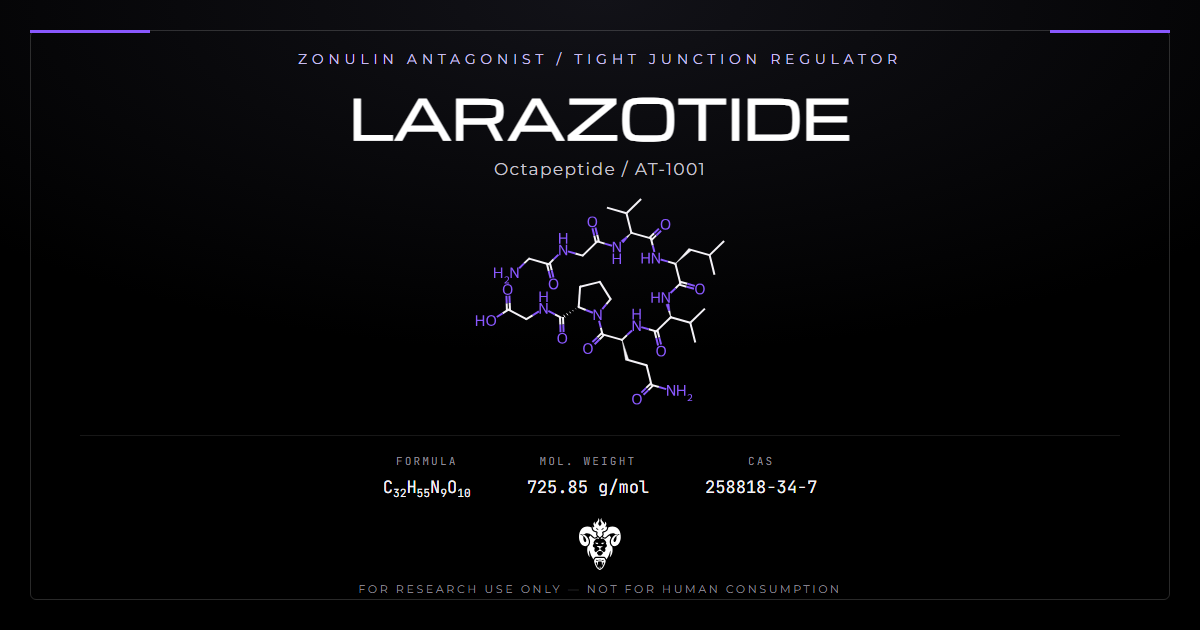
Everything below reports findings from cell cultures, isolated tissue and animals. This material is for research use only, not for human or veterinary use.
Larazotide is an eight-residue peptide. The sequence is Gly-Gly-Val-Leu-Val-Gln-Pro-Gly. There is no ring, no D-residue and no cap. The target sits in the gut lumen, on the same side of the epithelium as an oral dose.
Nearly every research peptide in a catalogue binds a cell-surface receptor. This one acts on the paracellular space. Tight junctions seal that gap. Zonulin opens it. Larazotide antagonises that opening.
A development programme and several indexed clinical papers exist. Those human endpoints sit outside the scope of this profile. The useful laboratory questions are identity, junction chemistry, and what cell and animal barrier assays actually measured.
Chemical identity of Larazotide
Eight residues, no cyclisation, no unnatural amino acids. The simplicity is the point.
| Property | Value |
|---|---|
| Sequence | Gly-Gly-Val-Leu-Val-Gln-Pro-Gly |
| Common names | Larazotide, AT-1001, INN-202, FZI/0 |
| Molecular formula | C32H55N9O10 |
| Molecular weight | 725.8 |
| Monoisotopic mass | 725.4072 Da |
| CAS | 258818-34-7 |
| PubChem CID | 9810532 |
| InChIKey | ORFLZNAGUTZRLQ-ZMBVWFSWSA-N |
| Configuration | All L |
| Salt often written | Acetate |
The catalogue carries it as Larazotide.
Reading the sequence
All eight residues are standard L-amino acids in their natural configuration. There is no D-substitution, no ring, no cap. Compare that to the melanocortin and GHRH analogues, where stability engineering dominates the structure.
Larazotide has no such armour because it does not need it for the geometry it was built for. Its site of action sits in the gut lumen. An orally presented peptide that stays on the apical face is doing the job. Systemic exposure is not the design.
The two glycine pairs at each end give the backbone flexibility. The terminal Gly-Gly and Pro-Gly motifs are both common protease targets. That is one reason the assay window after reconstitution is short.
The cholera connection
The sequence derives from a protein secreted by Vibrio cholerae (PMID 17697209) [4]. That protein, zonula occludens toxin, opens tight junctions. The peptide fragment does the reverse.
A sequence lifted from a permeability-opening toxin behaves as an antagonist at the same pathway. That is the unusual part. AT-1001, INN-202 and FZI/0 all name the same octapeptide. A methods section that switches codes mid-page has not switched compounds.
Wang and colleagues published the GGVLVQPG motif as an N-terminal zonulin-related oligopeptide that blocked zonulin receptor binding. Later reviews treat that octapeptide and Larazotide as the same tool [5][7]. Write the eight letters on the vial. A seven-residue truncation is a different reagent.
Residue four is leucine, not isoleucine. Residue six is glutamine, not glutamate. Those two facts are the identity traps that mass alone will miss. A lab that skips amino-acid analysis on a new synthesis is trusting the purchase order.
Tight junction and zonulin chemistry
Nearly every catalogue peptide binds a receptor on the cell surface. Larazotide targets the space between cells.
Zonulin and the seal
Zonulin regulates the competency of intercellular tight junctions. Raised zonulin signalling increases epithelial and endothelial permeability across a range of inflammatory conditions (PMID 33397225) [5]. Reviews of the pathway treat it as a control point rather than a bystander [6].
Antagonising that pathway associates with redistribution of tight junction proteins and actin filaments (PMID 33881350) [7]. Barrier function returns by putting the seal back, not by blocking a distant signal outright.
Occludin, claudins and ZO-1 are the proteins a western or a confocal stack should name. A paper that reports “barrier rescue” without naming a junction protein has reported a phenotype, not a mechanism.
Claudin composition sets charge selectivity of the pore. Occludin and ZO-1 set the scaffold. A tracer the size of Lucifer yellow reports a different leak than a monovalent ion current. TEER collapses both into one number. State the tracer when the claim is size-selective. State the claudin blot when the claim is pore composition. Larazotide work that reports only TEER has not finished the map.
A second mechanism appeared later
The same 2021 review links the peptide to inhibition of myosin light chain kinase [7]. Reduced tension on actin filaments would let tight junctions close. That is a different route to the same endpoint.
Two candidate mechanisms for one compound is not a contradiction. It does mean a paper attributing an effect purely to zonulin antagonism has chosen between them rather than demonstrated one. MLCK activity, phospho-MLC, and ZO-1 localisation are separable assays. Run the ones the claim needs.
Why systemic exposure is not the goal
An orally dosed peptide reaching the bloodstream intact would be the exception. Here that limitation is the design. The target sits luminally, so minimal absorption keeps the compound where the tight junctions are.
That property shapes every experiment. A cell-culture study applying Larazotide basolaterally is not modelling the intended geometry. Apical application on a polarised monolayer is the geometry the sequence assumes.
Transepithelial electrical resistance and Lucifer yellow flux are the usual monolayer readouts [7]. Lactulose-to-mannitol ratios are a different assay, built for whole animals and for people. Four indexed human papers used that ratio [1][2] and [8]. Human scores sit outside this profile. The method lesson still travels. Do not adopt lactulose/mannitol as a positive control for this peptide on the bench. TEER and junction imaging have the better track record in the mechanistic literature [7].
Barrier assays in cells and animals
The zonulin pathway appears in many inflammatory models, so the peptide has been applied well beyond a single disease label [5]. All of the work below is preclinical.
Monolayers
Polarised Caco-2 and similar lines are the standard dish. Seed on inserts. Wait for a stable TEER. Challenge the apical face with a zonulin-pathway opener or with gliadin. Then add Larazotide on the same face.
A rise in TEER, or a fall in a paracellular tracer, is the expected direction if the seal holds. Slifer and colleagues summarise that pharmacological approach (PMID 33881350) [7]. Confocal stacks of ZO-1 and occludin should match the electrical trace. An electrical rescue without a protein redistribution is a thinner result.
Basolateral dosing inverts the geometry. A paper that applies the peptide under the insert has asked a different question. Write the face next to the TEER value.
Rodent models
Zonulin transgenic mice show greater permeability at baseline. DSS colitis produced 40 to 70% mortality against zero in wild type (PMID 28423466) [12]. Adding AT-1001 to drinking water was the intervention that linked barrier function to the outcome.
A rat acute liver failure model gave the peptide by drinking water and by gavage before thioacetamide (PMID 34791921) [13]. The authors then examined intestinal tissue by light and electron microscopy alongside serum ammonia, AST and ALT. Those liver numbers are a downstream consequence in that model. The primary object is still the gut seal.
Reviews also record collagen-induced arthritis in mice [7]. A zonulin antagonist in an arthritis model is a test of whether a leaky gut sits upstream of that phenotype. It is not a certificate for a different species.
Large animal work
The mechanism review records intestinal ischaemic injury in pigs [7]. Porcine intestine is the closer model to human gut, so that second result carries more weight than its citation count suggests.
None of this transfers to a human symptom score. Read-across from a rodent barrier model to a 342-person rating scale does not hold. Reviews that cover both keep them separate [14][15].
| Study | System | Route | Readout |
|---|---|---|---|
| Slifer 2021 [7] | Polarised monolayers | Apical | TEER, junction protein redistribution |
| Slifer 2021 [7] | Pig intestine | Tissue | Ischaemic injury, barrier |
| Slifer 2021 [7] | Mouse | Various | Collagen-induced arthritis models |
| Sturgeon 2017 [12] | Zonulin transgenic mouse | Drinking water | DSS mortality 40-70% vs zero in wild type |
| Caliskan 2021 [13] | Rat ALF, thioacetamide | Water and gavage | Intestinal microscopy; AST, ALT, ammonia |
| Paterson 2007 [4] | Sequence origin | n/a | ZOT-derived antagonist logic |
| Troisi 2021 [5] | Review | n/a | Zonulin pathway across inflammatory models |
| Mohammadi-Kordkhayli 2025 [6] | Review | n/a | Junction regulation map |
The barrier hypothesis the peptide was built on
Larazotide is a test of an idea as much as a compound. The idea holds that a leaky epithelium lets antigen reach the lamina propria. Close the junctions and you interrupt the sequence upstream of the immune event [8].
The case for it
Increased intestinal permeability sits at the centre of several barrier reviews [11][14]. Zonulin transgenic animals are leakier at baseline and fare worse under challenge [12]. The mechanism is coherent and the animal work supports it.
Larazotide is the cleanest available probe of that hypothesis, because it acts on the junction and on very little else [7]. No confounding GPCR panel sits on the certificate.
The case against it
Permeability may be a consequence rather than a cause. Inflammation opens junctions on its own, so a leaky barrier in an inflamed gut does not establish direction. Reviews covering pathogenesis are careful about this and do not claim it settled [15].
Indexed human papers show a split between symptom scales and permeability ratios [1][2] and [3]. That split is a reason to keep the profile in cells and animals. It is not a reason to fill the gap with a guess about people.
Why the reagent outlives any one programme
A compound that does not carry an approval label can still be the best tool for the question it was built to ask. Larazotide has a defined target, oral luminal activity, and no confounding receptor pharmacology [1][7]. Those are reagent properties. They do not depend on a regulatory outcome.
The 2026 barrier review lists the peptide among experimental agents rather than established ones [11]. Field reviews still treat a gluten-free diet as the clinical standard [16][17]. Those sentences are status maps. They are not laboratory identity results.
Limits of the published record
Four gaps sit between the published record and the claims that circulate around it.
Population and certainty
Four randomised papers and a meta-analysis sit in the list. Human symptom scores and human milligram arms sit outside this profile. Dose-response notes in those papers exist [9][10]. This page does not quote them as a use ladder.
Which face of the monolayer
Apical versus basolateral changes the experiment. A TEER rescue on the wrong face is a different claim.
Which readout
TEER, tracer flux, confocal junction maps, and lactulose/mannitol ratios are not interchangeable [7][11]. A paper that reports “permeability” without naming the method has hidden the interesting part.
What this profile will not do
It will not quote patient-reported scores, human dose arms, or approval labels. Those sentences turn a research article into a use document. The papers remain cited so a reader can find them.
Four questions to ask of any Larazotide result
Most disagreement about this compound traces to comparing figures that were never comparable.
Which structure was measured?
Sequence GGVLVQPG, formula C32H55N9O10, mass 725.8 Da, CAS 258818-34-7, CID 9810532, InChIKey ORFLZNAGUTZRLQ-ZMBVWFSWSA-N. A lot that fails those checks is not Larazotide.
Which face and which cell line?
State apical or basolateral, the line, and the TEER baseline. Dual mechanism is a pair of assays, not a slogan.
Which animal model?
Zonulin transgenics under DSS, thioacetamide rats, arthritic mice and ischaemic pig intestine are different systems [7][12] and [13]. Read-across between them is a claim that needs its own experiment.
Is the comparator the same octapeptide?
AT-1001 and FZI/0 are the same chain. A seven-residue truncation is not. A result that names “a zonulin antagonist” without naming the lot is not usable.
Verifying research material
The octapeptide is a defined chemical entity with published identifiers, so verification is arithmetic rather than judgement. Batch documentation sits on the certificates of analysis page.
Identity
Formula C32H55N9O10 and InChIKey ORFLZNAGUTZRLQ-ZMBVWFSWSA-N. Mass spectrometry should return a molecular weight near 725.8. Put that mass on the first notebook line before the sequence. A lot that misses 725.8 is not Larazotide, whatever the label says.
At eight residues with no unusual chemistry, sequencing by tandem mass spectrometry is straightforward. The Val-Leu-Val run is the region worth reading carefully because those residues are close in mass.
Leucine and isoleucine are the classic trap in that region. They are isomers, identical at 113.08 daltons, and standard fragmentation does not separate them. A synthesis error substituting Ile for Leu at position four produces a peptide that passes every mass check and is not Larazotide. Amino acid analysis after hydrolysis, or a chromatographic comparison against a reference lot, is what answers it.
The two glycine pairs at each end are the other feature worth noting. Glycine residues give the backbone flexibility. The terminal Gly-Gly and Pro-Gly motifs are both common protease targets, which is one reason the assay window after reconstitution is short.
Purity and stereochemistry
All eight residues are L-configured, which removes the D-amino acid check that dominates verification of the melanocortin and GHRP peptides. It does not remove the need for chiral analysis. Racemisation during synthesis produces epimers with identical mass.
Glutamine deamidation is the degradation route to watch. It converts Gln to Glu and adds one dalton, which a low-resolution instrument will miss on a 725.8 parent. High-resolution mass, or a mapped fragment that includes residue six, is what finds it.
Deletion sequences at this length are easy to hide inside a broad chromatographic peak. Reversed-phase chromatography with mass detection finds them. Ultraviolet detection alone often does not. Peptide content differs from chromatographic purity. Lyophilised material carries counterions and water, so a vial labelled by weight holds less peptide than that. Acetate or trifluoroacetate content belongs on the certificate.
Handling
The sequence has no tryptophan, tyrosine or cysteine, so it lacks the photodegradation and disulfide-scrambling routes that complicate storage of peptides like LL-37 and Thymosin Alpha-1. Lyophilised material stored cold and dry is stable by peptide standards.
Store the lyophilised powder cold, dry and dark, and reconstitute close to the point of use.
Storage guidance is a house recommendation. Analytical documentation is per-lot release testing.
Aqueous solutions are the weak point. Proline-glycine sequences at a C-terminus are prone to hydrolysis over time, so freshly reconstituted material and month-old material are not equivalent inputs. Aliquot on reconstitution. Freeze-thaw cycling drives aggregation, which changes the species present without changing the label.
A second handling question is the counterion. Trifluoroacetate from cleavage cocktails is common on research peptides and changes both the mass of the salt form and the peptide content of a weighed vial. Acetate exchange, if it was done, belongs on the certificate next to the free-base mass. Do not infer the salt from the sequence.
Laboratories source Larazotide as a zonulin-pathway tight-junction reference. Related work appears in the peptides category.
Common questions about Larazotide
What does it target? The paracellular space between epithelial cells, not a cell-surface receptor. It regulates tight junction permeability [7].
Is it the same as AT-1001? Yes. AT-1001, INN-202 and FZI/0 all name the same octapeptide.
Why is it derived from a cholera protein? The parent protein opens tight junctions. This fragment antagonises the same pathway [4].
Does this page report human outcomes? No. Indexed clinical papers are listed so they can be found. This profile stops at chemistry, junction logic and barrier assays.
Which monolayer readout has the better record? Transepithelial electrical resistance and junction-protein imaging [7]. Lactulose/mannitol did not separate in the larger indexed human papers [1]. Do not use that ratio as a bench positive control.
Why does Larazotide need no stability engineering? Its target is luminal, so an oral or apical dose reaches it without crossing the epithelium. Systemic exposure is not the objective.
What degradation route matters most? Glutamine deamidation, which adds one dalton and converts Gln to Glu. Low-resolution mass spectrometry will miss it on a 725.8 parent.
What did the zonulin transgenic mice show? Higher baseline permeability. DSS then produced 40 to 70% mortality against zero in wild type. AT-1001 in drinking water was the intervention [12].
Summary of the evidence
Write the name, the eight letters and the junction on the first line of a notebook page. Everything else in this profile is a check on those facts.
Identity: GGVLVQPG, C32H55N9O10, 725.8 Da, CAS 258818-34-7, CID 9810532, InChIKey ORFLZNAGUTZRLQ-ZMBVWFSWSA-N. A certificate that omits intact mass is not finished.
Larazotide is the long name for that lot. AT-1001, INN-202 and FZI/0 are the same chain. Do not treat a code as a second compound.
Design: an eight-residue fragment of a cholera toxin pathway that antagonises zonulin-mediated opening [4][5] and [7]. A later review adds myosin light chain kinase as a second candidate route [7].
Animal and cell evidence: apical TEER and junction imaging in monolayers [7], zonulin transgenic mice under DSS [12], thioacetamide rats [13], and pig intestine in review [7].
Limits: human symptom scores, human dose arms and human adverse-event figures are out of scope here. Those papers remain in the reference list.
Status: supplied for laboratory research use only.
References
- Hoilat GJ, Altowairqi AK, Ayas MF, Alhaddab NT, Alnujaidi RA, Alharbi HA, Alyahyawi N, Kamal A, et al. Larazotide acetate for treatment of celiac disease: a systematic review and meta-analysis of randomized controlled trials. Clin Res Hepatol Gastroenterol. 2022;46(1):101782. PMID 34339872. DOI
- Kelly CP, Green PH, Murray JA, DiMarino A, Colatrella A, Leffler DA, Alexander T, Arsenescu R, et al. Larazotide acetate in patients with coeliac disease undergoing a gluten challenge: a randomised placebo-controlled study. Aliment Pharmacol Ther. 2013;37(2):252-262. PMID 23163616. DOI
- Leffler DA, Kelly CP, Green PH, Fedorak RN, DiMarino A, Perrow W, Rasmussen H, Wang C, et al. Larazotide acetate for persistent symptoms of celiac disease despite a gluten-free diet: a randomized controlled trial. Gastroenterology. 2015;148(7):1311-1319.e6. PMID 25683116. DOI
- Paterson BM, Lammers KM, Arrieta MC, Fasano A, Meddings JB. The safety, tolerance, pharmacokinetic and pharmacodynamic effects of single doses of AT-1001 in coeliac disease subjects: a proof of concept study. Aliment Pharmacol Ther. 2007;26(5):757-766. PMID 17697209. DOI
- Troisi J, Venutolo G, Terracciano C, Carri MD, Di Micco S, Landolfi A, Fasano A. The therapeutic use of the zonulin inhibitor AT-1001 (larazotide) for a variety of acute and chronic inflammatory diseases. Curr Med Chem. 2021;28(28):5788-5807. PMID 33397225. DOI
- Mohammadi-Kordkhayli M, Mousavi MJ, Camara-Lemarroy CR, Noorbakhsh F, Saboor-Yaraghi AA. Elucidating the significance of zonulin in the pathogenesis of chronic inflammatory disorders: emphasis on intestinal barrier function and tight junction regulation. Curr Med Chem. 2025;32(30):6547-6562. PMID 39252622. DOI
- Slifer ZM, Krishnan BR, Madan J, Blikslager AT. Larazotide acetate: a pharmacological peptide approach to tight junction regulation. Am J Physiol Gastrointest Liver Physiol. 2021;320(6):G983-G989. PMID 33881350. DOI
- Leffler DA, Kelly CP, Abdallah HZ, Colatrella AM, Harris LA, Leon F, Arterburn LA, Paterson BM, et al. A randomized, double-blind study of larazotide acetate to prevent the activation of celiac disease during gluten challenge. Am J Gastroenterol. 2012;107(10):1554-1562. PMID 22825365. DOI
- Khaleghi S, Ju JM, Lamba A, Murray JA. The potential utility of tight junction regulation in celiac disease: focus on larazotide acetate. Therap Adv Gastroenterol. 2016;9(1):37-49. PMID 26770266. DOI
- Kulkarni A, Patel S, Khanna D, Parmar MS. Current pharmacological approaches and potential future therapies for celiac disease. Eur J Pharmacol. 2021;909:174434. PMID 34418405. DOI
- Damianos JA, Bledsoe A, Camilleri M, Murray JA. Coeliac disease and the intestinal barrier: mechanisms of disruption and strategies for restoration. Gut. 2026;75(4):826-838. PMID 40579122. DOI
- Sturgeon C, Lan J, Fasano A. Zonulin transgenic mice show altered gut permeability and increased morbidity/mortality in the DSS colitis model. Ann N Y Acad Sci. 2017;1397(1):130-142. PMID 28423466. DOI
- Caliskan AR, Gul M, Yilmaz I, Otlu B, Uremis N, Uremis MM, Kilicaslan I, Gul S, et al. Effects of larazotide acetate, a tight junction regulator, on the liver and intestinal damage in acute liver failure in rats. Hum Exp Toxicol. 2021;40(12_suppl):S693-S701. PMID 34791921. DOI
- Jauregi-Miguel A. The tight junction and the epithelial barrier in coeliac disease. Int Rev Cell Mol Biol. 2021;358:105-132. PMID 33707052. DOI
- Valitutti F, Fasano A. Breaking down barriers: how understanding celiac disease pathogenesis informed the development of novel treatments. Dig Dis Sci. 2019;64(7):1748-1758. PMID 31076989. DOI
- D’heedene M, Vanuytsel T, Wauters L. Celiac disease: hope for new treatments beyond a gluten-free diet. Clin Nutr. 2024;43(6):1240-1249. PMID 38648685. DOI
- Serena G, Kelly CP, Fasano A. Nondietary therapies for celiac disease. Gastroenterol Clin North Am. 2019;48(1):145-163. PMID 30711207. DOI
Larazotide is sold for laboratory research use only. Not for human consumption, nor medical, veterinary, or household uses.