
Everything below reports findings from cell cultures, isolated tissue and animals. This material is for research use only, not for human or veterinary use.
The gut already secretes a peptide that hits the glucagon receptor and the GLP-1 receptor at once. It is called oxyntomodulin. It is weak at both receptors, and it lasts minutes.
Mazdutide is that hormone rebuilt as a long-acting analogue. A 33-residue glucagon backbone, aminoisobutyric acid at position 2, and a C20 fatty diacid on a lysine turn a meal hormone into a weekly laboratory reagent [13][17].
A development programme and several indexed clinical papers exist. Those human endpoints are outside the scope of this profile. The useful laboratory questions are identity, receptor logic, and what animal systems actually measured.
Chemical identity
Mazdutide is a 33-residue peptide built on a glucagon backbone. It carries a fatty diacid that binds albumin and slows clearance.
| Property | Value |
|---|---|
| Development codes | IBI362, LY3305677 |
| Class | Glucagon receptor and GLP-1 receptor dual agonist |
| Residues | 33, C-terminally amidated |
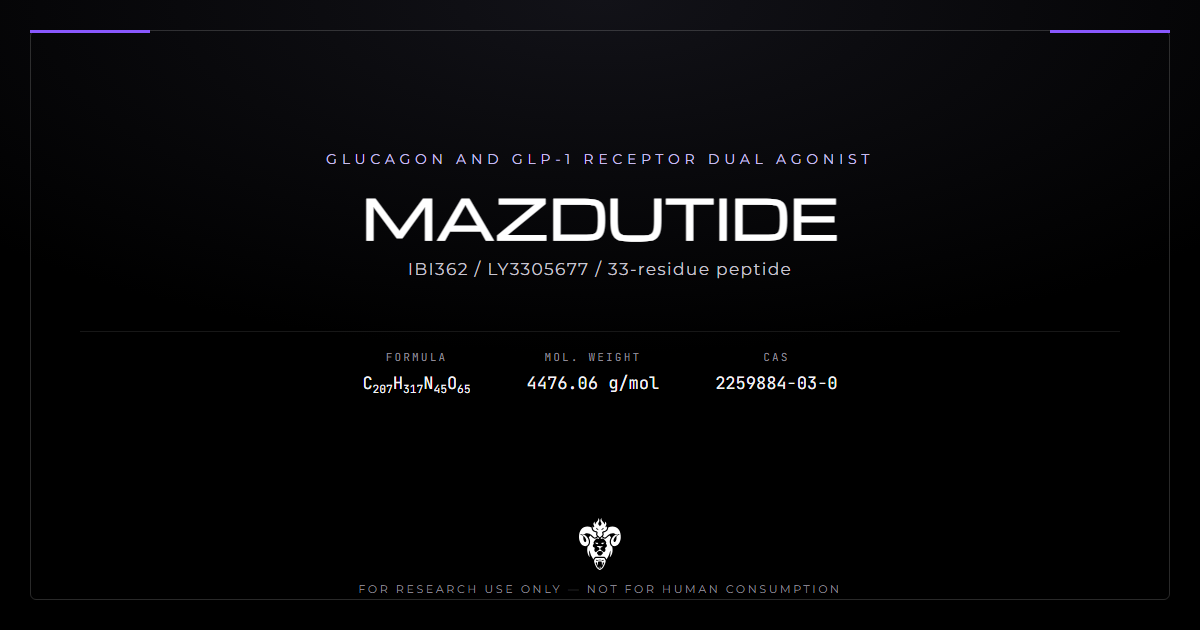
| Molecular formula | C207H317N45O65 |
| Average mass | 4,476 Da |
| Monoisotopic mass | 4,473.2883 Da |
| CAS number | 2259884-03-0 |
| PubChem CID | 167312357 |
| InChIKey | XRBYWQZGSZWYEJ-HMQIFOERSA-N |
| Natural template | Oxyntomodulin |
| Half-life extension | C20 diacid on a lysine, via glutamate and two short glycol spacers |
| Originator | Eli Lilly, developed with Innovent Biologics |
Reading the structure
Three modifications separate this peptide from the hormone it copies, and none of them are original to it.
Position 2 carries aminoisobutyric acid rather than serine. That substitution blocks dipeptidyl peptidase-4, the enzyme that clips native glucagon-family peptides within minutes. Semaglutide uses the same trick at its own position 8. The residue is a design choice, not a proof of shared pharmacology.
The lysine near the middle of the chain carries a C20 fatty diacid, attached through a glutamate spacer and two short glycol units. Albumin binds that chain. The complex clears slowly enough that weekly sampling schedules are used in animal work. Tirzepatide uses a C20 diacid and semaglutide a C18. All three share spacer chemistry. Shared lipidation is not shared receptor balance.
So the pharmacokinetic half of Mazdutide is standard incretin engineering. The receptor pharmacology is where it differs.
The oxyntomodulin template
Proglucagon is one gene that yields several peptides. Glucagon, GLP-1 and oxyntomodulin all come out of it, which is why one sequence can activate two receptors without anything being bolted on.
Oxyntomodulin activates both receptors weakly, and the body releases it after meals [11][13]. Building a potent, long-acting version of an existing physiological signal is the argument for the whole class, and for Mazdutide in particular.
Mazdutide takes the glucagon end of that family as its starting sequence. Survodutide does the same from a different backbone. The two are the leading members of the class in a research catalogue, and they are not interchangeable lots.
The shared-gene argument is the part that travels. Because glucagon, GLP-1 and oxyntomodulin are cleavage products of one precursor, a single chain can present epitopes for two receptors without a fusion tag. That is why the template is oxyntomodulin and not a stapled heterodimer. A laboratory that wants the heterodimer experiment should build one. Mazdutide is not that construct.
Mass still decides identity after that story. A 33-residue chain with a C20 diacid is a defined increment away from glucagon (3,483 Da) and from survodutide (4,232 Da). If a certificate quotes one of those other masses, the vial is not Mazdutide, whatever the label says.
The glucagon arm and what it is meant to add
Adding glucagon activity to a glucose-lowering design sounds backwards. The rationale is specific, and worth separating from any claim about people.
What glucagon does besides raising glucose
Glucagon stimulates lipolysis and mitochondrial fat oxidation in the liver. It regulates amino acid metabolism through a liver to alpha-cell axis. It reduces caloric intake, and it raises energy expenditure in animal models [13].
The mirror-image evidence is stronger than most summaries admit. Glucagon receptor antagonists, developed as diabetes tools, increased body weight, hepatic fat and serum lipids in people with type 2 diabetes [13]. Blocking the receptor makes those metabolic measures worse. That is an argument for agonism which does not depend on any Mazdutide animal result.
GLP-1 agonism then covers the glycaemic cost in the design story. Insulin secretion and slowed gastric emptying offset the hyperglycaemic push. Whether that arithmetic holds for a given lot is an assay question, not a catalogue claim.
Infusion work on the parent hormones
Bagger and colleagues gave 15 healthy men five liquid meal tests under saline, GLP-1, glucagon, oxyntomodulin, or GLP-1 plus glucagon (PMID 26445112) [11]. Every peptide arm cut food intake by a similar amount. The combination added nothing over either hormone alone. Resting oxygen uptake did not change significantly under any infusion, including oxyntomodulin.
That is one acute study in lean young men. Chronic weekly dosing of Mazdutide is a different experiment. It still means the additive-mechanism claim rests on animal energetics rather than on a clean human additivity result for this analogue.
The same laboratory tradition shows the method can detect additivity when it exists. Co-infusing peptide YY with oxyntomodulin cut energy intake against saline, more than either hormone produced alone [12].
Receptor logic in cells and mice
The dual-agonist claim is a pair of potencies, not a slogan. Cell lines that express one receptor at a time are how that pair gets measured.
Two receptors, two readouts
Glucagon-receptor engagement is the arm that should move hepatic fat oxidation and energy expenditure [13]. GLP-1-receptor engagement is the arm that should move insulinotropic and intake readouts. A lot that is potent at one and silent at the other is a different reagent.
Mazdutide was built so both arms fire. Survodutide was built the same way on a 29-residue glucagon backbone. Comparing the two in the same cell assay is the experiment that tells them apart. Comparing marketing copy is not.
Selection biomarkers used on related dual agonists
Boehringer-style dual-agonist screens read GLP-1 engagement on oral glucose tolerance and glucagon engagement on hepatic NNMT messenger RNA plus plasma FGF21 [4]. Those glucagon biomarkers can move an order of magnitude in lean mice. NNMT is the same enzyme that 5-amino-1MQ inhibits, approached here from the opposite direction.
Treat those markers as a method, not as a Mazdutide certificate. If a laboratory wants to know which arm a given vial engages, it runs the cells.
Where the glucagon receptor may do something GLP-1 cannot
If the second receptor earns its place, the evidence should appear in organs where glucagon acts and GLP-1 does not. Three lines are worth separating by species.
Liver fat, against semaglutide in mice
A 9.4-tesla MRI study fed 42 male mice a high-fat diet for 13 weeks, then treated them with Mazdutide, semaglutide or vehicle for four weeks (PMID 40828048) [14].
Proton density fat fraction fell further on the dual agonist at four weeks, with a median change of 5.59% against 3.30%. At one week the two drugs did not separate. Hepatic iron, read as R2*, showed no difference at either timepoint.
Fat fraction correlated with hepatic triglyceride and with histological steatosis scores. A four-week mouse result does not transfer to human liver disease. Clinical fatty-liver work is a separate literature [17].
The kidney tubule
Genetic work published in 2026 gives the receptor a kidney-intrinsic role. Tubule-specific deletion of the glucagon receptor worsened diabetic kidney disease in mice, with phospholipid accumulation in enlarged lysosomes (PMID 42555719) [15].
The mechanism runs through V-ATPase assembly. Loss of the receptor disrupted its association with the ATP6V1A subunit and impaired lysosomal acidification, and re-expressing the receptor reversed the injury [15]. Tubular receptor expression was also reduced in human kidney samples from patients with the disease. That last point is tissue expression, not a Mazdutide outcome.
Cognition in one diabetic mouse model
Male db/db mice treated with Mazdutide outperformed dulaglutide-treated animals on behavioural testing. Multi-omics analysis pointed at neuroprotection, energy metabolism and synaptic plasticity pathways [16].
The authors state plainly that their findings apply to male mice only. Read it as a hypothesis about the second receptor, not as evidence about people.
Limits of the published record
Four gaps sit between the published record and the claims that circulate around it.
Population and certainty
The indexed efficacy papers ran in a narrow set of cohorts. A 2026 network meta-analysis graded emerging agents in this class at very low to low certainty [18]. Cardiovascular signalling of multi-agonists remains unsettled in review [20]. None of that is a laboratory identity result [8][9].
Which arm is being credited
Weight, appetite and glycaemic readouts are all explicable through GLP-1 alone. The glucagon-specific case rests on liver, kidney and energy expenditure data, mostly in animals [13][14] and [15].
Which molecule was in the vial
A lipidated 33-residue peptide is easy to confuse with survodutide (4,232 Da) or with a backbone that never received the C20 chain. Intact mass is the first check. A name on a label is not.
What this profile will not do
It will not quote human dose ladders, human adverse-event rates, or approval labels. Those sentences turn a research article into a use document. The papers remain cited so a reader can find them [3][5].
Four questions to ask of any Mazdutide result
Most disagreement about this compound traces to comparing figures that were never comparable.
Which structure was measured?
Intact mass 4,476 Da average, 4,473.29 monoisotopic, CAS 2259884-03-0, CID 167312357. A lot that fails those checks is not Mazdutide.
Which receptor assay?
State the cell line, the species of the receptor, and whether both arms were read. Dual agonist is a measured pair, not a class nickname.
Which animal model?
High-fat-diet mice, tubule-specific receptor knockouts, and db/db males are different systems [14][15] and [16]. Read-across between them is a claim that needs its own experiment.
Is the comparator the same backbone?
Survodutide, semaglutide and tirzepatide share lipidation tricks and do not share sequence. A result that names “a dual agonist” without naming the lot is not usable [10][19].
Verifying research material
A lipidated 33-residue peptide of 4,476 Da has a specific set of analytical questions.
Identity
Intact mass is the primary check, at 4,476 Da average and 4,473.29 monoisotopic. That resolution separates this peptide cleanly from its relatives: survodutide runs at 4,232, semaglutide at 4,114 and glucagon itself at 3,483.
The C20 diacid and its spacer are the features to confirm. A backbone missing that chain differs by a defined mass increment and would clear in hours rather than days.
Peptide mapping confirms sequence. At 33 residues the tryptic map is short, and full coverage by tandem mass spectrometry is routine. Put the residue count next to the mass. A 29-residue dual agonist at 4,232 Da is survodutide, not Mazdutide. The C20 chain is the other identity line. A backbone that never received it is a different reagent with a different clearance.
Purity and related substances
Deletion sequences are the expected impurity in solid-phase synthesis at this length. Each missing residue shifts intact mass by that residue, which is easy to miss inside a broad chromatographic peak.
Reversed-phase chromatography with mass detection finds them. Ultraviolet detection alone often does not. Isomers of the acylation site are the second concern, since the diacid can in principle attach to the wrong lysine.
Peptide content differs from chromatographic purity. Lyophilised material carries counterions and water, so a vial labelled by weight holds less peptide than that, and acetate or trifluoroacetate content belongs on the certificate.
Handling
Store the lyophilised powder cold, dry and dark, and reconstitute close to the point of use.
Storage guidance is a house recommendation. Analytical documentation is per-lot release testing.
The albumin-binding chain makes the peptide surface-active. Dilute solutions lose material to plastic, so aliquot on reconstitution rather than sampling one vial repeatedly. Freeze-thaw cycling drives aggregation, which changes the species present without changing the label.
A second handling question is the counterion. Trifluoroacetate from cleavage cocktails is common on research peptides and changes both the mass of the salt form and the peptide content of a weighed vial. Acetate exchange, if it was done, belongs on the certificate next to the free-base mass. Do not infer the salt from the sequence.
A third question is methionine and tryptophan oxidation if those residues are present in a related lot. Mazdutide’s published formula does not make oxidation the first impurity to hunt. Deletion sequences and mis-acylation still are. Run intact mass, then a mapped digest, then a reversed-phase trace with a mass detector. That order finds the failures that a single HPLC area percent hides.
Related dual-agonist and energy-expenditure reagents in this catalogue are not substitutes. Survodutide is the other glucagon and GLP-1 backbone. AOD-9604 is a fragment approach on a different design. 5-amino-1MQ hits NNMT rather than the glucagon receptor. Keep the names on separate labels.
Neff’s 2025 review of glucagon signalling is the paper to read before treating “glucagon activity” as a single phenotype (PMID 41025406, DOI) [13]. Hepatic fat oxidation, amino-acid disposal, and energy expenditure are different measurements. A mouse study that reports one of them has not reported the others.
The db/db cognition paper is the same class of limit (PMID 40479843) [16]. Multi-omics on male mice can generate a pathway list. It cannot license a claim about people, and it cannot identify an unknown vial.
Shirley’s development review sits in the reference list because it is the shortest map of how this analogue was named and coded (PMID 41028652) [17]. Use it for chronology and synonyms. Do not use it as a use document.
A cardiovascular narrative review of glucagon-receptor signalling in multi-agonists is likewise a map of what has not been settled (PMID 42535526) [20]. Unsettled cardiac signalling is a reason to keep the profile in cells and animals, not a reason to fill the gap with a guess.
Kimera publishes third-party certificates of analysis for every lot in its COA database. Laboratories source Mazdutide as a glucagon and GLP-1 receptor dual agonist reference. It sits alongside survodutide, the other dual agonist in this class, and with 5-amino-1MQ, which inhibits nicotinamide N-methyltransferase in the same hepatic metabolic space. Related work appears in the peptides category.
Common questions about Mazdutide
What is Mazdutide? A 33-residue oxyntomodulin analogue that activates the glucagon receptor and the GLP-1 receptor [13][17].
How does it differ from oxyntomodulin? Aminoisobutyric acid at position 2 and a C20 albumin-binding diacid. Native oxyntomodulin is weak at both receptors and short-lived [11][13].
How does it differ from survodutide? Residue count and mass. Mazdutide is 33 residues and 4,476 Da. Survodutide is 29 residues and 4,232 Da. Run both on the same intact-mass method before treating them as equivalents.
What does the glucagon receptor add in animals? Hepatic fat oxidation and energy expenditure in published models [13][14]. Acute co-infusion of the parent hormones did not show additivity on intake or resting energy expenditure [11].
Does this page report human outcomes? No. Indexed clinical papers are listed so they can be found [1][2] and [18]. This profile stops at chemistry, receptor logic and animal systems.
Summary of the evidence
Write the name, the mass and the two receptors on the first line of a notebook page. Everything else in this profile is a check on those three facts.
Identity: 33 residues, C207H317N45O65, 4,476 Da, with aminoisobutyric acid at position 2 and a C20 diacid for albumin binding. PubChem CID 167312357 and InChIKey XRBYWQZGSZWYEJ-HMQIFOERSA-N close the record. A certificate that omits intact mass is not finished.
Mazdutide is the long name for that lot. IBI362 and LY3305677 are the same chain under development codes. Do not treat a code as a second compound.
If a methods section names Mazdutide and then quotes a mass that belongs to survodutide, stop. The rest of that paper is about a different reagent. The same rule applies in reverse. This is the cheapest way to keep two dual-agonist literatures from contaminating each other, and it costs one intact-mass line. Keep the certificate next to the notebook. A later reader should be able to match the Mazdutide lot to the paper without asking you what was in the vial. That is the whole point of keeping a written research-use laboratory record.
Design: an oxyntomodulin analogue on a glucagon backbone [11][13], using lipidation chemistry that also appears on other incretin-class peptides.
Glucagon-specific evidence: greater hepatic fat reduction than semaglutide in mice [14], a kidney-intrinsic role for the receptor [15], and no additive effect in an acute parent-hormone co-infusion [11].
Limits: human efficacy, human dose and human adverse-event figures are out of scope here. Those papers remain in the reference list [6][7].
Status: supplied for laboratory research use only.
References
- Ji L, Jiang H, Bi Y, Li H, Tian J, Liu D, et al. Once-weekly mazdutide in Chinese adults with obesity or overweight. N Engl J Med. 2025;392(22):2215-2225. PMID 40421736. DOI
- Gao L, Jiang H, Cai H, Tian J, Zhang Y, Qiu W, et al. Treatment with 9-mg mazdutide for weight reduction in Chinese adults with obesity: the GLORY-2 randomized clinical trial. JAMA. 2026;336(5):377-388. PMID 42251595. DOI
- Ji L, Jiang H, An P, Deng H, Liu M, Li L, et al. IBI362 (LY3305677), a weekly-dose GLP-1 and glucagon receptor dual agonist, in Chinese adults with overweight or obesity: a randomised, placebo-controlled, multiple ascending dose phase 1b study. EClinicalMedicine. 2021;39:101088. PMID 34430840. DOI
- Ji L, Gao L, Jiang H, Yang J, Yu L, Wen J, et al. Safety and efficacy of a GLP-1 and glucagon receptor dual agonist mazdutide (IBI362) 9 mg and 10 mg in Chinese adults with overweight or obesity: a randomised, placebo-controlled, multiple-ascending-dose phase 1b trial. EClinicalMedicine. 2022;54:101691. PMID 36247927. DOI
- Ji L, Jiang H, Cheng Z, Qiu W, Liao L, Zhang Y, et al. A phase 2 randomised controlled trial of mazdutide in Chinese overweight adults or adults with obesity. Nat Commun. 2023;14(1):8289. PMID 38092790. DOI
- Ji L, Jiang H, Cheng Z, Li X, Wang Y, Gu J, et al. Mazdutide 9 mg in Chinese adults with a body mass index of 30 or above but without diabetes: a phase 2 randomized controlled trial. Med. 2026;7(5):101063. PMID 41875890. DOI
- Bhattachar SN, Tham LS, Li Y, Chua L, Loghin C, Robins D, et al. Mazdutide reduces body weight in adults with overweight or obesity: a high-dose phase 1 trial. Diabetes Obes Metab. 2025;27(11):6460-6469. PMID 40832785. DOI
- Zhang B, Cheng Z, Chen J, Zhang X, Liu D, Jiang H, et al. Efficacy and safety of mazdutide in Chinese patients with type 2 diabetes: a randomized, double-blind, placebo-controlled phase 2 trial. Diabetes Care. 2024;47(1):160-168. PMID 37943529. DOI
- Zhu D, Zhao J, Cai H, Chu X, Zhang B, Ji L, et al. Mazdutide versus placebo in Chinese adults with type 2 diabetes. Nature. 2025;652(8108):174-180. PMID 41407859. DOI
- Guo L, Zhang B, Xue X, Zhang X, Jiang H, Ji L, et al. Mazdutide versus dulaglutide in Chinese adults with type 2 diabetes. Nature. 2025;652(8108):181-188. PMID 41407860. DOI
- Bagger JI, Holst JJ, Hartmann B, Andersen B, Knop FK, Vilsboll T. Effect of oxyntomodulin, glucagon, GLP-1, and combined glucagon plus GLP-1 infusion on food intake, appetite, and resting energy expenditure. J Clin Endocrinol Metab. 2015;100(12):4541-4552. PMID 26445112. DOI
- Field BC, Wren AM, Peters V, Baynes KC, Martin NM, Patterson M, et al. PYY3-36 and oxyntomodulin can be additive in their effect on food intake in overweight and obese humans. Diabetes. 2010;59(7):1635-1639. PMID 20357366. DOI
- Neff GW. Shared mechanistic pathways of glucagon signalling. Diabetes Obes Metab. 2025;27(12):6869-6883. PMID 41025406. DOI
- Xia H, Min Y, Wang Y, Gao S, Wang H, Yan F, et al. Multiparametric MRI evaluation of liver fat and iron after glucagon-like peptide-1 receptor and glucagon receptor dual-agonist treatment in a high-fat diet-induced mouse model. Radiology. 2025;316(2):e243780. PMID 40828048. DOI
- Qu H, Xu M, Du P, Zhang L, Li Y, Wang J, et al. Renoprotective effects of tubular glucagon receptor activation mediated by V-ATPase. Sci Adv. 2026;12(32):eaeg2534. PMID 42555719. DOI
- Dong W, Bai J, Yuan Q, Zhang Y, Wang X, Li H, et al. Mazdutide, a dual agonist targeting GLP-1R and GCGR, mitigates diabetes-associated cognitive dysfunction: mechanistic insights from multi-omics analysis. EBioMedicine. 2025;117:105791. PMID 40479843. DOI
- Shirley M. Mazdutide: first approval. Drugs. 2025;85(12):1621-1627. PMID 41028652. DOI
- Nong K, Shi Q, Xie X, Wang Y, Zeng L, Guyatt G, et al. Comparative effects of drugs for adults with overweight or obesity: systematic review and network meta-analysis. BMJ. 2026;394:e372161. PMID 42419792. DOI
- Azam MH, Azam KU, Azam MA, Khan A. Efficacy and safety of mazdutide in managing overweight and obesity among non-diabetic adults: a meta-analysis of randomised controlled trials. Diabetes Obes Metab. 2026;28(6):4464-4473. PMID 41804840. DOI
- Kushner PR, Michos ED. Cardiovascular effects of glucagon receptor signaling alone and combined with glucagon-like peptide-1 receptor signaling in multiagonists: a narrative review with a translational focus. J Am Heart Assoc. 2026;15(15):e049727. PMID 42535526. DOI
Mazdutide is sold for laboratory research use only. Not for human consumption, nor medical, veterinary, or household uses.
Literature retrieved from PubMed.