
Everything below reports findings from cell cultures, isolated tissue and animals. This material is for research use only, not for human or veterinary use.
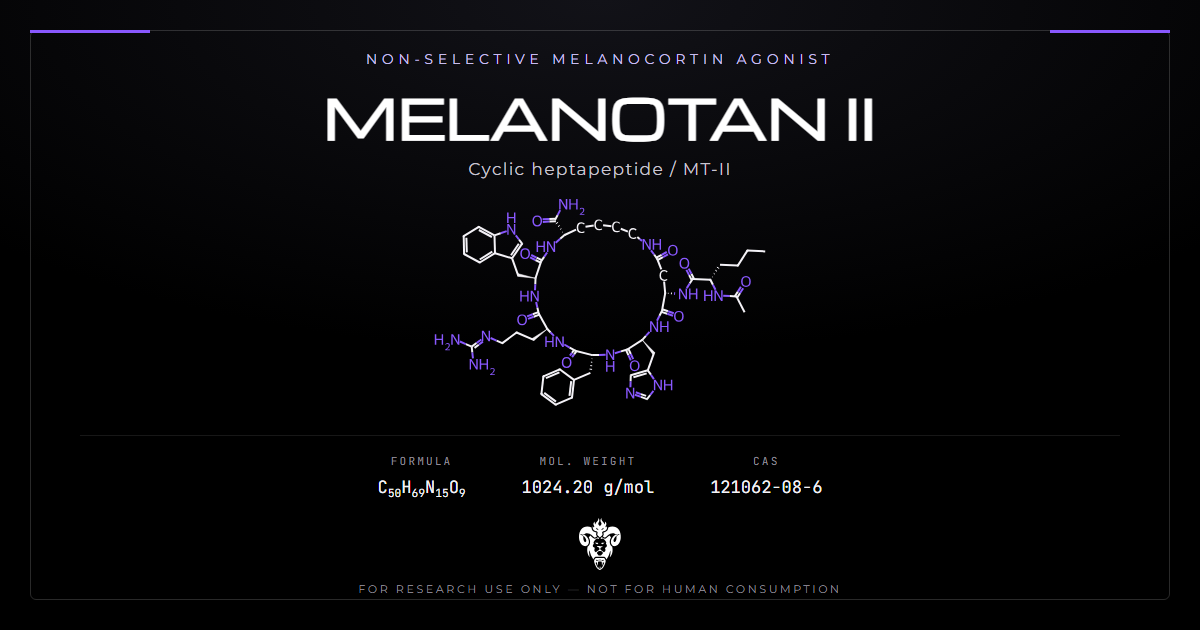
Melanotan II is a cyclic heptapeptide built from alpha-melanocyte-stimulating hormone. A lactam bridge joins an aspartate side chain to a lysine side chain. D-phenylalanine sits inside that ring.
The ring is the reagent. It holds the His-D-Phe-Arg-Trp pharmacophore in a constrained loop and it resists the proteases that would linearise a short chain. The same motif appears on the linear sibling and on the free-acid analogue PT-141. Shared motif is not shared mass, and it is not shared receptor balance.
Indexed human papers exist. Those human endpoints sit outside this profile. The useful laboratory questions are the macrocycle, the four melanocortin receptors, and what animal systems actually measured.
Chemical identity
A cyclic heptapeptide closed by a lactam bridge between an aspartate and a lysine.
| Property | Value |
|---|---|
| Sequence | Ac-Nle-cyclo[Asp-His-D-Phe-Arg-Trp-Lys]-NH2 |
| Common names | Melanotan II, MT-II, MTII |
| Molecular formula | C50H69N15O9 |
| Molecular weight | 1,024.2 g/mol |
| Monoisotopic mass | 1,023.5403 Da |
| CAS | 121062-08-6 |
| PubChem CID | 92432 |
| InChIKey | JDKLPDJLXHXHNV-MFVUMRCOSA-N |
| Residues | 7 |
| Ring | Lactam, Asp to Lys side chains |
| Parent hormone | Alpha-MSH |
| Targets | MC1R, MC3R, MC4R, MC5R |
| Hydrogen-bond donors | 13 (PubChem computed) |
| Hydrogen-bond acceptors | 11 (PubChem computed) |
| Rotatable bonds | 17 (PubChem computed) |
| XLogP3-AA | 0 (PubChem computed) |
Reading the macrocycle
The ring is the point, and so is one inverted residue.
Cyclisation joins an aspartate side chain to a lysine side chain, locking the backbone into a constrained loop. That rigidity holds the pharmacophore in the shape the receptor wants. It also resists the proteases that would linearise it.
D-phenylalanine at the Phe position does the other half. Substituting the natural L-residue for its mirror image raised potency and stability together. The same inversion appears in the linear sibling.
PubChem lists this chain as CID 92432. The condensed sequence is Ac-Nle-Asp(1)-His-D-Phe-Arg-Trp-Lys(1)-NH2, with the (1) marks closing the lactam. A certificate that quotes a free C-terminal acid has named PT-141 instead.
The family it belongs to
Three synthetic ligands share the alpha-MSH pharmacophore and differ in how far the engineering went.
Melanotan I is linear and biased toward MC1R. It keeps the full tridecapeptide chain, with norleucine at position 4 and D-phenylalanine at position 7. Related chemistry sits in the Melanotan I profile.
PT-141 is the deamidated form of this cyclic amide. It carries a free acid where Melanotan II carries an amide. Related chemistry sits in the PT-141 profile.
This heptapeptide sits between them. It is cyclic like PT-141 and amidated like a classic peptide C-terminus. It is not a substitute for either neighbour.
The lactam and the inverted residue
Two covalent choices make this lot what it is. Miss either one and the vial is a different reagent.
What ring closure costs in mass
Lactam formation loses water. A linear impurity with the same seven residues therefore differs from the cyclised product by 18 Da. Incomplete cyclisation is measurable rather than inferred.
Tandem mass spectrometry behaves differently on a macrocycle. Ring opening has to occur before sequence ions appear. A fragmentation spectrum from a cyclic peptide therefore reads unlike its linear equivalent. The two do not compare directly on a linear peptide map.
Norleucine at the N-terminus removes the methionine oxidation site that the native hormone carries. The acetyl cap removes the free amine that aminopeptidases recognise. The C-terminal amide removes the free acid that carboxypeptidases recognise. Each of those choices is a defined mass increment.
Why D-Phe is a stereochemical claim
Chromatographic purity does not test configuration. The all-L epimer has the same mass and the same formula. It is a different compound pharmacologically.
Chiral analysis, or amino acid analysis after hydrolysis, is what answers that question. A lot that passes intact mass and fails chiral analysis is not Melanotan II in the sense the 1980s design intended. It is a linear-looking impurity class sitting at the same m/z.
Tryptophan is the oxidation-prone residue here. Oxidation adds 16 Da. A +16 peak on an otherwise correct intact mass is a handling problem, not a cyclisation problem.
Four receptors, four readouts
A single agonist at four related receptors produces four effect sets simultaneously. None of them can be dialled out on this sequence.
What each receptor does
The receptors sit in different tissues and answer to the same ligand.
| Receptor | Principal location | Laboratory readout |
|---|---|---|
| MC1R | Melanocytes | Eumelanin synthesis, pigment assays |
| MC3R | Hypothalamus, periphery | Energy-homeostasis models |
| MC4R | Hypothalamus, brainstem | Intake and autonomic assays |
| MC5R | Sebaceous glands, exocrine | Sebum and exocrine secretion |
MC1R is a Gs-coupled receptor on melanocytes. Agonism raises intracellular cAMP. That rise drives the transcriptional programme that shifts output from pheomelanin toward eumelanin. Nothing about that step is unusual. The peptide is asking a receptor to do its normal job.
Physiological pigment runs on the same receptor by a longer route. Ultraviolet damage triggers keratinocytes to release alpha-MSH. Neighbouring melanocytes then see that hormone. A laboratory agonist supplies the signal directly and skips the keratinocyte step. That is a mechanistic description, not a use instruction.
Why non-selectivity is a design fact
A drug-development programme wants one axis and a clean margin around it. This sequence offers neither.
Later programmes split the activities across separate backbones. The linear 13-mer narrowed toward MC1R. The free-acid cyclic 7-mer narrowed toward MC4R [8][14]. That split is a structure verdict. It is not a treatment story.
If a laboratory wants one receptor, it should pick a narrower ligand. If a laboratory wants the four-receptor pattern, this is the parent amide. Write which question the vial is answering before the assay starts.
The same receptor on transformed melanocytes
Melanoma overexpresses MC1R, and that overexpression is exploitable. Zhou and colleagues used Melanotan II as a targeting moiety in ligand-drug conjugates for exactly that reason (PMID 33073191) [11].
A camptothecin conjugate inhibited A375 melanoma cells at an IC50 of 16 nM [11]. That result belongs to the conjugate, not to the unconjugated peptide. It still shows why a melanocortin ligand can be a delivery handle.
Hold both halves. A ligand seeking out melanocytes is useful when it carries a cytotoxic payload. It is harder to interpret when it carries nothing but agonism.
Identity versus Melanotan I and PT-141
Names in this family are close enough to swap by accident. Formulae are not.
Mass, amide, and acid
| Compound | Scaffold | Formula | Average mass |
|---|---|---|---|
| alpha-MSH | Linear 13-mer, Met4 | C77H109N21O19S | 1,664.9 |
| Melanotan I | Linear 13-mer, Nle4, D-Phe7 | C78H111N21O19 | 1,646.8 |
| Melanotan II | Cyclic 7-mer amide | C50H69N15O9 | 1,024.2 |
| PT-141 | Cyclic 7-mer acid | C50H68N14O10 | 1,025.2 |
The relationship to PT-141 is exact and worth stating in atoms. Melanotan II carries C50H69N15O9. PT-141 carries C50H68N14O10. One NH becomes one O.
That single swap converts the C-terminal amide into a free carboxylic acid. Nothing else moves. Both compounds share the InChIKey stereochemical block MFVUMRCOSA, so every stereocentre matches.
Mass spectrometry separates the pair by one unit, and the direction runs opposite to intuition. PT-141 is heavier at 1,025.2 against 1,024.2, because the substitution trades NH for the heavier O. A supplier confusing the two ships a compound one dalton light, not one dalton heavy.
Linear 13-mer versus cyclic 7-mer
Melanotan I keeps the full alpha-MSH chain. This analogue throws the chain away and keeps the pharmacophore in a ring. Both approaches beat the native hormone on stability. They arrive there by opposite routes.
A 600 Da gap separates the linear peptide from the cyclic pair. Intact mass is the cheapest way to keep those literatures from contaminating each other. A methods section that writes only “melanotan” has not identified the reagent [14].
What the animal work adds
Rodent and cell studies map the central and pigment axes that the sequence was built to touch.
Feeding, and where in the brain
Baird and colleagues injected Melanotan II into the third or fourth ventricle of rats (PMID 21734020). They then analysed licking microstructure rather than intake alone [2].
Both sites reduced sucrose intake at 0.1 and 1 nM. Forebrain injection also reduced the initial lick rate and mean burst duration, measures associated with taste evaluation. Hindbrain injection did not [2].
Read that as two mechanisms rather than one. The anorexia carries a postingestive component from both sites and a taste-evaluation component only from the forebrain. Central ventricular injection is not a subcutaneous vial study. Write the site with the concentration.
Melanoma cells and a topical mouse model
Wu and colleagues tested topical Melanotan II against B16-F10 melanoma (PMID 31968661) [10]. It did not change proliferation. It did inhibit migration, invasion, and colony formation. Topical application attenuated tumour progression in mice with established melanoma.
The mechanism they report runs through raised PTEN protein, suppressed AKT and NF-kappaB signalling, and reduced COX-2 with lower prostaglandin E2 [10]. That is a mouse xenograft and a topical route. It does not cancel a case series in another species, and it does not license a claim about people.
Amyloid pathology in one transgenic line
One study used an APP/PS1 mouse model of Alzheimer’s disease. Central administration of a Melanotan II derivative reduced amyloid-beta accumulation and astrocytic activation, particularly in hippocampus (PMID 33623128) [12]. The A1 reactive astrocyte subtype fell specifically.
That result belongs to a transgenic mouse and a central injection route. It illustrates how wide melanocortin signalling reaches. It establishes nothing about the unconjugated amide in any other setting.
| Model | Route | What moved |
|---|---|---|
| Rat, third ventricle [2] | Central, 0.1 and 1 nM | Sucrose intake and lick microstructure |
| Rat, fourth ventricle [2] | Central, 0.1 and 1 nM | Sucrose intake, not taste evaluation |
| B16-F10 cells and mice [10] | Topical | Migration, invasion, tumour progression |
| A375 cells, conjugate [11] | In vitro | 16 nM IC50 for a camptothecin conjugate |
| APP/PS1 mice [12] | Central, derivative | Amyloid-beta and astrocyte activation |
Limits of the published record
Four gaps sit between the published record and the claims that circulate around this amide.
What the indexed human papers are
One controlled crossover paper exists [1]. Case reports and reviews of unregulated exposure sit beside it. A long-term paper on the free-acid analogue is in the same file [8]. A review of the linear sibling’s indication family is also listed [14].
Those human endpoints are outside the scope of this profile. The papers remain cited so a reader can find them. This page does not quote human erectile scores, human adverse-event rates, or approval labels.
Which direction on melanoma
A mouse xenograft reporting tumour suppression [10] and a case-series review of eruptive naevi [7] are answering different questions in different species. Neither settles the other.
Which name was in the methods
Papers and case reports sometimes write only “melanotan” [5][14]. Melanotan I and Melanotan II are different molecules with different receptor profiles. The distinction changes the pharmacology entirely.
What this profile will not do
It will not treat pigmentation or autonomic readouts as wanted effects. It will not treat approved relatives as a use document for this lot. Structure, receptor logic, animal systems, and analytical identity are the usable content.
How to read a Melanotan II study
Four questions, and the first two account for most of the confusion in this literature.
Which melanotan?
Melanotan I and Melanotan II are different molecules with different receptor profiles [14]. PT-141 is the deamidated cyclic relative. Check the sequence, then the mass, then the C-terminus.
What route and what site?
Central ventricular injection in a rodent is not a peripheral injection [2][12]. Forebrain and hindbrain injection of the same dose gave different effects in the same study [2]. Topical application on a melanoma model is a third route [10].
Case report or controlled laboratory study?
One controlled human trial exists [1]. Everything else in the human literature is a case report or a review of case reports [7][9]. Laboratory studies use characterised compound. Case reports mostly do not [3][13].
Was the material assayed?
A study dosing verified peptide at a stated concentration describes the pharmacology of Melanotan II. A case report describes the consequence of injecting something a patient bought. The two are not the same claim even when the outcome is identical.
Look for a content assay before treating a reported milligram figure as a dose at all.
Verifying research material
A cyclic seven-residue peptide with a lactam bridge has one analytical question that a linear peptide does not.
Identity
Intact mass is 1,024.2 average and 1,023.540 monoisotopic. That separates it cleanly from PT-141, which differs by the amide-to-acid change, and from the linear 13-mer at a different mass entirely.
The ring is the thing to confirm. A linear impurity with the same residues differs from the cyclised product by 18 Da, the water lost on ring closure.
PubChem CID 92432 and InChIKey JDKLPDJLXHXHNV-MFVUMRCOSA-N close the record. A lot that fails those checks is not Melanotan II, whatever the label says.
Purity and stereochemistry
D-phenylalanine at the pharmacophore is a stereochemical claim that chromatographic purity does not test.
The all-L epimer has the same mass and the same formula. Chiral analysis, or amino acid analysis after hydrolysis, is what answers that question.
Deletion sequences and the acetyl and amide caps are the other routine asks. A missing N-terminal acetyl shifts mass by 42 Da. A free C-terminal acid shifts mass by 1 Da and produces PT-141.
Handling
Store lyophilised, cold, dry, and dark, and reconstitute close to use.
Storage guidance is a house recommendation. Analytical documentation is per-lot release testing.
Tryptophan is the oxidation-prone residue here, adding 16 Da when it goes. Cyclisation makes the peptide more resistant to proteases than a linear equivalent. That is a stability advantage rather than a licence to leave stocks in solution.
Adsorption to plastic is the routine loss at low concentration. Aliquot on reconstitution rather than sampling one vial repeatedly. Freeze-thaw cycling drives aggregation, which changes the species present without changing the label.
Counterion identity still changes the weighed mass. Trifluoroacetate from cleavage cocktails is common on research peptides. Acetate exchange, if it was done, belongs on the certificate next to the free-base mass. Do not infer the salt from the sequence.
Peptide content differs from chromatographic purity. Lyophilised material carries counterions and water, so a vial labelled by weight holds less peptide than that figure.
A second identity check is the linear precursor. An intact mass 18 Da high means the lactam never closed. A mass 1 Da high means the C-terminus is an acid and the vial is PT-141. A signal near 1,646.8 means the vial is the linear 13-mer. Run intact mass first, then a cyclic-aware fragment spectrum, then a reversed-phase trace with a mass detector. That order finds the failures that a single HPLC area percent hides.
Kimera publishes third-party certificates of analysis for every lot in its COA database. Laboratories source Melanotan II as a non-selective melanocortin receptor agonist reference. It appears alongside Melanotan I, the MC1R-biased linear relative, and PT-141, the deamidated cyclic acid. Related work appears in the peptides category.
Common questions about Melanotan II
Why is it non-selective? The sequence agonises MC1R, MC3R, MC4R, and MC5R together. Later programmes split those activities onto a linear 13-mer and a free-acid 7-mer [8][14].
How does it differ from Melanotan I? Scaffold and mass. This analogue is a cyclic 7-mer at 1,024.2 Da. Melanotan I is a linear 13-mer at 1,646.8 Da.
How does it differ from PT-141? The C-terminus. Melanotan II is the amide. PT-141 is the free acid. The swap is one nitrogen for one oxygen, and PT-141 is one dalton heavier.
What animal assays are published? Ventricular injections in rats on sucrose licking [2], topical application on B16-F10 melanoma [10], and a central derivative in APP/PS1 mice [12].
Can it be used as a targeting ligand? Zhou built melanocortin-directed conjugates on this sequence and reported a 16 nM IC50 for a camptothecin conjugate on A375 cells [11].
Does this page report human outcomes? No. Indexed crossover and case papers are listed so they can be found [1][7]. This profile stops at chemistry, receptor logic, animal systems, and analytical identity.
Summary of the evidence
Write the name, the mass, and the four receptors on the first line of a notebook page. Everything else in this profile is a check on those facts.
Identity: Ac-Nle-cyclo[Asp-His-D-Phe-Arg-Trp-Lys]-NH2, C50H69N15O9, 1,024.2 g/mol, CAS 121062-08-6. Cyclic heptapeptide, lactam bridge, D-Phe in the pharmacophore. PubChem CID 92432 and InChIKey JDKLPDJLXHXHNV-MFVUMRCOSA-N close the record.
Family: the linear MC1R-biased 13-mer and the deamidated MC4R-leaning acid are different lots [8][14]. Shared His-D-Phe-Arg-Trp is not shared mass.
Animal record: ventricular Melanotan II reduces sucrose intake from forebrain and hindbrain sites, with a taste-evaluation component only from the forebrain [2]. Topical application suppressed migration, invasion, and tumour progression in B16-F10 melanoma through PTEN and COX-2 [10]. A derivative reduced amyloid-beta and astrocyte activation in APP/PS1 mice [12]. The peptide also serves as an MC1R-targeting moiety for melanoma-directed conjugates [11].
Limits: human efficacy, human autonomic scores, and human adverse-event rates are out of scope here. Those papers remain in the reference list [4][6].
Status: supplied for laboratory research use only.
References
- Wessells H, Levine N, Hadley ME, Dorr R, Hruby V. Melanocortin receptor agonists, penile erection, and sexual motivation: human studies with Melanotan II. Int J Impot Res. 2000;12 Suppl 4:S74-S79. PMID 11035391. DOI
- Baird JP, Palacios M, LaRiviere M, Grigg LA, Lim C, Matute E, Lord J. Anatomical dissociation of melanocortin receptor agonist effects on taste- and gut-sensitive feeding processes. Am J Physiol Regul Integr Comp Physiol. 2011;301(4):R1044-R1056. PMID 21734020. DOI
- Nelson ME, Bryant SM, Aks SE. Melanotan II injection resulting in systemic toxicity and rhabdomyolysis. Clin Toxicol (Phila). 2012;50(10):1169-1173. PMID 23121206. DOI
- Kaski D, Stafford N, Mehta A, Jenkins IH, Malhotra P. Melanotan and the posterior reversible encephalopathy syndrome. Ann Intern Med. 2013;158(9):707-708. PMID 23648958. DOI
- Adler NR, Dowling JP, Pan Y. The unregulated use of melanotan-II is of public health interest to Australian dermatologists. Australas J Dermatol. 2017;58(4):327-329. PMID 28905366. DOI
- Dreyer BA, Amer T, Fraser M. Melanotan-induced priapism: a hard-earned tan. BMJ Case Rep. 2019;12(2):e227644. PMID 30796078. DOI
- Burian EA, Jemec GBE. Eruptive melanocytic nevi: a review. Am J Clin Dermatol. 2019;20(5):669-682. PMID 31119650. DOI
- Simon JA, Kingsberg SA, Portman D, Williams LA, Krop J, Jordan R, Lucas J, Clayton AH. Long-term safety and efficacy of bremelanotide for hypoactive sexual desire disorder. Obstet Gynecol. 2019;134(5):909-917. PMID 31599847. DOI
- Peters B, Hadimeri H, Wahlberg R, Afghahi H. Melanotan II: a possible cause of renal infarction, review of the literature and case report. CEN Case Rep. 2020;9(2):159-161. PMID 31953620. DOI
- Wu JC, Tsai HE, Hsiao YH, Wu JS, Wu CS, Tai MH. Topical MTII therapy suppresses melanoma through PTEN upregulation and cyclooxygenase II inhibition. Int J Mol Sci. 2020;21(2):681. PMID 31968661. DOI
- Zhou Y, Mowlazadeh Haghighi S, Liu Z, Wang L, Hruby VJ, Cai M. Development of ligand-drug conjugates targeting melanoma through the overexpressed melanocortin 1 receptor. ACS Pharmacol Transl Sci. 2020;3(5):921-930. PMID 33073191. DOI
- Lau JKY, Tian M, Shen Y, Lau SF, Fu WY, Fu AKY, Ip NY. Melanocortin receptor activation alleviates amyloid pathology and glial reactivity in an Alzheimer’s disease transgenic mouse model. Sci Rep. 2021;11(1):4359. PMID 33623128. DOI
- Eijmael MJPM, Janmaat CJ, Briët-Schipper EMN. The risks of tanning with the Barbie drug. Ned Tijdschr Geneeskd. 2022;166:D6578. PMID 35736369.
- Minder AE, Kluijver LG, Barman-Aksözen J, Minder EI, Langendonk JG. Erythropoietic protoporphyrias: pathogenesis, diagnosis and management. Liver Int. 2025;45(1):e16027. PMID 39011756. DOI
Melanotan II is sold for laboratory research use only. Not for human consumption, nor medical, veterinary, or household uses.
Literature retrieved from PubMed.