
Everything below reports findings from cell cultures, isolated tissue and animals. This material is for research use only, not for human or veterinary use.
Methylcobalamin sells on one claim. It is the active form, so the body uses it directly, while cyanocobalamin needs converting first.
The first half of that is true and the second half does not follow. Cells strip the methyl group off before use, and the methyl group that ends up on the working cofactor is not the one that arrived [5].
That does not make the compound interchangeable with cyanocobalamin. A real argument for preferring it exists, it is well documented, and it has nothing to do with which form is active. Indexed ALS and stroke papers exist. Those human endpoints sit outside the scope of this profile. This page does not quote their milligram-per-day figures.
Chemical identity
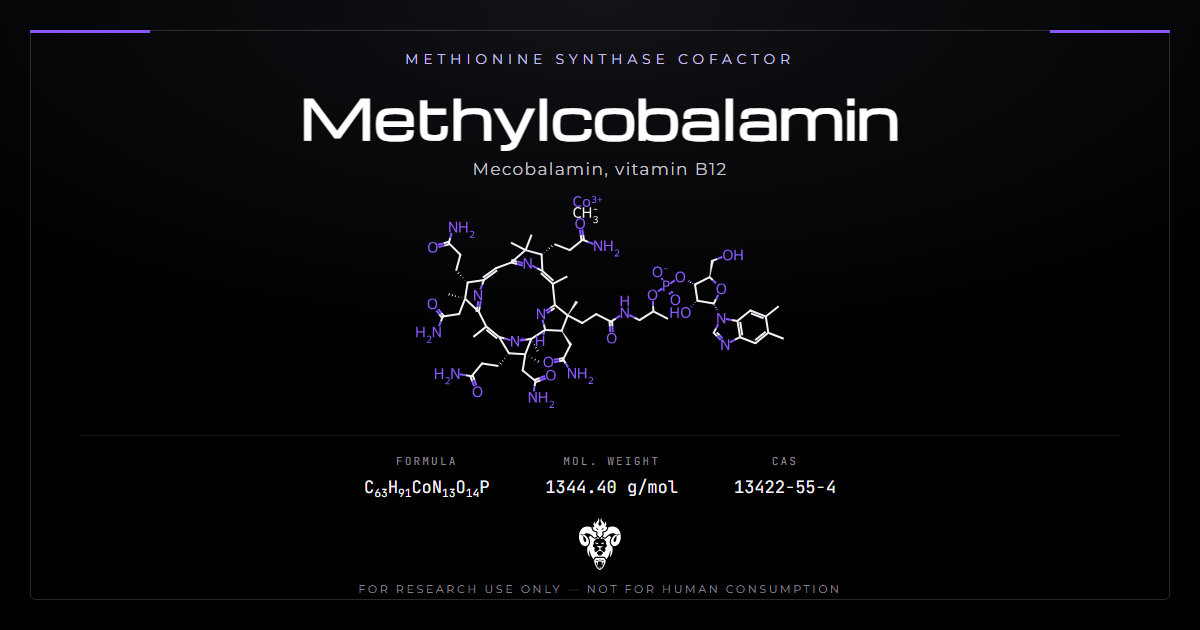
A cobalt atom held in a corrin ring, with a methyl group on the upper axial position and a dimethylbenzimidazole nucleotide below.
| Property | Value |
|---|---|
| Systematic name | Methyl-5,6-dimethylbenzimidazolylcobalamin |
| Common names | Methylcobalamin, mecobalamin, MeCbl |
| Molecular formula | C63H91CoN13O14P |
| Average mass | 1344.4 g/mol |
| Monoisotopic mass | 1343.5878 Da |
| CAS number | 13422-55-4 |
| PubChem CID | 10898559 |
| InChIKey | ZFLASALABLFSNM-WYVZQNDMSA-L |
| Stereocentres | 20 |
| Metal centre | Cobalt(III) |
| Upper axial ligand | Methyl |
The four forms
Cobalamin chemistry turns on what occupies the upper axial position of the cobalt. Swap that ligand and the name changes.
| Form | Upper ligand | Occurs in biology | Role |
|---|---|---|---|
| Methylcobalamin | Methyl | Yes | Cofactor for methionine synthase |
| Adenosylcobalamin | 5-deoxyadenosyl | Yes | Cofactor for methylmalonyl-CoA mutase |
| Hydroxocobalamin | Hydroxyl | Yes | Circulating form; photolysis product |
| Cyanocobalamin | Cyanide | Trace only | Synthetic, used for fortification |
Three of those occur in biology. Cyanocobalamin does not, beyond traces following cyanide exposure such as smoking [5]. It exists because it crystallises well and resists degradation, which made it the practical choice for fortification and for most supplements.
The irony is worth noting. The form chosen for its stability is the one that carries a group the body has to remove.
The cobalt-carbon bond
Methylcobalamin contains one of the very few cobalt-carbon bonds in biology, and that bond is the reason the compound is difficult to handle.
It breaks under light. Photolysis of the cobalt-methyl bond is fast enough that ordinary room lighting degrades solutions during an experiment, which shapes every practical recommendation later in this article [13].
The photolysis product is hydroxocobalamin. A red solution that shifts shade under the bench lamp is already a mixture. Treat it as partly converted.
Twenty stereocentres sit on the corrin and the nucleotide. The cell builds that architecture. A synthetic lot that scrambles them is not this cofactor. Intact mass 1344.4 does not prove the configuration. It proves the elemental count.
Corrin is not porphyrin. The ring is missing one meso carbon and it holds cobalt, not iron. A notebook that writes “heme analogue” has the wrong metal and the wrong ring. Methylcobalamin is a corrinoid. Treat it that way on the label.
The lower axial ligand is 5,6-dimethylbenzimidazole, tethered through a nucleotide loop. That loop is part of the mass. A hydrolysed lot that has lost the nucleotide is a different cobalt species. Intact mass will catch it. A cobalt-only ICP number will not.
Dimethylbenzimidazole proton NMR is the cheap way to see that loop still attached. If those aromatic lines vanish and the cobalt remains, the corrin survived and the nucleotide did not. That lot is not Methylcobalamin.
Two enzymes, two cofactors
Human biology uses cobalamin in exactly two reactions, and they need different forms.
Methionine synthase
Methylcobalamin is the cofactor for methionine synthase, in the cytosol. That enzyme transfers a methyl group from 5-methyltetrahydrofolate to homocysteine, producing methionine.
Failure here raises homocysteine and traps folate in a form the cell cannot use. This is the reaction behind every homocysteine-lowering file discussed as background below.
Methylmalonyl-CoA mutase
Adenosylcobalamin is the cofactor for methylmalonyl-CoA mutase, in mitochondria. That enzyme converts methylmalonyl-CoA to succinyl-CoA in the catabolism of odd-chain fatty acids and several amino acids.
Failure here raises methylmalonic acid, which is why methylmalonic acid is the more specific marker of cobalamin deficiency than homocysteine.
Why one form cannot serve both
Supplying methylcobalamin does nothing directly for the mitochondrial enzyme, which needs the adenosyl form. Any complete account of cobalamin status therefore requires interconversion, and interconversion is where the marketing claim breaks down.
A flask that only reports methionine synthase has not reported the mutase. A flask that only reports methylmalonic acid has not reported the cytosolic enzyme. Write both markers if you claim a cobalamin status.
The active form argument does not survive contact with cells
Paul and Brady reviewed the assimilation pathways for all four forms (PMID 28223907) [5].
What actually happens to an ingested dose
The cell reduces every supplemental or dietary form to a core cobalamin molecule. From that core, the cell builds both active cofactors.
The decisive finding is the ratio. Cells make intracellular methylcobalamin and adenosylcobalamin in proportions that the ingested form does not influence [5]. Feed the cell one form and it makes the same mix.
More pointedly still, the cell cleaves and discards the methyl and adenosyl groups on supplemental cobalamins. Those groups never appear on the intracellular cofactors [5].
So the methyl group you buy is not the methyl group methionine synthase uses. It is a leaving group.
Where the trafficking actually limits things
Cobalamin has to pass through the lysosome to reach the cytosol, and that transit is a genuine bottleneck.
Zhao and colleagues argue that lysosomal function deteriorates in long-lived post-mitotic cells such as neurons, and that impaired lysosomal processing of cobalamin may contribute to age-related neurological decline (PMID 22015613) [2]. Their case is mechanistic rather than trial-based, and it identifies a step that no choice of upper axial ligand addresses.
Absorption, transport and cellular uptake can all limit cobalamin status [5]. Starting with the methylated form bypasses none of those steps.
Batista and colleagues list the panel worth running when a paper claims a status change: total cobalamin, holotranscobalamin, homocysteine, methylmalonic acid and folate [10]. Serum total cobalamin alone counts haptocorrin cargo that never reaches tissue.
The cyanide argument that does hold up
A real reason to prefer methylcobalamin exists. It concerns the cyanide in cyanocobalamin, and it emerged from indexed stroke-prevention files.
Cyanocobalamin carries a cyanide ion that the body must remove and excrete. Spence traced a set of confusing trial results to exactly that step [4]. Hankey reviewed the same file [6]. Spence and Hankey later put the recommendation into a guideline critique [12].
Note the shape of the argument. It is not that methylcobalamin works better on a rating scale. It is that cyanocobalamin carries a liability in a specific renal setting, and the alternatives do not.
This profile does not quote their milligram-per-day figures or their percent stroke lines. Those sentences turn a research article into a use document. The papers stay in the list [4][6] and [12].
The chemistry that survives is simple. Cyanide is a leaving group that still has to be cleared. Methyl and adenosyl are leaving groups that cells already handle as part of cofactor assembly [5]. Hydroxocobalamin has no cyanide to clear.
Indexed pharmacological-dose papers
A separate body of work uses methylcobalamin at loads far above a dietary requirement [1][11]. Neuropathy, pain and autism files sit alongside [3][7] and [8][9].
This profile does not quote those milligram figures, their rating-scale deltas, or their adverse-event percents. Kaji’s 1998 electrophysiology paper and Oki’s later phase 3 paper remain cited so a reader can find them [1][11]. Jiang, Buesing, Rolim and Rossignol stay in the list for the same reason.
Animal work in the pain file supports nerve-regeneration and cyclooxygenase notes at loads far above a nutritional requirement [7]. Homocysteine is separately neurotoxic, and methionine synthase activity governs it. Neither line is established as a mechanism for those indexed human papers at those loads. The honest position is that those trials sit in the list without this page becoming a protocol.
Measuring cobalamin status
Deciding whether a cobalamin intervention did anything requires knowing what to measure, and serum cobalamin is the weakest of the options.
Why serum cobalamin misleads
Total serum cobalamin counts molecules bound to two carrier proteins. Most rides on haptocorrin, which does not deliver to tissue. Only the fraction on transcobalamin, holotranscobalamin, reaches cells.
A normal total can therefore sit alongside functional deficiency at the enzyme. Spence calls metabolic cobalamin deficiency common and usually undiagnosed in the stroke file [4]. That is a status claim from that paper, not a protocol here.
The functional markers
Methylmalonic acid and homocysteine measure whether the two cobalamin enzymes are working, which is the question that matters.
Methylmalonic acid is the more specific of the pair, because only the mitochondrial mutase produces it. Homocysteine also rises with folate deficiency and with renal impairment, so it needs interpreting alongside both.
Trials that report only serum cobalamin cannot distinguish a repleted pool from a working enzyme [10].
The folate complication
Folate fortification changes the picture in a way that catches people out.
Adequate folate normalises the haematological signs of cobalamin deficiency while neurological damage can continue, so the blood count stops working as a warning. In fortified populations, Spence notes, the main causes of raised homocysteine reduce to renal failure and metabolic cobalamin deficiency [4].
That is also why fortification status changes trial results in the indexed stroke file [6]. This page does not reprint those percents.
How to read a paper on Methylcobalamin
Four questions separate an informative cobalamin paper from an uninformative one.
Was the system deficient? Repleting an empty pool and adding cobalamin to a full one are different experiments. Most neuropathy papers do not report baseline status at all [3][8].
Which endpoint? Serum cobalamin will rise on any form and proves only that the load was absorbed. Methylmalonic acid and homocysteine test whether the enzymes responded [10].
Nutritional or pharmacological load? Indexed ALS work and oral neuropathy work sit in different worlds [8][11]. Results do not transfer between them in either direction. This page does not quote either ladder.
Was the comparator another cobalamin? Trials holding methylcobalamin constant across both arms test whatever else changed, not the cobalamin [3].
What the record does not establish
No trial that this profile can quote has shown methylcobalamin correcting deficiency better than another form in a general population on a head-to-head of the functional markers [10].
Nobody has tested the renal-cyanide argument in a prospective form-versus-form randomisation [4][12]. The case rests on reanalysis.
Nobody has replicated the ALS file outside its original setting on this page [11]. Oral high-load work at the scale of that file is not sitting in the same methods.
Genetic polymorphism testing has outrun the evidence. Paul and Brady note that the polymorphisms which might favour one form are not the ones commercial tests report [5].
Verifying research material
Two properties dominate handling, and both come from the cobalt-carbon bond.
Light sensitivity
Methylcobalamin is photolabile. Light cleaves the cobalt-methyl bond, converting the compound to hydroxocobalamin, and the reaction proceeds fast enough to matter during routine bench work.
Work under amber light or in foil-wrapped vessels. Prepare solutions immediately before use, and treat any material left out under room lighting as partly converted. Temova Rakusa and colleagues review the full stability picture, including sensitivity to temperature, pH, oxidants, reductants and other water-soluble vitamins in the same formulation [13].
That last point catches people out. Combining cobalamin with vitamin C or thiamine in one solution accelerates its degradation.
Identity and purity
Average mass is 1344.4 and monoisotopic mass 1343.5878. Cobalt makes the compound straightforward to quantify by ICP-MS against total cobalt, which is a useful orthogonal check on a chromatographic purity figure.
Photolysis yields hydroxocobalamin, the expected impurity. A certificate should name it rather than folding it into a single purity number. Colour offers a rough field check. Methylcobalamin solutions run red, and the shade shifts as degradation proceeds. Name the upper ligand on the notebook line. A red solution that sat in light is a hydroxocobalamin question before it is a purity question.
Keep the solid cold, dark and dry. A certificate that does not state light protection during handling has not addressed the main failure mode of this compound.
Storage guidance is a house recommendation. Analytical documentation is per-lot release testing.
Kimera publishes third-party certificates of analysis for every lot in its COA database. Laboratories source methylcobalamin as a methionine synthase cofactor, often alongside NAD+ where one-carbon and redox metabolism intersect, or glutathione and CoQ10 where a different cofactor pool is the comparator. Related work appears in the redox and cofactors category.
What a spectrum should show
UV-visible spectra of the four forms differ at the upper ligand. Methylcobalamin is not interchangeable with adenosylcobalamin on a quick scan. Hydroxocobalamin is the photolysis product and the common contaminant. Cyanocobalamin is the stable synthetic neighbour.
NMR of a 1344 Da corrin is crowded. Intact mass plus a named hydroxocobalamin line beats an area percent that hides the photolysis product. If the lot sat on a window bench, run the impurity check again.
Cobalt content by ICP-MS should match the formula within the water and counterion story. A high cobalt with a low chromatographic area is a salt or a degradant, not a bonus.
Photolysis is a time course, not a binary. A few minutes under a fluorescent lamp starts the split. An hour finishes it. Methylcobalamin that sat in a clear vial on a window bench is hydroxocobalamin plus leftover parent. Run the impurity line before you blame the enzyme.
The cobalt-carbon bond is also acid-sensitive and reductant-sensitive [13]. A cocktail that already holds ascorbate will eat the cofactor. So will a thiol excess that was meant to “protect” a different reagent. Keep this lot in its own amber tube.
Adenosylcobalamin has its own cobalt-carbon bond and its own photolysis path. Do not store the two forms in one clear rack and then trust the labels. Light does not read the label.
A third handling error is freeze-thaw of a dilute aqueous stock. Ice crystals and oxygen finish what the lamp started. Prepare a working dilution once. Discard it when the red shifts.
Common questions about methylcobalamin
Is methylcobalamin the active form? Two active intracellular forms exist, methylcobalamin and adenosylcobalamin. An ingested dose still does not arrive ready to use, because cells cleave the methyl group and rebuild both cofactors from a core cobalamin [5].
So is it better than cyanocobalamin? Not on the active-form argument. A better-supported reason exists: cyanocobalamin carries cyanide, which appeared as a liability in indexed renal-stroke files [4][12].
Does this page report ALS or stroke outcomes? No. Those papers remain in the list. This profile stops at chemistry, trafficking and lot checks.
Which marker shows cobalamin status best? Methylmalonic acid is more specific, since it reflects the mitochondrial enzyme. Homocysteine also rises in folate deficiency and renal impairment.
Why does it have to be kept in the dark? The cobalt-methyl bond photolyses. Light converts methylcobalamin to hydroxocobalamin during ordinary bench work [13].
Can mass spectrometry prove the upper ligand? Intact mass plus a UV or chromatographic match against a named standard can. A cobalt number alone cannot. Hydroxocobalamin is the usual photolysis neighbour.
Summary of the evidence
Identity: methylcobalamin, C63H91CoN13O14P, 1344.4 g/mol, CAS 13422-55-4. Cobalt(III) corrin with a methyl upper axial ligand and 20 stereocentres. PubChem CID 10898559.
Biochemistry: cofactor for cytosolic methionine synthase. Adenosylcobalamin serves mitochondrial methylmalonyl-CoA mutase, so no single supplemental form covers both reactions.
The active-form claim: cells reduce every form to a core cobalamin, then build both cofactors in a fixed ratio and discard the supplemental methyl group [5].
The supported chemistry argument: cyanocobalamin carries cyanide. Indexed stroke-prevention files led two review groups to prefer methylcobalamin or hydroxocobalamin on that ground [4][6] and [12]. This page does not quote their dose lines.
Indexed ALS, neuropathy, pain and autism papers stay in the list. This page does not quote their milligram figures.
Handling: photolabile through the cobalt-carbon bond, degrading to hydroxocobalamin under ordinary lighting [13].
Write the name, the mass and the light-protection note on the first notebook line. Methylcobalamin means 1344.4 Da and a cobalt-methyl bond that ordinary room light will break. A later reader should match the lot to the chromatogram without asking which upper ligand sat in the vial. If a methods section names Methylcobalamin and then quotes a hydroxocobalamin UV maximum, stop. That run already photolysed the reagent. Keep the certificate next to the notebook for that Methylcobalamin lot. Amber glass is part of the identity story, not a packing preference. Do not leave a clear aliquot on the bench and then trust the label after that light exposure.
Status: supplied for laboratory research use only.
References
- Kaji R, Kodama M, Imamura A, et al. Effect of ultrahigh-dose methylcobalamin on compound muscle action potentials in amyotrophic lateral sclerosis: a double-blind controlled study. Muscle Nerve. 1998;21(12):1775-1778. PMID 9843082. DOI
- Zhao H, Brunk UT, Garner B. Age-related lysosomal dysfunction: an unrecognized roadblock for cobalamin trafficking? Cell Mol Life Sci. 2011;68(24):3963-3969. PMID 22015613. DOI
- Jiang DQ, Li MX, Wang Y, Wang Y. Effects of prostaglandin E1 plus methylcobalamin alone and in combination with lipoic acid on nerve conduction velocity in patients with diabetic peripheral neuropathy: a meta-analysis. Neurosci Lett. 2015;594:23-29. PMID 25800109. DOI
- Spence JD. Homocysteine lowering for stroke prevention: unravelling the complexity of the evidence. Int J Stroke. 2016;11(7):744-747. PMID 27462097. DOI
- Paul C, Brady DM. Comparative bioavailability and utilization of particular forms of B12 supplements with potential to mitigate B12-related genetic polymorphisms. Integr Med (Encinitas). 2017;16(1):42-49. PMID 28223907.
- Hankey GJ. B vitamins for stroke prevention. Stroke Vasc Neurol. 2018;3(2):51-58. PMID 30022794. DOI
- Buesing S, Costa M, Schilling JM, Moeller-Bertram T. Vitamin B12 as a treatment for pain. Pain Physician. 2019;22(1):E45-E52. PMID 30700078.
- Rolim LC, da Silva EM, Flumignan RL, Abreu MM, Dib SA. Acetyl-L-carnitine for the treatment of diabetic peripheral neuropathy. Cochrane Database Syst Rev. 2019;6(6):CD011265. PMID 31201734. DOI
- Rossignol DA, Frye RE. The effectiveness of cobalamin (B12) treatment for autism spectrum disorder: a systematic review and meta-analysis. J Pers Med. 2021;11(8):784. PMID 34442428. DOI
- Batista KS, Cintra VM, Lucena PAF, et al. The role of vitamin B12 in viral infections: a comprehensive review of its relationship with the muscle-gut-brain axis and implications for SARS-CoV-2 infection. Nutr Rev. 2022;80(3):561-578. PMID 34791425. DOI
- Oki R, Izumi Y, Fujita K, et al. Efficacy and safety of ultrahigh-dose methylcobalamin in early-stage amyotrophic lateral sclerosis: a randomized clinical trial. JAMA Neurol. 2022;79(6):575-583. PMID 35532908. DOI
- Spence JD, Hankey GJ. Problem in the recent American Heart Association guideline on secondary stroke prevention: B vitamins to lower homocysteine do prevent stroke. Stroke. 2022;53(8):2702-2708. PMID 35748292. DOI
- Temova Rakuša Ž, Roškar R, Hickey N, Geremia S. Vitamin B12 in foods, food supplements, and medicines: a review of its role and properties with a focus on its stability. Molecules. 2022;28(1):240. PMID 36615431. DOI
Methylcobalamin is sold for laboratory research use only. Not for human consumption, nor medical, veterinary, or household uses.
Literature retrieved from PubMed.