
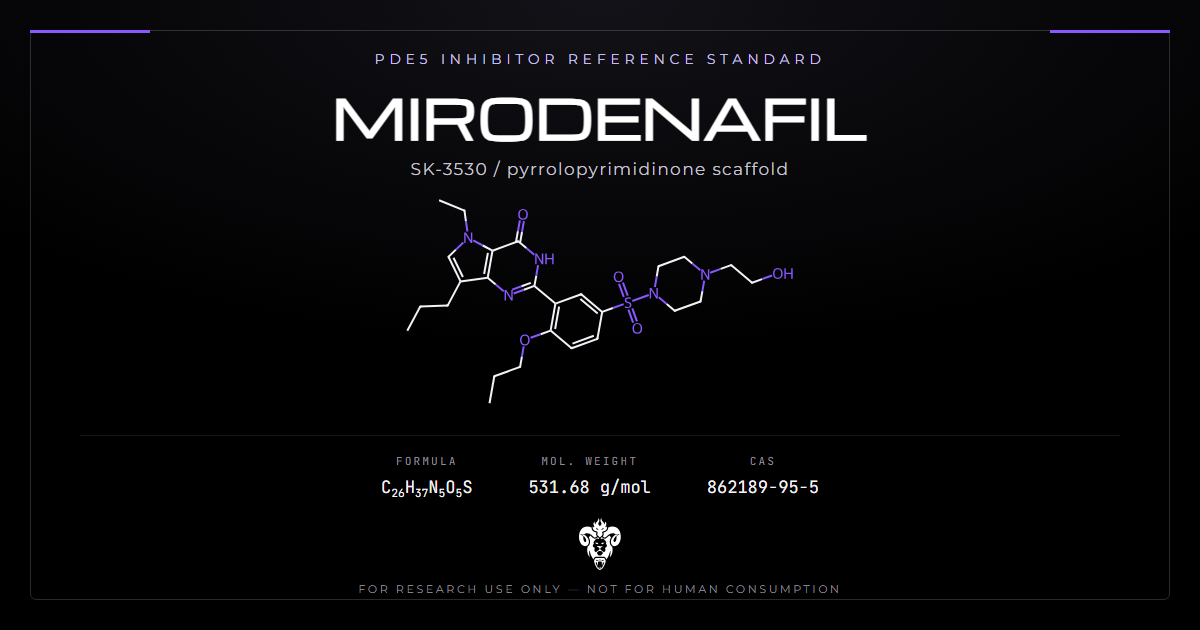
Mirodenafil holds a marketing approval in South Korea, granted in 2007, for an indication this article does not cover. What makes it interesting as a research compound is everything that has happened since. Groups in Korea have run it through Alzheimer models, two stroke models, a systemic sclerosis model and a bladder ischaemia model, and the reason they chose this compound over the better-known PDE5 inhibitors is specific.
It crosses the blood-brain barrier, and it does at least two things at the molecular level that other PDE5 inhibitors do not [1].
Kimera supplies mirodenafil as a research reference material and as a PDE5 inhibitor tool compound. It is not a pharmaceutical product here, and no use guidance appears below.
All information here describes laboratory research findings. This material is supplied for research use only and is not for human or veterinary use.
What mirodenafil is
The compound is a pyrrolopyrimidinone, built on the sildenafil-type scaffold rather than the tadalafil one. Its development code is SK-3530. A 2014 review records the Korean launch in 2007 and an orally disintegrating film formulation developed in 2011 [2].
Identity and physical data
| Property | Value |
|---|---|
| Compound | Mirodenafil |
| Development code | SK-3530 |
| PubChem CID | 135497803 |
| CAS number | 862189-95-5 |
| Molecular formula | C26H37N5O5S |
| Molecular weight | 531.7 g/mol |
| InChIKey | MIJFNYMSCFYZNY-UHFFFAOYSA-N |
| Stereocentres | None |
| Chemical class | Pyrrolopyrimidinone sulfonamide |
The flat InChIKey is correct here
That key ends UHFFFAOYSA, the block meaning no defined stereochemistry. For this compound that reflects the molecule rather than an incomplete record. Mirodenafil has no stereocentre.
The practical consequence is worth stating because it separates this compound from half its own catalogue category. A single achiral purity method characterises it completely. No chiral column, no circular dichroism, no configuration question.
Selectivity, and the actions that are not PDE5
A 2016 review describes the biochemical profile as high affinity for PDE5 with high selectivity over other PDE isoforms, comparing favourably against sildenafil, vardenafil and tadalafil on that measure [3].
Two effects the others do not produce
The Alzheimer study is the one that matters for mechanism [1]. Its authors tested the compound in neuroblastoma and hippocampal cell lines and reported two findings they explicitly separate from the PDE5 class.
Homodimerization and nuclear localization of the glucocorticoid receptor were inhibited by this compound and, in their comparison, not by other PDE5 inhibitors. Only this compound reduced expression of Dickkopf-1, the Wnt antagonist, which activated Wnt/beta-catenin signalling.
Why that changes how it should be used as a tool
A compound with actions outside its nominal class is a poor choice as a generic PDE5 probe. Attributing an observed effect to PDE5 inhibition requires a second PDE5 inhibitor as comparator, or the result may belong to the glucocorticoid receptor or Wnt arms instead.
That cuts both ways. The same property makes it the right tool for anyone specifically interested in those arms, which is presumably why the neurodegeneration programmes selected it.
Preclinical models beyond the original indication
Findings stay bound to the model that produced them.
Alzheimer models
In the APP-C105 mouse model, the compound improved performance on the Morris water maze and passive avoidance tests [1]. Amyloid beta and phosphorylated tau burden both fell. Cell work traced the effects through cGMP/PKG/CREB signalling, glycogen synthase kinase 3 beta activity, glucocorticoid receptor transcriptional activity and Wnt/beta-catenin.
The authors describe this as a polypharmacological approach, targeting several pathways at once rather than one. That framing is a claim about strategy, and the evidence for it is a single model in one laboratory.
Stroke models
A 2024 study used transient and permanent middle cerebral artery occlusion in rats [4]. Dosing started 24 hours after occlusion and continued for 9 days in the transient model and 28 days in the permanent one, subcutaneously at 0.5, 1 and 2 mg/kg per day.
Sensorimotor and cognitive recovery improved against saline controls, with effects rising up to 1 mg/kg. Degenerative cells and cleaved caspase-3 and PARP immunoreactive cells all fell.
One result deserves emphasis because it constrains the interpretation. Infarct volume did not change in either model. So whatever produced the functional recovery, it was not a reduction in the size of the lesion. Benefit also appeared when treatment was delayed 72 hours, though shorter delays worked better.
Fibrosis and smooth muscle
A bleomycin-induced systemic sclerosis mouse model showed reduced dermal thickness and lower COL1A1 and alpha-smooth muscle actin [5]. In fibroblasts, the compound inhibited TGF-beta-induced phosphorylation of Smad2 and Smad3, which is the proposed route.
A separate rat model of chronic bladder ischaemia reported preserved bladder capacity and compliance, and reversal of submucosal fibrosis, against untreated ischaemic controls [6].
Fibrosis appears in both. Taken with the TGF-beta/Smad result, an antifibrotic action is the most consistent thread across the non-neurological models. It is also the thread most easily explained by PDE5 inhibition alone, since cyclic GMP signalling is well established as antifibrotic. That makes it the least distinctive of the findings, and the one least in need of the off-class actions to account for it.
Metabolism is the dominant variable
This is the single most practical section for anyone designing an in vivo protocol with this compound.
CYP3A4 sensitivity spans more than two orders of magnitude
A three-period crossover study in healthy volunteers gave the compound alone, then after ketoconazole, then after rifampicin [10]. Cytochrome P450 3A4 metabolises it to the active metabolite N-dehydroxyethyl mirodenafil.
| Condition | Effect on AUC |
|---|---|
| With ketoconazole, a CYP3A4 inhibitor | 5.04-fold increase (90% CI 3.78 to 6.72) |
| With rifampicin, a CYP3A4 inducer | 0.03-fold, a 97 percent decrease (90% CI 0.02 to 0.05) |
Those two figures span roughly 150-fold. Few compounds show a window that wide, and it makes CYP3A4 status the variable that dominates exposure. Any protocol combining this compound with another CYP3A4 substrate, inhibitor or inducer needs that interaction accounted for rather than assumed away.
First-pass metabolism is the reason
Rat work explains where the sensitivity comes from [7]. Pharmacokinetics were dose-dependent after both intravenous and oral administration, which the authors attribute to saturable hepatic metabolism.
Oral bioavailability came to roughly 29.4 percent. Only about 2.59 percent of an oral dose went unabsorbed, so poor absorption is not the explanation. The losses were first-pass: approximately 21.4 percent of the dose to hepatic extraction and approximately 54.3 percent to gastrointestinal extraction. Plasma protein binding measured 87.8 percent.
Gastrointestinal first-pass exceeding hepatic first-pass is the unusual part, and it points at gut wall CYP3A as much as liver.
A strain confound worth knowing
A study comparing spontaneously hypertensive rats against DOCA-salt hypertensive rats found smaller non-renal clearance and greater AUC in the spontaneously hypertensive animals, but not in the DOCA-salt ones [8].
Both groups were hypertensive. Only one showed the pharmacokinetic difference. The authors concluded the effect traces to hereditary characteristics of that strain rather than to the hypertensive state.
That is a general lesson wearing a specific coat. A disease model differs from its control in more than the disease, and attributing a pharmacokinetic difference to the induced condition requires a second model of the same condition.
What the interaction studies actually measured
Three volunteer studies sit in this literature, and reading them for their design rather than their conclusions is the useful exercise. All three measured disposition or haemodynamics, not efficacy.
The enzyme studies are the informative ones
The ketoconazole and rifampicin study used a one-sequence, three-period, three-treatment crossover across 22 days [10]. Nineteen subjects enrolled and 18 completed. Each received the same 100 mg dose in every period, so the design isolates enzyme status as the only variable.
Adverse event counts tracked exposure closely. Twenty-eight events occurred in the ketoconazole period, where systemic exposure ran highest. Seven occurred in the compound-alone period and five under rifampicin. That gradient is itself evidence the exposure change was real rather than an artefact of the assay.
The alcohol study found no pharmacokinetic interaction
A single-dose randomised-sequence crossover compared the compound alone, alcohol alone at 0.5 g/kg, and both together (DOI). Area under the curve came to 842.0 ng/mL/h alone and 833.4 ng/mL/h with alcohol [11]. Those figures are indistinguishable.
Blood pressure told a different story from the kinetics. Alcohol alone produced larger falls in systolic and diastolic pressure than the compound alone did. Combining them added little beyond alcohol by itself.
The lesson for protocol design is that a haemodynamic interaction and a pharmacokinetic interaction are separate questions. This pair answered one negatively and the other with a small additive effect, and only measuring both distinguished them.
The alpha-blocker study measured pulse, not just pressure
A two-period crossover pretreated subjects with tamsulosin for seven days, then gave the compound or placebo [12]. Supine and standing blood pressure and pulse rate were recorded repeatedly for 24 hours.
Blood pressure changes did not reach significance in either position. Pulse rate did, rising 7.2 beats per minute supine and 10.7 standing against placebo. A study measuring pressure alone would have reported nothing.
That is a general point about vasodilator interaction design. Heart rate compensates for pressure change, so a protocol that records only one of the pair can miss the response entirely.
Why these belong in a research article at all
None of these studies establishes what the compound does for anyone. They establish how it behaves when something else is present, which is the question that matters when designing a multi-compound experiment. Treat them as disposition data.
Physicochemical properties and handling
| Parameter | Detail |
|---|---|
| Solubility | Soluble in DMSO; limited aqueous solubility |
| Storage | Sealed, dry, protected from light |
| Stability | Stable as a dry solid at ambient conditions |
| Stock solutions | Prepare in DMSO; aliquot and avoid freeze-thaw |
The hydroxyethyl piperazine and propoxy groups give more polarity than the tadalafil-family compounds carry, though not enough for practical aqueous stocks. Prepare in DMSO and dilute into buffer immediately before use.
Account for the active metabolite
N-dehydroxyethyl mirodenafil is pharmacologically active, and two further metabolites, SK3541 and SK3544, appear in the rat literature [8]. An assay measuring parent compound alone underreports total related exposure.
Where a study runs long enough for metabolism to matter, measure the metabolite as well. Quantifying only the parent is defensible for a short in vitro exposure and misleading for anything in vivo.
Analytical characterization
Routine identity and purity
Reversed-phase HPLC with ultraviolet detection resolves the compound. The pyrimidinone and aryl sulfonamide give a strong chromophore, so detection sensitivity is good. Mass spectrometry against 531.7 confirms identity, and NMR resolves the propyl, propoxy and hydroxyethyl environments distinctly.
No chiral method is needed. That single sentence separates the analytical burden for mirodenafil from the tadalafil-family compounds sharing its category, where configuration is a live question and a chiral column is often unavoidable.
Published quantitative methods
An LC-MS/MS method has been published for plasma and tissue, developed at a doping control laboratory and applied to a direct comparison against sildenafil after equal oral doses in rats [9]. Peak concentration and area under the curve both ran higher for mirodenafil, while time to peak, half-life and mean residence time did not differ.
That study is a useful template because it establishes the extraction and transitions rather than leaving them to be rederived.
What a certificate should show
Purity by HPLC with the method named, identity by mass spectrometry or NMR, and residual solvent. Batch documentation for catalogue material sits in the certificate of analysis database.
Mirodenafil among the phosphodiesterase inhibitors
The catalogue category holds six compounds across two unrelated scaffolds, and the split is analytical as much as structural.
| Compound | Scaffold | Chiral method needed |
|---|---|---|
| Mirodenafil | pyrrolopyrimidinone | No |
| Acetildenafil | pyrazolopyrimidinone | No |
| Nortadalafil | tetracyclic tadalafil type | Yes |
| Aminotadalafil | tetracyclic tadalafil type | Yes |
| N-ethyl Tadalafil | tetracyclic tadalafil type | Yes |
| N-Isopropyl Tadalafil | tetracyclic tadalafil type | Yes |
The two families differ in their literature too
The tadalafil-family compounds appear almost entirely in analytical and forensic papers, as reference standards for detecting undeclared compounds in consumer products. Mirodenafil appears mostly in pharmacology, because it went through a full development programme and is still being studied.
Anyone working across the category should expect that asymmetry. Further reading sits in the PDE5 inhibitor research library, and the reference standard ships against batch documentation.
Designing experiments with this compound
Four points follow from the sections above, and together they cover most of what goes wrong.
Control the enzyme, not just the dose
Exposure depends more on CYP3A4 status than on the number on the vial. Housing diet, vehicle composition and any co-administered compound can shift that status. Where a study runs across groups, keep those constant and record them, because a difference in exposure will otherwise read as a difference in response.
Route changes the answer more than usual
Gastrointestinal first-pass extraction accounted for roughly 54 percent of an oral dose in rats, more than the hepatic component (DOI). Oral and parenteral routes therefore give very different exposure for the same nominal dose. Comparing a published oral result against a new intravenous one is not a comparison of dose.
Use a second PDE5 inhibitor as comparator
This follows from the off-class actions [1]. Without a comparator, an effect attributed to PDE5 inhibition may belong to the glucocorticoid receptor or Wnt arms. Sildenafil is the obvious choice, since a published LC-MS/MS method already handles both compounds in the same run [9].
Sample past the parent compound
The active metabolite and the two named rat metabolites mean parent concentration understates related exposure. Build the assay for all of them at the start. Retrofitting transitions after the samples are collected wastes the samples.
The dose-response may not be monotonic
Stroke model effects rose to 1 mg/kg and did not improve further at 2 mg/kg (DOI). One study is thin evidence for a ceiling, and it is enough to justify a range rather than a single dose. Testing one concentration risks sampling the flat part of the curve.
Open questions and how to read this literature
Nearly all of it comes from one country, and much from one company
The pharmacology, the pharmacokinetics and the repurposing programmes are overwhelmingly Korean. The Alzheimer and stroke work shares a corporate affiliation [1][4]. That is normal for a compound developed and marketed in one territory, and it means independent replication is thin rather than absent.
The selectivity claim needs a direct comparison
The assertion that glucocorticoid receptor and Dickkopf-1 effects are unique among PDE5 inhibitors rests on the comparison inside a single paper [1]. It is a strong and testable claim. Nobody outside that group appears to have tested it.
No infarct volume change is the honest headline
The stroke work reports functional recovery with unchanged lesion size [4]. That combination is common in neuroprotection literature and frequently precedes disappointment. It is also exactly the pattern a genuinely non-lesional mechanism would produce. The published data do not distinguish those readings.
What would move it
An independent laboratory testing the glucocorticoid receptor result against sildenafil and tadalafil side by side would settle the most load-bearing claim. For anyone using the compound as a tool rather than studying it, the CYP3A4 window is the fact with immediate consequences.
Frequently asked questions
Does mirodenafil need a chiral purity method?
No. The molecule has no stereocentre and its InChIKey carries an undefined stereo block accordingly. A single achiral method characterises it.
Why is CYP3A4 status so important with this compound?
Because exposure swings roughly 150-fold across inhibited and induced states, from a 5.04-fold AUC increase with ketoconazole to a 97 percent decrease with rifampicin. Saturable first-pass metabolism is the underlying reason.
Is it related to sildenafil or to tadalafil?
To sildenafil, structurally. It is a pyrrolopyrimidinone on the sildenafil-type scaffold, not a member of the tetracyclic tadalafil family that makes up the rest of this catalogue category.
What is it being studied for now?
Alzheimer models, two stroke models, systemic sclerosis and bladder ischaemia [1][4] and [5][6]. Blood-brain barrier penetration and its off-PDE5 actions are the stated reasons for choosing it.
Should the active metabolite be measured?
For in vivo work, yes. N-dehydroxyethyl mirodenafil is active, and SK3541 and SK3544 also appear in rat studies [8]. Parent-only assays understate related exposure.
Why does route of administration matter so much here?
Because gastrointestinal first-pass extraction removed roughly 54 percent of an oral dose in rats, exceeding the hepatic component [7]. Oral and parenteral dosing therefore produce very different exposure from the same nominal amount.
What are SK3541 and SK3544?
Two metabolites characterised in the rat pharmacokinetic work [8]. They sit alongside N-dehydroxyethyl mirodenafil, which is the active metabolite formed by CYP3A4.
Did the stroke work reduce lesion size?
No. Infarct volume was unchanged in both the transient and permanent occlusion models, while functional recovery improved [4]. That combination constrains the mechanism and is worth stating whenever the result is cited.
Does it work as a general PDE5 probe?
Poorly, on its own. It has reported actions outside the class [1], so any effect attributed to PDE5 inhibition needs a second PDE5 inhibitor as comparator.
References
- Kang BW, Kim F, Cho JY, et al. Phosphodiesterase 5 inhibitor mirodenafil ameliorates Alzheimer-like pathology and symptoms by multimodal actions. Alzheimers Res Ther. 2022;14(1):92. PubMed DOI
- Park HJ, Moon KH, Lee SW, et al. Mirodenafil for the treatment of erectile dysfunction: a systematic review of the literature. World J Mens Health. 2014;32(1):18-27. PubMed DOI
- Cho MC, Paick JS. A review of the efficacy and safety of mirodenafil in the management of erectile dysfunction. Ther Adv Urol. 2016;8(2):100-17. PubMed DOI
- Kim F, Singh P, Jo H, et al. Therapeutic effects of mirodenafil, a phosphodiesterase 5 inhibitor, on stroke models in rats. Neurotherapeutics. 2025;22(1):e00463. PubMed DOI
- Roh JS, Jeong H, Lee B, et al. Mirodenafil ameliorates skin fibrosis in bleomycin-induced mouse model of systemic sclerosis. Anim Cells Syst. 2021;25(6):387-395. PubMed DOI
- Choi H, Bae JH, Shim JS, et al. Mirodenafil prevents bladder dysfunction induced by chronic bladder ischemia in rats. Int Neurourol J. 2015;19(1):19-26. PubMed DOI
- Choi YH, Lee YS, Bae SH, et al. Dose-dependent pharmacokinetics and first-pass effects of mirodenafil, a new erectogenic, in rats. Biopharm Drug Dispos. 2009;30(6):305-17. PubMed DOI
- Lee YS, Choi YH, Yoon IS, et al. Pharmacokinetics of mirodenafil and its two metabolites, SK3541 and SK3544, in spontaneously or DOCA-salt-induced hypertensive rats. Biopharm Drug Dispos. 2011;32(1):38-49. PubMed DOI
- Lee SK, Kim Y, Kim TK, et al. Determination of mirodenafil and sildenafil in the plasma and corpus cavernous of SD male rats. J Pharm Biomed Anal. 2009;49(2):513-8. PubMed DOI
- Shin KH, Kim BH, Kim TE, et al. The effects of ketoconazole and rifampicin on the pharmacokinetics of mirodenafil in healthy Korean male volunteers. Clin Ther. 2009;31(12):3009-20. PubMed DOI
- Kim BH, Yi S, Kim J, et al. Influence of alcohol on the hemodynamic effects and pharmacokinetic properties of mirodenafil. Clin Ther. 2009;31(6):1234-43. PubMed DOI
- Gu N, Kim J, Lim KS, et al. Assessment of the effect of mirodenafil on the hemodynamics of healthy male Korean volunteers administered tamsulosin. Clin Ther. 2012;34(9):1929-39. PubMed DOI