
Everything below reports findings from cell cultures, isolated tissue and animals. This material is for research use only, not for human or veterinary use.
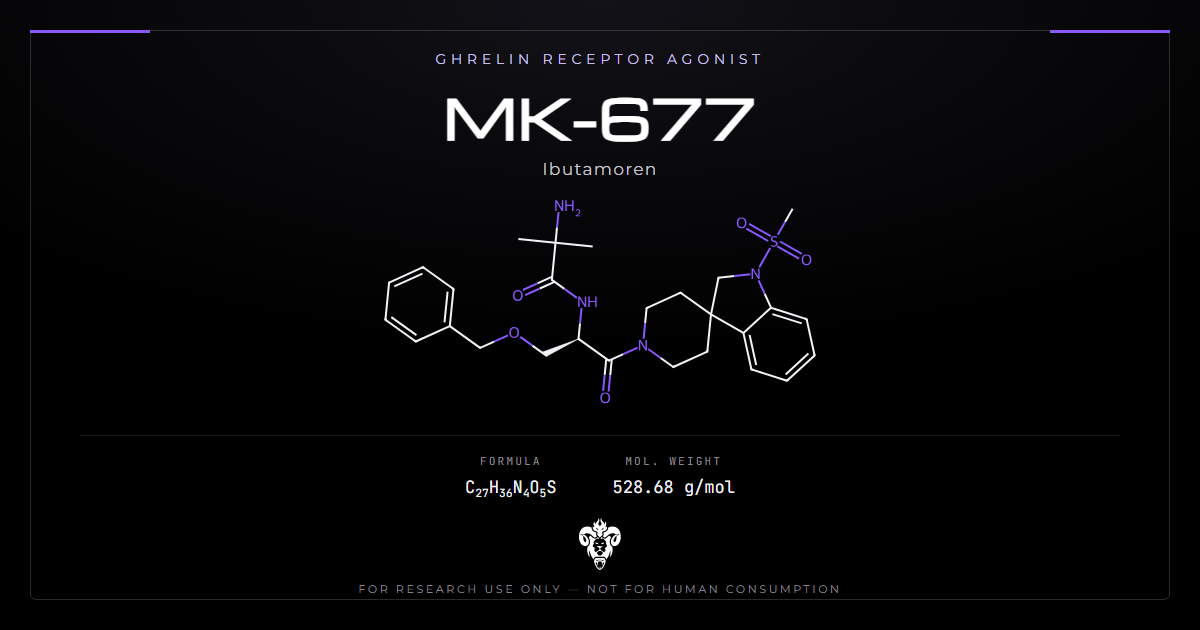
MK-677 is a spiroindoline piperidine built to hit the growth hormone secretagogue receptor. The structure is not a peptide. Growth hormone itself is a different molecule. Androgen receptor ligands sit in another class entirely.
Merck chemists arrived at the structure before anyone had cloned the receptor or isolated ghrelin [1][2] and [3]. That order still shapes how a laboratory should read the file. The useful questions are identity, receptor logic, and what cell and animal systems actually measured.
Indexed clinical papers exist. Those human endpoints sit outside this profile.
Chemical identity: what you are actually handling
MK-677 is a defined small molecule with one (R) stereocentre. Suppliers usually ship the mesylate salt.
| Property | Value |
|---|---|
| INN | Ibutamoren |
| Development codes | MK-677, MK-0677, L-163,191 |
| Free base formula | C27H36N4O5S |
| Free base weight | 528.66 g/mol |
| Free base PubChem CID | 178024 |
| Free base InChIKey | UMUPQWIGCOZEOY-JOCHJYFZSA-N |
| Mesylate formula | C28H40N4O8S2 |
| Mesylate weight | 624.77 g/mol |
| Mesylate PubChem CID | 6450830 |
| Stereocentre | One, (R) |
| Molecular target | Growth hormone secretagogue receptor (GHS-R1a) |
| Originator | Merck Research Laboratories |
The salt form is not a footnote
The two forms differ by 96 g/mol. That gap is the methanesulfonic acid.
The free base is 528.66 g/mol. The mesylate is 624.77 g/mol. Ibutamoren therefore accounts for about 84.6 percent of mesylate mass. A weighing that treats mesylate as free base overstates the ligand by about 18 percent.
Match the form before any molar calculation. Ion chromatography or NMR integration of the mesylate methyl settles the question directly.
The scaffold
The core is a spiro[indoline-3,4-piperidine]. The indoline and piperidine rings share one carbon. A methanesulfonyl group sits on the indoline nitrogen. An O-benzyl serine-derived linker joins that bicycle to a terminal 2-methylalaninamide.
That arrangement is the whole pharmacophore. Sulfonamide here is a covalent N-methylsulfonyl, not a counterion. Benzyl ether on the serine linker is part of the designed structure, not a leftover protecting group. Salt formation happens at the terminal primary amine.
Two amide bonds, one sulfonamide, one benzyl ether, and that amine set hydrolysis risk, hydrogen-bond pattern, and how the solid behaves in water.
Compare the pieces to the peptide leads they replaced. GHRP-6 carries several amide nitrogens and a charged N-terminus [10]. MK-677 keeps one basic nitrogen and hides the rest of the peptide in a bicycle and a sulfonamide. That is why oral work in animals was even plausible [2].
One stereocentre, one epimer risk
The linker carbon is the only defined stereocentre. Published identity uses the (R) configuration. The (S) epimer shares formula and accurate mass exactly.
A mass match does not prove configuration. Only a chiral method reports the epimer. Treat a certificate that skips chiral purity as incomplete for this lot.
The receptor, and how it was found backwards
The history is unusual. It explains why a synthetic ligand preceded the hormone it copies.
Smith describes the programme as reverse pharmacology [3]. Neither the receptor nor the natural ligand that sets growth hormone pulse amplitude was known when the work began. Lead finding therefore ran on function alone.
Four routes to raising pulse amplitude looked possible. Increase releasing-hormone secretion. Amplify releasing-hormone signalling in pituitary somatotrophs. Reduce somatostatin release. Or antagonise somatostatin receptor signalling [3].
The secretagogues turned out to act through all four [3]. Medicinal chemistry moved from peptide leads through more drug-like non-peptides. MK-677 emerged as an orally active member of that series [2][10].
The receptor came afterwards. Expression cloning identified a previously unknown G-protein coupled receptor. It sits mainly in brain, pituitary and pancreas [3]. Researchers then used the cloned receptor to find its endogenous agonist, ghrelin. That closed the loop and classed these compounds as ghrelin mimetics [3].
Structure-activity work continued after that. Later molecules in the series proved substantially more potent in vitro than MK-677 itself [11].
Why pulsatile secretion was the design goal
One further point explains why the programme chased a secretagogue rather than the hormone.
Growth hormone does not arrive as a steady infusion. It arrives in pulses. The pattern of those pulses carries information that a flat concentration does not reproduce. Early work in this field aimed at regulating secretion rather than replacing the hormone [1].
A secretagogue acting through a receptor can preserve pulse structure. It also stays subject to the axis’s own negative feedback. Exogenous hormone overrides both. That architectural argument is why the compound remains a laboratory tool even after later programmes moved on [3][12].
Receptor coupling in cells
GHS-R1a is a seven-transmembrane receptor. Agonists raise intracellular calcium through Gq-family coupling in pituitary and transfected cell systems [3]. That calcium rise is the practical engagement readout.
The same receptor also shows high basal signalling in some assays. A ligand can therefore look like a full agonist, a partial agonist, a silent occupant, or an inverse agonist, depending on the assay. MK-677 entered the file as a full agonist on growth hormone release. That does not license every later analogue.
Ghrelin is the endogenous agonist found after the drugs [3]. Peptide secretagogues such as GHRP-6 occupied the same receptor family first [10]. MK-677 is the non-peptide reference, not the first ligand and not the most potent one [11].
What MK-677 does biochemically
The designed action is stimulation of pulsatile growth hormone release through GHS-R1a. Downstream, insulin-like growth factor I is the usual circulating marker in animal and cell work that reads the axis [1][3].
Peak growth hormone responses in secretagogue assays often attenuate with repeated exposure even while the axis stays engaged [3][4]. That attenuation is a class feature, not a proof that the lot failed.
Cortisol and prolactin can move in some secretagogue panels. They do not always move on the same timescale as growth hormone [4]. A protocol that reads only one hormone will miss that split.
Bone turnover markers and body-composition readouts appear in indexed papers [5][8]. Those human endpoints stay outside this profile. The laboratory question is whether the receptor is occupied and whether the pulse machinery still runs.
Later analogues in the same series
Lu and colleagues published later spiroindoline secretagogues that outran MK-677 in vitro [11]. One analogue in that set was active in animals at oral doses as low as 0.06 mg/kg.
Two facts follow. MK-677 is not the most potent compound in its chemotype. It remains the best-documented reference because the series was built around it [2][3] and [11].
A laboratory that wants potency can look at those later structures. A laboratory that wants a characterised tool usually stays with MK-677 and states the salt form.
The same paper is also a warning about names. A vial labelled as a later analogue is not MK-677. Intact mass and the methanesulfonyl count still decide the lot [11].
Pituitary slice and transfected-cell work from the reviews remains the right first experiment [1][3]. Measure calcium or growth hormone in the medium. Do not start with a body-composition readout and work backwards.
Where MK-677 sits among secretagogues
The class is broader than one vial. Placing MK-677 inside it clarifies what the bottle is for.
| Compound | Type | Route in published work | Distinguishing feature |
|---|---|---|---|
| GHRP-6 | Peptide | Injection | Early lead, established the pharmacology [10] |
| Ghrelin | Endogenous peptide | Injection | Natural receptor ligand, found after the drugs [3] |
| MK-677 | Non-peptide | Oral in animals | Reference non-peptide, extensive published file [3] |
| Later analogues | Non-peptide | Oral in animals | More potent in vitro than MK-677 [11] |
Two things follow from that table. Later medicinal chemistry produced more active molecules [11]. MK-677 remains the reference because the file is thicker, not because it is the tightest binder.
Peptide secretagogues and this non-peptide share a receptor and do not share handling. Peptides need cold aqueous work and protease awareness. MK-677 is a small solid with a salt question.
CJC-1295 (no DAC) acts on a different receptor in the same axis. It is not a substitute lot. MK-777 is the N-acetyl analogue of this scaffold and has no published pharmacology of its own.
Indexed papers and laboratory scope
A development programme and several indexed papers exist. Human daily milligram figures, functional scores, and adverse-event rates sit outside this profile.
Murphy and colleagues reported nitrogen-balance work under caloric restriction [4]. Murphy and colleagues also pooled bone-turnover markers in older adults [5]. Codner and colleagues reported axis engagement in a growth-hormone-deficient paediatric cohort [6]. Sevigny and colleagues ran a large Alzheimer-disease study [7]. Nass and colleagues ran a two-year body-composition study [8]. Adunsky and colleagues ran a hip-fracture study that stopped early [9].
Cite those papers for the fact that a file exists. Do not import their human endpoints into a laboratory protocol.
How to read the indexed file
Ask three questions of any MK-677 paper.
Which form was in the vial? Free base and mesylate are not interchangeable masses.
Which species and which matrix? Pituitary cells, transfected GHS-R1a lines, and intact animals answer different questions [3].
Which marker was read? Growth hormone peaks, insulin-like growth factor I, cortisol, and prolactin are not one result [4].
A paper that reports only a clinical score has not reported receptor occupancy. A paper that reports only a hormone peak has not reported a functional claim. This profile uses the first kind of measurement and leaves the second kind on the shelf.
Physicochemical properties and handling
The primary amine on the terminal 2-methylalaninamide is the basic centre. Amide bonds and the sulfonamide hold up under ordinary storage. The benzyl ether resists hydrolysis. It does undergo hydrogenolysis, which is a synthetic concern rather than a shelf concern.
Aqueous solubility is modest for the free base and better for the mesylate. That is why the salt is the supplied form.
Dimethyl sulfoxide dissolves both forms for stock solutions. Aqueous working dilutions of the free base may haze. Check the solution before the assay rather than during it.
Store the solid at minus 20 degrees Celsius, sealed, dry and dark. Bring a cold vial to room temperature before opening it, or condensation lands on the powder.
Storage guidance is a house recommendation. Analytical documentation is per-lot release testing.
Confirm salt form before any molar calculation. Write the form on the tube. A later reader cannot recover that fact from the mass alone.
Light is a lesser risk than moisture for this solid. Still keep the vial closed. The mesylate is hygroscopic enough that a humid weigh-out biases every later concentration the same way.
Analytical characterisation
Four checks cover this compound.
Salt form comes first. The 96 g/mol difference between free base and mesylate propagates into every concentration derived from a weighed mass. Ion chromatography or NMR integration of the mesylate methyl signal settles it.
Accurate mass confirms C27H36N4O5S at 528.66 for the free base. One sulfur in the free base and two in the mesylate give different isotope contributions. That sulfur count is a quick filter against a mislabelled lot.
Chiral purity addresses the single (R) stereocentre. The epimer shares formula and accurate mass, so only a chiral method reports it.
Proton NMR confirms the spiro architecture and the methanesulfonyl group. That distinguishes the compound from related secretagogues in the same medicinal chemistry series [11].
What a rigorous certificate should contain
Salt form, stated explicitly, with the counterion named.
Chromatographic purity with method conditions.
Accurate mass confirming the formula for the stated form.
Chiral purity at the (R) centre.
Residual solvents from synthesis.
A proton spectrum that shows the methanesulfonyl methyl and the benzyl aromatic set.
Kimera publishes third-party certificates of analysis for every lot in its COA database. Laboratories source MK-677 as a reference secretagogue, often alongside MK-777, its acetylated relative, or CJC-1295 (no DAC), which acts on a different receptor in the same axis. Related chemistry appears in the SARMs category.
NMR signals worth assigning
The methanesulfonyl methyl is a sharp three-proton singlet. It sits well clear of the aliphatic envelope. Its absence on a mesylate lot, or its presence at the wrong integral, is a red flag.
The benzyl methylene and the aromatic five-proton set confirm the O-benzyl ether. A lot missing that ether is a different compound, not a salt-form problem.
Spiro piperidine methylenes are broad and overlapped. They still prove the bicycle once the sulfonamide and the benzyl are in place.
Infrared is optional. The sulfonamide S=O stretches and the two amide carbonyls are visible, but they do not separate this lot from a close analogue the way mass and NMR do.
Residual solvent is the other practical check. Process chemistry for this scaffold often uses chlorinated or ethereal solvents. A certificate that names them is more useful than a single purity figure.
Common misclassifications
Four errors recur.
MK-677 is called a SARM. It is a ghrelin receptor agonist acting on the growth hormone axis, with no androgen receptor activity.
Copy describes it as a growth hormone. The compound instead stimulates endogenous pulsatile secretion through a receptor. That is a different experiment from giving the hormone [3][12].
Its body-composition file is read as a strength file. Indexed papers that measured both are human work and sit outside this profile [8].
Its safety record is described as settled. Indexed papers that discuss tolerability are likewise outside this profile [8][9].
A fifth error is quieter. Readers treat later, more potent analogues as drop-in replacements [11]. Shared chemotype is not shared potency, and it is not shared salt arithmetic.
Experimental design considerations
Specify and match the salt form. Free base and mesylate are not the same weighing problem [4][9].
Use a functional assay at GHS-R1a, not only a binding number. Calcium flux in a transfected line is the usual first readout [3].
Include a peptide secretagogue or ghrelin as a comparator when the question is class behaviour [3][10].
Expect peak attenuation in repeated-exposure designs [4]. Plan the sampling window around that, rather than calling the second day a failed lot.
Read more than one hormone if the axis is the claim. Growth hormone, insulin-like growth factor I, cortisol and prolactin can diverge [4][8].
Do not import human milligram figures into an animal or cell protocol. Indexed papers used those figures in a different species with a different question.
If the lot is MK-777, stop. That analogue has no published activity and cannot inherit this file.
Keep a written record of solvent, concentration, form, and date on every aliquot. A later chromatogram that shows a new peak needs that record. Hydrolysis at an amide is slow in a dry vial and faster in a wet stock.
Plastic adsorption is a smaller problem than it is for peptides, but dilute aqueous working solutions still lose material to some tubes. Glass or low-bind plastic is the conservative choice for the last dilution.
Frequently asked questions
What is MK-677? Ibutamoren, a non-peptide growth hormone secretagogue and ghrelin receptor agonist from Merck. Kimera supplies it as a laboratory research material.
Is it a peptide? No. The core is a spiroindoline piperidine. Peptide secretagogues such as GHRP-6 sit in the same receptor class and are different chemicals [10].
Is it a SARM? No. It acts on the ghrelin receptor, not the androgen receptor.
Does the salt form change the structure? No. It changes the mass and the solubility. The ligand is the same ibutamoren.
Why does the salt form matter for weighing? Free base and mesylate differ by 96 g/mol. Weighing the mesylate as if it were free base overstates the ligand by about 18 percent.
Is MK-677 the most potent compound in its series? No. Later analogues from the same chemotype were more potent in vitro, and one was active in animals at 0.06 mg/kg oral [11].
Has anyone published human work? Yes. Several indexed papers exist. Their endpoints are outside the scope of this profile.
How was the receptor found? By reverse pharmacology. The ligands came first. Expression cloning then identified GHS-R1a, and ghrelin was found afterwards [3].
What should a certificate show? Salt form, chromatographic purity, accurate mass, chiral purity at the (R) centre, and residual solvents.
Is MK-777 the same compound? No. MK-777 is the N-acetyl analogue. It has no published pharmacology.
Summary of the evidence
Identity: C27H36N4O5S at 528.66 g/mol as free base, commonly supplied as the mesylate at 624.77 g/mol, one (R) stereocentre.
Target: growth hormone secretagogue receptor, identified after the compounds were made and later matched to ghrelin [3].
Designed action: pulsatile growth hormone release through that receptor, with insulin-like growth factor I as a downstream marker in axis work [1][3].
Class position: reference non-peptide secretagogue. Peptide leads such as GHRP-6 came first [10]. Later analogues are more potent in vitro [11].
Indexed human papers exist and sit outside this profile.
Status: laboratory research material. No approval claim belongs in this file.
References
- Smith RG, Van der Ploeg LH, Howard AD, et al. Peptidomimetic regulation of growth hormone secretion. Endocr Rev. 1997;18(5):621-645. PMID 9331545. DOI
- Patchett AA, Smith RG, Wyvratt MJ. Orally active growth hormone secretagogues. Pharm Biotechnol. 1998;11:525-554. PMID 9760695. DOI
- Smith RG. Development of growth hormone secretagogues. Endocr Rev. 2005;26(3):346-360. PMID 15814848. DOI
- Murphy MG, Plunkett LM, Gertz BJ, et al. MK-677, an orally active growth hormone secretagogue, reverses diet-induced catabolism. J Clin Endocrinol Metab. 1998;83(2):320-325. PMID 9467534. DOI
- Murphy MG, Bach MA, Plotkin D, et al. Oral administration of the growth hormone secretagogue MK-677 increases markers of bone turnover in healthy and functionally impaired elderly adults. J Bone Miner Res. 1999;14(7):1182-1188. PMID 10404019. DOI
- Codner E, Cassorla F, Tiulpakov AN, et al. Effects of oral administration of ibutamoren mesylate, a nonpeptide growth hormone secretagogue, on the growth hormone-insulin-like growth factor I axis in growth hormone-deficient children. Clin Pharmacol Ther. 2001;70(1):91-98. PMID 11452249. DOI
- Sevigny JJ, Ryan JM, van Dyck CH, et al. Growth hormone secretagogue MK-677: no clinical effect on AD progression in a randomized trial. Neurology. 2008;71(21):1702-1708. PMID 19015485. DOI
- Nass R, Pezzoli SS, Oliveri MC, et al. Effects of an oral ghrelin mimetic on body composition and clinical outcomes in healthy older adults: a randomized trial. Ann Intern Med. 2008;149(9):601-611. PMID 18981485. DOI
- Adunsky A, Chandler J, Heyden N, et al. MK-0677 (ibutamoren mesylate) for the treatment of patients recovering from hip fracture: a multicenter, randomized, placebo-controlled phase IIb study. Arch Gerontol Geriatr. 2011;53(2):183-189. PMID 21067829. DOI
- Micic D, Casabiell X, Gualillo O, et al. Growth hormone secretagogues: the clinical future. Horm Res. 1999;51 Suppl 3:29-33. PMID 10592441. DOI
- Lu Z, Tata JR, Cheng K, et al. Highly potent growth hormone secretagogues. Bioorg Med Chem Lett. 2007;17(13):3657-3659. PMID 17482461. DOI
- Nieman LK, Biller BM, Findling JW, et al. The diagnosis of Cushing’s syndrome: an Endocrine Society Clinical Practice Guideline. J Clin Endocrinol Metab. 2008;93(5):1526-1540. PMID 18334580. DOI
MK-677 is sold for laboratory research use only. Not for human consumption, nor medical, veterinary, or household uses.
Literature retrieved from PubMed.