
Everything below reports findings from cell cultures, isolated tissue and animals. This material is for research use only, not for human or veterinary use.
NAC occupies an unusual position. The same free sulfhydryl does three separable jobs. A paper that mixes those jobs is unreadable.
Both facts describe the same molecule. They follow from one chemical feature, a free thiol on an acetylated cysteine.
Keeping those three apart is the only way to read this literature. An indexed antidote paper tells you nothing about a glutamate-antiporter experiment. The mechanism differs in each case.
Indexed clinical papers exist. Those human milligram figures and endpoints sit outside this profile.
Chemical identity
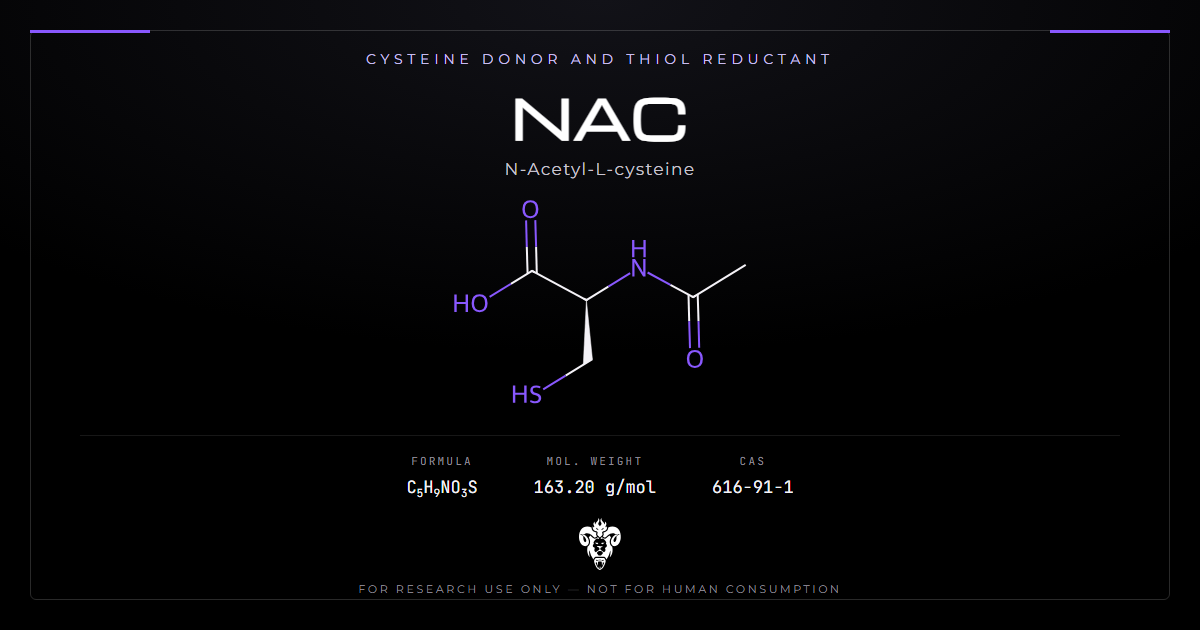
The compound is L-cysteine with its amine acetylated.
| Property | Value |
|---|---|
| Systematic name | (2R)-2-acetamido-3-sulfanylpropanoic acid |
| Common names | NAC, N-acetylcysteine, acetylcysteine |
| Molecular formula | C5H9NO3S |
| Molecular weight | 163.20 g/mol |
| CAS number | 616-91-1 |
| PubChem CID | 12035 |
| InChIKey | PWKSKIMOESPYIA-BYPYZUCNSA-N |
| Reactive group | Free thiol |
| Stereochemistry | R configuration, from L-cysteine |
| Parent amino acid | L-cysteine |
| Oxidation product | N,N-diacetylcystine |
Why acetylate cysteine at all
Free cysteine oxidises readily to cystine. It is unstable in solution and awkward to handle at the masses a glutathione-resynthesis experiment needs.
Acetylating the amine group solves those problems. Deacetylases in gut wall and liver preparations strip the acetyl group, releasing cysteine where the enzymes sit.
The trade is that the molecule becomes a prodrug. Conversion then forms part of its pharmacokinetics. Little intact NAC reaches a circulation in oral-animal work [2].
The smell is chemistry, not spoilage
A free thiol on a small molecule smells of sulfur. That is characteristic of the compound rather than a sign of degradation. It is prominent enough that formulation chemists have built prodrugs specifically to mask it [2].
Mass and the disulfide
Intact NAC is 163.20 g/mol. The symmetric disulfide N,N-diacetylcystine is 324.4 g/mol, minus two hydrogens. A mass spectrum that shows 323 rather than 163 is telling you the lot has already done the one reaction that destroys the reagent.
That dimer still contains two acetylated cysteines. It does not donate a free thiol. Ellman’s reagent will read it as dead.
The single sulfur in the parent gives a useful isotope shoulder. The disulfide doubles that contribution. A quick look at the M+2 peak can flag a mixed lot before chromatography.
Where the compound came from
The mucolytic use of the thiol came first. Pharmacology recognised in the 1960s that a small free thiol could cut the disulfide cross-links holding mucus together.
Researchers later worked out the cysteine-donation route after the NAPQI mechanism of paracetamol injury became clear. Supplying cysteine to rebuild glutathione followed directly from that chemistry.
The glutamate-antiporter work is the newest of the three, and it arrived last because its mechanism was named last [3].
That order matters for reading the evidence. Each literature followed its own mechanism, rather than one observation stretching across three fields.
Three mechanisms
The same sulfhydryl group accounts for all three, and the three do not overlap.
| Mechanism | Chemistry | Principal literature |
|---|---|---|
| Disulfide reduction | Thiol cleaves S-S bonds in polymers | Mucin rheology; von Willebrand multimers |
| Cysteine donation | Deacetylated to cysteine, the rate-limiting glutathione precursor | NAPQI / glutathione-pool work |
| Glutamate modulation | Cystine supply drives the cystine-glutamate antiporter | Indexed psychiatric papers [9][10] |
Disulfide reduction
Disulfide bonds cross-link mucin polymers, and that cross-linking sets the viscosity of mucus. A free thiol breaks those bonds, and the network loosens [3].
Braunreuther and colleagues measured this directly [11]. They tracked the rheology of a disulfide-crosslinked mucus-mimetic hydrogel as reducing agents degraded it. NAC, dithiothreitol and a thiolated polyglycerol sulfate each degraded the gel by a distinguishable mechanism.
The same chemistry extends beyond mucus. Von Willebrand factor resembles mucin structurally, and its ultra-large multimers are also disulfide-linked. A four-patient case series added NAC to established plasma-exchange work [8]. That series is indexed. Its human endpoints sit outside this profile.
Cysteine donation
Cysteine availability rate-limits glutathione synthesis [6]. NAC supplies it.
This is the tightest link between chemistry and a defined toxic intermediate anywhere in this compound’s file. NAPQI is a reactive quinone imine. Glutathione conjugation detoxifies it. When the pool runs out, NAPQI attacks protein.
Glutamate modulation
The cystine-glutamate antiporter exchanges extracellular cystine for intracellular glutamate. Raising cystine supply therefore shifts extracellular glutamate, which affects synaptic signalling.
Raghu and colleagues identify this as the discovery that opened a later literature [3]. It differs from the other two mechanisms and operates on a different timescale. It justifies nothing about mucin rheology or NAPQI work.
Indexed antidote papers
The liver converts part of a paracetamol load to NAPQI. Glutathione conjugation detoxifies it. In overdose the glutathione pool runs out.
Smilkstein and colleagues reported the US national multicentre series [1]. Licata and colleagues reviewed later regimen papers [5]. Baum and colleagues compared capped and uncapped regimens in heavier patients [4].
Those papers exist. Their human milligram figures, timing windows, and outcome rates sit outside this profile.
Why a long oral schedule appears in that file
Little intact NAC survives first pass [2], and the useful product is cysteine delivered to hepatocytes for glutathione resynthesis. Paracetamol meanwhile continues generating NAPQI for as long as the parent drug persists.
The laboratory lesson is the same even without importing those human figures. Sustained precursor supply, not a single peak, is what the molecule delivers.
What has been refined since
Later reviews still narrow the useful variable to timing rather than to a single recipe [5]. That is a statement about the indexed file, not a laboratory protocol.
Note the scale those papers used. Antidote work delivers grams, repeatedly, over days. That exposure is not interchangeable with a cell-culture thiol load.
Bioavailability is the recurring constraint
Oral NAC has poor systemic availability, for well characterised reasons. Extensive first-pass metabolism, poor lipophilicity and high protein binding all contribute [2].
Bhilare and colleagues built a thioester prodrug to work around this (PMID 26338258). They detected 4.85 percent of the administered NAC in rat blood at eight hours [2]. The prodrug reduced lung inflammation at half the equimolar dose of the parent.
This mirrors the situation with glutathione itself, and the comparison is worth making explicitly. A single oral dose of glutathione fails to raise plasma at all in the classic availability paper [13]. Longer daily dosing can raise tissue stores in a separate trial [12]. NAC sidesteps the gamma-glutamyl bottleneck by supplying the precursor rather than the product. That is a different solution to the same delivery problem.
Neither route is efficient. Both work by sustained supply rather than by achieving a high peak.
The thioester prodrug in the rat study also hid the odour [2]. That is a formulation result, not a new mechanism. The useful number from that paper is the 4.85 percent recovery in blood, because it puts a ceiling on how much intact thiol an oral experiment can claim.
Indexed psychiatric papers
This is the largest body of contested evidence, and the mechanisms above are what a laboratory can use.
Fond and colleagues ran an umbrella review of adjunctive agents [9] (PMID 37852631). Fornaro and colleagues ran a network meta-analysis [10]. Xu and colleagues reviewed bipolar adjuncts [7].
Those syntheses exist. Their human milligram-per-day figures, scale scores, and grades sit outside this profile.
Two laboratory lessons survive the cut. The longest exposures were the ones those authors trusted most [9]. And the glutamate-antiporter hypothesis was inferred, not measured, in the participants [3][9].
Other indexed files
Several further uses have been tested, and grouping them honestly means separating a physical-property readout from a downstream outcome.
How to read this group
One pattern connects them. Where the endpoint is a physical property the thiol acts on directly, the results hold. Where the endpoint is several steps downstream, they weaken or vanish.
That is the ordinary distance between a mechanism and an outcome, and this molecule makes the distance unusually visible because its mechanism is so simple.
Respiratory chemistry
The mucolytic action rests on direct disulfide chemistry rather than inference [3][11]. Whether reducing mucus viscosity changes a disease outcome is a separate question, and one where indexed trial results have been mixed [3].
Reducing viscosity and changing a clinical endpoint are different claims. The first is measurable in a rheometer. The second needs a trial and sits outside this profile.
Contrast-imaging kidney papers
NAC was widely adopted for preventing kidney injury after contrast imaging on the strength of small early trials, and larger studies did not sustain the finding [3].
The episode is worth remembering because the mechanism was plausible, the early evidence was positive, and the effect did not survive better trials. Plausibility is not evidence.
Reading a study of this compound
Four questions separate an informative NAC experiment from an uninformative one, and they come directly from the three mechanisms.
Which mechanism is the study invoking? Disulfide reduction acts within minutes on a physical property. Cysteine donation acts over hours against a depleted pool. Glutamate modulation, if it operates, takes weeks. A short experiment testing a glutamatergic hypothesis is too short by the standard the field has set for itself [9].
What exposure, and for how long? Antidote papers and psychiatric papers used different scales [1][9]. Those human figures do not transfer. A cell or animal protocol still has to name which literature it is testing.
Was the baseline depleted? Restoring an exhausted glutathione pool is a different intervention from adding precursor to an adequate one. The antidote data comes entirely from the depleted case.
What was measured? Plasma NAC is close to uninformative given the first-pass losses [2]. The meaningful measurements sit downstream, in the pool or in the physical endpoint.
Verifying research material
The thiol governs both the chemistry and the handling.
Oxidation gives the disulfide N,N-diacetylcystine, which is the expected related substance and the main degradation product. A certificate should report it rather than quoting one purity figure. Oxidised material has lost the group that does the work.
Ellman’s reagent quantifies free thiol quickly and is the fastest check that a lot is what it claims. HPLC with thiol-specific derivatisation separates the parent from the disulfide.
Solutions are acidic. A gram dissolved in water sits well below pH 3, and neutralising the solution accelerates oxidation. Prepare fresh, keep cold, and expect a sulfurous smell.
The stereochemistry matters. The compound derives from L-cysteine, giving the R configuration at its single stereocentre. Specific rotation offers a straightforward identity check. Pair the free-thiol result with the mass. A lot that fails Ellman’s is already the disulfide, not NAC.
Proton NMR shows the acetyl methyl, the alpha proton, and the beta methylene next to sulfur. Those three spin systems confirm the structure. They do not prove the lot is reduced. Pair NMR with Ellman’s or with a thiol-selective chromatogram.
Residual cysteine and residual cystine are the plausible related substances from incomplete acetylation or from hydrolysis. Both shift the mass. Neither is NAC.
Kimera publishes third-party certificates of analysis for every lot in its COA database. Laboratories work with the compound as a thiol reducing agent and cysteine donor, frequently alongside glutathione as the downstream product, or NAD+ and CoQ10 where a different redox pool is under study. Related chemistry appears in the redox and cofactors category.
What the compound is used for as a reagent
Away from the indexed clinical file, NAC has settled laboratory roles that carry none of the interpretive difficulty.
It is a standard thiol reducing agent, milder than dithiothreitol and cheaper than tris(2-carboxyethyl)phosphine, useful where a gentler reduction suits the substrate. Braunreuther and colleagues used exactly that comparison, running all three against the same hydrogel [11].
It is the reference cysteine donor in cell culture work on glutathione synthesis, since it enters cells more readily than cysteine and avoids the toxicity of cystine loading.
It also serves as a scavenger for electrophilic compounds in reactivity assays, trapping them as thiol adducts that mass spectrometry can identify.
Those three uses depend only on the chemistry, which is why they are uncontested.
Dithiothreitol is stronger and smells worse. TCEP is odourless and does not reduce as a thiol, so it does not compete in Ellman’s assays the same way. NAC sits between them: weaker, cheaper, and already the cysteine donor if the next step is glutathione synthesis [6][11].
A laboratory that only needs reduction should pick the reductant that matches the substrate. A laboratory that needs a cysteine precursor should pick NAC and then measure the pool, not the parent.
What the record does not establish
The antidote evidence does not transfer. Grams given against a glutathione-depleting poisoning is a different question from daily exposure in an unstressed system. No study bridges them.
Nobody has defined an optimal laboratory exposure outside the depleted-pool setting. Psychiatric papers clustered at one milligram-per-day band because that is what was tested [9], not because a dose-response study identified it. Those figures stay outside this profile.
The clinical trials infer the glutamate mechanism rather than measuring it. No psychiatric trial has demonstrated antiporter engagement in participants alongside a symptom change.
No study has compared NAC against glutathione head to head as a way to raise the pool. Both have poor oral availability, for different reasons. The choice currently rests on argument rather than comparison.
Long-term safety at supplement exposures lacks the scrutiny the antidote use received. That sentence is a gap statement, not a protocol.
Handling and storage
The solid is stable and the solutions are not, which is the practical shape of working with any free thiol.
Aqueous solutions oxidise to the disulfide over hours, faster when warm, aerated, alkaline or in contact with trace copper and iron. Prepare fresh. Where the reduced fraction matters to the experiment, degas the buffer and add a chelator.
The compound is markedly acidic. A 100 mM aqueous solution sits around pH 2.5, and buffering it toward neutral is exactly what accelerates oxidation. Deciding that trade-off in advance beats discovering it mid-assay.
The solid is hygroscopic and picks up water from repeated opening in humid air, which biases every subsequent weighing the same way. Aliquot on receipt.
Store the solid at minus 20 degrees Celsius, dry and dark. Expect the smell. A lot that does not smell of sulfur is more suspicious than one that does.
Write the solvent, the concentration and the date on every aliquot. A later Ellman’s number that has collapsed needs that record. Copper and iron traces in cheap buffers are a common reason a fresh solution dies in an hour.
Storage guidance is a house recommendation. Analytical documentation is per-lot release testing.
Common questions about NAC
Why is the antidote chemistry so much tighter than the rest? Because the mechanism, the intermediate and the pool all align. Glutathione depletion lets NAPQI stand, NAC restores the precursor, and hepatocyte injury is a short-timescale readout [1].
Does timing matter in that file? Yes. Later reviews still treat the start window as the dominant variable [5]. Human rates from those papers sit outside this profile.
Is NAC the same as taking glutathione? No. It supplies cysteine, the rate-limiting precursor [6], leaving synthesis to the cell. Oral glutathione supplies the finished product, and most of that is dismantled before absorption [13].
Why does it smell like that? A free thiol on a small molecule always does. The odour is a property of the compound, and prodrug work has targeted it specifically [2].
What does the psychiatric file actually support? Indexed syntheses exist and agree on direction at low certainty [9][10]. Their milligram-per-day figures sit outside this profile.
Why do those papers use long durations? Because the glutamatergic mechanism, if it operates, works over weeks rather than hours. The umbrella review found the longest trials produced the most reliable findings [9].
Is the mucolytic action the same mechanism? No. That is direct chemical reduction of disulfide bonds in mucin polymers [3][11], with no glutathione or glutamate involvement.
Summary of the evidence
Identity: (2R)-2-acetamido-3-sulfanylpropanoic acid, C5H9NO3S, 163.20 g/mol, CAS 616-91-1. Acetylated L-cysteine, functioning as a prodrug.
Three mechanisms: direct disulfide reduction, cysteine donation for glutathione synthesis, and glutamate modulation through the cystine-glutamate antiporter [3].
Indexed antidote papers exist, including a national multicentre series and later reviews [1][5]. Human milligram figures and outcome rates sit outside this profile.
Bioavailability: poor, from extensive first-pass metabolism, poor lipophilicity and high protein binding; 4.85 percent of an oral dose detected in rat blood at eight hours [2].
Indexed psychiatric syntheses exist [7][9] and [10]. Their human endpoints sit outside this profile.
Mucolytic chemistry: disulfide cleavage in mucin polymers, measurable rheologically [11], with the same chemistry applied experimentally to von Willebrand factor multimers [8].
A certificate that reports only area percent at 214 nm has not answered the thiol question. Ask for the disulfide as a named impurity.
Status: supplied for laboratory research use only.
References
- Smilkstein MJ, Knapp GL, Kulig KW, Rumack BH. Efficacy of oral N-acetylcysteine in the treatment of acetaminophen overdose. Analysis of the national multicenter study (1976 to 1985). N Engl J Med. 1988;319(24):1557-1562. PMID 3059186. DOI
- Bhilare NV, Dhaneshwar SS, Sinha AJ, Kandhare AD, Bodhankar SL. Novel thioester prodrug of N-acetylcysteine for odor masking and bioavailability enhancement. Curr Drug Deliv. 2016;13(4):611-620. PMID 26338258. DOI
- Raghu G, Berk M, Campochiaro PA, et al. The multifaceted therapeutic role of N-acetylcysteine (NAC) in disorders characterized by oxidative stress. Curr Neuropharmacol. 2021;19(8):1202-1224. PMID 33380301. DOI
- Baum RA, Woolum JA, Bailey AM, et al. Evaluation of dosing strategies of N-acetylcysteine for acetaminophen toxicity in patients greater than 100 kilograms: should the dosage cap be used? J Med Toxicol. 2021;17(3):241-249. PMID 33884558. DOI
- Licata A, Minissale MG, Stankevičiūtė S, et al. N-acetylcysteine for preventing acetaminophen-induced liver injury: a comprehensive review. Front Pharmacol. 2022;13:828565. PMID 36034775. DOI
- Nasr S, Perl A. Principles behind SLE treatment with N-acetylcysteine. Immunometabolism (Cobham). 2022;4(4):e00010. PMID 36312742. DOI
- Xu H, Du Y, Wang Q, et al. Comparative efficacy, acceptability, and tolerability of adjunctive anti-inflammatory agents on bipolar disorder: a systematic review and network meta-analysis. Asian J Psychiatr. 2023;80:103394. PMID 36525766. DOI
- Beyler O, Demir C. Use of N-acetylcysteine therapy in patients with relapsed refractory thrombotic thrombocytopenic purpura. Transfus Apher Sci. 2023;62(4):103713. PMID 37137784. DOI
- Fond G, Mallet J, Urbach M, et al. Adjunctive agents to antipsychotics in schizophrenia: a systematic umbrella review and recommendations for amino acids, hormonal therapies and anti-inflammatory drugs. BMJ Ment Health. 2023;26(1):e300771. PMID 37852631. DOI
- Fornaro M, Caiazza C, Billeci M, et al. Nutraceuticals and phytoceuticals in the treatment of schizophrenia: a systematic review and network meta-analysis. Mol Psychiatry. 2025;30(1):168-187. PMID 39026098. DOI
- Braunreuther M, Arenhoevel J, Bej R, et al. Magnetic microwire rheometer reveals differences in hydrogel degradation by disulfide reducing agents. Soft Matter. 2025;21(3):427-434. PMID 39704007. DOI
- Richie JP, Nichenametla S, Neidig W, et al. Randomized controlled trial of oral glutathione supplementation on body stores of glutathione. Eur J Nutr. 2015;54(2):251-263. PMID 24791752. DOI
- Witschi A, Reddy S, Stofer B, Lauterburg BH. The systemic availability of oral glutathione. Eur J Clin Pharmacol. 1992;43(6):667-669. PMID 1362956. DOI
NAC is sold for laboratory research use only. Not for human consumption, nor medical, veterinary, or household uses.
Literature retrieved from PubMed.