
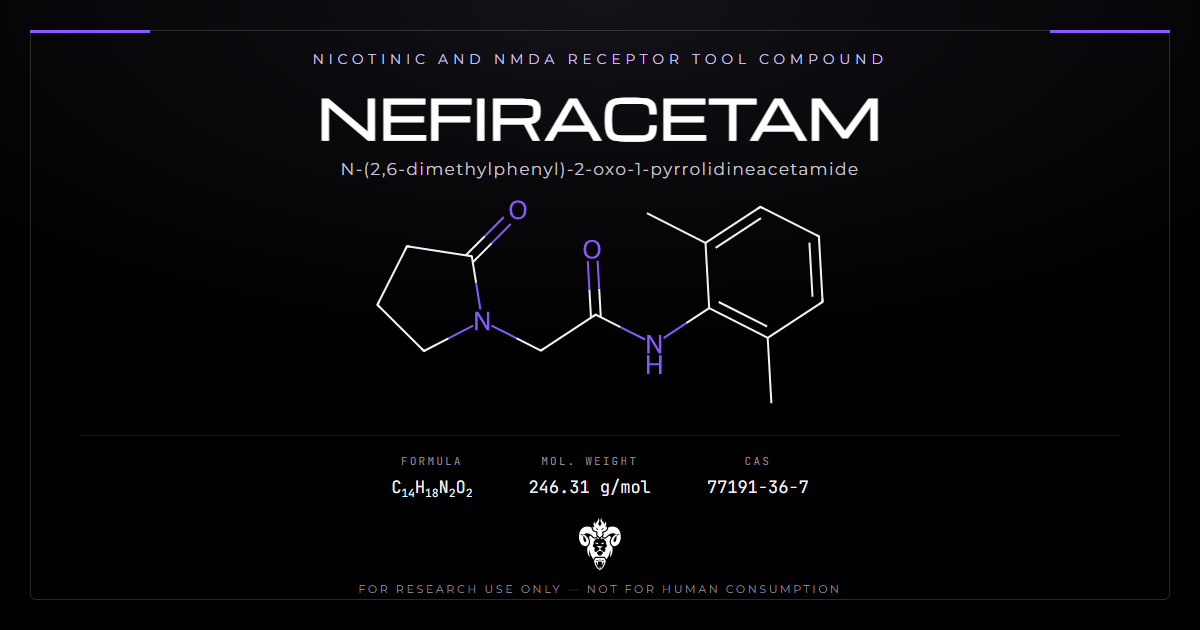
Nefiracetam occupies an unusual position in the pyrrolidinone series. Most racetams have no identified molecular target after decades of screening. Nefiracetam has several, characterised down to receptor subtype and phosphorylation site. It also has something none of its siblings has: a completed late-stage development programme that its sponsor withdrew for insufficient efficacy [1].
Those two facts sit together awkwardly, and that tension is what makes the compound worth understanding. Better mechanistic characterisation did not produce a better clinical result. Laboratories source nefiracetam as a nicotinic and NMDA receptor tool compound. It also serves as the control that separates nicotinic-mediated effects from the rest of the racetam class.
All information here describes laboratory research findings. This material is supplied for research use only and is not for human or veterinary use.
What nefiracetam is
Nefiracetam carries a 2,6-dimethylphenyl group on the acetamide nitrogen of the pyrrolidinone scaffold. That aromatic substitution distinguishes it from piracetam and gives it both greater lipophilicity and, as the pharmacology below shows, a different target profile.
Identity and physical data
| Property | Value |
|---|---|
| Compound | Nefiracetam |
| Development codes | DM-9384, DZL-221 |
| PubChem CID | 71157 |
| CAS number | 77191-36-7 |
| Molecular formula | C14H18N2O2 |
| Molecular weight | 246.30 g/mol |
| InChIKey | NGHTXZCKLWZPGK-UHFFFAOYSA-N |
| Systematic name | N-(2,6-dimethylphenyl)-2-oxo-1-pyrrolidineacetamide |
| Chemical class | Pyrrolidinone, N-aryl acetamide |
No stereocentre
The InChIKey ends UHFFFAOYSA, and here that reflects a genuine absence of stereochemistry rather than an undefined racemate. Nefiracetam has no stereocentre, so the chiral purity question that attaches to oxiracetam does not arise. A single achiral purity method answers the composition question completely.
Nefiracetam is not mechanistically a racetam
The clearest experiment on this point came from Kobe in 2000 [2]. Working in rat hippocampal slices, investigators found that nefiracetam facilitated neurotransmission in the dentate gyrus across 1 nM to 1 microM. Nicotinic antagonists blocked that facilitation. Both alpha-bungarotoxin and mecamylamine abolished it.
The control experiment that matters
Piracetam and aniracetam produced a similar facilitation in the same preparation. Nicotinic antagonists did not block theirs (DOI). The two effects also failed to occlude one another, which means they run through separate pathways rather than converging on one [2].
In Xenopus oocytes the separation went further. Nefiracetam potentiated currents through alpha3beta2, alpha3beta4, alpha4beta2, alpha4beta4 and alpha7 nicotinic receptors. Neither piracetam nor aniracetam touched alpha7 currents at all. Aniracetam delayed the decay of AMPA receptor currents, where nefiracetam and piracetam did nothing.
Why that finding is useful in practice
Shared scaffold does not mean shared mechanism. A study treating the racetams as an interchangeable series will attribute to the class an effect that belongs to one member. Any experiment using nefiracetam as a class representative needs a second racetam as a comparator, or the result describes nefiracetam alone.
Nicotinic receptor pharmacology
The nicotinic thread runs through most of the compound’s mechanistic literature and is the best characterised part of it.
Subtype selectivity and downstream release
A 2009 study in cultured rat cortical neurons measured miniature postsynaptic currents [3]. Nefiracetam at 10 nM, combined with 30 nM acetylcholine, raised the frequency of both excitatory and inhibitory miniature currents beyond the level acetylcholine produced alone. Dihydro-beta-erythroidine abolished that potentiation, pointing to alpha4beta2 receptors as the route.
Amplitude went unchanged across every condition. A frequency effect without an amplitude effect places the action presynaptically, on release probability rather than on postsynaptic receptor density. Nefiracetam also did nothing in neurons that failed to respond to acetylcholine, which argues it modulates an existing cholinergic signal rather than generating one.
The galantamine comparison
That same study tested galantamine at 1 microM under identical conditions and found no significant potentiation of frequency [3]. Both compounds had been reported to potentiate nicotinic activity, so the divergence is informative for anyone selecting a positive control.
NMDA receptor potentiation
A second mechanism operates at the NMDA receptor, and its details are unusually specific for this class.
Three separate actions on one receptor
Whole-cell patch clamp work used rat cortical and hippocampal neurons [4]. It found potentiation of NMDA currents through protein kinase C rather than partial agonism. Chelerythrine, a PKC inhibitor, blocked the potentiation. H89, a PKA inhibitor, did not.
The compound allosterically enhanced glycine binding, and at 10 nM it largely eliminated voltage-dependent magnesium block (DOI). Removing the magnesium block is a substantial change to receptor behaviour, since that block is what makes the NMDA receptor a coincidence detector.
The glycine site question
A 2015 molecular dynamics study modelled how nefiracetam might compete with glycine at the GluN1 ligand binding domain [5]. Its authors proposed a two-step process. Binding at a site within the spiral beta-strands comes first. Disruption of the glycine binding dynamics follows, then displacement of glycine from the cleft. That work is computational and has not been confirmed experimentally.
Downstream kinase signalling
Receptor-level effects converge on two kinases. In olfactory bulbectomised mice, nefiracetam restored hippocampal long-term potentiation in CA1 [6]. It raised CaMKII alpha autophosphorylation at Thr286. It also raised PKC alpha phosphorylation at Ser657. Antagonist work separated the two routes: an mGluR5 antagonist blocked the LTP enhancement while an mGluR1 antagonist did not.
Earlier work identified N and L-type calcium channel activation without effect on T-type channels, mediated by pertussis-toxin-sensitive G proteins and cAMP-dependent pathways [7]. Taken together the picture is a compound acting on several receptor systems that all feed the same kinase cascade.
The concentration problem
This is the single most practical point in the nefiracetam literature, and getting it wrong inverts results.
The dose response is bell-shaped
Effects peak at low nanomolar concentrations and fall away above and below. PKC alpha activation peaked at 10 nM [4]. The broad behavioural and biochemical survey from 1997 reported bell-shaped curves in both domains [8]. Neither a higher concentration nor a lower one produces a larger effect.
At some concentrations the sign reverses
Work on Torpedo nicotinic receptors expressed in oocytes found a biphasic response [7]. Between 0.01 and 0.1 microM, nefiracetam produced short-term depression of acetylcholine-evoked currents. Between 1 and 10 microM it produced long-term enhancement. Those authors attributed the depression to PKA-mediated phosphorylation and the enhancement to PKC.
One compound, one receptor, opposite signs at concentrations a hundredfold apart. A single-concentration screen can therefore report nefiracetam as an inhibitor or as a potentiator depending only on where it sampled.
What this means for experimental design
Any protocol using this compound needs a concentration range spanning at least three orders of magnitude. A single point is uninterpretable. When comparing published results, check the concentration before concluding that two studies disagree, because they may be reporting different arms of the same curve.
Preclinical findings by model
Findings stay bound to the model that produced them.
Amnesia challenge models
The 1997 survey tested nefiracetam against amnesia induced by scopolamine, bicuculline, picrotoxin, ethanol, chlordiazepoxide and cycloheximide, reporting improvement across all six [8]. Nifedipine and flunarizine antagonised the effect in the scopolamine model where diltiazem did not, which supports the calcium channel involvement.
Breadth across six unrelated amnestic agents cuts two ways. It suggests action on a common consolidation step rather than on any one transmitter system. It also makes the finding harder to localise.
Traumatic brain injury
In rats given a moderate fluid percussion injury, chronic post-injury administration at 3 and 9 mg/kg attenuated Morris water maze deficits [9]. Animals at 9 mg/kg did not differ significantly from uninjured controls. The same dose produced neither benefit nor harm in uninjured animals, which is the control that makes the injured-animal result interpretable.
Ageing rabbit eyeblink conditioning
Two studies used delay eyeblink classical conditioning in older rabbits. In 56 animals given scopolamine, a 15 mg/kg dose reversed the induced impairment [10]. In 104 animals, combining 10 mg/kg nefiracetam with low-dose physostigmine improved learning rate and magnitude over either vehicle or nefiracetam alone [11].
A negative result on receptor binding
Nefiracetam reversed apomorphine-induced amnesia in a passive avoidance paradigm, yet failed to displace either [3H]SCH 23390 or [3H]spiperone at millimolar concentrations [12]. So the effect on a dopaminergic challenge does not run through D1 or D2 receptors. Negative binding data of this kind narrows the hypothesis space and deserves reporting alongside the positive findings.
The development programme and its withdrawal
Nefiracetam went further in development than any other racetam, and reporting that history accurately means reporting how it ended.
What was planned
Daiichi developed the compound for sequelae of cerebrovascular disorders [1]. By September 1999 it had reached phase II in the United States for mental symptoms following stroke and for Alzheimer type dementia. Chinese trials completed by August 2000 ahead of a filing. Analysts projected Japanese sales of 3 billion yen in 2002 rising to 13 billion by 2005.
What happened
Daiichi withdrew the Japanese NDA in February 2002 for insufficient efficacy in the revised trial [1]. A 2010 review of the class recorded separately that nefiracetam failed to improve cognition in post-stroke patients [13]. Older literature catalogues the programme under three names, DM 9384, DZL 221 and Translon [16]. Searching on one name alone will miss part of the record.
How to read that
A withdrawn filing is a stronger negative signal than an absent one, because it means the sponsor ran the trial and did not like the answer. The mechanistic literature above remains valid on its own terms. Receptor pharmacology measured in oocytes and brain slices does not become wrong because a clinical endpoint failed. It simply never predicted that endpoint.
For a laboratory, this makes nefiracetam a well-characterised tool compound rather than a candidate. That is a legitimate and useful thing to be.
Physicochemical properties and handling
| Parameter | Detail |
|---|---|
| Solubility | Soluble in DMSO and ethanol; sparingly soluble in water |
| Storage | Sealed, dry, protected from light |
| Stability | Stable as a dry solid at ambient conditions |
| Stock solutions | Prepare in DMSO; aliquot to avoid freeze-thaw cycles |
The aryl group makes nefiracetam considerably more lipophilic than piracetam or oxiracetam, so aqueous stock preparation is not practical at useful concentrations. Prepare concentrated stocks in DMSO and dilute into buffer immediately before use.
Lipophilicity changes the practical handling
The aryl substitution shifts this compound well away from its siblings on polarity. Piracetam and oxiracetam dissolve freely in water. This one does not. That difference governs three things at the bench.
Stock preparation is the first. Aqueous stocks cannot reach useful concentrations, so an organic carrier is required. Adsorption is the second. Lipophilic compounds bind to plasticware, and a dilute working solution left in a polypropylene tube can lose material to the wall. Glass or low-binding plastic is the safer choice for dilute standards. Recovery during extraction is the third. A protocol validated for a water-soluble racetam will not transfer without checking, since partition behaviour differs.
Carrier concentration matters at these working concentrations
Active concentrations sit in the low nanomolar range, so a stock diluted from DMSO can carry a solvent percentage that exceeds the pharmacology under test. Calculate final carrier concentration explicitly and run a vehicle control at the matched percentage. This is routine practice, and it matters more here than for compounds active at micromolar levels.
Analytical characterization
Identity and purity determination is straightforward for this compound, which is a consequence of having no stereocentre.
Standard methods suffice
Reversed-phase HPLC with ultraviolet detection resolves nefiracetam and its likely process impurities. The aromatic ring provides a strong chromophore, so detection sensitivity is better than for the aliphatic racetams. Mass spectrometry against the expected 246.30 confirms identity, and proton NMR resolves the two aryl methyl groups as a clean singlet worth six protons.
What to check on a certificate
Purity by HPLC with the method stated, identity by mass spectrometry or NMR, and residual solvent if the synthesis used dimethylformamide or similar. No chiral method is required. Batch documentation for catalogue material sits in the certificate of analysis database.
The aryl amide is the impurity to watch
Synthesis routes to this scaffold couple 2,6-dimethylaniline to an activated pyrrolidinone acetic acid. Unreacted aniline is the impurity that matters most. It is a distinct chromophore and elutes well away from the product. A UV trace at one wavelength can therefore under-report it, if that wavelength was chosen for the product alone. A diode array scan across the run answers this in one injection.
Residual aniline also matters for a second reason. Substituted anilines are reactive toward oxidation, so a sample carrying them can darken on storage while the main peak stays within specification. Colour change in a solid that still assays clean is a signal worth investigating rather than dismissing.
Confirming the two methyl groups
Proton NMR gives the fastest identity confirmation for this structure. The two aryl methyls are equivalent by symmetry and appear as one singlet integrating for six protons. Loss of that symmetry, or an integration that does not come out at six, points to a substitution pattern other than 2,6. That single resonance distinguishes the intended compound from its 2,4 and 2,5 isomers. All three share a formula and a mass, so mass spectrometry cannot separate them.
Nefiracetam among the other racetams
Structural comparison across the series is the most common laboratory application, and nefiracetam is the member that most often breaks the pattern.
| Compound | Distinguishing feature | Nicotinic action |
|---|---|---|
| Piracetam | Unsubstituted parent | None reported |
| Aniracetam | Anisoyl group, AMPA decay effect | None reported |
| Oxiracetam | 4-hydroxy, chiral centre | None reported |
| Nefiracetam | 2,6-dimethylphenyl amide | alpha7 and alpha4beta2 |
The class review position
A 1994 review covering 407 references found no receptor affinity across a broad panel for the racetam class [14]. It carved out this compound’s GABA-A binding as the single exception. Later nicotinic work extended that exception considerably. Read the class reviews as describing the other members, with this compound annotated separately.
Further reading across the series sits in the nootropics research library, and the reference standard ships against batch documentation.
Open questions and how to read this literature
The evidence base here has a distinctive shape. Mechanism is well mapped. Translation is not. Four points govern how to read it.
The mechanistic work concentrates in few hands
A large share of the receptor-level papers share authors. Moriguchi, Yeh, Narahashi and Fukunaga appear across the nicotinic, NMDA and kinase studies [3][4] and [6]. That is normal for a specialised technique, and it also means the findings are less independent than a raw paper count suggests. Independent replication of the magnesium block result would strengthen it considerably.
One target or several
Published work assigns actions at nicotinic receptors, NMDA receptors, calcium channels and GABA uptake [2][4] and [7][8]. Those could reflect one upstream event with several downstream readouts. They could equally reflect genuine polypharmacology. Nothing in the literature settles which, and the distinction matters for anyone using this compound as a selective tool.
The computational glycine model is unconfirmed
Molecular dynamics produced a specific and testable proposal about displacement of glycine from the GluN1 cleft [5]. No wet experiment has tested it. Treat it as a hypothesis with a mechanism attached rather than as a finding.
Why the clinical programme failed is not known
The withdrawal notice records insufficient efficacy and no more [1]. Several explanations are available. Dose selection, the bell-shaped curve placing clinical doses off peak, patient population, or an endpoint the pharmacology never addressed. The published record does not choose between them, and speculating past it is not supportable.
What the compound is good for
None of this diminishes its value on the bench. A tool that potentiates alpha7 currents where piracetam and aniracetam do not is useful precisely because of that contrast [2]. Its failure as a candidate and its utility as a reagent are separate questions with separate answers.
Frequently asked questions
Why is nefiracetam grouped with the racetams?
By scaffold. It carries the 2-oxopyrrolidine acetamide core that defines the series [15]. Its pharmacology diverges from the rest of the group [2].
Does it have a stereocentre?
No. Purity determination needs no chiral method, unlike oxiracetam.
What concentration should a screen use?
Published activity peaks near 10 nM, and the response is bell-shaped [4][8]. A range spanning several orders of magnitude is necessary, since a single point can report the opposite sign of effect [7].
Was nefiracetam ever approved?
No. Daiichi withdrew the Japanese NDA in February 2002 for insufficient efficacy [1].
Does it bind dopamine receptors?
No. It failed to displace D1 or D2 ligands at millimolar concentrations, despite reversing apomorphine-induced amnesia [12].
Is this the racetam that went into ADHD trials?
No, and the codes invite the confusion. Nefiracetam is DM-9384 and was developed for cerebrovascular sequelae [1]. Fasoracetam carries the codes NS-105 and NFC-1, and it is the one associated with ADHD work. Two different compounds, two different sponsors, two different programmes, and a pair of similar-looking identifiers. Check the CAS number rather than the code when resolving which is which.
How does it compare with aniracetam on AMPA receptors?
Aniracetam delays AMPA receptor current decay. Nefiracetam has no measurable effect on those currents [2].
References
- Crespi F. Nefiracetam. Daiichi Seiyaku. Curr Opin Investig Drugs. 2002;3(5):788-93. PubMed
- Nomura T, Nishizaki T. Nefiracetam facilitates hippocampal neurotransmission by a mechanism independent of the piracetam and aniracetam action. Brain Res. 2000;870(1-2):157-62. PubMed DOI
- Moriguchi S, Zhao X, Marszalec W, et al. Nefiracetam and galantamine modulation of excitatory and inhibitory synaptic transmission via stimulation of neuronal nicotinic acetylcholine receptors in rat cortical neurons. Neuroscience. 2009;160(2):484-91. PubMed DOI
- Moriguchi S, Shioda N, Maejima H, et al. Nefiracetam potentiates N-methyl-D-aspartate (NMDA) receptor function via protein kinase C activation and reduces magnesium block of NMDA receptor. Mol Pharmacol. 2006;71(2):580-7. PubMed DOI
- Omotuyi OI, Ueda H. Molecular dynamics study-based mechanism of nefiracetam-induced NMDA receptor potentiation. Comput Biol Chem. 2015;55:14-22. PubMed DOI
- Moriguchi S, Han F, Shioda N, et al. Nefiracetam activation of CaM kinase II and protein kinase C mediated by NMDA and metabotropic glutamate receptors in olfactory bulbectomized mice. J Neurochem. 2009;110(1):170-81. PubMed DOI
- Yoshii M, Nishizaki T, Watabe S. Facilitatory actions of the cognitive enhancer nefiracetam on neuronal Ca2+ channels and nicotinic ACh receptors. Nihon Yakurigaku Zasshi. 1998;112 Suppl 1:41P-43P. PubMed DOI
- Hiramatsu M, Shiotani T, Kameyama T, Nabeshima T. Effects of nefiracetam on amnesia animal models with neuronal dysfunctions. Behav Brain Res. 1997;83(1-2):107-15. PubMed DOI
- DeFord SM, Wilson MS, Gibson CJ, et al. Nefiracetam improves Morris water maze performance following traumatic brain injury in rats. Pharmacol Biochem Behav. 2001;69(3-4):611-6. PubMed DOI
- Pak J, Green J, Heifets B, et al. Nefiracetam ameliorates associative learning impairment in the scopolamine-injected older rabbit. Med Sci Monit. 2002;8(4):BR105-12. PubMed
- Woodruff-Pak DS, Ewers M, Shiotani T, et al. Nefiracetam and physostigmine: separate and combined effects on learning in older rabbits. Neurobiol Aging. 2004;25(6):807-16. PubMed DOI
- Doyle E, O’Boyle KM, Shiotani T, Regan CM. Nefiracetam (DM-9384) reverses apomorphine-induced amnesia of a passive avoidance response. Neurochem Res. 1996;21(6):649-52. PubMed DOI
- Malykh AG, Sadaie MR. Piracetam and piracetam-like drugs: from basic science to novel clinical applications to CNS disorders. Drugs. 2010;70(3):287-312. PubMed DOI
- Gouliaev AH, Senning A. Piracetam and other structurally related nootropics. Brain Res Brain Res Rev. 1994;19(2):180-222. PubMed DOI
- Tanaka M, Takasuna K, Takayama S. Nefiracetam, a novel cognition-enhancing agent. An introductory overview. Arzneimittelforschung. 1994;44(2A):193-4. PubMed
- Nefiracetam. DM 9384, DZL 221, Translon. Drugs R D. 2002;3(3):212-6. PubMed DOI