
Very few compounds in a research catalogue have a published human half-life. NSI-189 does. A phase 1B study in 2016 measured 17.4 to 20.5 hours and reported area under the curve rising in near proportion to dose across three cohorts [1].
That data exists because this molecule was built to test one hypothesis: that stimulating adult hippocampal neurogenesis changes behaviour. Neuralstem designed it as a neurogenic agent rather than a receptor ligand, and its literature reads differently from most research chemicals as a result.
Indexed later papers exist [2][4]. Human endpoints from those papers sit outside this profile. The half-life stays because it is already bound to the 2016 report [1].
Everything below describes laboratory findings. This material is for research use only, not for human or veterinary use. NSI-189 is the free-base name for that phosphate salt. Write NSI-189 on the notebook line before the lot number.
What NSI-189 is
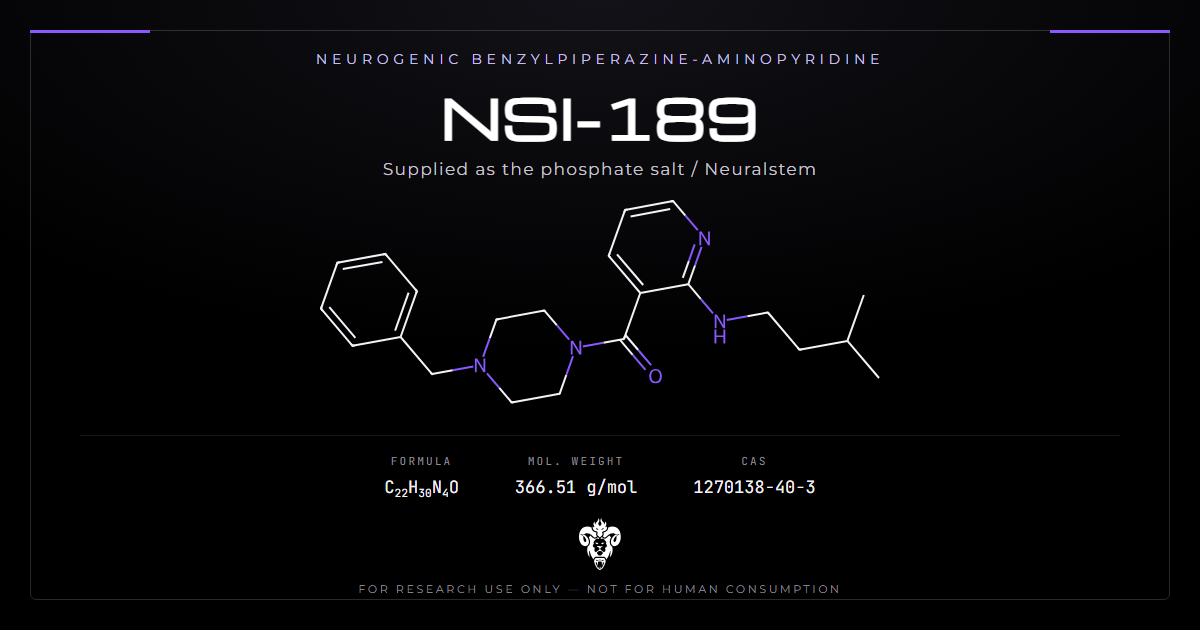
NSI-189 is a benzylpiperazine-aminopyridine [3]. The scaffold pairs a benzylpiperazine with a substituted pyridine through a ketone bridge. Nothing in that structure resembles a monoamine reuptake inhibitor, and the developers made that point repeatedly.
Identity and physical data
| Property | Free base | Phosphate salt |
|---|---|---|
| Compound | NSI-189 | NSI-189 phosphate |
| PubChem CID | 50922681 | 50922680 |
| CAS number | 1270138-40-3 | Salt of the above |
| Molecular formula | C22H30N4O | C22H33N4O5P |
| Molecular weight | 366.5 g/mol | 464.5 g/mol |
| InChIKey | DYTOQURYRYYNOR-UHFFFAOYSA-N | LWHMGALTTIYPJU-UHFFFAOYSA-N |
| Chemical class | Benzylpiperazine-aminopyridine | Mono-phosphate salt |
The IUPAC name tells you the assembly
The systematic name is (4-benzylpiperazin-1-yl)-[2-(3-methylbutylamino)pyridin-3-yl]methanone [7]. Read it backwards and the synthesis appears: a pyridine ring carrying an isopentylamino group at position 2, acylated at position 3, joined to a benzyl-substituted piperazine. The InChIKey stereo block is UHFFFAOYSA, which means no defined stereocentres. That simplifies identity confirmation. There is no enantiomeric purity question here.
Where the compound came from
Neuralstem developed the molecule and appears on both published human papers [1][2]. The later paper carries the registry identifier NCT02695472 [9]. Company scientists appear as authors on most of the preclinical papers as well, which is worth knowing when weighing the literature: the majority of positive results come from groups with a stake in the compound. The diabetes, radiation and stroke work involved academic laboratories with their own animal models, and those are the studies that carry independent weight (PubMed).
The hypothesis it was built to test
Adult hippocampal neurogenesis entered psychiatry through a 2003 Science paper [11]. Mice given X-irradiation to block neurogenesis stopped responding behaviourally to a monoamine-class ligand set. The conclusion drawn from that experiment shaped a decade of probe design.
Why the hypothesis is still contested
Human evidence has gone in both directions. Carbon-14 dating of genomic DNA in postmortem tissue put the figure at roughly 700 new hippocampal neurons per day in adults [12]. One 2018 study found neurogenesis persisting across the lifespan [13]. A second 2018 study, published weeks apart, reported the opposite: undetectable levels in adults [14]. A 2019 paper then found abundant new neurons in healthy adults and a sharp drop in Alzheimer’s disease [15].
What that disagreement means for a research compound
Four groups, four methods, four answers. The disagreement is methodological, and it centres on tissue fixation and marker specificity. A compound designed to stimulate a process whose existence in adult humans is disputed carries that dispute with it. For laboratory work the implication is narrow: rodent and cell culture endpoints stand on their own, and human extrapolation does not follow.
Neurogenic activity in the laboratory
Cells and rodents
The compound stimulates neurogenesis of human hippocampus-derived neural stem cells in culture and neurogenesis in mouse hippocampus in vivo [3]. Those two observations are the foundation the whole programme rests on, and every later paper cites them.
What a neurogenesis readout measures
Assays in this field count cells, and the counting method decides the result. Thymidine analogues such as BrdU or EdU mark cells that copied their DNA during the labelling window. Doublecortin marks immature neurons. NeuN marks mature ones, and co-labelling a thymidine analogue with NeuN is what separates a new neuron from a dividing glial cell.
Proliferation and maturation are therefore two different endpoints. A compound can raise progenitor division without producing more mature neurons, and the 2024 comparison paper scored exactly that distinction [10]. Read any neurogenesis figure by asking which marker pair produced it.
Synaptic plasticity in slices
A 2019 study went further into mechanism [7]. Incubating acute hippocampal slices from wild-type mice produced a time-dependent and concentration-dependent increase in long-term potentiation after theta burst stimulation. The same protocol worked in slices from a mouse model of Angelman syndrome. Treated Angelman mice recovered cognitive and motor performance, and the effects tracked activation of the TrkB and Akt pathways [7].
Why the TrkB result matters
TrkB is the BDNF receptor. Linking a neurogenic compound to TrkB and Akt signalling connects it to the neurotrophic literature that surrounds Cerebrolysin and DIHEXA, which reach related endpoints through unrelated chemistry. The mechanism is downstream signalling, not receptor occupancy, and no binding target has been published.
Human pharmacokinetics
The 2016 paper is the source of the kinetic pair that stays in this file [1].
The numbers worth keeping
Half-life came in at 17.4 to 20.5 hours. Area under the curve increased in a dose-related and nearly proportional way across cohorts [1]. Dose-proportional exposure and a day-long half-life are unusual data to have for a catalogue compound, and they are the reason this molecule appears as a benchmark elsewhere.
This profile does not quote human milligram ladders, scale scores, or adverse-event language from that paper. Those sentences turn a research article into a use document.
Indexed later papers and what they are not
Indexed papers after the kinetic report exist [2][4] and [9]. Human endpoints from those papers sit outside this profile.
What those papers are
Papakostas and colleagues published a later randomised study of NSI-189 phosphate [2]. A 2020 post-hoc analysis re-cut that file [4]. The registry identifier NCT02695472 sits on the later study [9]. Use those papers as a map. Do not quote scale scores, subgroup splits, or a missed primary endpoint as a use story.
What this profile will not do
It will not treat a later paper as a licence to use the salt. It will not walk through enrichment designs built for symptom scores. The kinetic pair above is the only human figure this page keeps [1].
Why the animal file still matters more
Diabetes, radiation injury, stroke and Angelman-model work all measured recovery from an induced deficit [5][6], [7][8] and [9]. Those readouts do not depend on a rating scale. They also do not transfer to people. Keep them in the species that produced them.
Findings in non-psychiatric models
The neurogenic premise sent this compound into several fields at once. Each of the studies below used a different injury model.
Diabetic neuropathy
A 2019 study in Diabetes tested mouse models of both type 1 and type 2 diabetes and reported improvement in central and peripheral measures [5]. Three years later, a follow-up in Zucker diabetic fatty rats measured mitochondrial function directly in dorsal root ganglia and cortex. Improvement there came alongside reversal of neuropathy and memory deficits [6].
Radiation-induced cognitive dysfunction
A 2018 study in Radiation Research gave the compound orally to irradiated animals and measured cognitive endpoints [8]. Cranial radiotherapy produces lasting cognitive deficits with no clinical countermeasure, which is why a neurogenic agent was tested there at all.
Ischaemic stroke
A 2017 rat study began oral treatment six hours after middle cerebral artery occlusion and continued for 12 weeks [9]. Behavioural and neurostructural measures both improved. The 12-week treatment window is longer than most stroke work and worth noting when comparing protocols.
What the four models share
Diabetes, cranial irradiation, ischaemia and a synaptic genetic disorder have little in common at the level of cause. All four damage the hippocampus, and all four produce measurable cognitive deficits in rodents. That is the common thread the programme exploited.
The pattern also sets the limit of the evidence. Each study measured recovery from an induced deficit. None measured enhancement in an intact animal, and the Angelman work reported only a slight change in wild-type controls [7]. Deficit reversal and enhancement are separate claims, and only the first has support here.
Markers that are not interchangeable
BrdU or EdU counts cells that copied DNA in a window. Doublecortin counts immature neurons. NeuN plus a thymidine analogue counts a new mature neuron. The 2024 comparator paper scored that last pair, not a raw proliferation count [10]. A notebook that writes “neurogenesis” over a single BrdU number has not scored what that paper scored.
The Angelman slice work is a different readout again. It measured long-term potentiation after theta burst, then TrkB and Akt phosphorylation [7]. Those are synaptic and signalling endpoints. They can move without a new neuron appearing. Write the marker pair on the same line as the compound name.
The mitochondrial thread
Two of the diabetes papers point the same way. The 2022 study measured mitochondrial indices in two tissues and reported enhancement in both [6]. Neurogenesis is metabolically expensive, so a compound that supports mitochondrial function might produce neurogenic readouts without acting on stem cells directly. Nothing published separates those two possibilities, and an experiment that did would be worth running.
The design for it is straightforward. Measure mitochondrial respiration and progenitor division in the same preparation, then block one and see whether the other holds. Neither the diabetes papers nor the psychiatric work took that step, and the two readouts have stayed correlated without either being shown to cause the other.
NSI-189 as a benchmark compound
A 2024 medicinal chemistry paper screened diphenyl acrylonitrile derivatives for adult rat hippocampal neurogenesis [10]. The authors used NSI-189 as the comparator, and three of their compounds beat it at driving newborn cells toward mature neurons.
Using it as a positive control
Positive controls in a neurogenesis assay have to satisfy two conditions. They must produce a measurable effect at a workable concentration, and that effect must reproduce between operators and passages. Published activity in human-derived neural stem cells and in rodent hippocampus covers the first condition [3]. The second is a property of a laboratory rather than of a compound, and it needs establishing locally before any comparison runs.
Record the salt form on the control tube as well. A control prepared from salt mass and compared against a free-base concentration will read 27 percent low, and a positive control that drifts is worse than none.
What benchmark status implies
A compound becomes a benchmark when its assay behaviour is reproducible enough to calibrate against. That is a practical endorsement of the material as a tool, separate from any clinical question. Researchers running neurogenesis assays need a positive control, and this one has published activity in both human-derived cells and rodent hippocampus [3].
Physicochemical properties and handling
| Property | Detail |
|---|---|
| Supplied form | Phosphate salt, crystalline solid |
| Salt correction | 1.27 mg salt delivers 1.00 mg free base |
| Solubility | Salt form is water soluble; free base favours DMSO |
| Storage, solid | Minus 20 degrees Celsius, desiccated |
| Storage, solution | Minus 20 degrees Celsius, single-use aliquots |
| Stability note | Hygroscopic behaviour is typical of phosphate salts; keep dry |
| Handling | Standard laboratory controls for a fine powder |
Store the solid desiccated at minus 20 degrees Celsius. Aliquot solutions once. Storage guidance is a house recommendation. Analytical documentation is per-lot release testing.
Vehicle choices in the published work
Rodent studies gave the compound orally, in drinking water or by gavage depending on the group [5][8] and [9]. Cell work used the salt in aqueous medium. Match the vehicle to the published protocol you are reproducing, and record it: an oral rodent result and a slice-perfusion result are not comparable exposures.
The salt correction is the practical trap
Molecular weight runs 464.5 for the salt against 366.5 for the free base. Dividing gives a factor of 1.27. Weighing salt mass and calling it free base mass overstates concentration by 27 percent, which is large enough to move a dose-response curve a visible distance. Published studies specify NSI-189 phosphate, so check which form a protocol means before reproducing it.
Solution preparation
The phosphate salt dissolves in aqueous buffer, which the free base does not do well. That difference is the practical reason the salt exists. Prepare stocks fresh, and record which form the concentration refers to on the tube itself.
Analytical characterization
Mass and identity
Electrospray mass spectrometry of the free base gives a protonated ion at m/z 367.3 against the C22H30N4O formula. The phosphate counterion does not appear in positive-mode electrospray, so a mass spectrum alone cannot confirm the salt form. Ion chromatography or a phosphorus-31 NMR experiment answers that question directly.
Confirming the counterion matters
A certificate reporting only organic purity leaves the salt stoichiometry unstated. For a compound where the correction factor is 27 percent, stoichiometry is part of identity rather than a footnote. Batch documentation for catalogue material sits in the certificate of analysis database.
NMR expectations
Proton NMR of the free base shows a five-proton aromatic multiplet from the benzyl ring, pyridine ring protons in a three-spin pattern, piperazine methylenes as broad signals near 3.5 ppm, and the isopentyl chain as a doublet plus multiplets upfield. Phosphorus-31 NMR gives a single phosphate resonance for the salt and nothing for the free base (PubChem). Running both experiments confirms the organic identity and the counterion in one session.
Chromatography
Reversed-phase HPLC with ultraviolet detection separates the compound from its likely process impurities, since the benzylpiperazine and aminopyridine fragments differ sharply in polarity from the assembled molecule. The pyridine chromophore gives adequate ultraviolet response for routine purity work.
The ketone bridge is the other identity handle. A benzylpiperazine fragment and an aminopyridine fragment each have their own mass. The assembled molecule sits at 366.5. A lot that assays as two smaller peaks with those fragment masses is unfinished coupling, not NSI-189. Record the intact ion at m/z 367.3 before you trust an area percent.
Phosphate stoichiometry is a third check. One phosphorus-31 resonance matches the mono-phosphate salt. A second resonance, or none, means the correction factor of 1.27 no longer applies. Weighing then becomes a guess.
Where it sits among neurogenic research compounds
| Compound | Studied mechanism | Class |
|---|---|---|
| NSI-189 | Hippocampal neurogenesis, TrkB and Akt signalling | Benzylpiperazine-aminopyridine |
| DIHEXA | Hepatocyte growth factor and c-Met pathway | Angiotensin IV analogue |
| 9-ME-BC | Dopaminergic signalling, neurotrophic factor induction | Beta-carboline |
| Cerebrolysin | Mixed neurotrophic peptide fractions | Peptide preparation |
Only one of these four has human pharmacokinetic data behind it. Further reading sits in the nootropics research library.
What this literature does not establish
The target is unknown
No binding target has been published. The compound is defined by what it does in an assay, not by what it binds. That is a legitimate way to characterise a tool compound, and it limits how far mechanism claims can go.
The later human papers stay out of scope
The kinetic pair comes from one 2016 paper [1]. Later controlled papers exist [2][4]. This profile does not quote their endpoints. Nothing published since adds a binding target.
Neurogenesis remains a contested readout
The human neurogenesis literature has not converged. A compound whose entire rationale rests on that process inherits the uncertainty.
Cross-model consistency is the strongest part
Diabetes, radiation injury, stroke and a genetic model all produced positive readouts in different laboratories [5][6] and [8][9]. Consistency across unrelated injury models is a better argument for a real biological effect than any single result, and it is the part of this literature that would justify further work.
A fair summary of NSI-189 runs in two halves. The later human papers exist and stay cited [2][4]. As a laboratory probe NSI-189 still holds a place, because its neurogenesis activity is reproducible enough for other groups to score their own compounds against it [10]. Those two readings of NSI-189 are compatible, and keeping them apart is the whole discipline of reading this literature.
Frequently asked questions
Does this page report human outcomes?
No. Indexed later papers are listed so they can be found [2][4]. This profile keeps the 17.4 to 20.5 hour half-life [1] and stops at chemistry, neurogenesis assays and animal injury models.
Why is the phosphate salt supplied rather than the free base?
Aqueous solubility. The salt dissolves in buffer; the free base does not do so readily. Published studies specify the phosphate form.
How much salt equals a given mass of free base?
Multiply by 1.27. The salt weighs 464.5 g/mol against 366.5 for the free base.
Does the compound have a known receptor?
No published binding target exists. Activity is described through neurogenesis assays and downstream TrkB and Akt signalling [7].
What was the measured human half-life?
Between 17.4 and 20.5 hours in the phase 1B study, with near dose-proportional exposure across three cohorts [1].
Which studies were run by independent laboratories?
The diabetes, radiation-injury and stroke work came from academic groups with their own models [5][6] and [8][9]. Company scientists co-authored much of the rest.
Does the compound show effects in healthy animals?
The published work measures recovery from induced deficits. Wild-type controls in the Angelman study changed only slightly [7].
Is it used as a reference compound?
Yes. A 2024 neurogenesis structure-activity study used it as the comparator against which new scaffolds were scored [10].
References
- Fava M, Johe K, Ereshefsky L, et al. A phase 1B, randomized, double blind, placebo controlled, multiple-dose escalation study of NSI-189 phosphate, a neurogenic compound, in depressed patients. Mol Psychiatry. 2016;21(10):1372-80. PubMed DOI
- Papakostas GI, Johe K, Hand H, et al. A phase 2, double-blind, placebo-controlled study of NSI-189 phosphate, a neurogenic compound, among outpatients with major depressive disorder. Mol Psychiatry. 2020;25(7):1569-1579. PubMed DOI
- McIntyre RS, Johe K, Rong C, et al. The neurogenic compound, NSI-189 phosphate: a novel multi-domain treatment capable of pro-cognitive and antidepressant effects. Expert Opin Investig Drugs. 2017;26(6):767-770. PubMed DOI
- Johe KK, Kay G, Kumar S, et al. NSI-189 phosphate, a novel neurogenic compound, selectively benefits moderately depressed patients: a post-hoc analysis of a phase 2 study of major depressive disorder. Ann Clin Psychiatry. 2020;32(3):182-196. PubMed
- Jolivalt CG, Marquez A, Quach D, et al. Amelioration of both central and peripheral neuropathy in mouse models of type 1 and type 2 diabetes by the neurogenic molecule NSI-189. Diabetes. 2019;68(11):2143-2154. PubMed DOI
- Jolivalt CG, Aghanoori MR, Navarro-Diaz MC, et al. Enhancement of mitochondrial function by the neurogenic molecule NSI-189 accompanies reversal of peripheral neuropathy and memory impairment in a rat model of type 2 diabetes. J Diabetes Res. 2022;2022:8566970. PubMed DOI
- Liu Y, Johe K, Sun J, et al. Enhancement of synaptic plasticity and reversal of impairments in motor and cognitive functions in a mouse model of Angelman syndrome by a small neurogenic molecule, NSI-189. Neuropharmacology. 2019;144:337-344. PubMed DOI
- Allen BD, Acharya MM, Lu C, et al. Remediation of radiation-induced cognitive dysfunction through oral administration of the neuroprotective compound NSI-189. Radiat Res. 2018;189(4):345-353. PubMed DOI
- Tajiri N, Quach DM, Kaneko Y, et al. NSI-189, a small molecule with neurogenic properties, exerts behavioral and neurostructural benefits in stroke rats. J Cell Physiol. 2017;232(10):2731-2740. PubMed DOI
- Liu SS, Ma CX, Quan ZY, et al. Discovery of novel diphenyl acrylonitrile derivatives that promote adult rats’ hippocampal neurogenesis. Int J Mol Sci. 2024;25(2):1241. PubMed DOI
- Santarelli L, Saxe M, Gross C, et al. Requirement of hippocampal neurogenesis for the behavioral effects of antidepressants. Science. 2003;301(5634):805-9. PubMed DOI
- Spalding KL, Bergmann O, Alkass K, et al. Dynamics of hippocampal neurogenesis in adult humans. Cell. 2013;153(6):1219-1227. PubMed DOI
- Boldrini M, Fulmore CA, Tartt AN, et al. Human hippocampal neurogenesis persists throughout aging. Cell Stem Cell. 2018;22(4):589-599.e5. PubMed DOI
- Sorrells SF, Paredes MF, Cebrian-Silla A, et al. Human hippocampal neurogenesis drops sharply in children to undetectable levels in adults. Nature. 2018;555(7696):377-381. PubMed DOI
- Moreno-Jimenez EP, Flor-Garcia M, Terreros-Roncal J, et al. Adult hippocampal neurogenesis is abundant in neurologically healthy subjects and drops sharply in patients with Alzheimer’s disease. Nat Med. 2019;25(4):554-560. PubMed DOI