
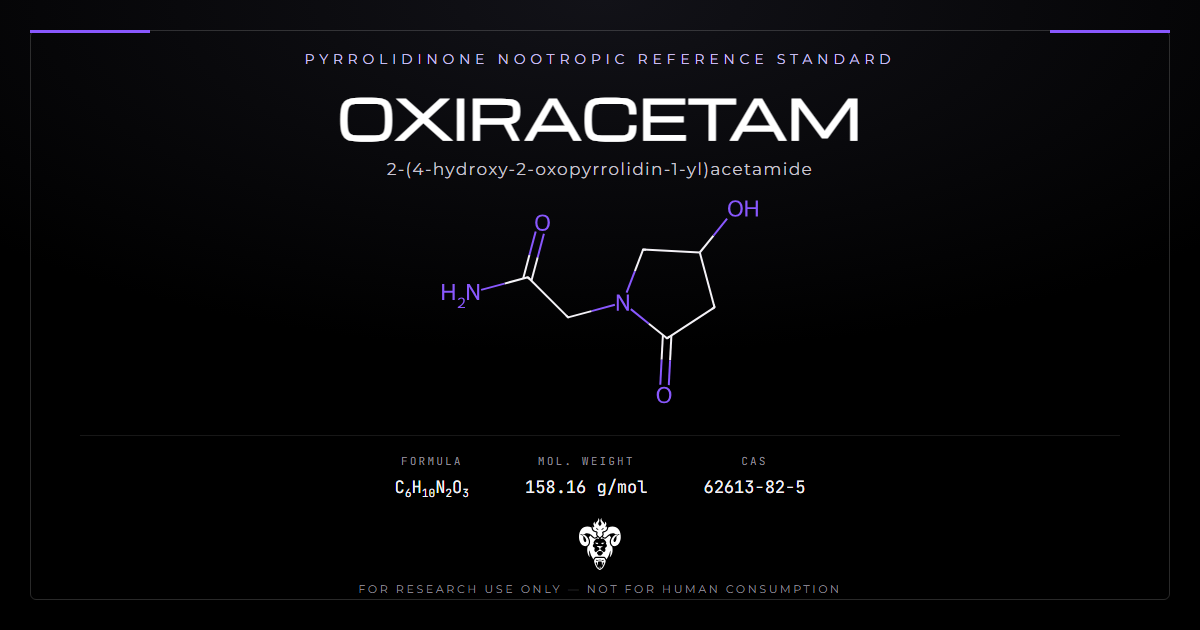
Oxiracetam is a 4-hydroxy derivative of piracetam and one of the most studied members of the pyrrolidinone nootropic class. Laboratories source it as a reference standard for cholinergic and glutamatergic assay work, for comparative studies across the racetam series, and for method development in chiral chromatography. That last application deserves attention first. It turns on a property the compound’s own certificate of analysis usually cannot report.
The material sold as oxiracetam is a racemate. A 2017 study in rats identified the (S) enantiomer as the component carrying activity in a chronic cerebral hypoperfusion model, with the (R) enantiomer inactive on the same endpoints [1]. A standard purity assay does not resolve the two. Everything below treats that gap as the organising question.
All information here describes laboratory research findings. This material is supplied for research use only and is not for human or veterinary use.
What oxiracetam is
Oxiracetam belongs to the pyrrolidinone family that grew out of piracetam in the 1970s. Its structural difference from the parent is a single hydroxyl at the 4-position of the pyrrolidinone ring. That hydroxyl introduces a stereocentre the parent does not have, and that one atom is the source of the analytical complexity discussed below.
Identity and physical data
| Property | Value |
|---|---|
| Compound | Oxiracetam |
| PubChem CID | 4626 |
| Molecular formula | C6H10N2O3 |
| Molecular weight | 158.16 g/mol |
| InChIKey (racemate) | IHLAQQPQKRMGSS-UHFFFAOYSA-N |
| InChIKey ((S) enantiomer) | IHLAQQPQKRMGSS-BYPYZUCNSA-N |
| Chemical class | Pyrrolidinone, 4-hydroxy piracetam analogue |
| Stereocentres | One, at ring position 4 |
| Physical form | White crystalline solid |
Reading the two InChIKeys
Both keys open with the same block, IHLAQQPQKRMGSS. That block encodes the molecular skeleton, so a racemate and a single enantiomer share it. Only the second block differs, and stereochemistry lives in that second block. A record ending UHFFFAOYSA carries no defined stereochemistry. For a racemate that is the correct representation rather than an error in the record.
One practical consequence follows. Both species carry formula C6H10N2O3 and a mass near 158.16, so mass spectrometry cannot separate them. Nuclear magnetic resonance in an achiral solvent cannot either. Telling them apart needs a method that is itself chiral. The PubChem record for the (S) enantiomer carries its own CID and its own stereo-defined key.
The racemate problem
Investigators at Peking University addressed the question directly in 2017 [1]. Working in rats subjected to chronic cerebral hypoperfusion, they compared the racemate against each isolated enantiomer. The (S) form reduced neuron damage and white matter lesions. It also raised cerebral blood flow and suppressed astrocyte activation. The (R) form did none of these things.
What the 2017 study established
That team used MALDI mass spectrometry imaging alongside LC-MS/MS to track metabolic changes (DOI). They reported effects on ATP metabolism, on the glutamine and glutamate pool, and on antioxidant markers in cortex [1]. Their conclusion was that the (S) enantiomer alone accounts for the activity of racemic oxiracetam in this model.
What it did not establish
Two limits deserve stating plainly. This finding rests on one model in one species, so read-across to other endpoints does not follow. Nor does the study show that the (R) enantiomer is inert in every assay. It shows only that (R) failed to produce the measured effects here. Anyone designing a comparative experiment should treat the inactive enantiomer as untested elsewhere rather than as established ballast.
Toxicokinetics separate the two as well
A 2019 dog study compared racemic oxiracetam against the isolated (S) form across acute and 13-week repeated oral dosing [2]. At matched doses the (S) form showed a lower clearance rate and a longer elimination half-life. Time to peak concentration ran later, and apparent volume of distribution ran higher. Those authors proposed a no-observed-adverse-effect level of 100 mg/kg.
That result matters beyond toxicology. If two enantiomers differ in disposition, then a batch of unknown enantiomeric ratio is not pharmacokinetically interchangeable with another batch of a different ratio. Identical stated purity does not close that gap.
Mechanism of action
No consensus mechanism exists for oxiracetam, or for the racetam class generally. A 1994 review covering 407 references found no measurable affinity across a wide receptor panel for the class (DOI). Adrenergic, muscarinic, serotonergic, dopaminergic, adenosine A1, mu-opioid, GABA, benzodiazepine and glutamate receptors all came back negative, with nefiracetam’s GABA-A binding the single exception [3]. A 2010 review reached the same position and described the modes of action as unresolved [4].
The cholinergic evidence
The strongest mechanistic thread runs through acetylcholine. In rats, oxiracetam reduced scopolamine-induced amnesia. It also attenuated the associated acetylcholine decrease in cortex and hippocampus, though not in striatum [5]. A review of the class attributes this pattern to stimulation of high-affinity choline uptake rather than to direct receptor binding [6].
The dose relationship is not monotonic
Dose behaviour in that work complicates any simple potency reading. Doses of 50 and 100 mg/kg produced the effect. Both lower and higher doses did not [5]. A bell-shaped curve of this kind means a single-dose comparison can rank two compounds in either order depending on where each sits on its own curve. Comparative protocols need a dose range, not a dose.
The glutamatergic thread
A separate line implicates excitatory amino acid signalling. Pretreatment antagonised the passive avoidance disruption caused by AP-5, a selective NMDA receptor antagonist, across a 50 to 500 mg/kg range in rats [7]. The 1994 class review proposes modulated ion flux as a unifying account [3]. That account covers sodium influx through AMPA-gated channels and calcium influx through non-L-type voltage-dependent channels.
Why no receptor has been found
Absence of binding across a broad panel is itself informative. It argues against the compound acting as a conventional agonist or antagonist at any of the sites tested. Modulation of ion flux through channels already opened by other transmitters fits the negative binding data better than direct occupancy. That hypothesis remains unproven after three decades.
Brain penetration
Radiolabelled oxiracetam given to rats reached brain tissue unmetabolised [8]. Recovery was largest in septum, then hippocampus, then cortex and striatum. Delivered directly into the lateral ventricles at amounts matching those reaching brain after systemic dosing, it antagonised scopolamine-induced amnesia in a dose-dependent way. That distribution pattern held regardless of administration route, which argues the tropism belongs to the molecule rather than to how it arrives.
Preclinical findings by model
Findings below stay bound to the model that produced them. None transfers to another species or endpoint without separate evidence.
Cholinergic challenge models
Beyond the scopolamine work, oxiracetam prevented mecamylamine-induced impairment of active avoidance learning in mice [9]. Passive avoidance impairment went unchanged in the same animals. Dissociation between two paradigms is the informative part here, since it argues against a blanket effect on performance or motivation.
Hypoperfusion and ischaemia models
In rats with chronic cerebral hypoperfusion, treatment reduced cognitive impairment on spatial endpoints [10]. A 2021 mouse study reported neuroprotective effects under hypoxia-ischaemia and attributed them to regulation of microglial activity [11]. Both sit in the same vascular family as the 2017 enantiomer work, which is worth noting when weighing how independent these results are from one another.
Altitude exposure
A 2017 study examined cognitive injury at high altitude, comparing oxiracetam against fastigial nucleus stimulation [12]. That model stands apart from the vascular series and has not been replicated widely. Treat it as a single result rather than as a line of evidence.
Indexed papers and what they are not
Indexed clinical papers on Oxiracetam exist [13][14] and [15]. Human endpoints from those papers sit outside this profile.
What those papers are
One multicentre placebo-controlled paper from 1992 sits in the dementia file (DOI) [13]. The 1989 paper examined mixed diagnostic labels [14]. The 2023 protocol describes a later vascular-cognitive programme [15]. Malykh and Sadaie recorded that the compound had left use in the territories they surveyed [4].
Use those papers as a map. Do not quote scale scores, enrolment counts, or a regulatory position as a use story.
What this profile will not do
It will not treat an old quality-of-life difference as a laboratory result. It will not treat a protocol as a finding. The kinetic pair in the next section is the only human figure this page keeps [16][17].
Pharmacokinetics in published human studies
Disposition data for oxiracetam are old but clean. They come from small kinetic papers rather than from large programmes. The milligram ladders in those papers stay out. The half-life, bioavailability and urine-recovery figures stay in [16][17].
Single-dose kinetic pair
Absolute oral bioavailability came to 75 plus or minus 7 percent after matched intravenous and oral legs [16]. More than 90 percent of an intravenous amount appeared unchanged in urine within 48 hours. Roughly half an oral amount appeared within 6 hours. Mean residence times ran 3.9 to 6.5 hours. Human milligram figures from that paper sit outside this profile.
Repeat-dose kinetic pair in older subjects
Peak serum concentrations reached 25 plus or minus 6 micrograms per millilitre within 1 to 3 hours [17]. Half-life ran 3 to 6 hours, and 84 percent came back unchanged in urine within 24 hours. No accumulation appeared across a week. Those authors attributed lower clearance against younger subjects to the expected decline in renal function with age. Human milligram figures from that paper sit outside this profile.
What both studies agree on
Renal elimination of unchanged compound is the consistent finding. That makes renal function the dominant variable in disposition. Any comparative protocol using animals of differing age or renal status should account for it directly rather than assume equivalent exposure.
Physicochemical properties and handling
| Parameter | Detail |
|---|---|
| Solubility | Freely soluble in water; sparingly soluble in ethanol |
| Storage | Sealed, dry, protected from light |
| Stability | Stable as a dry solid at ambient conditions |
| Hygroscopicity | Takes up moisture on prolonged air exposure |
Store the solid sealed, dry and protected from light. Storage guidance is a house recommendation. Analytical documentation is per-lot release testing.
Prepare aqueous solutions fresh for quantitative work. The hydroxyl group makes oxiracetam more polar than piracetam. That shortens retention on reversed-phase columns and is worth accounting for during method transfer between the two. A method written for the parent will dump this analogue near the void unless the aqueous fraction goes up.
Weighing and moisture
Hygroscopicity is the practical handling issue. A solid that has taken up atmospheric moisture weighs more than the compound it contains, so a gravimetric preparation from an exposed container reads high on mass and low on concentration. Equilibrate containers to room temperature before opening them, since condensation on cold material compounds the same error. For work where concentration accuracy governs the result, a Karl Fischer determination of water content converts a nominal mass into a corrected one.
Method transfer from piracetam assays
Laboratories running an existing piracetam method often adapt it rather than develop a new one. The polarity difference is the variable that matters. Expect earlier elution and reduced retention on a C18 column under identical mobile phase conditions, which can push the peak toward the void volume and compromise integration. Increasing the aqueous fraction, or moving to a polar-embedded or HILIC stationary phase, restores usable retention. Confirm peak purity after any such change rather than assuming the transfer carried cleanly.
Analytical characterization and chiral purity
This section returns to the opening problem. A routine purity determination by reversed-phase high performance liquid chromatography answers one question: how much non-oxiracetam material is present. It does not answer what proportion of the oxiracetam is (S).
Why a standard assay cannot see it
Enantiomers share identical physical properties in an achiral environment. Same mass, same reversed-phase retention, same ultraviolet spectrum. Separating them requires a chiral stationary phase, which creates transient diastereomeric interactions that do differ between the two forms.
A 1991 study modelled exactly this (DOI). Its authors used a cellulose-based chiral stationary phase to resolve the enantiomers of three related lactams and explained the differences in their chromatographic behaviour [18]. That method exists and has existed for three decades. It is simply not what a general purity assay runs.
What to specify when it matters
For work where enantiomer ratio is a variable rather than a constant, specify chiral purity explicitly and request the supporting chromatogram. A certificate reporting 99 percent purity by an achiral method is consistent with any enantiomeric ratio at all. That includes a ratio differing between two batches from one supplier. Batch documentation for catalogue material sits in the certificate of analysis database.
Identity confirmation
For identity rather than chiral composition, the usual combination applies. Mass spectrometry against the expected 158.16, proton and carbon NMR against published assignments, and infrared for functional group confirmation. None of these resolves stereochemistry. No combination of them substitutes for a chiral method.
Oxiracetam among the other racetams
Comparison across the series is the most common laboratory use of oxiracetam, and the structural progression is straightforward. Piracetam is the unsubstituted parent. Aniracetam carries an anisoyl group and is markedly more lipophilic. Pramiracetam carries a bulky diisopropylaminoethyl chain. Nefiracetam is the one class member with measurable GABA-A affinity [3].
Where the stereochemistry sits in that series
Among these, only the 4-hydroxy compound presents a stereocentre in the ring. That is why the racemate question attaches to oxiracetam and not to the parent. Fasoracetam, a later entrant, is supplied as a single defined enantiomer rather than as a racemate, so the analytical question there takes a different shape.
A caution on read-across
That 1994 review found the class shares low toxicity and a common failure to bind the receptors tested [3]. Yet members differ in potency, in lipophilicity, and in the case of nefiracetam, in receptor pharmacology. Class membership predicts scaffold, not behaviour. Further reading across the class sits in the nootropics research library, and the reference standard itself ships against batch documentation.
Open questions and how to read this literature
Anyone planning work with oxiracetam benefits from knowing where the evidence is thin before designing around it. Four gaps stand out.
The enantiomer question is one study deep
A single 2017 paper carries the claim that (S) is the active form [1]. One 2019 toxicokinetic study supports a difference between the forms on disposition rather than on activity [2]. No independent group has repeated the activity comparison in a second model. That is a strong result resting on a narrow base, and treating it as settled overstates what two papers can carry.
The mechanism rests on negative results
Most of what the field knows about this class is what it does not do. Two reviews report an absence of binding across a broad receptor panel [3][4]. Absence of binding narrows the hypothesis space without identifying a target. The ion-flux account remains the leading proposal and remains unconfirmed after thirty years, which is a long time for a compound with this much literature behind it.
The indexed human papers are old, small, and geographically split
Both older papers date from the late 1980s and early 1990s [13][14]. A later protocol sits in a different territory [15]. A reader comparing those files is comparing different diagnostic criteria and different endpoints. Those comparisons need stating rather than assuming. This profile does not quote their outcomes.
Model overlap inflates apparent replication
Three of the rodent results share a vascular insult design: chronic cerebral hypoperfusion, hypoxia-ischaemia, and the hypoperfusion model used for the enantiomer comparison [1][10] and [11]. Agreement between them is weaker evidence than three agreeing results in three unrelated models. Counting papers overstates independence when the designs converge.
What would settle the open questions
An independent replication of the enantiomer comparison in a non-vascular model would do the most work. A binding or functional screen identifying any positive target would do more. Neither has appeared, and until one does, oxiracetam remains a compound with a large descriptive literature and no confirmed mechanism.
Frequently asked questions
Is oxiracetam supplied as a single enantiomer?
Catalogue material is the racemate, which is the form used in nearly all published work. Single-enantiomer material is a separate specification and requires a chiral method to verify.
Does a purity certificate report enantiomeric ratio?
Not unless it names a chiral method. Purity by reversed-phase HPLC quantifies chemical impurities and stays blind to the ratio of (S) to (R) [18].
Which enantiomer carries the activity?
In the one model where anyone tested the question directly, the (S) form produced the measured effects and the (R) form did not [1]. That finding is specific to chronic cerebral hypoperfusion in rats.
What is the established mechanism?
None is established. Evidence points toward cholinergic and glutamatergic modulation without direct receptor binding, and two major reviews describe the question as open [3][4].
How does oxiracetam differ structurally from piracetam?
By a single hydroxyl group at the 4-position of the pyrrolidinone ring. That addition raises polarity and introduces the stereocentre [3].
Does this page report human outcomes?
No. Indexed papers are listed so they can be found [13][14] and [15]. This profile keeps the cited kinetic pair [16][17] and stops at chemistry, enantiomer logic and animal systems.
References
- Li W, Liu H, Jiang H, et al. (S)-Oxiracetam is the Active Ingredient in Oxiracetam that Alleviates the Cognitive Impairment Induced by Chronic Cerebral Hypoperfusion in Rats. Sci Rep. 2017;7(1):10052. PubMed DOI
- Liu TT, Guo XM, Rong ZY, et al. Comparative toxicity and toxicokinetic studies of oxiracetam and (S)-oxiracetam in dogs. Xenobiotica. 2019;49(9):1054-1062. PubMed DOI
- Gouliaev AH, Senning A. Piracetam and other structurally related nootropics. Brain Res Brain Res Rev. 1994;19(2):180-222. PubMed DOI
- Malykh AG, Sadaie MR. Piracetam and piracetam-like drugs: from basic science to novel clinical applications to CNS disorders. Drugs. 2010;70(3):287-312. PubMed DOI
- Spignoli G, Pepeu G. Interactions between oxiracetam, aniracetam and scopolamine on behavior and brain acetylcholine. Pharmacol Biochem Behav. 1987;27(3):491-5. PubMed DOI
- Pepeu G, Spignoli G. Nootropic drugs and brain cholinergic mechanisms. Prog Neuropsychopharmacol Biol Psychiatry. 1989;13 Suppl:S77-88. PubMed DOI
- Paoli F, Spignoli G, Pepeu G. Oxiracetam and D-pyroglutamic acid antagonize a disruption of passive avoidance behaviour induced by the N-methyl-D-aspartate receptor antagonist 2-amino-5-phosphonovalerate. Psychopharmacology (Berl). 1990;100(1):130-1. PubMed DOI
- Ponzio F, Pozzi O, Banfi S, Dorigotti L. Brain entry and direct central pharmacological effects of the nootropic drug oxiracetam. Pharmacopsychiatry. 1989;22 Suppl 2:111-5. PubMed DOI
- Oxiracetam prevents mecamylamine-induced impairment of active, but not passive, avoidance learning in mice. Pharmacol Biochem Behav. 1990;36(2):427-30. PubMed DOI
- Oxiracetam can improve cognitive impairment after chronic cerebral hypoperfusion in rats. Psychiatry Res. 2016;244:374-379. PubMed DOI
- Oxiracetam Mediates Neuroprotection Through the Regulation of Microglia Under Hypoxia-Ischemia. Mol Neurobiol. 2021;58(10):5289-5304. PubMed DOI
- Oxiracetam or fastigial nucleus stimulation reduces cognitive injury at high altitude. Brain Behav. 2017;7(9):e00762. PubMed DOI
- Oxiracetam in dementia: a double-blind, placebo-controlled study. Acta Neurol Scand. 1992;86(3):237-41. PubMed DOI
- Oxiracetam in the treatment of multi-infarct dementia and primary degenerative dementia. J Neuropsychiatry Clin Neurosci. 1989;1(3):249-55. PubMed DOI
- Efficacy and safety of oxiracetam in patients with vascular cognitive impairment: A multicenter randomized trial. Contemp Clin Trials. 2023;128:107108. PubMed DOI
- Perucca E, Albrici A, Gatti G, et al. Pharmacokinetics of oxiracetam following intravenous and oral administration in healthy volunteers. Eur J Drug Metab Pharmacokinet. 1984;9(3):267-74. PubMed DOI
- Perucca E, Parini J, Albrici A, et al. Oxiracetam pharmacokinetics following single and multiple dose administration in the elderly. Eur J Drug Metab Pharmacokinet. 1987;12(2):145-8. PubMed DOI
- Camilleri P, Murphy JA, Saunders MR, Thorpe CJ. Molecular modelling studies and the chromatographic behaviour of oxiracetam and some closely related molecules. J Comput Aided Mol Des. 1991;5(4):277-84. PubMed DOI