
Everything below reports findings from cell cultures, isolated tissue and animals. This material is for research use only, not for human or veterinary use.
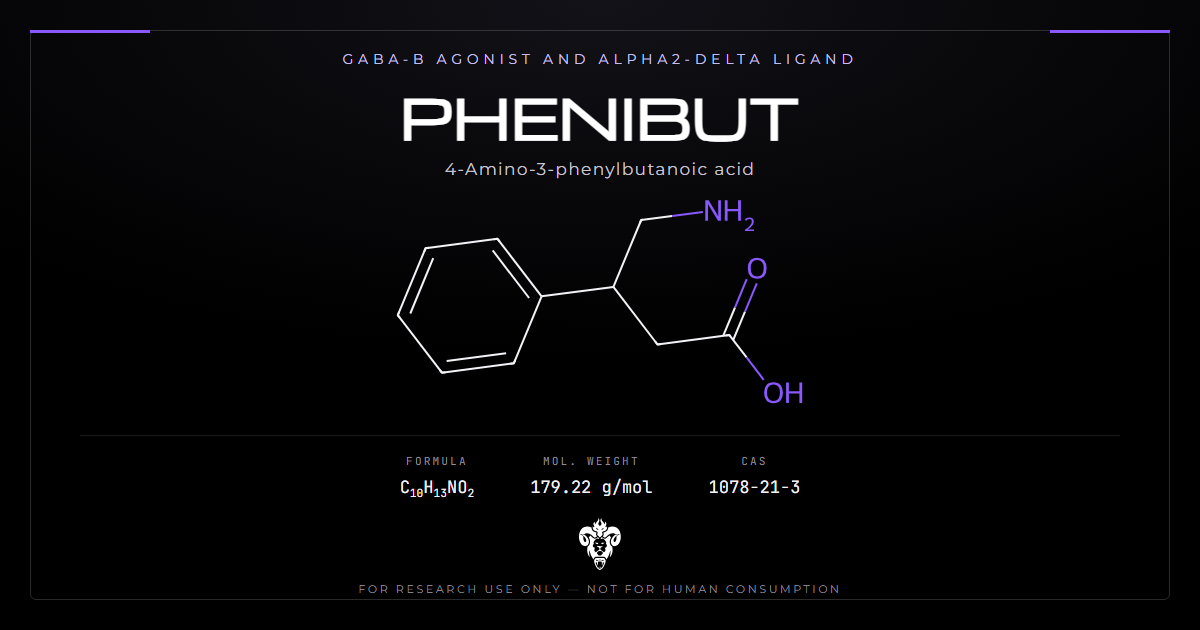
One chlorine atom separates Phenibut from baclofen. Baclofen is beta-(4-chlorophenyl)-GABA. Phenibut is the same chain with a plain phenyl ring.
That single substitution moves potency by two orders of magnitude. Irie compared both in a patch-clamp study on mouse Purkinje cells (PMID 32735986). Baclofen gave an EC50 of 6.0 uM. Phenibut needed 1,362 uM at the same GABA-B readout [7].
Every laboratory question about Phenibut starts from that gap. A weak agonist at the named receptor still binds a second target. The racemate then splits those two pharmacologies across two enantiomers [2]. Indexed clinical and case papers exist. Those human endpoints sit outside this profile.
Chemical identity
Phenibut is gamma-aminobutyric acid with a phenyl ring on the beta carbon. Lots arrive as the hydrochloride salt or as a free-base powder.
| Property | Value |
|---|---|
| Systematic name | 4-amino-3-phenylbutanoic acid |
| Common names | Phenibut, beta-phenyl-GABA, Noofen, Anvifen |
| Molecular formula | C10H13NO2 |
| Molecular weight | 179.22 g/mol |
| Monoisotopic mass | 179.0946 Da |
| CAS number | 1078-21-3 |
| PubChem CID | 14113 |
| InChIKey | DAFOCGYVTAOKAJ-UHFFFAOYSA-N |
| Stereocentres | 1, at C3 |
| Marketed form | Racemate |
| Baclofen relation | 4-chloro analogue, CID 2284 |
| Primary targets | GABA-B receptor, alpha2-delta subunit |
| Hydrogen-bond donors | 2 (PubChem computed) |
| Hydrogen-bond acceptors | 3 (PubChem computed) |
| Rotatable bonds | 4 (PubChem computed) |
| XLogP3 | -1.6 (PubChem computed) |
Reading the structure
Three features do the work, and none of them is complicated.
The amine and the carboxylate reproduce GABA itself. The phenyl ring on the beta carbon adds lipophilicity. That ring lets Phenibut cross the blood-brain barrier. Unmodified GABA does not cross it in useful amounts.
That ring also creates a stereocentre at C3. Baclofen carries the same centre. Baclofen then adds a chlorine on the para position of the ring. That halogen is the whole difference in GABA-B potency.
PubChem lists Phenibut as CID 14113 with InChIKey DAFOCGYVTAOKAJ-UHFFFAOYSA-N. The SMILES string is C1=CC=C(C=C1)C(CC(=O)O)CN. A certificate that quotes a different formula or a different key names a different lot.
This zwitterion sits across much of the physiological pH range. A free amino acid therefore carries both a protonated amine and a deprotonated carboxylate in water. Adding the hydrochloride salt introduces a chloride counterion and changes the mass of a weighed vial by about one fifth.
The racemate question
Every racemic lot holds two enantiomers, and they do not share a target profile.
The R enantiomer carries the GABA-B activity. The S enantiomer does not bind that receptor at all [2]. Commercial lots arrive as the racemate. Half of any given mass is therefore an enantiomer with no activity at the receptor the name points to.
The picture changes at the second target. Both enantiomers bind the alpha2-delta subunit, at 23 uM and 39 uM respectively [2]. The racemate is a mixture of one dual-target compound and one single-target compound. A methods section that writes “Phenibut” without naming the enantiomer has not named the reagent.
The chlorine that separates it from baclofen
Structure-activity work on this series goes back to the original Russian programme. The position of the ring substituent mattered from the start [1].
The functional comparison
Irie and colleagues ran the cleanest available comparison [7]. They recorded outward potassium currents in mouse cerebellar Purkinje cells. They then measured the concentration each agonist needed.
Baclofen came in at 6.0 uM. The para-fluoro analogue came in at 23.3 uM. Phenibut needed 1,362 uM to produce the same current [7].
That is a 227-fold gap against baclofen in one assay, in one cell type. Binding studies and behavioural work put the difference in the same range rather than contradicting it [1][2].
A matched readout matters here. Comparing a baclofen Ki from one lab with a Phenibut EC50 from another lab does not give the same number. Irie held the cell, the current, and the method constant. That is why the 227-fold figure is the one to quote.
The fluoro analogue and the halogen series
The halogen on the para position is not a decoration. Fluorine sits between hydrogen and chlorine on this ring. The functional rank follows that order: baclofen, then the fluoro analogue, then Phenibut [7].
The fluoro analogue is a different reagent with a different mass. Nuclear magnetic resonance separates the three at once. Baclofen shows a para-substituted ring pattern. Phenibut shows a monosubstituted ring. The fluoro analogue shows a third coupling pattern and a third molecular ion.
Do not treat an analogue label as a Phenibut lot. The catalogue name is not the mass. The mass is not the halogen. Write the structure on the notebook line before the assay starts.
| Compound | Ring substituent | GABA-B EC50, Purkinje cells [7] |
|---|---|---|
| Baclofen | para-chloro | 6.0 uM |
| Fluoro analogue | para-fluoro | 23.3 uM |
| Phenibut | none | 1,362 uM |
| GABA | no phenyl ring | does not cross the barrier in useful amounts |
The second target
GABA-B agonism is the label Phenibut wears. It is not the only thing the molecule does. On the analgesia endpoint it may not be the relevant thing.
Binding at the alpha2-delta subunit
Zvejniece and colleagues measured binding to the alpha2-delta subunit of voltage-dependent calcium channels (PMID 26234470). They used radiolabelled gabapentin as the probe [2].
| Compound | Ki at alpha2-delta |
|---|---|
| Gabapentin | 0.05 uM |
| R enantiomer | 23 uM |
| S enantiomer | 39 uM |
| Baclofen | 156 uM |
The R enantiomer binds that subunit about four times more tightly than it binds the GABA-B receptor [2]. It also outperforms baclofen there by roughly sevenfold. That ranking inverts the GABA-B comparison from the Purkinje-cell assay.
Set that against gabapentin and the picture stays consistent. Phenibut is a weak ligand at both targets. It sits roughly 460-fold behind gabapentin at the site where it does better.
These Ki values are displacement numbers, not use numbers. They tell you which protein a lot can occupy. They do not transfer a gabapentin protocol onto a Phenibut vial.
Which effects belong to which target
The same paper separated the two pharmacologies experimentally. That split is rare in this literature.
The R enantiomer reduced nociceptive responses in the formalin paw-licking test. It also relieved allodynia after chronic constriction injury of the sciatic nerve [2]. The GABA-B antagonist CGP35348 did not block the formalin effect.
An antagonist at the receptor failing to block the response places that response elsewhere. The authors assigned the antinociception to the calcium channel subunit rather than to GABA-B [2].
A second finding limits the read-across further. At doses up to 100 mg/kg, the R enantiomer did nothing to pentylenetetrazole-induced seizures [2]. The anticonvulsant profile does not follow the anxiolytic one that older reviews describe [1].
Write both targets on the assay plan. A GABA-B antagonist control tells you which arm moved. A study that reports one arm without the other cannot assign the effect.
Animal findings
The modern mechanistic papers used isolated enantiomers and named animal systems. Those systems do not stand in for each other.
Antinociception after nerve injury
Zvejniece ran the formalin test and a chronic constriction model in rodents [2]. The R enantiomer moved both readouts. The S enantiomer binds alpha2-delta more weakly, at 39 uM against 23 uM. Authors treat that gap as a reason to test the R enantiomer on pain assays rather than the racemate.
CGP35348 is the control that makes the assignment. If a GABA-B antagonist leaves the formalin effect intact, GABA-B is not the required receptor for that endpoint [2]. Copy that control if the question is “which protein did this lot hit.”
Chronic constriction injury is a neuropathic model. Formalin is an inflammatory nociception model. A result in one does not license a claim about the other. Name the model in the first line of the notebook entry.
Traumatic brain injury and brain levels
Kupats and colleagues dosed the R enantiomer after lateral fluid percussion injury in male Swiss-Webster mice (PMID 33274011) [8].
That enantiomer at 50 mg/kg reached brain tissue within 15 minutes. Peak levels were 0.6 ug/g after intraperitoneal injection and 0.2 ug/g after oral dosing [8]. Those two numbers are the existing pharmacokinetic record for this enantiomer in a mammal. No published human pharmacokinetic study describes absorption, half-life, or clearance.
The same group then injected 10 or 50 mg/kg intraperitoneally two hours after injury, then once daily for seven days. The 50 mg/kg schedule improved functional scores on days 1, 4, and 7. It also cut Nissl-stained dark neurons and interleukin-1beta in the cortical impact zone [8].
In vitro, both enantiomers at 0.5 ug/ml slowed calcium-induced mitochondrial swelling in brain homogenate. Both enantiomers also limited the rise in mitochondrial hydrogen peroxide after anoxia and reoxygenation [8]. That mitochondrial readout does not require GABA-B. Both enantiomers moved it.
A fluid-percussion mouse is not a cell assay. A 50 mg/kg intraperitoneal schedule is not an oral milligram in a dish. Keep the route on the same line as the dose.
Seizure models that did not move
The same laboratory that assigned antinociception to alpha2-delta also ran a pentylenetetrazole challenge [2]. The R enantiomer at up to 100 mg/kg left those seizures untouched.
That negative result is useful. It stops a reader from treating every GABA-B agonist as an anticonvulsant reagent. Phenibut and baclofen share a receptor and do not share every behavioural output. The chlorine gap already said that at the current. The seizure model says it again at the animal.
Lapin’s older review still lists a wide behavioural set [1]. Read those claims against the papers that named the enantiomer and the antagonist. The 2015 and 2020 Latvian papers are the ones that split the targets [2][8].
Where the compound came from
Workers in the Soviet Union synthesised the molecule in the 1960s [1]. That history is why the evidence base looks unlike a Western development file.
Lapin’s 2001 review is the standard English-language account (PMID 11830761) [1]. It describes action mainly at GABA-B, with some GABA-A involvement. Dopamine receptor stimulation and antagonism of beta-phenethylamine also appear in that review. Those extra arms have not been rebuilt with the antagonist logic that Zvejniece used for alpha2-delta.
Gurley and Koturbash restated the same chronology in 2024 [16]. A compound from a military research programme later appeared in Western catalogues under a supplement-style name. Jouney had already called that framing inaccurate, given a pharmacological profile closer to a prescription sedative [4].
The naming fight is a laboratory problem as much as a market problem. A certificate that files Phenibut under a food-additive heading still has to report intact mass, salt form, and enantiomer ratio. The heading does not change the receptor.
Limits of the published record
Four gaps sit between the published record and the claims that circulate around Phenibut.
What the indexed human papers are
Kupats and colleagues systematically reviewed trial reports [6]. Separate groups later pooled toxicity and withdrawal case series [11][12] and [17]. Poison-centre and forensic papers add exposure counts [5][9], [15][19] and [20]. Mixed-methods reviews of online reports sit in the same file [3][14].
Those human endpoints are outside the scope of this profile. The papers remain cited so a reader can find them. This page does not quote human gram figures, human adverse-event rates, or substitution schedules.
Which enantiomer was in the vial
Most of the modern mechanistic work used the R enantiomer [2][8]. Commercial lots are racemic. A result on the isolated enantiomer describes half of a racemic lot by mass, and more than half of the GABA-B activity.
Which target was credited
GABA-B and alpha2-delta give different answers on the same structure [2][7]. Antinociception survived GABA-B blockade. Seizure readouts did not move. A paper that reports “a GABA-B effect” without an antagonist control has not finished the assignment.
What this profile will not do
It will not compare Phenibut with baclofen as treatments. It will not turn a case series into a use document. Structure, binding, animal systems, and analytical identity are the usable content.
Detection and forensic data
Analytical coverage lags the exposure papers, which the 2024 review notes as a recurring theme [16].
LC-MS/MS methods
Dziadosz and colleagues built an LC-MS/MS screen and quantification method (PMID 38146811) [15]. They then applied it to driving cases. Published limits of detection sit near 0.002 ug/mL in blood. The method is the transferable object. The driving-case narrative is not.
A 2021 report documented Phenibut in blood and urine at autopsy after routine toxicology had been unremarkable [9]. The finding required a purpose-built assay. If a laboratory wants this compound in a screen, it must add it. A standard panel does not imply a negative.
Wastewater methods have now reached it as well. Two Brazilian plants were sampled during a festival week and a reference week [19]. That paper is an environmental analytical result. It is not a laboratory identity certificate.
Single-patient plasma measurements exist, including one reporting Phenibut and mitragynine together [20]. Isolated values of that kind describe one sample rather than a population pharmacokinetic curve.
What a certificate still has to answer
Two analytical studies looked at labelled powders and capsules. Cohen and colleagues measured four brands before and after a regulator warning [10]. Servings spanned 21 to 1,164 mg. Upmanis and colleagues bought six Phenibut-containing samples from three suppliers and ran HPLC with mass spectrometry [18]. Three of the six held substantially less than the label. One held more. Every capsule also carried undeclared supplement-trade ingredients [18].
Those papers are about content versus label. They are the reason a research lot needs a certificate rather than a name on a pouch. They are not a shopping guide.
How to read a Phenibut study
Four questions decide whether a given result transfers.
Racemate or single enantiomer?
Most of the modern mechanistic work used the R enantiomer specifically [2][8]. Commercial lots are racemic. A result on the isolated enantiomer does not describe the S half.
Ask for a chiral assay if the paper claims “Phenibut” and then quotes a GABA-B EC50. Only the R enantiomer should produce that current [2][7].
Which target was tested?
GABA-B and alpha2-delta give different answers on the same compound [2][7]. A study that reports one without controlling for the other cannot assign its effect.
CGP35348 is the published GABA-B check [2]. Gabapentin displacement is the published alpha2-delta check [2]. Run both if the claim is dual pharmacology.
What dose, and by what route?
Rodent studies dosing intraperitoneally at 50 mg/kg are not modelling an oral milligram in a dish [8]. Brain levels after oral dosing were one third of the intraperitoneal peak in the same paper. Route is part of the identity of the result.
Cell EC50 values sit in the high-micromolar range for Phenibut at GABA-B [7]. Animal milligram-per-kilogram figures sit on a different scale. Do not convert one into the other without a measured brain level.
Where did the material come from?
Analytical studies found label content wrong in both directions [10][18]. A methods line that says “commercial source” without a mass or a chiral ratio has not identified the reagent.
Forensic and environmental papers show that purpose-built methods detect the compound when standard panels do not [9][15] and [19]. That is an argument for adding Phenibut to the assay list. It is not a claim about any one vial.
Verifying research material
A small, cheap, achiral-by-default amino acid derivative has a specific set of analytical questions. None of them is exotic.
Identity
Mass spectrometry resolves 179.22 g/mol without difficulty, and the compound ionises well. Published LC-MS/MS methods reach detection limits near 0.002 ug/mL in blood [15].
Nuclear magnetic resonance separates Phenibut from baclofen immediately. The chlorinated analogue shows a para-substituted ring pattern rather than a monosubstituted one. It also carries a different molecular ion near 213.66 g/mol.
The hydrochloride salt and the free base differ in mass by roughly 20%. Material sold by weight should state which form the certificate reports. The difference lands directly in any concentration calculation.
PubChem CID 14113 and InChIKey DAFOCGYVTAOKAJ-UHFFFAOYSA-N close the record. A lot that fails those checks is not Phenibut, whatever the pouch says.
Purity and enantiomer content
Chromatographic purity says nothing about enantiomer ratio. Here that ratio is a pharmacological variable rather than a technicality.
Chiral separation is the relevant assay. A racemate contains one enantiomer with GABA-B activity and one without [2]. A certificate reporting only achiral HPLC purity leaves the more informative question unanswered.
Residual solvents and synthesis intermediates are the other routine ask. The undeclared ingredients found in commercial capsules [18] are a formulation problem rather than a synthesis one. They still set the standard for what a certificate should exclude.
Peptide-style deletion sequences are not the impurity class here. Phenibut is a small amino acid analogue. Look for residual phenyl-series intermediates, leftover solvents, and the wrong halogenated analogue.
Handling
Store the powder dry and sealed. The free amino acid is hygroscopic enough that ambient moisture will shift a gravimetric measurement.
Storage guidance is a house recommendation. Analytical documentation is per-lot release testing.
Solubility in water is good for the hydrochloride and poorer for the free base. That difference matters when a laboratory prepares stock solutions at defined molarity. Buffer choice should account for the zwitterion.
Weighing is the practical failure point at the concentrations this literature uses. Milligram-scale accuracy is straightforward on a laboratory balance. It is not available from a scooped estimate. The wide ranges in unverified reports start there [12][17].
Kimera publishes third-party certificates of analysis for every lot in its COA database. Laboratories source Phenibut as a GABA-B and gabapentinoid reference compound. It appears alongside Selank and Noopept, which share its Soviet-era research lineage, or with Bromantane where the same evidence-base problem applies. Related work appears in the nootropics category.
Common questions about Phenibut
What is Phenibut chemically? GABA with a phenyl ring on the beta carbon, which is baclofen without its para-chlorine [1].
How does it compare with baclofen at GABA-B? In one patch-clamp assay it needed 1,362 uM against 6.0 uM for baclofen, a 227-fold gap [7].
Is GABA-B its only target? No. The R enantiomer binds the alpha2-delta calcium channel subunit at 23 uM, about four times more tightly than it binds GABA-B [2].
Does the racemate behave as one drug? No. R carries the GABA-B activity. S carries none at that receptor. Both bind alpha2-delta [2].
What animal pharmacokinetic numbers exist? The R enantiomer reached mouse brain within 15 minutes at 50 mg/kg. Peaks were 0.6 ug/g intraperitoneally and 0.2 ug/g orally [8].
Does this page report human outcomes? No. Indexed trial and case papers are listed so they can be found. This profile stops at chemistry, receptor logic, animal systems, and analytical identity.
Summary of the evidence
Write the name, the mass, and the two targets on the first line of a notebook page. Everything else in this profile is a check on those three facts.
Identity: 4-amino-3-phenylbutanoic acid, C10H13NO2, 179.22 g/mol, CAS 1078-21-3. Sold as the racemate, with one stereocentre at C3. PubChem CID 14113 and InChIKey DAFOCGYVTAOKAJ-UHFFFAOYSA-N close the record.
Relation to baclofen: the same molecule without a para-chlorine, and roughly 227-fold weaker at GABA-B in a matched patch-clamp comparison [7]. The fluoro analogue sits between them at 23.3 uM.
Second target: the R enantiomer binds alpha2-delta at 23 uM, against 156 uM for baclofen and 0.05 uM for gabapentin. Its antinociception survives GABA-B blockade [2].
Enantiomers: R carries the GABA-B activity, S carries none, and both bind alpha2-delta [2]. The marketed racemate is therefore two compounds.
Animal record: the R enantiomer at 50 mg/kg reached mouse brain in 15 minutes and improved functional scores after fluid-percussion injury [8]. The same enantiomer at up to 100 mg/kg left pentylenetetrazole seizures untouched [2].
Analytical record: purpose-built LC-MS/MS detects the compound when routine panels do not [9][15]. Label content in uncertified samples ran wide [10][18].
Limits: human efficacy, human gram figures, and human adverse-event rates are out of scope here. Those papers remain in the reference list [13].
Status: supplied for laboratory research use only.
References
- Lapin I. Phenibut (beta-phenyl-GABA): a tranquilizer and nootropic drug. CNS Drug Rev. 2001;7(4):471-481. PMID 11830761. DOI
- Zvejniece L, Vavers E, Svalbe B, Veinberg G, Rizhanova K, Liepins V, Kalvinsh I, Dambrova M. R-phenibut binds to the alpha2-delta subunit of voltage-dependent calcium channels and exerts gabapentin-like anti-nociceptive effects. Pharmacol Biochem Behav. 2015;137:23-29. PMID 26234470. DOI
- Owen DR, Wood DM, Archer JR, Dargan PI. Phenibut (4-amino-3-phenyl-butyric acid): availability, prevalence of use, desired effects and acute toxicity. Drug Alcohol Rev. 2016;35(5):591-596. PMID 26693960. DOI
- Jouney EA. Phenibut (beta-phenyl-gamma-aminobutyric acid): an easily obtainable “dietary supplement” with propensities for physical dependence and addiction. Curr Psychiatry Rep. 2019;21(4):23. PMID 30852710. DOI
- McCabe DJ, Bangh SA, Arens AM, Cole JB. Phenibut exposures and clinical effects reported to a regional poison center. Am J Emerg Med. 2019;37(11):2066-2071. PMID 30878413. DOI
- Kupats E, Vrublevska J, Zvejniece B, Vavers E, Stelfa G, Zvejniece L, Dambrova M. Safety and tolerability of the anxiolytic and nootropic drug phenibut: a systematic review of clinical trials and case reports. Pharmacopsychiatry. 2020;53(5):201-208. PMID 32340063. DOI
- Irie T, Yamazaki D, Kikura-Hanajiri R. F-phenibut (beta-(4-fluorophenyl)-GABA), a potent GABA(B) receptor agonist, activates an outward-rectifying K(+) current and suppresses the generation of action potentials in mouse cerebellar Purkinje cells. Eur J Pharmacol. 2020;884:173437. PMID 32735986. DOI
- Kupats E, Stelfa G, Zvejniece B, Grinberga S, Vavers E, Makrecka-Kuka M, Svalbe B, Zvejniece L, Dambrova M. Mitochondrial-protective effects of R-phenibut after experimental traumatic brain injury. Oxid Med Cell Longev. 2020;2020:9364598. PMID 33274011. DOI
- Arndt C, Gray TR. Phenibut, a GABAB agonist, detected in a fatality. J Anal Toxicol. 2021;bkab099. PMID 34520515. DOI
- Cohen PA, Ellison RR, Travis JC, Gaufberg SV, Gerona R. Quantity of phenibut in dietary supplements before and after FDA warnings. Clin Toxicol (Phila). 2022;60(4):486-488. PMID 34550038. DOI
- Weleff J, Kovacevich A, Burson J, Nero N, Anand A. Clinical presentations and treatment of phenibut toxicity and withdrawal: a systematic literature review. J Addict Med. 2023;17(4):407-417. PMID 37579098. DOI
- Feldman R, Autry B, Dukes J, Lofy T, Marchetti G, Patt A, Batterman N, Theobald J. A systematic review of phenibut withdrawal focusing on complications, therapeutic approaches, and single substance versus polysubstance withdrawal. Clin Toxicol (Phila). 2023;61(11):941-951. PMID 38112312. DOI
- Patt A, Fox H, Wells L, Theobald J, Feldman R. Seizure occurring during baclofen monotherapy for phenibut withdrawal. Clin Neuropharmacol. 2023;46(2):79-81. PMID 36735548. DOI
- Behmer Hansen RA, Behmer Hansen RT, Noureddine C, Behmer VA, Opler D. Reasons for use and experiences of using phenibut, a mixed methods analysis of online reports. Am J Drug Alcohol Abuse. 2023;49(4):458-469. PMID 37184879. DOI
- Dziadosz M, Rosenberger W, Bolte K, Klintschar M, Teske J. Phenibut screening and quantification with liquid chromatography-tandem mass spectrometry and its application to driving cases. J Forensic Sci. 2024;69(2):725-729. PMID 38146811. DOI
- Gurley BJ, Koturbash I. Phenibut: a drug with one too many “buts”. Basic Clin Pharmacol Toxicol. 2024;135(4):409-416. PMID 39197876. DOI
- Stewart C, Simonsen H, Satyasi SK, Ashraf N, Sukpraprut-Braaten S. A systematic review of phenibut withdrawals. Cureus. 2024;16(9):e68775. PMID 39376891. DOI
- Upmanis T, Sevostjanovs E, Zvejniece L, Kazoka H, Kisis V, Pugovics O, Dambrova M. Purchasing “nootropics” online: identification and quantification of ingredients in phenibut-containing products. Medicina (Kaunas). 2024;60(10):1561. PMID 39459348. DOI
- Gomes BRS, de Oliveira AFB, Vieira AM, Nadarajan D, Bade R, Santos JM. Surveillance of phenibut in wastewater during a Brazilian Carnival. Drug Test Anal. 2026;18(2):192-197. PMID 41276941. DOI
- Rianprakaisang TN, Moss MJ, Gerona R, Hendrickson RG. Plasma concentrations of phenibut and mitragynine in a single patient. Clin Toxicol (Phila). 2023;61(7):561-562. PMID 37417309. DOI
Phenibut is sold for laboratory research use only. Not for human consumption, nor medical, veterinary, or household uses.
Literature retrieved from PubMed.