
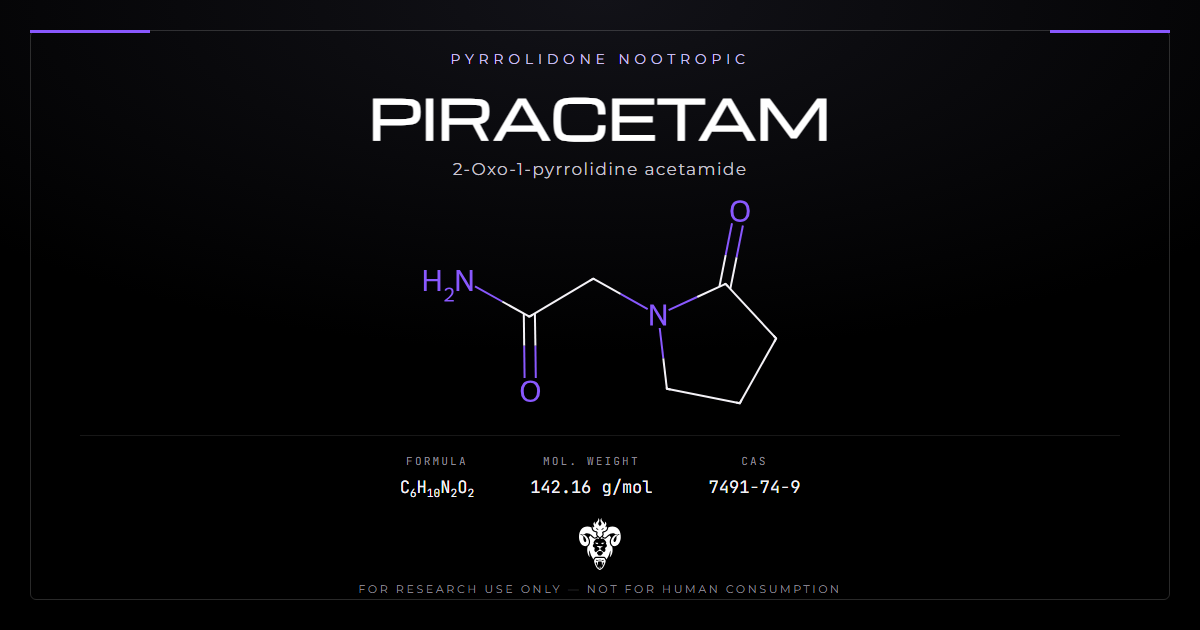
Everything below reports findings from cell cultures, isolated tissue and animals. This material is for research use only, not for human or veterinary use.
The word “nootropic” did not exist before this compound. Corneliu Giurgea coined it in 1972 to describe what he thought he had made [1].
Fifty years later the picture is stranger than the marketing suggests. A Cochrane review of the naming indication exists [10]. Human endpoints from that review sit outside this profile.
Two further facts sit oddly beside the reputation. The pyrrolidone scaffold does have a high-affinity, stereoselective target in the brain, and Piracetam is the member of the family that does not bind it [9]. Indexed later papers on other endpoints exist [3][5] and [7]. Those human milligram figures sit outside this profile.
Chemical identity
A small, very polar cyclic derivative of gamma-aminobutyric acid, and the parent of everything with “racetam” in its name.
| Property | Value |
|---|---|
| Systematic name | 2-(2-oxopyrrolidin-1-yl)acetamide |
| Common names | Piracetam, Nootropil, 2-oxo-1-pyrrolidine acetamide |
| Molecular formula | C6H10N2O2 |
| Molecular weight | 142.16 g/mol |
| Monoisotopic mass | 142.0742 Da |
| CAS number | 7491-74-9 |
| PubChem CID | 4843 |
| InChIKey | GMZVRMREEHBGGF-UHFFFAOYSA-N |
| Calculated logP | -1.3 |
| Stereocentres | 0 |
| Closest structural relative | Levetiracetam, C8H14N2O2, CID 5284583 |
| Stereocentres on that relative | One, S-configured |
Reading the structure
Two rings’ worth of chemistry in a molecule with almost nothing on it.
The core is a 2-pyrrolidinone, a five-membered lactam. An acetamide sits on the ring nitrogen. That is the entire molecule.
Note the logP of -1.3. Piracetam sits about as far from CoQ10 as a small polar solid gets. Absorption is not the constraint here. Water solubility is.
The pyrrolidone family
Every racetam shares the lactam core of Piracetam and differs in what hangs off it.
Aniracetam adds an anisoyl group. Oxiracetam adds a hydroxyl. Pramiracetam replaces the amide with a bulky diisopropylaminoethyl amine. Piracetam itself carries no substituent and no stereocentre.
That last point matters more than it looks. A molecule with no chiral centre cannot have an enantioselective target, and the family’s best-characterised target is enantioselective [9].
Mass is the cheap identity check across that family. Piracetam is 142.16. Oxiracetam is 158.16, one oxygen heavier. Aniracetam is 219.24. Pramiracetam free base is 269.38. Levetiracetam is 170.21. A certificate that quotes 142 and an InChIKey ending UHFFFAOYSA has named this lot. A certificate that quotes 170 has named the SV2A ligand instead. Keep both masses on the same notebook line when the series shares a shelf.
The word was invented for this molecule
Giurgea published the nootropic concept in 1972, in French, in a pharmacology annual [1]. He built the category around Piracetam, rather than assigning Piracetam to an existing category.
Giurgea’s criteria
The definition was a list of properties rather than a mechanism.
A nootropic should enhance learning and memory, and protect learned behaviour against disruption. It should protect the brain against physical or chemical injury and increase the efficacy of cortical control mechanisms. It should also lack the sedation, stimulation and toxicity of conventional psychotropics.
Read the list as a specification written from observations of one drug. Nothing in it names a receptor, a pathway or a measurable target.
What the criteria left out
A definition built from effects rather than mechanism cannot be falsified by pharmacology.
No criterion requires a binding site. None requires a dose-response relationship in a defined system. Nor does any of them separate an effect in an impaired animal from an effect in a healthy one, which turns out to be the distinction that matters most for Piracetam.
That structure is why the term travelled so far. It describes a hoped-for profile, and almost any compound can be claimed to fit it.
The mechanism problem
Sixty years of work has not produced an agreed molecular target, and the leading candidate is a physical property rather than a receptor.
Membrane fluidity
Müller and colleagues developed the best-supported account, and its most interesting feature is a negative result.
Preincubating brain membranes from aged mice with Piracetam at 0.1 to 1.0 mmol/L increased membrane fluidity (PMID 9037245). Aged rat and human brain membranes behaved the same way. Young mouse membranes did not change at all [2].
Chronic dosing reproduced the split. At 300 mg/kg daily, membrane fluidity rose in some brain regions of aged rats and not in young ones, and active avoidance learning improved in the aged animals only [2].
The same group later turned to human tissue. Hippocampal membranes from Alzheimer’s disease patients showed lower hydrocarbon core fluidity than elderly controls, and preincubation with Piracetam abolished the difference [8]. A mitochondrial extension followed, reporting enhanced membrane potential and ATP production in cell and animal models [13].
Note the concentration. Effects appear at 0.1 to 1.0 mmol/L in vitro, which is a demanding number to hold in a tissue bath.
Müller and colleagues state the pattern plainly in their own review. Piracetam combines a non-specific physico-chemical mode of action with a profile in which effects are always more pronounced when function is impaired [6].
That is an honest description and an awkward one. A reagent that acts on a bulk physical property of membranes, and only where those membranes are already altered, has no reason to move an intact young preparation.
One laboratory, four papers
The membrane account is coherent, and it is also concentrated.
Four of the mechanistic papers cited here share an author, and three share a laboratory in Frankfurt [2][6] and [8][13]. Two of them appeared in the same 1999 journal supplement devoted to Piracetam [6][7].
None of that makes the work wrong. It does mean the leading mechanism has had less independent replication than its prominence suggests, and the concentration is visible from the author lists rather than inferred.
The target it does not hit
The pyrrolidone family does have a real, high-affinity, stereoselective binding site. It belongs to a different member.
Genton and Van Vleymen set the two side by side [9]. Levetiracetam is an S-enantiomer of a close relative. A brain-specific stereoselective binding site exists for which levetiracetam and other S-enantiomers have high affinity, and Piracetam does not.
That site is synaptic vesicle protein 2A, and its importance is not theoretical. A homozygous SV2A mutation in a human produced intractable epilepsy, involuntary movements and microcephaly [14].
So the scaffold yielded a widely used antiepileptic once someone found a stereospecific site on it. An achiral molecule was never going to bind that site. The reason is structural rather than historical.
What that means for read-across
Results on one racetam do not transfer to another, and the family history shows why.
Levetiracetam and Piracetam differ by an ethyl group and a stereocentre. That changed the profile completely. Piracetam improves learning in preclinical models, and levetiracetam is far more active against seizures [9].
Indexed papers on both molecules sit in a myoclonus file [7][15] and [16]. Human endpoints from those papers sit outside this profile. The laboratory point is the route: one ligand hits SV2A and the other does not.
Indexed reviews and what they are not
The naming indication has a formal review in the file. Human endpoints from that review sit outside this profile.
What the Cochrane paper is
Flicker and Grimley Evans searched the trial literature and went further. They obtained a comprehensive abstract list, including many unpublished studies, from the company that marketed most of the world’s supply [10]. That access makes the paper harder to dismiss as a thin search.
Indexed later papers on other endpoints also exist [3][5] and [7]. Use them as a map. Do not quote pooled impression scores, milligram ladders, or a use recommendation.
What this profile will not quote
Gram-per-day figures stay out. Stroke-scale scores and mortality rates stay out [3][4]. A myoclonus sum score stays out (PMID 9527146) [5]. Those sentences turn a research article into a use document.
The membrane file against the later papers
The laboratory account and the indexed human papers do not live at the same concentration.
What the bath work actually used
Membrane fluidity moved at 0.1 to 1.0 mmol/L [2]. Chronic animal work used 300 mg/kg [2]. Those are bath and animal numbers. They are not a human milligram ladder.
Why the later papers stay cited
Koskiniemi, Genton, De Deyn and Flicker remain in the reference list so a reader can find them. An economic re-cut of the stroke file sits there too [4]. This page does not lift their endpoints into a protocol.
A table of what the file contains, not what it recommends
| Paper | What it is | What this page keeps |
|---|---|---|
| Koskiniemi 1998 [5] | Indexed myoclonus paper | Citation only |
| Genton 1999 [7] | Indexed myoclonus series | Citation only |
| De Deyn 1997 [3] | Indexed stroke paper | Citation only |
| Flicker 2001 [10] | Cochrane review | Citation only |
The vascular strand
A separate literature treats Piracetam as a rheological agent rather than a cognitive one, and it fits the membrane account better.
Winnicka and colleagues summarise the case [12]. Piracetam alters plasma membrane physical properties, increases red cell deformability, and normalises aggregation of hyperactive platelets. Antithrombotic and microcirculatory effects follow from the same physical chemistry rather than from a receptor.
What a fluidity assay actually reads
Fluorescence anisotropy of a membrane probe is the usual readout. A drop in anisotropy means the probe tumbles faster, which the paper reports as raised fluidity [2]. Young mouse membranes did not move. Aged mouse, rat and human membranes did. Alzheimer’s hippocampal membranes sat below elderly controls until the same preincubation closed the gap [8].
That split is the whole mechanistic claim. A preparation that is already disordered is the one that moves. A young, tight bilayer is not. Write the tissue age and the probe on the same line as the concentration. A result that omits either is not copyable.
Leuner and colleagues later extended the same laboratory story to mitochondrial membrane potential and ATP [13]. That is still a physical-chemistry claim. It is not a receptor occupancy. It is also still concentrated in one group [2][6] and [8][13]. Independent anisotropy work on this lot would be the cheapest check a second laboratory could run.
Winblad’s review lists a wide set of claimed files [11]. The dementia entry is the one Cochrane had already reviewed [10]. Both documents are worth reading together. This profile does not quote their use lists.
A pattern worth naming
The same shape recurs across this compound’s evidence base and across others in this category.
A clinician’s global impression moves and the specific instruments do not, in the Cochrane pool [10]. Elsewhere a subjective scale separates while an objective marker does not, which is the shape of the statin and coenzyme Q10 literature. Then a subgroup rescues a null primary endpoint [3][4].
None of that proves an effect is absent. It does mean the endpoints most vulnerable to expectation are carrying the positive results in those files. This page does not turn that pattern into a use instruction.
The myoclonus papers remain the ones secondary sources quote as the counterexample [5][7]. Their milligram figures stay out.
How to read a Piracetam study
Four questions decide whether a result transfers.
Impaired or healthy?
The membrane effect appeared in aged animals and human tissue, and not in young animals [2]. A study in healthy young subjects tests a different system from the one where the mechanism operates.
Which concentration?
Bath work sits at 0.1 to 1.0 mmol/L [2]. Animal work sits at 300 mg/kg [2]. Indexed human papers sit somewhere else entirely [5][7]. Those are not the same intervention.
Which endpoint?
Global impression and specific instruments diverged in the pooled analysis [10]. Any abstract reporting improvement should be checked for which of the two moved. This page does not quote either number.
Which racetam?
The family shares a lactam core and little else [9]. Findings on levetiracetam belong to a stereoselective SV2A ligand and do not transfer to Piracetam.
Verifying research material
Piracetam is a small, achiral, highly water-soluble solid. That is the easiest class of compound to characterise, and there is no excuse for a thin certificate.
Identity
Melting point alone is informative here. Pure Piracetam melts sharply around 152 °C, so a depressed or broad range indicates impurity without any instrument at all. Record the melt range next to the lot number. A broad melt is a wet or hydrolysed vial before it is a new analogue.
Nuclear magnetic resonance settles the structure quickly. The molecule has six carbons and a simple proton spectrum, so a mismatch is obvious rather than subtle.
Mass spectrometry gives 142.07 for Piracetam. The plausible relatives differ by whole mass units or more: levetiracetam at 170.21, and the hydrolysis product 2-oxo-1-pyrrolidineacetic acid at 143.14.
Purity and related substances
Ask a supplier for the pharmacopoeial impurity profile.
The acid hydrolysis product is the impurity to expect. An amide in a moist environment slowly becomes a carboxylic acid. Melting point will not catch it and chromatography will.
That acid is 2-oxo-1-pyrrolidineacetic acid, 143.14 Da. It is one mass unit heavier than the parent amide as a neutral molecule and it carries a different charge in reversed-phase work. A certificate that does not name it has not finished the impurity panel. Residual 2-pyrrolidinone from a short synthesis is the other named fragment to ask for.
Proton NMR of a clean lot is short. The ring methylenes and the N-CH2-CONH2 singlet leave little room to hide a second species. A broad melt plus a second set of methylene signals is a wet, hydrolysed vial, not a new analogue.
Residual solvents and heavy metals belong on the certificate as usual. Chiral purity is not a question for Piracetam, which removes an ambiguity that complicates several of its relatives.
Handling
Store dry and sealed. Piracetam is hygroscopic and will pick up water from room air, which matters when weighing a stock.
Aqueous solubility is high, so preparing stock solutions is straightforward and no organic carrier is needed. Vehicle effects confound much of the cell literature on less soluble compounds, and they do not arise here.
Weighing accuracy is the practical issue because the solid is hygroscopic. Record the measured mass and the water content if the lot has sat open.
Store the solid dry and sealed. Storage guidance is a house recommendation. Analytical documentation is per-lot release testing.
Kimera publishes third-party certificates of analysis for every lot in its COA database. Laboratories source Piracetam as the reference member of the pyrrolidone series. It appears alongside aniracetam and oxiracetam, which vary the substituent on the same core. It also pairs with pramiracetam, where the amide itself is replaced. Related work appears in the nootropics category.
Common questions about Piracetam
Where does the word nootropic come from? Giurgea coined it in 1972 for this compound, defining the class by a list of desired properties rather than by a mechanism [1].
What is the proposed mechanism? Interaction with membrane phospholipids that raises fluidity. It is reported in aged and Alzheimer’s disease tissue and not in young animals [2][8].
Does it bind SV2A like levetiracetam? No. The stereoselective site takes S-enantiomers, and this molecule has no stereocentre [9].
Does this page report human outcomes? No. The Cochrane review and later papers are listed so they can be found. This profile stops at chemistry, membrane work and animal systems.
What did the Cochrane review actually pool? Global impression of change, with heterogeneity between studies [10]. Specific instruments did not carry the same result. This page does not quote the odds ratio as a use figure.
Why do myoclonus and stroke papers stay in the list? So a reader can find them [3][5] and [7]. Their milligram figures and scale scores stay out.
Summary of the evidence
Identity: C6H10N2O2, 142.16 g/mol, CAS 7491-74-9. A 2-pyrrolidinone with an acetamide on the ring nitrogen, achiral, logP -1.3.
Origin: the term nootropic was written for this molecule in 1972, as a list of properties rather than a mechanism [1].
Mechanism: membrane fluidity effects at 0.1 to 1.0 mmol/L. Present in aged mouse, rat and human brain membranes, absent in young ones [2], with Alzheimer’s hippocampal membranes normalised in vitro [8].
The family target: SV2A takes S-enantiomers and Piracetam is achiral. The scaffold’s best-characterised binding site belongs to levetiracetam instead [9][14].
Indexed papers: Cochrane, myoclonus and stroke reports stay in the reference list. Human milligram figures, scale scores and mortality rates are out of scope here. A post hoc subgroup carried a later economic case [4].
Limits: no agreed molecular target after sixty years, and an effect confined to impaired systems in the mechanistic work. Bath concentrations and animal mg/kg are the numbers this page keeps [2].
Status: supplied for laboratory research use only.
References
- Giurgea C. Pharmacology of integrative activity of the brain. Attempt at nootropic concept in psychopharmacology. Actual Pharmacol (Paris). 1972;25:115-156. PMID 4541214.
- Müller WE, Koch S, Scheuer K, Rostock A, Bartsch R. Effects of piracetam on membrane fluidity in the aged mouse, rat, and human brain. Biochem Pharmacol. 1997;53(2):135-140. PMID 9037245. DOI
- De Deyn PP, De Reuck J, Deberdt W, Vlietinck R, Orgogozo JM. Treatment of acute ischemic stroke with piracetam. Members of the Piracetam in Acute Stroke Study (PASS) Group. Stroke. 1997;28(12):2347-2352. PMID 9412612. DOI
- Murphy N, Kazek MP, Van Vleymen B, Melac M, Souêtre E. Economic evaluation of Nootropil in the treatment of acute stroke in France. Pharmacol Res. 1997;36(5):373-380. PMID 9441728. DOI
- Koskiniemi M, Van Vleymen B, Hakamies L, Lamusuo S, Taalas J. Piracetam relieves symptoms in progressive myoclonus epilepsy: a multicentre, randomised, double blind, crossover study comparing the efficacy and safety of three dosages of oral piracetam with placebo. J Neurol Neurosurg Psychiatry. 1998;64(3):344-348. PMID 9527146. DOI
- Müller WE, Eckert GP, Eckert A. Piracetam: novelty in a unique mode of action. Pharmacopsychiatry. 1999;32 Suppl 1:2-9. PMID 10338102. DOI
- Genton P, Guerrini R, Remy C. Piracetam in the treatment of cortical myoclonus. Pharmacopsychiatry. 1999;32 Suppl 1:49-53. PMID 10338109. DOI
- Eckert GP, Cairns NJ, Müller WE. Piracetam reverses hippocampal membrane alterations in Alzheimer’s disease. J Neural Transm (Vienna). 1999;106(7-8):757-761. PMID 10907734. DOI
- Genton P, Van Vleymen B. Piracetam and levetiracetam: close structural similarities but different pharmacological and clinical profiles. Epileptic Disord. 2000;2(2):99-105. PMID 10954241.
- Flicker L, Grimley Evans G. Piracetam for dementia or cognitive impairment. Cochrane Database Syst Rev. 2001;(2):CD001011. PMID 11405971. DOI
- Winblad B. Piracetam: a review of pharmacological properties and clinical uses. CNS Drug Rev. 2005;11(2):169-182. PMID 16007238. DOI
- Winnicka K, Tomasiak M, Bielawska A. Piracetam, an old drug with novel properties? Acta Pol Pharm. 2005;62(5):405-409. PMID 16459490.
- Leuner K, Kurz C, Guidetti G, Orgogozo JM, Müller WE. Improved mitochondrial function in brain aging and Alzheimer disease, the new mechanism of action of the old metabolic enhancer piracetam. Front Neurosci. 2010;4:44. PMID 20877425. DOI
- Serajee FJ, Huq AM. Homozygous mutation in synaptic vesicle glycoprotein 2A gene results in intractable epilepsy, involuntary movements, microcephaly, and developmental and growth retardation. Pediatr Neurol. 2015;52(6):642-646. PMID 26002053. DOI
- Frucht SJ, Louis ED, Chuang C, Fahn S. A pilot tolerability and efficacy study of levetiracetam in patients with chronic myoclonus. Neurology. 2001;57(6):1112-1114. PMID 11571347. DOI
- Striano P, Manganelli F, Boccella P, Perretti A, Striano S. Levetiracetam in patients with cortical myoclonus: a clinical and electrophysiological study. Mov Disord. 2005;20(12):1610-1614. PMID 16078205. DOI
Piracetam is sold for laboratory research use only. Not for human consumption, nor medical, veterinary, or household uses.
Literature retrieved from PubMed.