
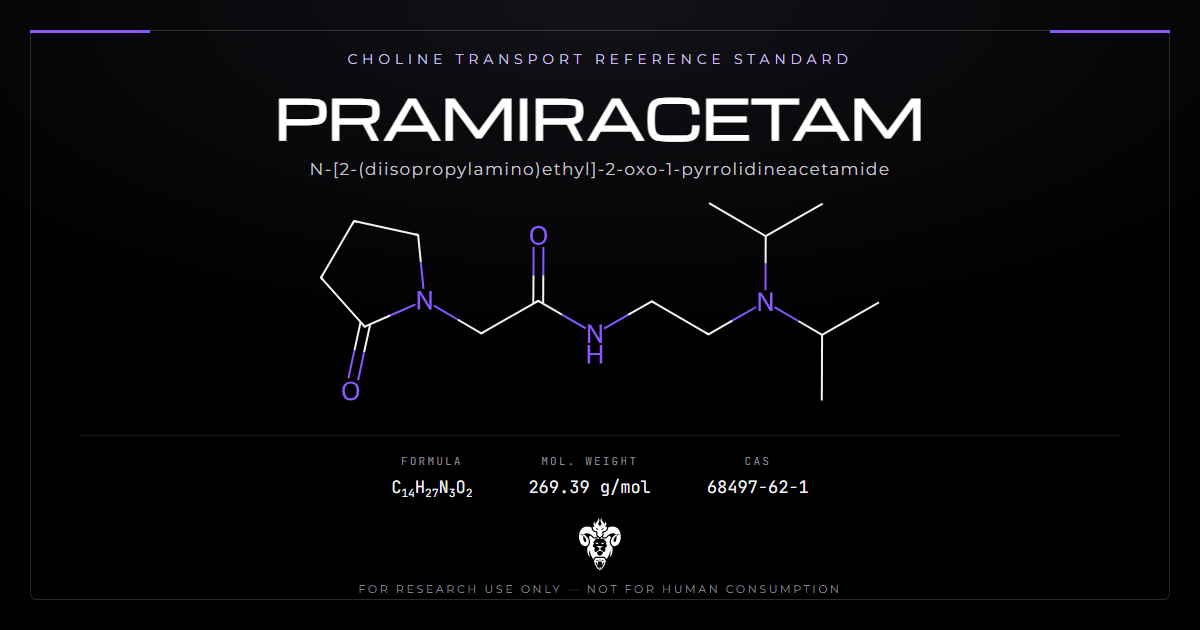
Pramiracetam presents two problems that most reference compounds do not. The first is arithmetic. Material circulates in two forms whose molecular weights differ by 98 g/mol, and weighing one as though it were the other produces a 27 percent concentration error before any experiment begins. The second is shape. Its dose response in animal models is an inverted U [4].
Both problems are tractable once stated. Neither is obvious from a certificate of analysis. Indexed later papers exist [1][10] and [11]. Human endpoints from those papers sit outside this profile. Laboratories source pramiracetam for cholinergic transport work, for comparative studies across the racetam series, and as a case study in what a non-monotonic dose response does to experimental design.
All information here describes laboratory research findings. This material is supplied for research use only and is not for human or veterinary use.
What pramiracetam is
Pramiracetam carries a bulky diisopropylaminoethyl chain on the acetamide nitrogen of the 2-oxopyrrolidine scaffold. Parke-Davis developed it under the code CI-879. That basic tertiary amine is what allows salt formation, and salt formation is where the arithmetic problem starts.
Identity and physical data
| Property | Free base | Sulfate salt |
|---|---|---|
| PubChem CID | 51712 | 51711 |
| Molecular formula | C14H27N3O2 | C14H29N3O6S |
| Molecular weight | 269.38 g/mol | 367.46 g/mol |
| InChIKey | ZULJGOSFKWFVRX-UHFFFAOYSA-N | ACSROKXFXFNERX-UHFFFAOYSA-N |
| CAS number | 68497-62-1 | 72869-16-0 |
| Development code | CI-879 | CI-879 sulfate |
Systematic name and class
The free base is N-[2-[bis(1-methylethyl)amino]ethyl]-2-oxo-1-pyrrolidineacetamide. Both forms share the pyrrolidinone core that defines the racetam series [2]. A 2008 crystal structure resolved the salt as a hydrogen sulfate, with the cation carrying the proton on the tertiary amine and the pyrrolidine ring adopting an envelope conformation [3].
Salt form is an identity question
Compare the two InChIKeys above. They differ in the first block, not the last. That first block encodes molecular skeleton, so a difference there means the two records describe different chemical entities rather than different arrangements of one.
The arithmetic
Sulfate salt is 73.3 percent pramiracetam by mass. Weighing the salt while assuming the free base weight delivers 73.3 percent of the intended concentration. That is a 26.7 percent shortfall, large enough to move a result onto a different part of the dose response curve discussed below.
The error runs the other direction too. Assuming salt when the material is free base over-delivers by 36 percent. Both errors are silent, because both preparations look identical and both assay as pure.
How to resolve which form is in the bottle
Three checks settle it. Read the CAS number rather than the compound name, since the two forms carry different registry numbers. Read the stated molecular weight on the certificate. And where neither is stated, elemental analysis or ion chromatography for sulfate answers it directly.
Mass spectrometry in positive ion mode is less helpful than it appears. The salt dissociates in the source, so both forms give the same protonated cation. A sulfate counter-ion needs negative ion mode or a separate method to see.
The inverted U dose response
Pramiracetam does not produce larger effects at larger doses. The relationship is an inverted U, visible in the animal work [4]. An indexed later paper used that shape as a design premise [1]. Human endpoints from that paper sit outside this profile.
The animal data show it directly
In an object recognition test, three doses went in at 15, 30 and 60 mg/kg [4]. Only the middle dose produced significant improvement in 24-hour retention. The dose above it and the dose below it did not.
That pattern repeats across the class. Any protocol testing a single concentration risks sampling the tail of the curve and reporting an inactive compound. A dose range is not optional here.
What an inverted U does to a protocol
A per-subject search will find an apparent optimum whether or not one exists, because it selects the best of several noisy measurements. Replication is the only thing separating a real optimum from a lucky draw.
That is a general methodological point rather than a claim about this compound. Any protocol using per-subject optimisation needs a replication phase, or its results describe measurement noise. The 1991 paper is the indexed example of that design problem [1]. This profile does not quote its milligram figures or scale scores.
Mechanism and the choline transport thread
Pramiracetam has no established receptor target, which places it with the rest of the class rather than with nefiracetam [2].
Choline transport across the blood-brain barrier
The most specific mechanistic finding concerns choline movement into brain. In rats given scopolamine for 14 days, choline extraction and the permeability-surface area product both rose across nine brain regions [5]. Coinjection of either pramiracetam or piracetam at 100 mg/kg per day prevented that rise. Both compounds also raised cerebral blood flow.
Those authors proposed that cholinergic innervation of brain endothelial cells regulates choline transport, and that these compounds act by altering brain choline metabolism. The effect differed between brain regions rather than applying uniformly.
Nitric oxide synthase
A separate line found that 300 mg/kg raised nitric oxide synthase activity in rat cortical homogenates by roughly 20 percent, with no change in hippocampus [6]. Messenger RNA expression did not change in either region, so the effect operates on enzyme activity rather than on transcription. A 100 mg/kg dose did nothing.
Lithium chloride pretreatment raised the response to 40 percent. Lithium alone produced no effect. That interaction is unexplained and has not been followed up.
What the class reviews say
Broad receptor screening across the racetam series found no measurable affinity at the sites tested [2]. A review of cholinergic mechanisms places pramiracetam among the pyrrolidinones that reverse scopolamine-induced deficits, with high-affinity choline uptake stimulation proposed as the shared route [7]. Proposed is the operative word, since no positive target has been identified.
Preclinical findings by model
Findings stay bound to the model that produced them.
Radial arm maze and the memory dissociation
Rats received 7.5 or 15 mg/kg daily for seven weeks before testing in a 16-arm maze with nine arms baited [8]. That design separates working memory from reference memory. Both doses improved the reference memory component. Neither affected working memory.
A dissociation of this kind is more informative than a general improvement, because it argues against a change in motivation, appetite or motor performance. Those would move both components together.
Object recognition
The one-trial object recognition test measures spontaneous exploration without rule learning or reinforcement [4]. Normal rats discriminate a novel object from a familiar one after 1 minute and fail to after 24 hours. At 30 mg/kg, retention at 24 hours improved. Overall exploratory behaviour did not change.
Hypoxia, where the result is weak
Two studies examined hypobaric hypoxia in immature rats using epileptic afterdischarges as the damage measure [9]. The published conclusion describes the action as only moderate. In 12-day-old animals pramiracetam did not influence afterdischarge prolongation at all. In 18-day-old animals it shortened the first afterdischarge significantly, though not to the level of unexposed animals.
Reporting this one matters. A compound with several positive findings also has negative and equivocal ones, and a summary that includes only the positives misrepresents the literature.
Indexed papers and what they are not
Indexed later papers on Pramiracetam exist. Human endpoints from those papers sit outside this profile.
What those papers are
Claus and colleagues published a small enrichment-design paper [1]. Mauri and colleagues published a scopolamine-challenge paper [10]. McLean and colleagues published a head-injury paper [11]. A 2010 class review repeated the head-injury claim (DOI) [16].
Use those papers as a map. Do not quote human milligram ladders, recall scores, or an open-label extension as a use story.
What this profile will not do
It will not treat a challenge study as a laboratory protocol. It will not treat an 18-month uncontrolled follow-up as kinetic evidence. The half-life pair in the next section is the only human figure this page keeps [12][13].
Human pharmacokinetics
Disposition is well characterised for a compound of this vintage, and the kinetics are linear.
Dose proportionality
Chang and colleagues reported single oral legs in a double-blind randomised design [12]. Peak plasma concentrations were reached between two and three hours. Elimination half-life stayed between 4.5 and 6.5 hours and did not vary with dose. Total body clearance, renal clearance and apparent volume of distribution were likewise dose independent.
Peak concentration and area under the curve rose linearly across a fourfold range. Linear kinetics of that kind simplifies protocol design considerably. Human milligram figures from that paper sit outside this profile.
Formulation and between-subject variation
A separate paper compared a solution against a tablet in fasting subjects [13]. Absorption ran faster from solution, and the plasma profile was otherwise similar. Half-life varied widely between subjects, from 2 to 8 hours, while staying consistent within a subject across formulations. Human milligram figures from that paper sit outside this profile.
Between-subject variability of that magnitude argues for a crossover design where the question permits one.
Animal distribution
Dog studies gave a half-life of 2.3 to 3.9 hours across doses [14]. In rats, tissue concentrations ranked kidney highest, then liver, intestine, lung, muscle, heart, gonad and spleen, with detectable material in brain. Urinary excretion accounted for 28.3 percent and faecal for 6.4 percent over 72 hours. Plasma protein binding measured 20.1 to 22.2 percent.
Physicochemical properties and handling
| Parameter | Detail |
|---|---|
| Solubility, sulfate | Freely soluble in water |
| Solubility, free base | Soluble in ethanol and DMSO |
| Storage | Sealed, dry, protected from light |
| Hygroscopicity | The sulfate salt is notably hygroscopic |
| Stock solutions | Prepare fresh; correct mass for salt form |
Store the solid sealed, dry and protected from light. Storage guidance is a house recommendation. Analytical documentation is per-lot release testing.
The sulfate takes up atmospheric moisture readily. A container left open on a balance gains weight measurably, and that gain reads as compound. Equilibrate to room temperature before opening, weigh promptly, and reseal.
Correcting the mass
Where the salt is used and free base concentration is the target, multiply the intended free base mass by 1.364 to obtain the salt mass required. State in the protocol which form the stated concentration refers to. Published papers are inconsistent on this point, so a concentration quoted without a form is ambiguous.
Analytical characterization
Identity and purity work is straightforward, with the salt form as the one complication.
Chromatographic methods
Reversed-phase HPLC resolves pramiracetam from process impurities. The compound lacks a strong chromophore, which limits ultraviolet detection sensitivity against the aromatic racetams. A gas chromatographic assay using nitrogen-specific detection was published for plasma work in 1983 and suits the nitrogen-rich structure [15].
Confirming the counter-ion
Sulfate content is the check that distinguishes the two forms, and it is not part of a standard purity panel. Ion chromatography quantifies it directly. Elemental analysis for sulfur answers the same question. Either belongs on a certificate for salt material, and the absence of both leaves the form unconfirmed. Batch documentation for catalogue material sits in the certificate of analysis database.
Structure confirmation
Proton NMR resolves the two isopropyl methyl doublets clearly, and their integration against the pyrrolidinone protons confirms the substitution. The published crystal structure provides reference geometry for the salt [3].
The tertiary amine is the protonation site. Bambagiotti-Alberti placed the hydrogen on that nitrogen and the pyrrolidine ring in an envelope [3]. A free-base lot will not show that hydrogen-sulfate pairing. Infrared or ion chromatography is the cheap check before anyone treats two bottles as the same reagent.
Nitrogen-specific gas chromatography was published for plasma work because the ultraviolet chromophore is weak [15]. That method still needs a confirmation that the injector has not cracked the amide. Liquid chromatography with mass detection is the safer routine identity run for a catalogue lot. Record the protonated cation at the free-base mass even when the bottle is sulfate. The counter-ion will not ride that ion.
Pramiracetam among the other racetams
Pramiracetam is the most lipophilic of the classical members and the only one commonly supplied as a salt.
| Compound | Substituent | Supplied as | Identity check |
|---|---|---|---|
| Piracetam | None | Free base | Standard purity |
| Aniracetam | Anisoyl | Free base | Standard purity |
| Oxiracetam | 4-hydroxy | Racemate | Chiral method |
| Pramiracetam | Diisopropylaminoethyl | Often sulfate | Counter-ion |
Direct comparison in the object recognition test placed the effective dose at 30 mg/kg against 400 mg/kg for piracetam, a roughly thirteenfold difference in the same assay on the same day [4]. Single-assay potency comparisons of this kind are worth more than cross-study ones, since they hold the model constant.
Further reading across the series sits in the nootropics research library, and the reference standard ships against batch documentation.
Open questions and how to read this literature
The mechanism is a proposal, not a finding
Choline transport is the best supported route and rests on one detailed study [5]. Nitric oxide synthase activation rests on another [6]. Neither identifies a binding target, and the class reviews report none [2][7].
Published concentrations are often ambiguous
Because two forms circulate and papers do not always state which, a dose quoted in milligrams per kilogram may refer to either. Where a comparison across studies matters, check the methods section for the salt form before treating two numbers as equivalent.
The indexed later papers do not converge
A scopolamine-challenge paper sits in the file [10]. An enrichment-design paper sits beside it [1]. A head-injury paper reported an uncontrolled extension [11]. These designs differ enough that agreement between them would be surprising, and disagreement is not informative either. This profile does not quote their endpoints.
The reviews single this compound out, on thin grounds
A 2010 survey of the class repeated a head-injury claim, while recording that oxiracetam and aniracetam had left the territories it surveyed (DOI). That distinction traces back to the McLean paper and its open-label extension [16]. One small single-site paper is a narrow base for a claim repeated in review after review.
Citation inheritance of this kind is worth watching in any older literature. A finding enters a review, the review is cited instead of the primary paper, and the qualifications attached to the original stop travelling with it. Reading the primary source is the only reliable correction, and here the primary source is PMID 1786500.
The negative results are underrepresented
Positive findings dominate the searchable record. The hypoxia work reporting only moderate action sits in a regional journal with no digital object identifier [9]. The enrichment trial that failed replication appeared in Neurology and is well indexed, yet is cited far less often than the head injury result [1]. Neither pattern reflects study quality.
Anyone assembling a picture of this compound from the first page of search results will get a more favourable one than the literature supports. That is a property of how the literature is indexed rather than of what it contains.
What would move the field
Identification of any positive molecular target would do the most. Absent that, the compound remains useful as a transport-modulating tool and as a comparator in racetam series work, which is what the catalogue supports it for.
Frequently asked questions
Is pramiracetam supplied as a salt or a free base?
Both circulate. The sulfate is common. Check the CAS number and the stated molecular weight, since 68497-62-1 and 72869-16-0 describe different materials [3].
How much does the salt form change a preparation?
Sulfate is 73.3 percent pramiracetam by mass, so weighing salt as free base under-delivers by 26.7 percent. Multiply by 1.364 to correct.
Does this page report human outcomes?
No. Indexed later papers are listed so they can be found [1][10] and [11]. This profile keeps the 4.5 to 6.5 hour half-life [12] and stops at chemistry, salt arithmetic and animal systems.
Does higher dose mean larger effect?
No. The dose response is an inverted U [1]. In object recognition, 30 mg/kg worked where both 15 and 60 mg/kg did not [4].
What is the elimination half-life?
Between 4.5 and 6.5 hours, independent of dose across a fourfold range [12]. Between-subject variation runs wider, from 2 to 8 hours [13].
Does it bind a known receptor?
None has been identified. Broad screening across the racetam class returned no measurable affinity at the sites tested [2].
Why does the sulfate cake in the bottle?
The salt is hygroscopic. Moisture uptake causes clumping and adds apparent mass. Store sealed with desiccant, and equilibrate to room temperature before opening so condensation does not add water to a cold solid.
Which form do published doses refer to?
Papers vary and many do not say. Check the methods section for the form before comparing a dose between two studies, since the same number can mean two concentrations 36 percent apart.
References
- Claus JJ, Ludwig C, Mohr E, et al. Nootropic drugs in Alzheimer’s disease: symptomatic treatment with pramiracetam. Neurology. 1991;41(4):570-4. PubMed DOI
- Gouliaev AH, Senning A. Piracetam and other structurally related nootropics. Brain Res Brain Res Rev. 1994;19(2):180-222. PubMed DOI
- Bambagiotti-Alberti M, Bartolucci G, Bruni B, et al. Diisopropyl{2-[2-(2-oxopyrrolidin-1-yl)acetamido]ethyl}ammonium hydrogen sulfate. Acta Crystallogr Sect E. 2008;64(Pt 6):o1160. PubMed DOI
- Ennaceur A, Cavoy A, Costa JC, Delacour J. A new one-trial test for neurobiological studies of memory in rats. II: Effects of piracetam and pramiracetam. Behav Brain Res. 1989;33(2):197-207. PubMed DOI
- Brust P. Reversal of scopolamine-induced alterations of choline transport across the blood-brain barrier by the nootropics piracetam and pramiracetam. Arzneimittelforschung. 1989;39(10):1220-2. PubMed
- Corasaniti MT, Paoletti AM, Palma E, et al. Systemic administration of pramiracetam increases nitric oxide synthase activity in the cerebral cortex of the rat. Funct Neurol. 1995;10(3):151-5. PubMed
- Pepeu G, Spignoli G. Nootropic drugs and brain cholinergic mechanisms. Prog Neuropsychopharmacol Biol Psychiatry. 1989;13 Suppl:S77-88. PubMed DOI
- Murray CL, Fibiger HC. The effect of pramiracetam (CI-879) on the acquisition of a radial arm maze task. Psychopharmacology (Berl). 1986;89(3):378-81. PubMed DOI
- Maresová D, Mares P. The action of pramiracetam on consequences of hypobaric hypoxia is only moderate. Physiol Res. 1996;45(3):245-8. PubMed
- Mauri M, Sinforiani E, Reverberi F, et al. Pramiracetam effects on scopolamine-induced amnesia in healthy volunteers. Arch Gerontol Geriatr. 1994;18(2):133-9. PubMed DOI
- McLean A, Cardenas DD, Burgess D, Gamzu E. Placebo-controlled study of pramiracetam in young males with memory and cognitive problems resulting from head injury and anoxia. Brain Inj. 1991;5(4):375-80. PubMed DOI
- Chang T, Young RM, Goulet JR, Yakatan GJ. Pharmacokinetics of oral pramiracetam in normal volunteers. J Clin Pharmacol. 1985;25(4):291-5. PubMed DOI
- Auteri A, Blardi P, Celasco G, et al. Pharmacokinetics of pramiracetam in healthy volunteers after oral administration. Int J Clin Pharmacol Res. 1992;12(3):129-32. PubMed
- Fang Z, Liu X, Xiao Y, Jiang W. Pharmacokinetics of pramiracetam in animals. Hua Xi Yi Ke Da Xue Xue Bao. 1999;30(4):411-3. PubMed
- Chang T, Young RM. Gas chromatographic assay of pramiracetam in human plasma using nitrogen specific detection. J Chromatogr. 1983;274:346-9. PubMed DOI
- Malykh AG, Sadaie MR. Piracetam and piracetam-like drugs: from basic science to novel clinical applications to CNS disorders. Drugs. 2010;70(3):287-312. PubMed DOI