
Everything below reports findings from cell cultures, isolated tissue and animals. This material is for research use only, not for human or veterinary use.
Orexin signals through two receptors. Dual antagonists block both. Seltorexant blocks one.
That is the entire premise of the compound. It makes Seltorexant the tool for testing a specific hypothesis. The orexin-2 receptor may carry most of the arousal signal. Blocking it alone should leave orexin-1 signalling intact.
Indexed sleep and mood papers exist. Those human endpoints sit outside this profile. The useful laboratory questions are identity, subtype chemistry, cited pharmacokinetics, and how an assay confirms the published stereoisomer.
What follows covers the bridged diamine, the two-receptor argument, the cited 2 to 3 hour half-life, a fluorinated imaging analogue, and the two analytical errors that share the formula of Seltorexant.
Chemical identity: what you are actually handling
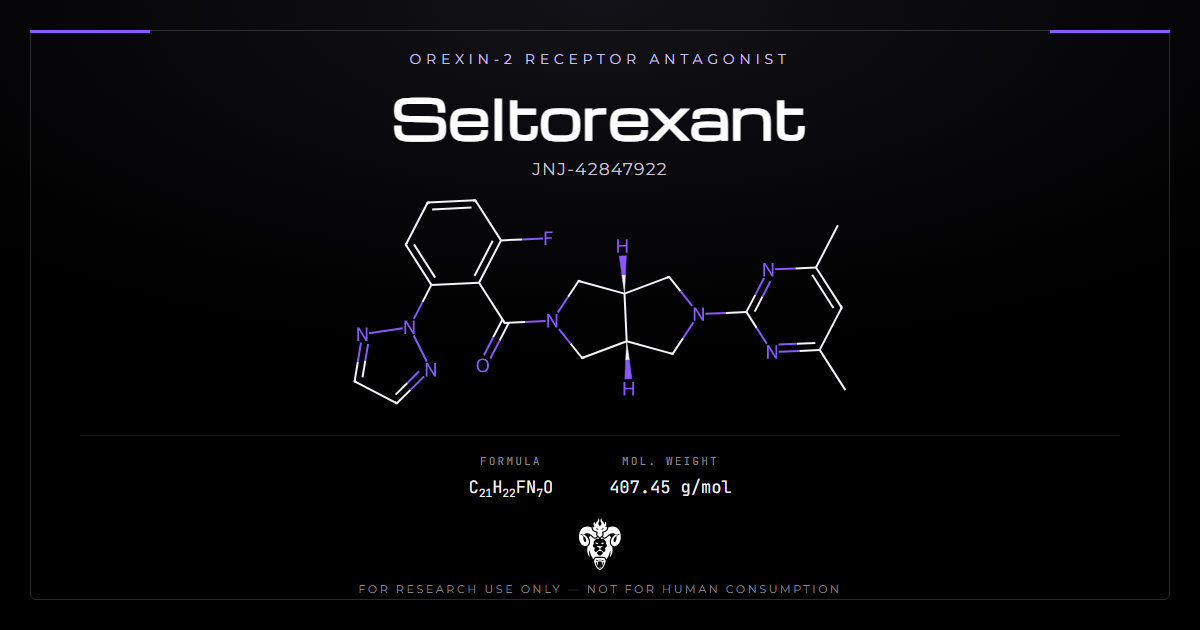
Seltorexant is a bridged bicyclic diamine carrying two distinct heterocycles.
| Property | Value |
|---|---|
| IUPAC name | [(3aS,6aR)-2-(4,6-dimethylpyrimidin-2-yl)-1,3,3a,4,6,6a-hexahydropyrrolo[3,4-c]pyrrol-5-yl]-[2-fluoro-6-(triazol-2-yl)phenyl]methanone |
| Synonyms | JNJ-42847922, MIN-202 |
| CAS | 1293281-49-8 |
| Molecular formula | C21H22FN7O |
| Molecular weight | 407.4 g/mol |
| PubChem CID | 86278359 |
| InChIKey | SQOCEMCKYDVLMM-IYBDPMFKSA-N |
| Stereocentres | Two, at the ring fusion |
| Molecular target | Orexin-2 receptor (OX2R) |
| Originator | Janssen |
The bicyclic core and its two heterocycles
The scaffold is a hexahydropyrrolo[3,4-c]pyrrole. That is a fused bicyclic diamine with a nitrogen at each end. One nitrogen carries a dimethylpyrimidine. The other carries an aroyl group whose aryl ring bears both a fluorine and a 2H-triazole.
Seven nitrogens across a pyrimidine, a triazole and two ring nitrogens make this a nitrogen-rich molecule. That composition is analytically useful. Accurate mass on C21H22FN7O is already a tight filter.
The amide that links the two halves is the only readily hydrolysable bond. Ordinary bench acid does not clip it. Strong acid or base would.
The two fusion stereocentres
The published configuration is (3aS,6aR). Those two carbons sit at the ring fusion. They set the shape of the diamine cage. The InChIKey stereoblock IYBDPMFKSA encodes that pair. A lot that inverts one centre is a different compound with the same formula.
Cis fusion is the intended geometry. The alternative cis diastereomer can form in the same ring-closing chemistry. Trans fusion is a different problem and a different spectrum. Ask the certificate which chiral method closed the question. A single HPLC area percent does not.
Seltorexant is the name for one stereoisomer. A racemate of the fusion pair would still pass a formula check. It would not match PubChem CID 86278359 as drawn.
Three names, one compound
Three designations appear in the literature, sometimes within a single paper. Seltorexant is the international nonproprietary name. JNJ-42847922 is the Janssen development code. MIN-202 is the Minerva code from the co-development period.
Anyone searching the literature needs all three. A search on one name alone will miss a substantial fraction of the record. Write all three on the first notebook line next to CAS 1293281-49-8.
The orexin system and what Seltorexant selectivity means
Orexin-A and orexin-B are neuropeptides that regulate wakefulness, arousal, appetite, the stress response, and reward processing [8]. They act through two G-protein coupled receptors. The orexin-1 receptor binds orexin-A preferentially. The orexin-2 receptor binds both peptides.
The selectivity hypothesis
Dual antagonists in this class block both subtypes. Suvorexant, lemborexant and daridorexant all work this way [7]. Seltorexant is the selective instrument.
The argument for selectivity runs as follows. Suppose the orexin-2 receptor carries most of the arousal-promoting signal. Blocking it alone should then leave orexin-1 signalling intact. Whatever the orexin-1 receptor contributes to appetite, stress or reward would remain untouched.
That is a hypothesis about division of labour between two receptors. A subtype-selective compound is the instrument for testing it. Whether that separation delivers a clinical advantage is a separate question. Those papers sit outside this profile [10][12].
Why a selective tool is not a dual tool
A lot labelled Seltorexant that also blocks orexin-1 is a different reagent. Cell lines that express one receptor at a time are how that pair gets measured. Comparing marketing copy is not.
The medicinal chemistry effort behind selective orexin-2 antagonists continues. Seltorexant serves as the benchmark against which newer candidates are measured in rodent sleep models (PMID 38283232) [9]. Brotschi and colleagues built pyrazole 2-SORA analogues and read them in rats. That paper is chemistry plus animal work. Use it as a comparator method, not as a certificate for the Janssen lot.
How the two subtypes divide the peptides
Orexin-A and orexin-B are not interchangeable ligands. The receptors are not interchangeable readouts.
Peptide preference
Orexin-1 prefers orexin-A. Orexin-2 accepts both. A selective antagonist at orexin-2 therefore sits on the receptor that both peptides can occupy. It does not sit on the receptor that prefers orexin-A. That is the chemical meaning of the Seltorexant claim.
Both peptides are hypothalamic. Both are cleaved from the same precursor. The receptors then split the signal. An assay that uses only orexin-A will occupy both subtypes. An assay that uses orexin-B leans on orexin-2. State the peptide in the methods. A paper that says “orexin” has not named the ligand.
Reviews of the class map this split and then move into human endpoints [7][8]. Stop at the map. The human file is a pointer.
Dual antagonists as a different chemical class
Suvorexant is a dual antagonist with a different formula. No analytical method would confuse it with Seltorexant. Summaries still group them. Do not. Write the subtype on the first line of the methods. A study that says “an orexin antagonist” has not named its tool.
Filorexant is another dual ligand that appears in the same reviews [8]. It is not a substitute lot. Keep the names on separate labels.
| Compound | Selectivity | Formula handle |
|---|---|---|
| Seltorexant | Orexin-2 selective | C21H22FN7O, fluorine, two fusion stereocentres |
| Suvorexant | Dual (OX1R and OX2R) | different scaffold and formula |
| Lemborexant | Dual | different scaffold and formula |
| Daridorexant | Dual | different scaffold and formula |
| Filorexant | Dual | different scaffold and formula |
No published trial has run Seltorexant head-to-head against a dual antagonist [7][10]. That is the study the selectivity hypothesis actually requires. A comparison against an older hypnotic does not substitute for it.
Cited pharmacokinetics
Van der Ark and colleagues characterised Seltorexant in healthy subjects across five cohorts (PMID 30182786) [6]. Plasma and urine sampling covered 24 hours on days 1, 5 and 10.
Half-life and time to peak
Absorption is rapid. Median time to peak concentration ranged from 0.5 to 1.5 hours. The mean half-life fell between 2 and 3 hours [6]. Those two numbers are the cited pharmacokinetic facts this profile keeps.
That short half-life is a design feature rather than an oversight. Exposure does not carry across a full day. An animal schedule that samples once at 24 hours will miss the peak.
What this profile will not quote from that paper
The same report also contains human dose ladders and central readouts [6]. Those sentences sit outside this profile. Keep the Tmax and the half-life. Leave the rest on the PubMed page.
Account for the short half-life in any design that claims steady exposure. At 2 to 3 hours, a once-daily animal arm is a pulsed experiment [6].
Indexed sleep and mood papers
A development programme and several indexed clinical papers exist. Those human endpoints sit outside the scope of this profile. The list remains so a reader can find the papers.
What those papers are
Brooks, De Boer, Recourt and Mesens reported polysomnography and related designs. Savitz and Jha reported mood-programme work [3][4]. Muehlan, Fagan, Doggrell and Thase reviewed the class [7][8] and [11][12].
Use those papers for chronology, synonyms and methods language. Do not use them as a use document. This profile will not quote sleep latency, mood scores, milligram ladders, or adverse-event rates. It will not position Seltorexant against zolpidem as a therapy.
What a laboratory still needs from that file
The file tells you the compound reached large programmes [10][12]. It does not identify an unknown vial. Intact mass, fluorine NMR and a chiral method still do that work. A phase label on a slide is not a certificate.
Doggrell’s commentary sits in the list because it points at the insomnia papers [11]. Read it as a map. Do not lift numbers from it.
Imaging and transporter interaction
A fluorinated version of the compound has been developed as a positron emission tomography probe for orexin receptors (PMID 35397430) [13].
Mouse uptake and specificity
The characterisation reported good binding specificity in ex vivo autoradiography. Blood-brain barrier penetration was suitable. Highest brain uptake came two minutes after injection in mice [13].
That two-minute peak matches a short-exposure ligand. It also matches the 2 to 3 hour plasma half-life on the parent [6]. Fast in, fast out.
P-glycoprotein
One finding has practical relevance beyond imaging. Pretreatment with a P-glycoprotein competitor significantly increased brain uptake. The compound therefore interacts with P-glycoprotein at the blood-brain barrier [13].
P-glycoprotein is an efflux transporter that pumps substrates out of the brain. A compound subject to it shows brain concentrations lower than passive permeability alone predicts. Its brain exposure also becomes sensitive to anything inhibiting or inducing the transporter.
State the transporter status in the methods if brain levels matter. A co-administered inhibitor will shift the Seltorexant exposure you think you set [13].
Physicochemical properties and handling
The molecule is a nitrogen-rich neutral solid. Its basic centres are weak. The pyrimidine and triazole nitrogens sit in aromatic rings. The two ring nitrogens are acylated or aryl-substituted rather than free.
Solubility and the amide
Expect pH-dependent aqueous solubility from the weakly basic nitrogens, and limited solubility overall. Dimethyl sulfoxide is the usual stock solvent.
The amide linking the two halves of the molecule is stable under ordinary conditions. Strong acid or base would be required to cleave it. Hydrolysis would split the aroyl half from the bicyclic diamine. Those fragments have different masses. Intact mass after a harsh workup is still worth running.
Stereochemical stability on the shelf
One further handling note follows from the stereochemistry. The two ring-fusion centres are configurationally stable. Neither carbon bears an acidic proton adjacent to a carbonyl. Ordinary storage will not racemise the material. Any stereochemical impurity present therefore came from the synthesis rather than from degradation. A single characterisation at receipt remains valid for the life of the vial.
Store the solid sealed, dry, cold and dark.
Storage guidance is a house recommendation. Analytical documentation is per-lot release testing.
Analytical characterisation
Four checks cover Seltorexant, and two of them address risks that a purity figure cannot see.
Mass, fluorine and the triazole
Accurate mass confirms C21H22FN7O at 407.4. Seven nitrogens produce a distinctive elemental composition. It is unusual enough that accurate mass alone comes close to an identification.
Fluorine NMR gives the fastest single confirmation. The aryl fluorine produces one clean signal.
Triazole regiochemistry requires proton NMR. The 2H-triazole and the 1H isomer share a molecular formula and an accurate mass, so only the spectrum separates them. This is the substitution error most likely to arise in synthesis, and the one mass spectrometry cannot detect.
The invisible diastereomer
Chiral purity at the ring fusion needs its own method. The (3aS,6aR) configuration is defined. A cis-fused bicyclic system can in principle form the alternative diastereomer, with identical formula and mass.
A selective tool is only selective if the material matches the published compound. Regiochemical error in the triazole changes the molecule without changing its mass. The alternative diastereomer at the ring fusion does the same. Neither appears on a chromatographic purity figure. Neither appears on a nominal mass measurement.
For a compound whose entire value is receptor subtype selectivity, those are not minor risks. They are the specific ways a vial can contain something that behaves differently from what the papers describe while still passing a basic certificate.
| Check | What it answers | What it cannot see |
|---|---|---|
| Accurate mass | Formula C21H22FN7O | Triazole regioisomer |
| 19F NMR | Aryl fluorine present | Ring-fusion stereochemistry |
| 1H NMR | 2H versus 1H triazole | A second lot without a reference spectrum |
| Chiral HPLC | (3aS,6aR) versus the other cis diastereomer | Regiochemistry if the method is not orthogonal |
| InChIKey | Published stereodescriptor IYBDPMFKSA | Purity of the lot |
Kimera publishes third-party certificates of analysis for every lot in its COA database. Laboratories source Seltorexant as a reference orexin-2 selective antagonist. Modafiendz and CE-123 act on arousal from the opposite direction. They are not substitutes. Related chemistry appears in the nootropics category.
Common misclassifications
Four errors recur around Seltorexant.
Class language
The compound is described as a sedative or hypnotic of the traditional kind. It is a receptor antagonist acting on an arousal-promoting peptide system. Class reviews discuss older hypnotics in the same paragraphs [7]. That grouping is a literature habit. It is not an identity result.
Grouping with suvorexant
It is grouped with suvorexant. That compound blocks both receptor subtypes and is structurally unrelated, with a different formula. No analytical method would confuse them, but summaries do.
Phase labels as identity
Its development stage is understated or overstated. Indexed programmes exist [10][12]. A phase number does not confirm the (3aS,6aR) fusion or the 2H-triazole.
Reading mood papers as sleep papers
The mood-programme papers are a separate file. Recourt used a sedating antihistamine control in one design [5]. That design question is about mechanism attribution in people. It sits outside this profile. Do not import it as a laboratory protocol.
Experimental design considerations
State the subtype. A study describing “an orexin antagonist” without specifying orexin-1 or orexin-2 selectivity has not defined its tool compound.
Arms, readouts and transporters
Include a dual antagonist arm if selectivity is the question. No published trial has done so, which leaves the central hypothesis untested [7][10].
Measure sleep with an objective method if sleep is the animal question. Brotschi read rodent sleep on pyrazole analogues against this benchmark [9]. Self-report language belongs to the out-of-scope file [1][2] and [10].
Consider P-glycoprotein. Brain exposure is sensitive to efflux transport, so co-administered inhibitors or inducers will shift it [13].
Half-life and the vial
Account for the short half-life. At 2 to 3 hours, exposure does not carry across a full day [6].
Verify regiochemistry and stereochemistry before starting. Both errors are invisible to routine purity methods.
Write Seltorexant, JNJ-42847922 and MIN-202 in the search string. Then write C21H22FN7O on the certificate line. A name without a mass is not a lot.
A last design note is the stock solvent. Dimethyl sulfoxide holds Seltorexant for dilution. Water alone will not. Dilute into the assay buffer close to use. A cloudy aqueous stock is a failed solution, not a high-concentration trick. Filter only if you then re-check concentration. Adsorption on a filter can steal a nitrogen-rich small molecule without changing the label.
Common questions about Seltorexant
What is Seltorexant? A selective orexin-2 receptor antagonist, also known as JNJ-42847922 and MIN-202. Kimera supplies it as a laboratory research material.
How does it differ from suvorexant? Suvorexant blocks both orexin receptor subtypes. Seltorexant is selective for the orexin-2 receptor.
What is the half-life? Between 2 and 3 hours, with peak concentration reached within 0.5 to 1.5 hours [6].
Does this page report human sleep or mood outcomes? No. Indexed clinical papers are listed so they can be found. This profile stops at chemistry, subtype logic and cited pharmacokinetics.
Which analytical risk matters most? Triazole regiochemistry and ring-fusion stereochemistry. Both share the molecular formula and accurate mass of the correct compound.
Why does P-glycoprotein appear in the methods? A PET analogue showed higher brain uptake after a P-glycoprotein competitor in mice [13]. Brain levels will move if the transporter moves.
Is a dual antagonist a substitute? No. Dual ligands occupy both subtypes [7]. Seltorexant is the selective tool. Run both only if the question is the split.
Summary of the evidence
Write the name, the mass and the subtype on the first line of a notebook page. Everything else in this profile is a check on those three facts.
Identity and what remains open
Identity: C21H22FN7O, 407.4 g/mol, CAS 1293281-49-8, seven nitrogens, one aryl fluorine, two ring-fusion stereocentres. PubChem CID 86278359 and InChIKey SQOCEMCKYDVLMM-IYBDPMFKSA-N close the record. A certificate that omits chiral and regiochemical checks is not finished.
Seltorexant is the long name for that lot. JNJ-42847922 and MIN-202 are the same chain under development codes. Do not treat a code as a second compound.
If a methods section names Seltorexant and then quotes a dual-antagonist formula, stop. The rest of that paper is about a different reagent. The same rule applies in reverse. This is the cheapest way to keep two orexin literatures from contaminating each other, and it costs one intact-mass line. Keep the certificate next to the notebook.
Selectivity: orexin-2 only, which distinguishes it from the dual ligands in the class [7]. Newer 2-SORA chemistry still uses Seltorexant as the rodent benchmark [9].
Pharmacokinetics: rapid absorption, 2 to 3 hour half-life, peak at 0.5 to 1.5 hours [6].
Imaging: a fluorinated analogue enters mouse brain fast and is a P-glycoprotein substrate [13].
Limits: human sleep latency, mood scores, milligram ladders and adverse-event figures are out of scope here. Those papers remain in the reference list.
Missing comparison: no published head-to-head against a dual antagonist, which is the study the selectivity hypothesis needs.
Status: supplied for laboratory research use only.
References
- Brooks S, Jacobs GE, de Boer P, et al. The selective orexin-2 receptor antagonist seltorexant improves sleep: an exploratory double-blind, placebo controlled, crossover study in antidepressant-treated major depressive disorder patients with persistent insomnia. J Psychopharmacol. 2019;33(2):202-209. PMID 30644312. DOI
- De Boer P, Drevets WC, Rofael H, et al. A randomized Phase 2 study to evaluate the orexin-2 receptor antagonist seltorexant in individuals with insomnia without psychiatric comorbidity. J Psychopharmacol. 2018;32(6):668-677. PMID 29848147. DOI
- Savitz A, Wajs E, Zhang Y, et al. Efficacy and safety of seltorexant as adjunctive therapy in major depressive disorder: a phase 2b, randomized, placebo-controlled, adaptive dose-finding study. Int J Neuropsychopharmacol. 2021;24(12):965-976. PMID 34324636. DOI
- Jha MK. Selective orexin receptor antagonists as novel augmentation treatments for major depressive disorder: evidence for safety and efficacy from a phase 2B study of seltorexant. Int J Neuropsychopharmacol. 2022;25(1):85-88. PMID 34791262. DOI
- Recourt K, de Boer P, Zuiker R, et al. The selective orexin-2 antagonist seltorexant (JNJ-42847922/MIN-202) shows antidepressant and sleep-promoting effects in patients with major depressive disorder. Transl Psychiatry. 2019;9(1):216. PMID 31481683. DOI
- van der Ark PD, Golor G, van Nueten L, Nandy P, de Boer P. Multiple daytime administration of the selective orexin-2 receptor antagonist JNJ-42847922 induces somnolence in healthy subjects without residual central effects. J Psychopharmacol. 2018;32(12):1330-1340. PMID 30182786. DOI
- Muehlan C, Vaillant C, Zenklusen I, Kraehenbuehl S, Dingemanse J. Clinical pharmacology, efficacy, and safety of orexin receptor antagonists for the treatment of insomnia disorders. Expert Opin Drug Metab Toxicol. 2020;16(11):1063-1078. PMID 32901578. DOI
- Fagan H, Jones E, Baldwin DS. Orexin receptor antagonists in the treatment of depression: a leading article summarising pre-clinical and clinical studies. CNS Drugs. 2023;37(1):1-12. PMID 36436175. DOI
- Brotschi C, Bolli MH, Gatfield J, et al. Pyrazole derivatives as selective orexin-2 receptor antagonists (2-SORA): synthesis, structure-activity-relationship, and sleep-promoting properties in rats. RSC Med Chem. 2023;15(1):344-354. PMID 38283232. DOI
- Mesens S, Krystal AD, Melkote R, et al. Efficacy and safety of seltorexant in insomnia disorder: a randomized clinical trial. JAMA Psychiatry. 2025;82(10):967-976. PMID 40802194. DOI
- Doggrell SA. Is seltorexant, an orexin-2 receptor antagonist, showing promise in insomnia? Expert Opin Investig Drugs. 2026;35(3):211-213. PMID 41766581. DOI
- Thase ME. A new direction for adjunctive therapy of difficult-to-treat depression: examining the role of orexin receptor antagonists. Eur Arch Psychiatry Clin Neurosci. 2025;275(6):1611-1619. PMID 40434499. DOI
- Bai P, Liu Y, Xu Y, et al. Synthesis and characterization of a new positron emission tomography probe for orexin 2 receptors neuroimaging. Bioorg Chem. 2022;123:105779. PMID 35397430. DOI
Seltorexant is sold for laboratory research use only. Not for human consumption, nor medical, veterinary, or household uses.
Literature retrieved from PubMed.