
Everything below reports findings from cell cultures, isolated tissue and animals. This material is for research use only, not for human or veterinary use.
Glucagon raises hepatic glucose output. GLP-1 agonists lower it. Putting both activities into one chain sounds like a design error.
It is not. The body already secretes a weak dual agonist. That hormone is oxyntomodulin. Survodutide is an engineered version of that idea [1].
A development programme and several indexed clinical papers exist. Those human endpoints are outside the scope of this profile. The laboratory questions are identity, receptor logic, and what animal systems actually measured.
Chemical identity
Survodutide is a 29-residue glucagon analogue. A fatty diacid binds albumin and slows clearance.
| Property | Value |
|---|---|
| Development code | BI 456906 |
| Class | Glucagon receptor and GLP-1 receptor dual agonist |
| Residues | 29, C-terminally amidated |
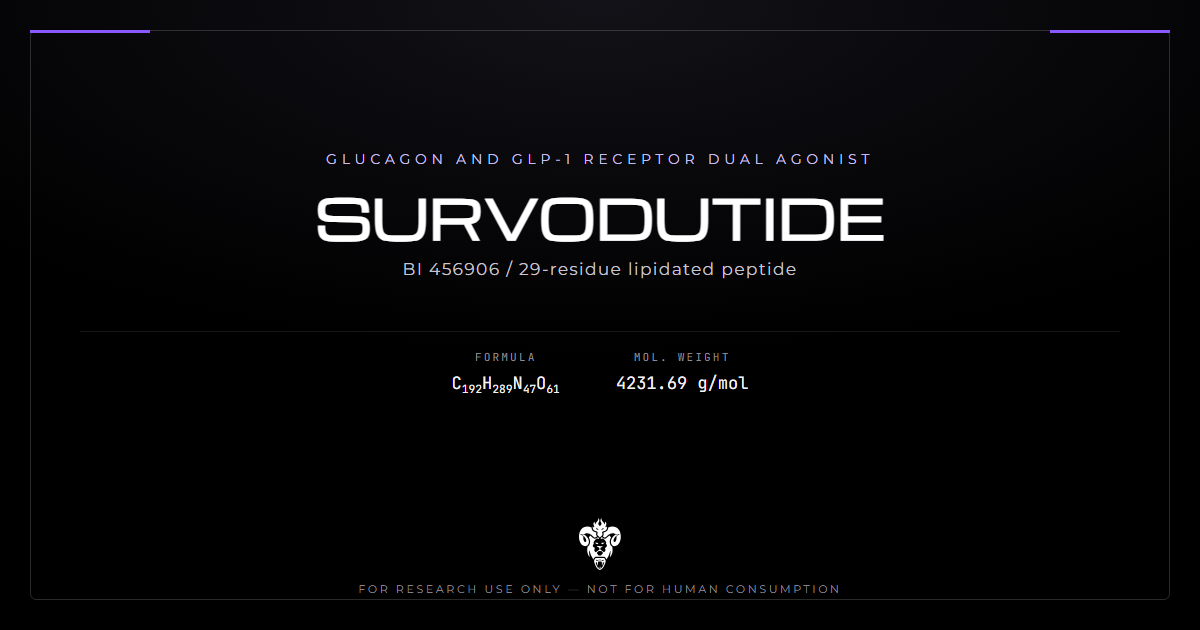
| Molecular formula | C192H289N47O61 |
| Average mass | 4,232 Da |
| Monoisotopic mass | 4,229.0957 Da |
| PubChem CID | 168429725 |
| InChIKey | MEDXQFAHWBMVIM-YIUAJOCSSA-N |
| Parent hormone | Glucagon, with GLP-1 activity built in |
| Natural template | Oxyntomodulin |
| Half-life extension | C18 diacid, albumin binding |
| Originator | Boehringer Ingelheim with Zealand Pharma |
Reading the design
Three decisions turn a gut hormone into a laboratory reagent that lasts.
The backbone starts from glucagon rather than from GLP-1. Potent GLP-1 activity then enters that sequence. Survodutide is therefore a glucagon analogue that also hits the incretin receptor [1].
Position 2 carries 1-aminocyclobutane-1-carboxylic acid rather than serine. PubChem records that cyclobutane in the connectivity of CID 168429725. The non-coded residue blocks dipeptidyl peptidase-4, the enzyme that clips glucagon-family peptides within minutes.
A lysine carries a C18 diacid through a glycine-serine spacer and a glutamate. Albumin binds that chain. The complex clears slowly enough that animal work can use sparse sampling [1]. Semaglutide uses the same lipidation trick on a different backbone.
So the kinetic half of Survodutide is standard incretin engineering. The receptor pair is where it differs.
The oxyntomodulin template
The dual-agonist idea is older than this lot. Physiology wrote it first.
The gut releases oxyntomodulin after a meal. That hormone activates the glucagon receptor and the GLP-1 receptor, weakly at each [1]. The body already runs this combination. That is the argument for building a potent mimic.
Survodutide is one member of that class. Tirzepatide pairs GLP-1 with GIP. Retatrutide adds a third receptor. Mazdutide is the other glucagon and GLP-1 dual agonist in a research catalogue [5]. The two are not interchangeable lots.
Proglucagon is one gene that yields several peptides. Glucagon, GLP-1 and oxyntomodulin all come out of it. A single chain can present epitopes for two receptors without a fusion tag. That is why the template is the oxyntomodulin template and not a stapled heterodimer.
Mass still decides identity after that story. A 29-residue chain with a C18 diacid sits a defined increment away from glucagon (3,483 Da) and from mazdutide (4,476 Da). If a certificate quotes one of those other masses, the vial is not Survodutide.
Mass against the relatives
Write the mass on the first line of a notebook page. Everything else is a check on that number.
Average mass is 4,232 Da. Monoisotopic mass is 4,229.0957 Da. Formula is C192H289N47O61. InChIKey is MEDXQFAHWBMVIM-YIUAJOCSSA-N.
Glucagon itself runs at 3,483 Da. Semaglutide runs at 4,114 Da. Mazdutide runs at 4,476 Da. Those gaps are large enough that intact mass separates the four on one method.
A backbone that never received the C18 chain differs by a defined increment and would clear in hours rather than days. Intact mass finds that failure before any receptor assay runs.
The glucagon paradox
The obvious objection to this design deserves a direct answer. The answer is what the whole class rests on.
Why adding glucagon is not a mistake
Glucagon does raise hepatic glucose output. It also increases energy expenditure and drives hepatic fat oxidation. Those two effects are what the design is after [1].
The GLP-1 arm covers the glycaemic side in the design story. Insulinotropic and intake readouts offset the hyperglycaemic push of glucagon-receptor agonism. Whether that arithmetic holds for a given lot is an assay question, not a catalogue claim.
The intended gain is simple. GLP-1 agonism reduces intake. Glucagon agonism raises expenditure. Acting on both sides of the balance should beat acting on one [1]. Klein’s perspective paper maps that argument for Survodutide in particular (PMID 37330144, DOI) [1].
How the candidate was chosen
Boehringer screened 19 dual agonists before picking this one. The selection method is the part that travels [4].
Potency at each receptor was read in CHO-K1 cells that express human GCGR or human GLP-1R. In vivo engagement was then read separately for each arm. Oral glucose tolerance covered the GLP-1 side. Hepatic NNMT messenger RNA plus plasma FGF21 covered the glucagon side [4].
Those glucagon biomarkers moved by a large margin. Hepatic NNMT expression rose 15 to 17 fold in lean mice. Plasma FGF21 rose up to sevenfold [4]. Note the enzyme. NNMT is the same target that 5-amino-1MQ inhibits, approached here from the opposite direction.
Treat those markers as a method, not as a Survodutide certificate. If a laboratory wants to know which arm a given vial engages, it runs the cells.
Receptor logic in cells and mice
The dual agonist claim is a pair of potencies, not a slogan. Cell lines that express one receptor at a time are how that pair gets measured.
Two receptors, two readouts
Glucagon-receptor engagement is the arm that should move hepatic fat oxidation and energy expenditure [1]. GLP-1-receptor engagement is the arm that should move insulinotropic and intake readouts. A lot that is potent at one and silent at the other is a different reagent.
Survodutide was built so both arms fire. Mazdutide was built the same way on a 33-residue oxyntomodulin backbone. Comparing the two in the same cell assay is the experiment that tells them apart. Comparing marketing copy is not.
State the cell line, the species of the receptor, and whether both arms were read. Dual agonist is a measured pair, not a class nickname.
Selection biomarkers in lean mice
Thomas and colleagues published the pharmacological profile used to pick this candidate (PMID 38560764, DOI) [4].
CHO-K1 cells expressing one human receptor at a time gave the in-vitro pair. Lean mice then supplied the in-vivo pair. Oral glucose tolerance stood in for GLP-1 engagement. Hepatic NNMT and plasma FGF21 stood in for glucagon engagement [4].
Those glucagon markers can move an order of magnitude in lean mice. That dynamic range is why the screen could rank 19 backbones. A laboratory that wants the same rank order must run the same pair of markers, not a single intake readout.
NNMT sits in the same hepatic metabolic space as 5-amino-1MQ. The enzyme is a biomarker here, not a second target of Survodutide. Do not treat an NNMT inhibitor and a glucagon-receptor agonist as substitutes.
Animal energy and hepatic readouts
If the second receptor earns its place, the evidence should appear in organs where glucagon acts and GLP-1 does not.
Lean-mouse glucagon markers
The selection paper is the cleanest animal dataset attached to this exact lot [4]. Lean mice showed a 15- to 17-fold rise in hepatic NNMT messenger RNA. Plasma FGF21 rose as much as sevenfold. Those are glucagon-arm readouts, not GLP-1-arm readouts.
Oral glucose tolerance moved on the other arm in the same animals [4]. A lot that moves only one of those two panels is not the reagent this profile describes.
Read the fold-changes as target engagement, not as a disease model. Lean mice on a screen are not a fatty-liver model. They are a ranking tool.
What a mouse liver readout can and cannot say
Glucagon stimulates lipolysis and mitochondrial fat oxidation in the liver. It also regulates amino-acid metabolism through a liver to alpha-cell axis [1]. Those are the phenotypes a glucagon arm is supposed to touch.
A mouse study that reports intake alone has not reported those phenotypes. A mouse study that reports hepatic fat without naming the lot has not reported Survodutide. Mass and a two-receptor assay still come first.
Clinical fatty-liver papers exist for this analogue [6][14] and [10]. Human histology and human imaging endpoints are outside the scope of this profile. Keep those papers in the list so a reader can find them.
How dual agonists differ in the catalogue
One indexed paper compared this dual agonist with a GLP-1 mono-agonist in people [2]. That human comparison is out of scope here. The laboratory comparison is backbone, mass and receptor pair.
Backbone and mass
| Analogue | Residues | Average mass | Lipid chain | Template |
|---|---|---|---|---|
| Glucagon | 29 | 3,483 Da | None | Native hormone |
| Survodutide | 29 | 4,232 Da | C18 diacid | Glucagon |
| Semaglutide | 31 | 4,114 Da | C18 diacid | GLP-1 |
| Mazdutide | 33 | 4,476 Da | C20 diacid | Oxyntomodulin |
Survodutide keeps the glucagon residue count and adds a C18 chain. Mazdutide starts from a longer oxyntomodulin-style chain and adds a C20 chain. Shared class language does not make them the same lot.
If a methods section names Survodutide and then quotes 4,476 Da, stop. The rest of that paper is about a different reagent. The same rule applies in reverse.
Shared lipidation is not shared pharmacology
Semaglutide, tirzepatide and Survodutide all use a fatty diacid to bind albumin. Shared spacer chemistry is not shared receptor balance.
Semaglutide is a GLP-1 mono-agonist. Tirzepatide pairs GLP-1 with GIP. Survodutide pairs glucagon with GLP-1 on a glucagon backbone [1][5]. A result that names “a dual agonist” without naming the lot is not usable.
Reviews that group entero-pancreatic multi-agonists exist [5][10] and [11]. Use them for chronology and synonyms. Do not use them as a use document.
Indexed papers outside this profile
The reference list is longer than the animal file. Most of those numbers point at human programmes.
Obesity and liver programmes
Indexed obesity papers exist, including dose-finding and confirmatory reports [3][15]. Baseline-characterisation papers exist for a type 2 diabetes cohort and for a Japanese cohort [12][13]. Human weight endpoints from those papers are outside the scope of this profile.
Indexed liver papers exist, including a histology-assessed MASH report and a later steatotic-liver report [6][14]. A class review of GLP-1 and glucagon multi-agonists in MASLD sits beside them [10]. Human liver-fat percentages and fibrosis grades are out of scope here.
One type 2 diabetes comparison paper exists [2]. Wan and colleagues published a pooled weight meta-analysis [9]. Arun and colleagues published a narrative cardiometabolic review [11]. Cite them as indexed records. Do not quote their human endpoints in a research-use profile.
Cardiovascular and special-population papers
A cardiovascular-outcome protocol paper exists [8]. No cardiovascular outcome from that programme belongs in this profile. Unsettled cardiac signalling is a reason to keep the write-up in cells and animals.
Lawitz and colleagues studied single and multiple Survodutide dosing in people with Child-Pugh class A, B and C cirrhosis (PMID 38857788) [7]. Healthy participants matched for age, sex and weight served as comparators. Area under the curve and maximum concentration were similar between cirrhosis and health, with confidence intervals spanning unity.
That pair of exposure sentences is the parked kinetic observation. Human dose ladders, human adverse-event rates and human liver-stiffness changes from the same paper stay out.
Analytical identity of a lipidated 29-mer
A 29-residue lipidated peptide of 4,232 Da has a specific set of analytical questions.
Intact mass and the diacid
Intact mass is the primary check, at 4,232 Da average and 4,229.10 monoisotopic. That resolution separates Survodutide from glucagon, semaglutide and mazdutide on one run.
The diacid is the feature to confirm. A peptide missing its C18 chain differs by a defined mass increment and would behave as a different reagent. Intact mass alone distinguishes the lipidated product from unmodified backbone.
Peptide mapping confirms sequence. At 29 residues the tryptic map is short. Full coverage by tandem mass spectrometry is routine rather than ambitious.
The cyclobutane at position 2 is a second mass handle. A lot that still carries serine at that position is closer to native glucagon and is not this analogue.
Deletion sequences and mis-acylation
Deletion sequences are the expected impurity in solid-phase synthesis at this length. Each missing residue shifts intact mass by that residue. The shift is easy to miss inside a broad ultraviolet peak.
Reversed-phase chromatography with mass detection finds them. Ultraviolet detection alone often does not. Isomers of the acylation site are the second concern, since the diacid can in principle attach to the wrong lysine.
Peptide content differs from chromatographic purity. Lyophilised material carries counterions and water, so a vial labelled by weight holds less peptide than that. Acetate or trifluoroacetate content belongs on the certificate.
Published kinetic observations
The kinetic half of the design is the C18 albumin-binding chain [1]. Human half-life figures beyond the parked Lawitz exposure pair are outside this profile.
What the cirrhosis paper actually measured
Lawitz and colleagues compared exposure in cirrhosis and in matched healthy participants [7]. Area under the curve and maximum concentration were similar between cirrhosis and health, with confidence intervals spanning unity.
Read that as an exposure comparison in a special population. Do not read it as a laboratory reconstitution guide. Do not read it as a use instruction.
Nothing comparable has been published for renal impairment on this lot inside the papers listed here. The cardiovascular-outcome protocol remains a design paper [8].
What a laboratory should measure instead
A research lot does not come with a human concentration-time curve. It comes with a mass, a map and a purity trace.
If a methods section needs a kinetic story, the story is albumin binding plus DPP-4 resistance at position 2 [1][4]. Sparse sampling in animals follows from that chemistry. It does not follow from a catalogue nickname.
How to read a Survodutide result
Four questions separate usable papers from unusable ones.
Which structure was measured?
Intact mass 4,232 Da average, 4,229.10 monoisotopic, CID 168429725. A lot that fails those checks is not Survodutide.
Name the lipid chain. A 29-residue glucagon backbone without the C18 diacid is a different reagent.
Which receptor assay?
State the cell line, the species of the receptor, and whether both arms were read. The selection paper used CHO-K1 cells and then lean-mouse NNMT plus FGF21 [4]. A single-receptor cAMP assay is not a dual-agonist certificate.
Which animal model?
Lean-mouse ranking assays and fatty-liver disease models are different systems [4]. Read-across between them is a claim that needs its own experiment.
Is the comparator the same backbone?
Mazdutide, semaglutide and tirzepatide share lipidation tricks and do not share sequence. A result that names “a dual agonist” without naming the lot is not usable.
Verifying research material
A lipidated 29-residue peptide of 4,232 Da has a short list of failure modes.
Identity
Run intact mass first. Then a mapped digest. Then a reversed-phase trace with a mass detector. That order finds the failures that a single HPLC area percent hides.
The C18 diacid and its glycine-serine spacer are the features to confirm. A backbone missing that chain differs by a defined increment.
The cyclobutane at position 2 is the DPP-4 handle. Confirm it on the map. A serine at that position is native-family chemistry, not this lot.
Purity and related substances
Deletion sequences and mis-acylation dominate the impurity list. Oxidation is a secondary hunt unless a methionine or tryptophan in a related lot forces it. Survodutide carries tryptophan near the C-terminus, so a peroxide-exposed solution can add 16 Da there.
Peptide content still differs from chromatographic purity. Counterion and water belong on the certificate next to the free-base mass. Do not infer the salt from the sequence.
Handling
Store the lyophilised powder cold, dry and dark, and reconstitute close to the point of use.
Storage guidance is a house recommendation. Analytical documentation is per-lot release testing.
The albumin binding chain makes the peptide surface-active. Dilute solutions lose material to plastic, so aliquot on reconstitution rather than sampling one vial repeatedly. Freeze-thaw cycling drives aggregation, which changes the species present without changing the label.
A second handling question is the counterion. Trifluoroacetate from cleavage cocktails is common on research peptides and changes both the mass of the salt form and the peptide content of a weighed vial. Acetate exchange, if it was done, belongs on the certificate.
Related dual-agonist and energy-expenditure reagents in this catalogue are not substitutes. Mazdutide is the other glucagon and GLP-1 backbone. AOD-9604 is a fragment approach on a different design. 5-amino-1MQ hits NNMT rather than the glucagon receptor. Keep the names on separate labels.
Kimera publishes third-party certificates of analysis for every lot in its COA database. Laboratories source Survodutide as a glucagon and GLP-1 receptor dual agonist reference. It sits alongside mazdutide, the other dual agonist in this class. Related work appears in the peptides category.
Common questions about Survodutide
What is Survodutide? A 29-residue glucagon analogue that activates the glucagon receptor and the GLP-1 receptor, with a C18 albumin-binding diacid [1].
How does it differ from oxyntomodulin? Aminocyclobutanecarboxylic acid at position 2 and a C18 diacid. Native oxyntomodulin is weak at both receptors and short-lived [1].
How does it differ from mazdutide? Residue count and mass. Survodutide is 29 residues and 4,232 Da. Mazdutide is 33 residues and 4,476 Da. Run both on the same intact-mass method before treating them as equivalents.
What does the glucagon receptor add in animals? Hepatic NNMT and plasma FGF21 moved in lean mice during candidate selection [4]. Energy expenditure and hepatic fat oxidation are the phenotypes the design assigns to that arm [1].
Does this page report human outcomes? No. Indexed clinical papers are listed so they can be found. This profile stops at chemistry, receptor logic and animal systems.
What did the cirrhosis paper add? Area under the curve and maximum concentration were similar between cirrhosis and matched healthy participants [7]. Human endpoints beyond that exposure pair stay out of scope.
Summary of the evidence
Write the name, the mass and the two receptors on the first line of a notebook page. Everything else in this profile is a check on those three facts.
Identity: 29 residues, C192H289N47O61, 4,232 Da, with aminocyclobutanecarboxylic acid at position 2 and a C18 diacid for albumin binding. PubChem CID 168429725 and InChIKey MEDXQFAHWBMVIM-YIUAJOCSSA-N close the record. A certificate that omits intact mass is not finished.
Survodutide is the long name for that lot. BI 456906 is the same chain under a development code. Do not treat a code as a second compound.
If a methods section names Survodutide and then quotes a mass that belongs to mazdutide, stop. The rest of that paper is about a different reagent. The same rule applies in reverse. This is the cheapest way to keep two dual-agonist literatures from contaminating each other, and it costs one intact-mass line. Keep the certificate next to the notebook. A later reader should be able to match the Survodutide lot to the paper without asking you what was in the vial.
Design: a glucagon backbone with GLP-1 activity built in, modelled on oxyntomodulin [1]. Nineteen candidates were ranked on CHO-K1 potencies plus lean-mouse NNMT and FGF21 [4].
Glucagon-specific evidence: hepatic NNMT up 15 to 17 fold and plasma FGF21 up to sevenfold in lean mice [4]. The parent-hormone argument for dual agonism sits in the Klein perspective [1].
Limits: human efficacy, human dose and human adverse-event figures are out of scope here. Those papers remain in the reference list.
Status: supplied for laboratory research use only.
References
- Klein T, Augustin R, Hennige AM. Perspectives in weight control in diabetes: survodutide. Diabetes Res Clin Pract. 2024;207:110779. PMID 37330144. DOI
- Blüher M, Rosenstock J, Hoefler J, Manuel R, Hennige AM. Dose-response effects on HbA1c and bodyweight reduction of survodutide, a dual glucagon/GLP-1 receptor agonist, compared with placebo and open-label semaglutide in people with type 2 diabetes: a randomised clinical trial. Diabetologia. 2024;67(3):470-482. PMID 38095657. DOI
- le Roux CW, Steen O, Lucas KJ, Startseva E, Unseld A, Hennige AM. Glucagon and GLP-1 receptor dual agonist survodutide for obesity: a randomised, double-blind, placebo-controlled, dose-finding phase 2 trial. Lancet Diabetes Endocrinol. 2024;12(3):162-173. PMID 38330987. DOI
- Thomas L, Martel E, Rist W, Uphues I, Hamprecht D, Neubauer H, Augustin R. The dual GCGR/GLP-1R agonist survodutide: biomarkers and pharmacological profiling for clinical candidate selection. Diabetes Obes Metab. 2024;26(6):2368-2378. PMID 38560764. DOI
- Gogineni P, Melson E, Papamargaritis D, Davies M. Oral glucagon-like peptide-1 receptor agonists and combinations of entero-pancreatic hormones as treatments for adults with type 2 diabetes: where are we now? Expert Opin Pharmacother. 2024;25(7):801-818. PMID 38753454. DOI
- Sanyal AJ, Bedossa P, Fraessdorf M, Neff GW, Lawitz E, Bugianesi E, et al. A phase 2 randomized trial of survodutide in MASH and fibrosis. N Engl J Med. 2024;391(4):311-319. PMID 38847460. DOI
- Lawitz EJ, Fraessdorf M, Neff GW, Schattenberg JM, Noureddin M, Alkhouri N, et al. Efficacy, tolerability and pharmacokinetics of survodutide, a glucagon/glucagon-like peptide-1 receptor dual agonist, in cirrhosis. J Hepatol. 2024;81(5):837-846. PMID 38857788. DOI
- Kosiborod MN, Platz E, Wharton S, le Roux CW, Brueckmann M, Ajaz Hussain S, et al. Survodutide for the treatment of obesity: rationale and design of the SYNCHRONIZE cardiovascular outcomes trial. JACC Heart Fail. 2024;12(12):2101-2109. PMID 39453356. DOI
- Wan H, Xu N, Wang L, Liu Y, Fatahi S, Sohouli MH, Guimarães NS. Effect of survodutide, a glucagon and GLP-1 receptor dual agonist, on weight loss: a meta-analysis of randomized controlled trials. Diabetol Metab Syndr. 2024;16(1):264. PMID 39508238. DOI
- Zafer M, Tavaglione F, Romero-Gómez M, Loomba R. Review article: GLP-1 receptor agonists and glucagon/GIP/GLP-1 receptor dual or triple agonists in MASLD. Aliment Pharmacol Ther. 2025;61(12):1872-1888. PMID 40364529. DOI
- Arun AJ, Darji B, Baig M, Frishman WH, Aronow WS. Survodutide: a dual GLP-1/glucagon agonist reshaping cardiometabolic care. Cardiol Rev. 2025. PMID 40963161. DOI
- Wharton S, le Roux CW, Bozkurt B, Platz E, Bleckert G, Ajaz Hussain S, et al. Baseline characteristics in the SYNCHRONIZE-2 randomized phase 3 trial of survodutide, a glucagon receptor/GLP-1 receptor dual agonist, for obesity in people with type 2 diabetes. Diabetes Obes Metab. 2026;28(2):1490-1498. PMID 41216778. DOI
- Yokote K, Yamauchi T, Fukushima Y, Takatsuka Y, Kato M, Yan S, et al. Survodutide for the treatment of obesity disease in Japanese participants: rationale, design and baseline characteristics of the phase 3 SYNCHRONIZE-JP trial. Diabetes Obes Metab. 2026;28(8):6595-6606. PMID 42219222. DOI
- Kaplan LM, Startseva E, le Roux CW, Wharton S, Bozkurt B, Mazo DF, et al. Survodutide in adults with obesity and metabolic dysfunction-associated steatotic liver disease: SYNCHRONIZE-MASLD, a randomized, double-blind, placebo-controlled phase 3 trial. Nat Med. 2026;32(8):2948-2958. PMID 42252333. DOI
- le Roux CW, Wharton S, Startseva E, Kloer IM, Hussain SA, Unseld A, et al. Survodutide once weekly for the treatment of adults with obesity. N Engl J Med. 2026. PMID 42253238. DOI
Survodutide is sold for laboratory research use only. Not for human consumption, nor medical, veterinary, or household uses.
Literature retrieved from PubMed.