
Most of the psychostimulant literature runs through the phenethylamine backbone. Amphetamine, methylphenidate, and their derivatives dominate both the historical record and the modern pharmacological toolkit, to the point that “stimulant” and “phenethylamine” are often treated as near-synonyms. Thozalinone belongs to a different structural lineage entirely — a small family of 2-amino-substituted oxazolin-4-ones developed at American Cyanamid in the early 1960s, characterized in a single dense pharmacology paper, trialed briefly in humans, and then almost entirely abandoned.
It is a useful compound precisely because of that separation. A dopaminergic agent built on a heterocyclic scaffold rather than a substituted benzene ring offers a structurally independent probe of the same neurochemistry, and the 1965 characterization data suggest a behavioral profile that diverges from amphetamine in ways that were unusual enough to be worth documenting at the time.
Chemical Identity
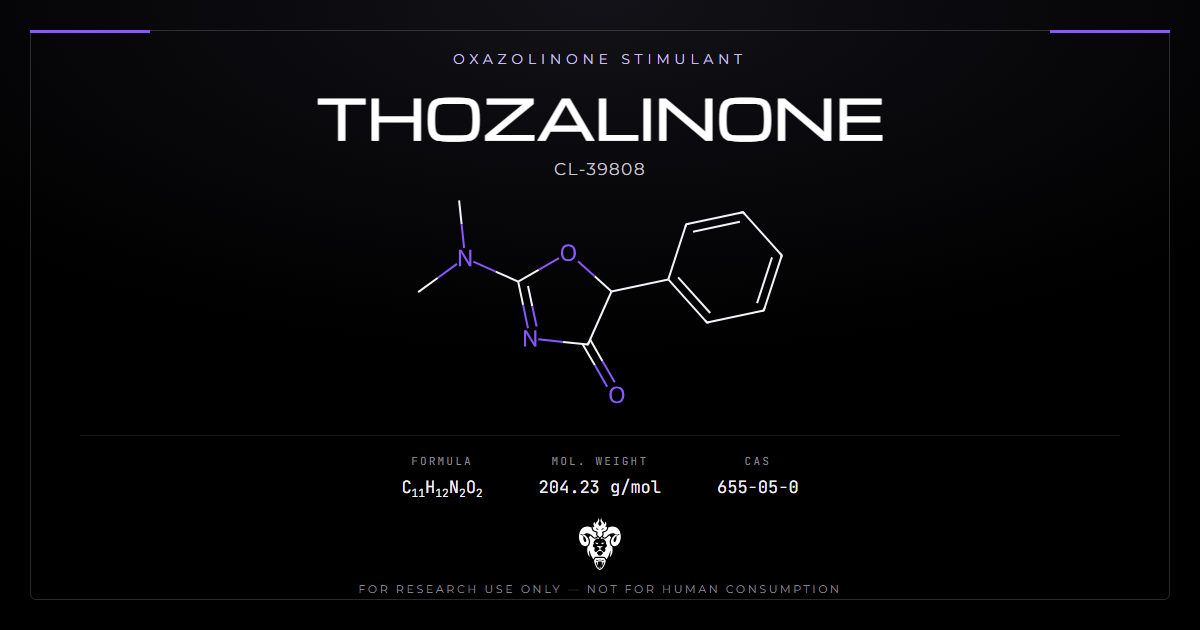
Thozalinone is the racemic compound 2-(dimethylamino)-5-phenyl-1,3-oxazol-4(5H)-one, assigned CAS 655-05-0 and catalogued as PubChem CID 12602. It carried the developmental code CL-39808 and was marketed in Europe and South America under the brand name Stimsen.
| Property | Value |
|---|---|
| Molecular formula | C₁₁H₁₂N₂O₂ |
| Molecular weight | 204.23 g/mol |
| Monoisotopic mass | 204.0899 Da |
| InChIKey | JJSHYECKYLDYAR-UHFFFAOYSA-N |
| SMILES | CN(C)C1=NC(=O)C(O1)C2=CC=CC=C2 |
| Chirality | Racemic |
| UNII | 68X5932947 |
The core is a five-membered oxazolinone ring: an oxygen and a nitrogen in the ring, a ketone at position 4, a dimethylamino substituent at position 2, and a phenyl group at position 5. That C5 phenyl-bearing carbon is the stereocenter, and the compound was developed and studied as the racemate rather than as resolved enantiomers — a detail worth noting for anyone designing chiral separation or enantioselective activity work, since the enantiomers were never systematically compared.
The synthesis reported by Howell and colleagues proceeds by deprotonating ethyl mandelate with sodium hydride and adding the resulting alkoxide to dimethylcyanamide, which then undergoes intramolecular cyclization to close the oxazolinone ring [1].
Structure–Activity Context: The Pemoline Family
Thozalinone is best understood as one member of a small, tightly related series. It is the N,N-dimethyl analog of pemoline (2-amino-5-phenyl-1,3-oxazol-4(5H)-one) — the same scaffold with two methyl groups added to the exocyclic amine. Fenozolone is the N-ethyl variant. Further out, aminorex and 4-methylaminorex share the 2-amino-oxazoline motif but lack the 4-keto group.
Lindberg and Pedersen ran a systematic survey of this chemical space in 1968, preparing and comparing a series of 2-amino-5-aryl-4-oxo-2-oxazolines to map how substitution at the 2-amino position and on the C5 aryl ring shifted activity [2]. That paper remains the single most useful reference for anyone approaching this family from a structure–activity direction, because it treats the compounds as a series rather than in isolation.
The practical consequence for research design is that these compounds are not interchangeable. Pemoline and thozalinone differ by two methyl groups and are frequently described as having different primary mechanisms, and pemoline’s well-documented hepatotoxicity signal — the reason it was ultimately withdrawn from several markets — does not automatically transfer to or away from its analogs. Substituting one for another in a protocol is a mechanistic change, not a convenience.
Mechanism of Action
Thozalinone is characterized in the literature as a dopaminergic stimulant that acts primarily by inducing the release of dopamine, with a secondary and considerably weaker effect on norepinephrine. This is the mechanism it shares in broad terms with pemoline and aminorex, though the relative weighting of dopamine versus norepinephrine differs across the series.
The most informative mechanistic evidence comes indirectly, from the assay work in which thozalinone was used as a tool rather than as a subject. Yen-Koo and Balazs used thozalinone as the dopaminergic challenge agent in a mouse model designed to detect neuroleptic-induced dopaminergic supersensitivity — administering it after chronic neuroleptic exposure and withdrawal, then measuring the resulting gnawing behavior as a readout of receptor sensitivity [3]. A follow-up study inverted the design, using neuroleptic pretreatment to block thozalinone-induced gnawing and comparing the resulting inhibition profile against apomorphine, amphetamine, and DOPA [4].
That pairing is what makes the compound analytically interesting. Apomorphine is a direct receptor agonist; amphetamine is a releaser and reuptake inhibitor; DOPA is a precursor. Thozalinone producing the same stereotyped behavioral endpoint as all three, while being blocked by the same antagonists, places it firmly in the dopaminergic pathway — and its behavior across those comparisons is what supports the releasing-agent classification rather than direct agonism.
A 1972 American Cyanamid patent covering thozalinone in parkinsonism additionally claims an increase in brain dopamine synthesis relative to dextroamphetamine [5]. This is a patent claim rather than a peer-reviewed finding and should be weighted accordingly, but it is the one substantive assertion in the record that distinguishes thozalinone’s mechanism from a straightforward release-and-reuptake profile, and it has never been independently replicated in the open literature. That gap is arguably the most interesting open question about the compound.
For a mechanistically adjacent comparison, bromantane approaches dopaminergic modulation from the opposite direction — upregulating tyrosine hydroxylase expression rather than driving release — while adrafinil represents the wakefulness-promoting branch of the same broad space with a distinct transporter profile. Placing all three against one another in the same assay is a more informative design than any of them in isolation.
The 1965 Pharmacology Profile
Greenblatt and Osterberg’s characterization in Toxicology and Applied Pharmacology remains the primary source for essentially everything known about thozalinone’s preclinical behavior [6]. Their findings, as reported:
- Locomotor and exploratory activity increased in mice and rats, accompanied by preening, searching movements, and heightened sensitivity to auditory and tactile stimuli.
- No convulsive ceiling. Unlike amphetamine, the stimulant response did not progress into tremor or convulsion as the administered amount was raised across the tested range — a genuinely unusual property for a dopaminergic stimulant and the finding most frequently cited from the paper.
- Anorexigenic activity described as more pronounced and longer-lasting than amphetamine’s.
- No tolerance development observed over the study period.
- Minimal cardiovascular effects, and analeptic actions absent.
- Greater margin of safety in mice than amphetamine.
Two caveats matter here. First, this is a single 1965 paper using the methods of its era; none of it has been replicated with modern instrumentation, and “no tolerance observed” in a 1965 rodent protocol is a much weaker statement than the same phrase would be today. Second, the absence of an aggregation-toxicity effect and the absence of convulsive progression are both negative findings, which are considerably harder to establish than positive ones.
Bernstein and Latimer later placed thozalinone in a comparative behavioral-facilitation study alongside amphetamine, α-pipradrol, and methylphenidate, examining how each interacted with imipramine and desipramine [7]. That paper is the closest thing in the literature to a head-to-head positioning of thozalinone against the standard stimulant panel.
Clinical Investigation and Discontinuation
Thozalinone reached human trials on two separate indications. Gallant and colleagues ran a double-blind study in depressed outpatients in 1966 [8], and Leite and colleagues published a trial in obese patients in Brazil in 1971 under the Stimsen trade name [9]. Both are short reports in journals of limited circulation, and neither is available in full text through standard channels.
It did not persist. Thozalinone is not FDA-approved for any indication, has no ATC code assigned, and is not commercially marketed anywhere today. The most probable explanation is unremarkable: it was a mid-1960s stimulant entering a market that was about to turn sharply against stimulant prescribing, developed by a company whose pharmaceutical portfolio was being restructured, with efficacy data that were adequate rather than compelling. Compounds disappear for commercial reasons far more often than for scientific ones.
A caution on secondary sources. Several chemical-vendor listings for CAS 655-05-0 currently circulate claims that do not appear in any primary literature — including references to European clinical trials spanning 1980–2005, a double-blind study with specific remission percentages, BDNF upregulation findings, and a 2024 murine α-synuclein study. None of these correspond to any indexed publication. These appear to be machine-generated product descriptions, and they are worth recognizing as such before they propagate further. The verifiable record on thozalinone is small: roughly nine primary sources, most of them from 1962–1971.
Contemporary Research Applications
Where the compound retains genuine utility is as a structurally independent dopaminergic tool. When an experimental question requires confirming that an observed effect is pathway-driven rather than scaffold-driven, running a non-phenethylamine releasing agent alongside amphetamine is a meaningful control. Thozalinone is one of very few available compounds that fills that role.
It also functions as an analytical reference point for the 2-amino-oxazolin-4-one class. Method development for pemoline, fenozolone, and related structures in biological matrices benefits from having a well-characterized structural neighbor available for retention-time and fragmentation comparison.
Additional context on this compound class is collected in the Kimera nootropics research library.
Regulatory Status
Thozalinone is not listed in any schedule of the U.S. Controlled Substances Act. Vendor listings asserting that it is a scheduled substance are inaccurate.
That said, the regulatory picture is not as simple as its absence from the schedules implies. Aminorex and 4-methylaminorex — which share the 2-amino-oxazoline motif — are Schedule I, and pemoline was previously Schedule IV. Under 21 U.S.C. § 802(32)(A), a substance not itself scheduled may still be treated as a controlled substance analogue where it is structurally and pharmacologically substantially similar to a Schedule I or II substance and intended for human consumption. The intended-use element is not incidental to that definition; it is a required element of it.
This is the reason material of this class is supplied strictly for laboratory research use, with no dosing, administration, or human-use guidance provided through any channel. Thozalinone is sold for laboratory research applications only — not for human consumption, nor for medical, veterinary, or household use.
Analytical Verification
Compounds with a thin commercial history present a specific sourcing problem: with no active manufacturing base and no widely available reference standard, identity confirmation cannot lean on comparison against a certified material. It has to be established from first principles.
For this structural class that means mass spectrometry to confirm molecular weight and fragmentation consistent with the oxazolinone core, NMR to confirm the substitution pattern — particularly the dimethylamino signal that distinguishes thozalinone from pemoline and fenozolone — and HPLC for purity determination and detection of structurally related process impurities. The near-neighbors in this family are close enough that an assay capable of resolving them is not optional.
Third-party COA verification data for catalog material is published in full at the Kimera COA archive.
References
- Howell CF, Quinones NQ, Hardy RA Jr. 2-Amino-2-oxazolin-4-ones. I. Synthesis. J Org Chem. 1962;27(5):1679–1685. doi:10.1021/jo01052a047
- Lindberg UH, Pedersen J. Compounds related to pemoline. 2-amino-5-aryl-4-oxo-2-oxazolines. Acta Pharm Suec. 1968;5(1):15–22. PMID 4386169
- Yen-Koo HC, Balazs T. Detection of dopaminergic supersensitivity induced by neuroleptic drugs in mice. Drug Chem Toxicol. 1980;3(2):237–247. doi:10.3109/01480548009108286 · PMID 6112126
- Yen-Koo HC, Davis DA, Balazs T. Inhibition of dopaminergic agonist-induced gnawing behavior by neuroleptic drugs in mice. Drug Chem Toxicol. 1985;8(6):495–502. doi:10.3109/01480548509041072 · PMID 2868876
- Gray WD, Edward CE. Method of treating parkinsonism. U.S. Patent 3,665,075. American Cyanamid Co.; 1972. patents.google.com/patent/US3665075
- Greenblatt EN, Osterberg AC. Some pharmacologic properties of thozalinone, a new excitant. Toxicol Appl Pharmacol. 1965;7(4):566–578. doi:10.1016/0041-008X(65)90042-6 · PMID 4378772
- Bernstein BM, Latimer CN. Behavioral facilitation: the interaction of imipramine and desipramine with amphetamine, alpha-pipradrol, methylphenidate, and thozalinone. Psychopharmacologia. 1968;12(4):338–345. doi:10.1007/BF00401412 · PMID 4385109
- Gallant DM, Bishop MP, Scrignar CB, Hornsby L, Moore B, Inturrisi BB. A double-blind study of thozalinone (CL 39,808) in depressed outpatients. Curr Ther Res Clin Exp. 1966;8(12):621–622. PMID 4962734
- Leite AC, Liepen LL, Costa VP. Clinical trial of Stimsen (thozalinone) in the treatment of obese patients [in Portuguese]. Rev Bras Med. 1971;28(9):475–478. PMID 5139648
- National Center for Biotechnology Information. PubChem Compound Summary for CID 12602, Thozalinone. pubchem.ncbi.nlm.nih.gov/compound/12602
- National Center for Advancing Translational Sciences. Inxight Drugs: Thozalinone (UNII 68X5932947). drugs.ncats.io/substance/68X5932947
- U.S. Drug Enforcement Administration, Diversion Control Division. List of Controlled Substances and Regulated Chemicals. deadiversion.usdoj.gov
All compounds referenced are supplied for laboratory research use only. Nothing in this article constitutes dosing guidance, a therapeutic claim, or a recommendation for use in humans or animals.