
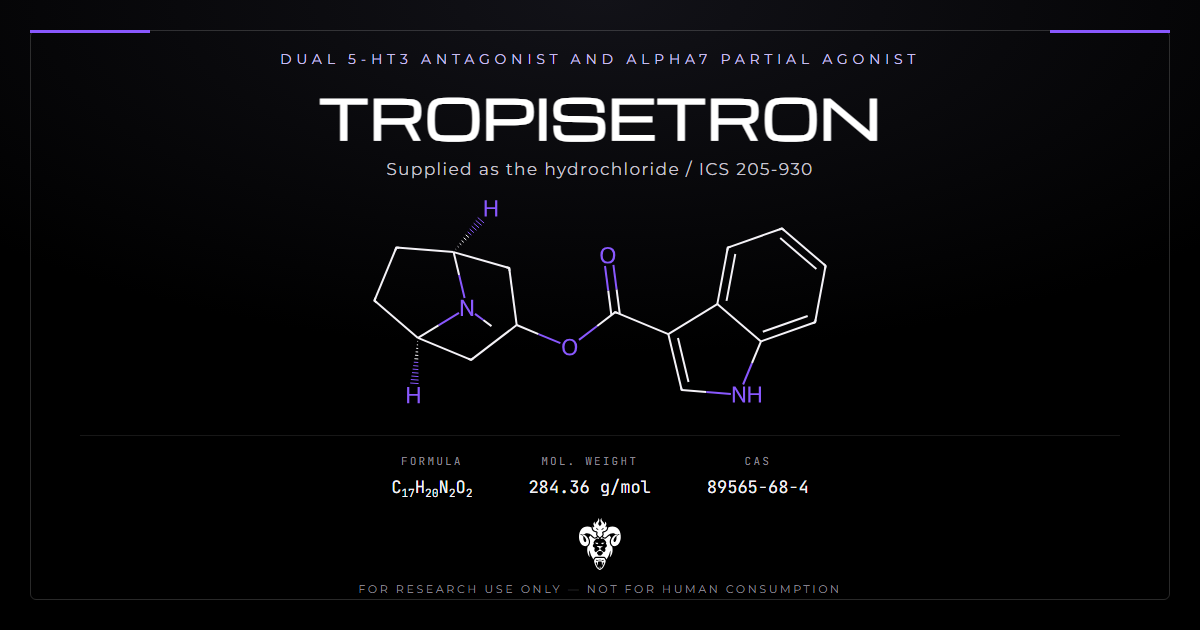
A ligand that binds two unrelated receptor families with high affinity is rare. Tropisetron does it. The molecule antagonises the serotonin 5-HT3 receptor, a ligand-gated ion channel, and acts as a partial agonist at the alpha7 nicotinic acetylcholine receptor, a different ion channel from a different gene family [1].
Its close structural relatives do neither. Ondansetron and granisetron share the setron pharmacophore and lack meaningful alpha7 activity [1][2]. That contrast is what makes this compound a reference tool rather than one antagonist among several.
Those two receptor families are the story this profile tells. Indexed antiemetic papers exist and sit outside it. Everything below reports laboratory findings. This material is for research use only, not for human or veterinary use. Tropisetron is the name this profile uses for that dual-family ligand. Write tropisetron on the notebook line before the lot number.
What tropisetron is
The molecule joins an indole-3-carboxylic acid ester to a tropane bicycle. Both halves matter, and the pharmacology of each has been separated experimentally [2].
Identity and physical data
| Property | Free base | Hydrochloride |
|---|---|---|
| PubChem CID | 656665 | 656664 |
| CAS number | 89565-68-4 | 105826-92-4 |
| Molecular formula | C17H20N2O2 | C17H21ClN2O2 |
| Molecular weight | 284.35 g/mol | 320.81 g/mol |
| InChIKey | ZNRGQMMCGHDTEI-FUNVUKJBSA-N | XIEGSJAEZIGKSA-KOQCZNHOSA-N |
| Development code | ICS 205-930 | Same compound |
| Chemical class | Tropane ester of indole-3-carboxylic acid | Hydrochloride salt |
The bridge in the middle
The systematic name is [(1R,5S)-8-methyl-8-azabicyclo[3.2.1]octan-3-yl] 1H-indole-3-carboxylate. That bicycle is the tropane skeleton, familiar from atropine and cocaine chemistry. The InChIKey stereo block reads FUNVUKJBSA rather than UHFFFAOYSA, so the record describes one defined diastereomer rather than a mixture. Confirming that block is the fastest identity check available on a certificate.
Why the codes matter in a literature search
Older papers write ICS 205-930 instead of the generic name. Searching one form alone loses the other, and the pharmacology from the 1980s sits mostly under the code. Both spellings belong in any systematic search of this compound.
Two receptors, one molecule
The 5-HT3 side
Tropisetron is a competitive antagonist at the 5-HT3 receptor, the only ligand-gated ion channel in the serotonin family. Setrons as a class occupy the orthosteric pocket at the subunit interface and hold the channel shut [3].
The alpha7 side
A 2001 study established the second activity [1]. The compound behaved as a potent and selective partial agonist at alpha7 nicotinic receptors, while two other 5-HT3 antagonists tested alongside, ondansetron and LY-278,584, showed no high-affinity alpha7 interaction. Quinuclidine analogues of the tropane half kept the alpha7 activity [1].
The affinity gap
The two activities do not sit at similar concentrations. Affinity differs by more than a thousandfold between the 5-HT3 receptor and the alpha7 receptor [4]. Any experiment using this compound has to state which receptor the chosen concentration addresses, because a concentration that saturates one leaves the other largely untouched.
Concentration ranges in practice
Design the experiment around the gap. A concentration chosen to block 5-HT3 receptors sits far below anything that engages alpha7, so a low-concentration result is a serotonin result by default. Testing the nicotinic side means working orders of magnitude higher, and at those concentrations the 5-HT3 receptor is fully blocked throughout.
That asymmetry has a useful consequence. A 5-HT3-selective comparator run alongside tropisetron isolates the nicotinic contribution without any change in concentration, which is exactly the control the rat hypoperfusion study used [9].
The structural evidence
Tropisetron bound to a soluble surrogate
Acetylcholine binding protein is a soluble homologue of the nicotinic receptor extracellular domain, and it crystallises well. A 2009 study solved Aplysia AChBP complexes with several partial agonists, including this one, at resolutions from 2.7 to 1.75 angstroms [5]. The protonated nitrogen hydrogen bonds to the carbonyl oxygen of tryptophan 147 in every structure.
Where partial agonism comes from
The same structures explain the partial part. Tight interactions with loop F fix the position of the indole substituent, and that position stops loop C from closing the way a full agonist allows [5]. Partial agonism appears here as a geometric constraint rather than a weaker binding energy, which is a satisfying result to have in hand.
The cautionary comparison
A 2017 paper put the limits of that approach plainly [4]. Granisetron co-crystallised with AChBP adopts an almost identical orientation to this compound, yet alpha7 receptors do not bind granisetron at all. Two ligands, one binding pose, opposite selectivity. Reading pharmacology off a homologue structure can mislead, and the authors said so in their title.
The PDB entries worth pulling
Two accessions carry the comparison. Entry 2WNC holds tropisetron bound to acetylcholine binding protein, and 2YME holds granisetron in the same protein [4]. Opening both in a viewer makes the 2017 argument in about a minute: the poses overlay, and the pharmacology does not (PubMed).
Structures from the same laboratory series also cover anabaseine and two benzylidene-anabaseine partial agonists [5]. Those give a partial agonist set to compare loop C positions across, rather than a single structure with nothing to measure against.
Structures at the real receptor
Cryo-electron microscopy has since resolved the full-length 5-HT3A receptor bound to several setrons [3][6]. Those datasets cover palonosetron, ondansetron and alosetron rather than this molecule, and they describe the competitive inhibition mechanism at the receptor itself. The tropane ester still lacks a published high-resolution structure at 5-HT3A.
Dissecting the pharmacophore
A 2005 study cut the molecule into pieces and tested each on oocytes expressing human alpha7, alpha4beta2 or alpha3beta4 receptors, plus rat 5-HT3A [2].
The tropane half carries alpha7 activity
Tropane and tropinone alone produced alpha7-selective agonist activity comparable to the intact compound. Tropinone proved more efficacious and roughly a hundredfold less potent [2]. Potency and efficacy separate cleanly in that comparison, which is the sort of result that only a fragment study gives.
The indole half adds selectivity
Some tropane fragments antagonised alpha3beta4 receptors while leaving alpha4beta2 alone [2]. The intact molecule inhibited alpha3beta4 more strongly than the bare fragments did. The indole is doing selectivity work, not affinity work, and that division is why the two halves are worth testing separately in any analogue programme.
Findings in cognition models
Each result below belongs to its model. None of it transfers to humans.
Auditory gating in DBA/2 mice
DBA/2 mice show a spontaneous deficit in inhibitory processing of the P20-N40 auditory evoked potential, treated as a rodent analogue of the human P50 response [7]. Injection improved the deficit in that strain, and the authors attributed the effect to alpha7 receptors [7].
Phencyclidine-induced deficits
A 2006 study gave subchronic treatment to mice after phencyclidine exposure and reported improvement in cognitive measures, again through alpha7 [8]. Order matters in that design: treatment followed the insult rather than preceding it.
Chronic cerebral hypoperfusion in rats
A 2020 study ran the cleanest comparison in this literature [9]. Rats received two-vessel occlusion surgery, then either this compound or granisetron, with spatial memory measured in a radial eight-arm maze. Only the alpha7-active molecule improved performance. Granisetron blocks the same 5-HT3 receptor and did nothing here, which points the effect at the nicotinic side.
Indexed P50 papers
A 2005 paper measured P50 auditory suppression in a clinical population [10]. That human endpoint sits outside this profile.
What P50 suppression measures in the laboratory
The paradigm is a paired click. A conditioning tone precedes a test tone by half a second, and the evoked response to each is recorded. Suppression means the second response is much smaller than the first. The ratio between them is the measure.
Reduced suppression has been tied to lower alpha7 receptor expression in the systems that paper reviews [10]. That link is why an alpha7-active molecule was tested against this endpoint rather than against a symptom scale. The readout is electrophysiological. It can serve as a target-engagement proxy in animal work such as the DBA/2 mouse P20-N40 assay [7].
Cite the 2005 paper for the fact that a file exists. Do not import its human findings into a laboratory protocol.
Neuroprotection and inflammation lines
The alpha7 anti-inflammatory route
Alpha7 receptors sit on immune cells and dampen cytokine release. A 2015 review collected the neuroprotective work on this compound and argued the alpha7 activity carries most of it [11]. That same year, a target review added a third claimed interaction: binding to the amyloid precursor protein ectodomain [12].
Rodent inflammation models
A 2020 rat study of cyclophosphamide-induced haemorrhagic cystitis reported reduced tissue damage and inflammatory markers [13]. The model is urological and far from the receptor’s usual context, which is the point: the anti-inflammatory readout follows the receptor rather than the organ.
Cancer cell work
A 2023 study reported that several 5-HT3 antagonists killed melanoma cells in culture through apoptosis, microtubule depolymerisation, ERK activation and NF-kappaB downregulation [14]. Those concentrations sit far above receptor-occupancy levels, and the authors treat the mechanism as separate from 5-HT3 blockade.
Metabolism and pharmacogenetics
CYP2D6 clears this compound, and that enzyme is polymorphic across donors. A pharmacogenetics guideline covering ondansetron and tropisetron was published in 2017 [15]. A pathway summary in PharmGKB sets out the metabolic route and the transporters involved [16]. Those documents exist. Their human dosing recommendations sit outside this profile. The useful laboratory fact is the enzyme and the transporter list.
Why this matters in the laboratory
Metabolic variability is a property of the compound worth knowing when reading any in vivo dataset. Exposure differences between poor and ultrarapid metabolisers can exceed the difference between two doses, which complicates comparison across studies that did not genotype their subjects. For in vitro work the issue disappears, and that is one reason receptor-level data on this molecule is more consistent than its whole-animal data.
The transporter angle
Metabolism is only half the disposition question. The PharmGKB pathway summary covers transporters alongside the enzymes [16]. Uptake transporters shape hepatic exposure for cationic compounds of this shape, and a molecule carrying a protonated tropane nitrogen at physiological pH qualifies. In cell work, transporter expression differs between lines, so intracellular exposure need not match the medium concentration.
Physicochemical properties and handling
| Property | Detail |
|---|---|
| Supplied form | Hydrochloride salt, crystalline solid |
| Salt correction | 1.13 mg salt delivers 1.00 mg free base |
| Solubility | Salt is water soluble; free base favours DMSO or ethanol |
| Storage, solid | Store at minus 20 degrees Celsius, desiccated, protected from light |
| Storage, solution | Store at minus 20 degrees Celsius, single-use aliquots |
| Stability note | The ester bond hydrolyses under strong acid or base; keep stocks near neutral |
| Handling | Standard laboratory controls for a fine powder |
The ester is the vulnerable bond
Indole-3-carboxylate esters hydrolyse to the free acid and the alcohol under harsh pH. Aqueous stocks held at extremes of pH lose material, and the degradation products are chromatographically distinct. Keep buffers near neutral and prepare working dilutions fresh.
Storage guidance is a house recommendation. Analytical documentation is per-lot release testing.
Light and the indole ring
Indoles photo-oxidise. Amber glass or foil is enough for routine work, and a stock left on an open bench under fluorescent light for a week is not worth trusting. Record the preparation date on the tube. Colour change in a stored solution is a late signal rather than an early one.
Salt arithmetic
Molecular weight runs 320.81 for the hydrochloride against 284.35 for the free base. The correction factor is 1.13. That is smaller than the phosphate-salt corrections seen elsewhere in the catalogue, and it still moves a curve if ignored.
Analytical characterization
Mass and ultraviolet detection
Electrospray mass spectrometry gives a protonated ion at m/z 285.2 for the C17H20N2O2 free base. The indole ring absorbs strongly in the ultraviolet near 280 nanometres, which makes routine HPLC purity work straightforward. Batch documentation for catalogue material sits in the certificate of analysis database.
What a certificate should separate
Two impurity classes matter. The hydrolysis products, indole-3-carboxylic acid and the tropanol, elute well away from the parent under reversed-phase conditions. The diastereomeric ester at the 3-position is the harder case, since it shares a formula and a mass with the target and needs chromatographic resolution rather than spectrometric detection.
Confirming the tropane geometry
Position 3 of a tropane ester accepts its substituent in two orientations. Those two isomers share a formula, an exact mass and most of their ultraviolet spectrum. Proton NMR separates them: the H3 signal shifts and its coupling pattern changes between the two arrangements, and nuclear Overhauser contacts to the N-methyl group differ. Identity work on tropisetron therefore needs an NMR experiment or a chromatographic comparison against a qualified standard, since mass spectrometry alone cannot make that call.
Water content in a hygroscopic salt
Hydrochloride salts pick up water. A mass measured on a humid day can carry a percent or more of it, which shifts every concentration downstream by the same fraction. Karl Fischer titration answers the question directly, and a certificate that reports water content lets you correct for it. Assay purity and water content are separate numbers, and only reading both gives a real concentration.
Fluorescent alternatives exist
Researchers studying this receptor family now have labelled ligands for binding assays [17]. A 2015 paper characterised several fluorescent tools for 5-HT3 pharmacology, which matters when radioligand work is impractical.
Where it sits among cholinergic research compounds
| Compound | Studied mechanism | Class |
|---|---|---|
| Tropisetron | 5-HT3 antagonism, alpha7 nicotinic partial agonism | Tropane indole ester |
| Alpha GPC | Choline donor for acetylcholine synthesis | Phospholipid precursor |
| CDP-Choline | Kennedy pathway intermediate, membrane phospholipids | Nucleotide precursor |
| 9-ME-BC | Dopaminergic signalling, neurotrophic factor induction | Beta-carboline |
Three of these four supply or support cholinergic machinery. Only one acts directly on a nicotinic receptor. Further reading sits in the nootropics research library.
Reading the antiemetic literature
Most of this compound’s PubMed footprint is antiemetic work. That literature answers a therapeutic question this article does not address, and it swamps a naive search.
Filtering the search
Restrict to title and abstract fields, then combine with a mechanism term. A query pairing tropisetron with alpha7, nicotinic or acetylcholine binding protein returns tens of records rather than thousands. Reading the query translation PubMed prints back is worth the extra second: term mapping can expand a compound name into a drug class and inflate the count beyond recognition.
The receptor literature is smaller and older
Core pharmacology on tropisetron dates from 2001 to 2009 [1][2] and [5]. The structural work continues, the cognition models cluster in the 2000s, and the inflammation papers are recent. Sorting the record by decade makes the shape of the evidence obvious in a way a relevance-ranked list does not.
What this literature does not establish
The dual pharmacology complicates every result
Any in vivo finding has two candidate explanations, and few studies separate them. The granisetron comparison is the exception that shows how to do it [9]. Ask of any new result whether a 5-HT3-only control was run.
Species differ across the assay set
The fragment study measured human alpha7, alpha4beta2 and alpha3beta4 receptors alongside a rat 5-HT3A receptor [2]. That mix is normal in the field and it complicates direct comparison. Setron affinity at 5-HT3 receptors is known to vary between species, so a rodent number and a human number are not interchangeable. Check which species each receptor came from before building a selectivity ratio out of two papers.
Three claimed targets, uneven evidence
The 5-HT3 and alpha7 activities rest on direct receptor measurements [1][2]. The amyloid precursor protein interaction rests on less [12]. Weight them accordingly.
Structural coverage is indirect
Published structures place this ligand in a soluble surrogate protein, not in either receptor it acts on [5]. The 2017 cautionary paper shows what that gap can hide [4].
Human data is narrow
One indexed P50 paper is the extent of the alpha7-related human evidence discussed here [10]. The antiemetic literature is far larger and addresses a different question. Both sit outside this profile.
Frequently asked questions
What makes tropisetron different from ondansetron?
Alpha7 nicotinic activity. Both block 5-HT3 receptors; only one is a potent alpha7 partial agonist [1].
Which half of the molecule binds alpha7?
The tropane half. Tropane and tropinone fragments retain alpha7-selective agonist activity on their own [2].
Is there a crystal structure of the compound at its receptors?
Not at either receptor. The published structure places it in acetylcholine binding protein, a soluble surrogate [5].
How much hydrochloride salt equals a given free base mass?
Multiply by 1.13. The salt is 320.81 g/mol against 284.35 for the free base.
Why do older papers call it ICS 205-930?
That was the development code. Literature searches need both terms to return the full record.
Does the compound bind alpha4beta2 nicotinic receptors?
Fragment testing found no effect there, while some tropane fragments antagonised alpha3beta4 [2]. Selectivity within the nicotinic family is part of what makes tropisetron useful.
Why do searches return thousands of papers?
Most of them are clinical antiemetic studies. Field-restricted searching with a mechanism term cuts the set to the receptor pharmacology.
What degrades in storage?
The ester bond. Extremes of pH hydrolyse it to indole-3-carboxylic acid and the tropanol, both of which separate cleanly by reversed-phase chromatography.
References
- Macor JE, Gurley D, Lanthorn T, et al. The 5-HT3 antagonist tropisetron (ICS 205-930) is a potent and selective alpha7 nicotinic receptor partial agonist. Bioorg Med Chem Lett. 2001;11(3):319-21. PubMed DOI
- Papke RL, Schiff HC, Jack BA, et al. Molecular dissection of tropisetron, an alpha7 nicotinic acetylcholine receptor-selective partial agonist. Neurosci Lett. 2005;378(3):140-4. PubMed DOI
- Basak S, Kumar A, Ramsey S, et al. High-resolution structures of multiple 5-HT3AR-setron complexes reveal a novel mechanism of competitive inhibition. Elife. 2020;9:e57870. PubMed DOI
- Ruepp MD, Wei H, Leuenberger M, et al. The binding orientations of structurally-related ligands can differ; a cautionary note. Neuropharmacology. 2017;119:48-61. PubMed DOI
- Hibbs RE, Sulzenbacher G, Shi J, et al. Structural determinants for interaction of partial agonists with acetylcholine binding protein and neuronal alpha7 nicotinic acetylcholine receptor. EMBO J. 2009;28(19):3040-51. PubMed DOI
- Zarkadas E, Zhang H, Cai W, et al. The binding of palonosetron and other antiemetic drugs to the serotonin 5-HT3 receptor. Structure. 2020;28(10):1131-1140.e4. PubMed DOI
- Hashimoto K, Iyo M, Freedman R, et al. Tropisetron improves deficient inhibitory auditory processing in DBA/2 mice: role of alpha 7 nicotinic acetylcholine receptors. Psychopharmacology (Berl). 2005;183(1):13-9. PubMed DOI
- Hashimoto K, Fujita Y, Ishima T, et al. Phencyclidine-induced cognitive deficits in mice are improved by subsequent subchronic administration of tropisetron: role of alpha7 nicotinic receptors. Eur J Pharmacol. 2006;553(1-3):191-5. PubMed DOI
- Divanbeigi A, Nasehi M, Vaseghi S, et al. Tropisetron but not granisetron ameliorates spatial memory impairment induced by chronic cerebral hypoperfusion. Neurochem Res. 2020;45(11):2631-2640. PubMed DOI
- Koike K, Hashimoto K, Takai N, et al. Tropisetron improves deficits in auditory P50 suppression in schizophrenia. Schizophr Res. 2005;76(1):67-72. PubMed DOI
- Khalifeh S, Fakhfouri G, Mehr SE, et al. Beyond the 5-HT3 receptors: a role for alpha7 nACh receptors in neuroprotective aspects of tropisetron. Hum Exp Toxicol. 2015;34(9):922-31. PubMed DOI
- Hashimoto K. Tropisetron and its targets in Alzheimer’s disease. Expert Opin Ther Targets. 2015;19(1):1-5. PubMed DOI
- Zirak MR, Karimi G, Rahimian R, et al. Tropisetron ameliorates cyclophosphamide-induced hemorrhagic cystitis in rats. Eur J Pharmacol. 2020;883:173310. PubMed DOI
- Barzegar-Fallah A, Alimoradi H, Dunlop JL, et al. Serotonin type-3 receptor antagonists selectively kill melanoma cells through classical apoptosis, microtubule depolymerisation, ERK activation, and NF-kappaB downregulation. Cell Biol Toxicol. 2023;39(3):1119-1135. PubMed DOI
- Bell GC, Caudle KE, Whirl-Carrillo M, et al. Clinical Pharmacogenetics Implementation Consortium (CPIC) guideline for CYP2D6 genotype and use of ondansetron and tropisetron. Clin Pharmacol Ther. 2017;102(2):213-218. PubMed DOI
- Huddart R, Altman RB, Klein TE. PharmGKB summary: ondansetron and tropisetron pathways, pharmacokinetics and pharmacodynamics. Pharmacogenet Genomics. 2019;29(4):91-97. PubMed DOI
- Jack T, Simonin J, Ruepp MD, et al. Characterizing new fluorescent tools for studying 5-HT3 receptor pharmacology. Neuropharmacology. 2015;90:63-73. PubMed DOI