
Everything below reports findings from cell cultures, isolated tissue and animals. This material is for research use only, not for human or veterinary use.
Y134 is a benzothiophene built on the raloxifene core with a different basic side chain, developed at the Shanghai Institute of Materia Medica. The compound has a primary pharmacology paper, two secondary appearances in the literature, and a set of numbers worth knowing before anyone quotes a selectivity figure.
The numbers matter because inflated ones circulate. Published potency values place it at 0.52 nM against one estrogen receptor subtype and 2.94 nM against the other. That is roughly a sixfold preference [1]. Figures an order of magnitude larger appear in supplier copy without a named assay behind them.
What the primary paper reports is more interesting than the inflated claim anyway. In ovariectomised rats, Y134 outperformed raloxifene on mammary endpoints while matching it on uterine ones. That dissociation is the specific result the whole compound class exists to achieve [1].
This article covers the chemistry, the receptor biology that makes tissue selectivity possible, what the three published studies establish, and how to verify the material.
Chemical identity: what you are actually handling
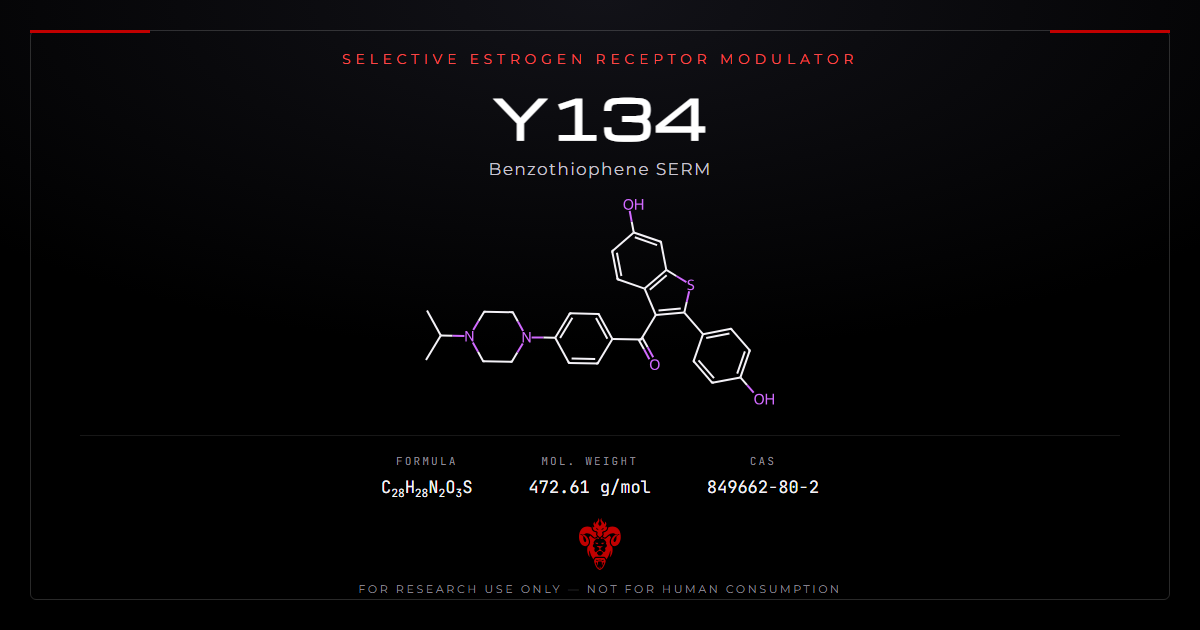
Y134 is a benzothiophene bearing two phenols and a basic piperazine.
| Property | Value |
|---|---|
| IUPAC name | [6-hydroxy-2-(4-hydroxyphenyl)-1-benzothiophen-3-yl]-[4-(4-propan-2-ylpiperazin-1-yl)phenyl]methanone |
| CAS | 849662-80-2 |
| Molecular formula | C28H28N2O3S |
| Molecular weight | 472.60 g/mol |
| PubChem CID | 11784736 |
| InChIKey | LQEOPHGPHCWOAC-UHFFFAOYSA-N |
| ChEMBL | CHEMBL178334 |
| Stereocentres | None |
| Parent scaffold | Raloxifene |
| Originator | Shanghai Institute of Materia Medica |
The raloxifene core, and where it diverges
Three features define the molecule. A benzothiophene core carries a phenol at position 6. A second phenol sits on the 2-aryl ring. An aroyl group at position 3 carries the basic amine.
Y134 shares the first three of those with raloxifene exactly: the 6-hydroxybenzothiophene, the 4-hydroxyphenyl at position 2, and the 3-aroyl ketone. The divergence is in the side chain.
Raloxifene carries a piperidinylethoxy group linked through an ether. Y134 carries an isopropylpiperazine attached directly to the aryl ring, with no ether linker.
That change does two things worth noting. Removing the ether removes a metabolically vulnerable linkage. And replacing a piperidine with a piperazine adds a second nitrogen, which shifts both basicity and the hydrogen-bonding pattern of the side chain.
The two phenols are the pharmacophore. In this class, the phenolic hydroxyl mimics the 3-hydroxyl of estradiol and anchors the ligand in the receptor pocket. The basic side chain then projects out of the pocket, disrupting the receptor conformation that recruits coactivators.
No stereocentres
The molecule carries no stereocentre, which removes the chiral purity question that dominates most compounds in this catalogue. Chemical purity and stereochemical purity are the same measurement here.
The receptor biology behind Y134 selectivity
Understanding what a selective estrogen receptor modulator claims requires understanding why one receptor can produce opposite outcomes in different tissues.
Two receptor subtypes
Estrogen acts through two nuclear receptors, ERα and ERβ, which have distinct functions and differential expression across tissues [11].
They are not redundant. Gene expression profiling in mouse aorta, using receptor-deficient animals, found the two subtypes regulating distinct and largely non-overlapping gene sets. ERα drove most of the estrogen-mediated increases in expression. ERβ mediated nearly 90 percent of the decreases [12].
In the mammary gland specifically, ERα is the subtype required for normal differentiation and growth, evidence coming from receptor-deficient animals [13].
Y134 binds both, with the preference described above. A compound with modest subtype preference is not a subtype-selective tool, and calling it one overstates the case.
Selectivity comes from conformation, not from binding
The deeper explanation for tissue selectivity has little to do with which subtype a ligand prefers.
Different ligands induce distinct structural changes in the receptor. Those conformations determine which coactivator and corepressor proteins the receptor can recruit [4]. The outcome in any given cell then depends on three further things: the relative expression of those coregulators, the receptor form present, and the promoter of the target gene [4].
That model explains the class’s defining oddity. Tamoxifen and raloxifene both antagonise in breast and act as agonists in bone, yet only tamoxifen shows agonist activity in the uterus [4].
Direct evidence has accumulated since. Proteomic mapping of nuclear receptor interactomes in breast cancer cells compared four ligands. The partners recruited by estradiol differed markedly from those recruited by tamoxifen, raloxifene or fulvestrant. Those three antagonists also differed significantly from one another [7].
Work in ovarian cancer cell lines made the mechanism concrete. Estradiol recruited coactivators including SRC-1, SRC-3 and CBP to target gene promoters, and induced expression. Raloxifene bound the same promoter sites but recruited corepressors instead, among them HDAC2, N-CoR and SMRT. It induced nothing [9].
Expression profiling reinforces the picture, with different antiestrogens producing distinct gene regulation signatures rather than a common antagonist pattern [8]. Reviews of the field summarise the consensus: ligand activity is determined primarily by the conformation it imposes and by which coregulators the resulting complex can engage [6][10].
Structural work has mapped how subtype preference itself arises. Crystal structures of receptor ligand-binding domains show specific residues discriminating between ligand scaffolds [11].
Antagonism is not simply blocked agonism
One further complication deserves stating, because it undermines a common shorthand.
Antiestrogens are usually described as compounds that block what estrogens do. Katzenellenbogen and colleagues documented a case running the other way [5]. Quinone reductase, a phase II detoxifying enzyme, is up-regulated by antiestrogens in a receptor-dependent manner in breast cancer cells, and that response is antagonised by estrogens [5].
They termed the pattern reversed pharmacology, and it means the antagonist is the active agent at that gene while the hormone opposes it. The response also proceeded through an electrophile response element rather than a classical estrogen response element [5].
Two further findings from the same work bear on how ligands are classified. Compounds acting as mixed agonist-antagonists through ERα behaved as pure antagonists through ERβ at estrogen-response-element-containing genes. And tamoxifen agonism specifically required the activation function 1 region of ERα, shown using chimeric receptor proteins [5].
The practical consequence for any experiment is that agonist and antagonist are not fixed properties of a molecule. They are properties of a molecule at a particular gene, in a particular cell, through a particular receptor subtype.
What the published record establishes
Three papers mention Y134. One characterises it, and two use it.
The characterisation study
Ning and colleagues set out to characterise a new class of modulators built on the raloxifene core. They evaluated five analogues drawn from two structural series [1].
Receptor potency came from a reporter assay in CV-1 cells. The cells were cotransfected with plasmids carrying either receptor subtype and an estrogen-response-element-driven luciferase construct. Y134 showed half-maximal inhibitory concentrations of 0.52 nM at ERα and 2.94 nM at ERβ, comparable to raloxifene [1].
Cytotoxicity was low, with little observed below 10 µM [1]. That separation between the nanomolar receptor activity and the micromolar cytotoxicity threshold is what makes the compound usable as a tool.
In cell proliferation assays, Y134 suppressed estrogen-stimulated proliferation of two receptor-positive human breast cancer lines, MCF-7 and T47D [1].
The animal comparison
The in vivo work is the part that distinguishes this compound, and the design deserves description.
Ning and colleagues gave ovariectomised female rats Y134 or raloxifene at identical doses. They then measured uterine and mammary gland growth, using wet weight, BrdU incorporation and terminal end bud counts as indicators [1].
Terminal end buds are the proliferative structures at the growing tips of mammary ducts. Their outgrowth is a sensitive readout of estrogenic drive in the gland.
Y134 proved more effective than raloxifene at arresting estrogen-induced terminal end bud outgrowth and mammary gland DNA synthesis. Inhibitory effects on the uterus were comparable between the two compounds [1].
Read that pairing carefully, because it is the whole result. Greater effect in one tissue with equal effect in another improves the ratio. That is what tissue selectivity means operationally. The authors concluded that Y134 shows better mammary gland selectivity than raloxifene [1].
Use as a tool compound
Two later papers used Y134 rather than studying it, and both are informative about how the compound is regarded.
Zhang and colleagues examined how ovarian hormones regulate dopamine neuron firing in the ventral tegmental area. They used Y134 as a selective ERα antagonist alongside raloxifene. Pretreatment with either compound largely attenuated cocaine-induced inhibition of dopamine neuron firing [2].
Patel and colleagues included Y134 in a panel of modulators applied to primary human vaginal epithelial cells. They tested effects on secretion of two antimicrobial peptides. Estradiol decreased secretion of both. Progesterone and the four modulators tested, Y134 among them, had no effect [3].
That second result is worth keeping. A well-documented negative finding in a defined system is genuinely useful information, and it indicates the compound does not act as an agonist in that particular epithelium.
Where Y134 sits among the benzothiophenes
Placing the compound against better-developed members clarifies what a citation to it supports.
| Compound | Core | Tissue profile reported | Evidence depth |
|---|---|---|---|
| Tamoxifen | Triphenylethylene | Breast antagonist, bone agonist, uterine agonist [4] | Extensive clinical |
| Raloxifene | Benzothiophene | Breast antagonist, bone agonist, uterine neutral [4] | Extensive clinical |
| Fulvestrant | Steroidal | Pure antagonist [7] | Extensive clinical |
| Y134 | Benzothiophene | Greater mammary effect than raloxifene, comparable uterine effect [1] | One preclinical study |
The pattern in the first three rows is the reason the class is interesting. Same receptor, three ligands, three different tissue profiles.
Y134 belongs in the fourth row and nowhere higher. Its single comparison is against raloxifene on two endpoints in one model, which supports a narrow claim about a ratio and nothing about clinical behaviour.
What the record does not establish
The limits are as important as the findings.
There is no pharmacokinetic study, no toxicology, no chronic dosing data, and no second species. The animal work is a single comparison in ovariectomised rats over the endpoints described.
No human study of any kind exists. Y134 holds no international nonproprietary name and no marketing approval in any jurisdiction.
No independent replication of the mammary selectivity finding has been published. The characterisation comes from one group, and the two subsequent papers used the compound rather than testing that claim.
Selectivity figures larger than roughly sixfold, quoted without a named assay, do not come from the published record [1].
Two further gaps are worth naming precisely, because they limit what the mammary result can support.
The comparison ran at a single matched dose rather than across a dose range [1]. A ratio measured at one dose does not establish that the ratio holds at other doses, and partial agonists in receptor pharmacology routinely show dose-dependent selectivity.
And the endpoints were structural and proliferative rather than functional. Terminal end bud counts and DNA synthesis measure tissue growth, which is a reasonable proxy for estrogenic drive but not the same thing as a clinical outcome. No study has followed the compound to any downstream endpoint.
Physicochemical properties and handling
The molecule carries two phenols, a ketone, a benzothiophene and a basic piperazine.
The phenols are the reactive centres and the stability concern. Electron-rich phenols oxidise on exposure to air and light, and their oxidation products usually carry colour. Discoloration of the solid toward yellow or brown therefore signals degradation.
The piperazine is basic and will be protonated at physiological pH. It will form salts with acids, so confirm whether the material is free base or a salt before converting mass to moles.
The benzothiophene gives strong ultraviolet absorbance, which makes HPLC-UV detection straightforward and sensitive.
Aqueous solubility is limited despite the basic nitrogen, as the fused aromatic core works against it. Dimethyl sulfoxide is the usual stock solvent. Store the solid sealed, dry, cold and dark, and prepare solutions fresh.
Analytical characterisation
Four checks cover this compound.
Accurate mass confirms C28H28N2O3S at 472.60. One sulfur produces a visible M+2 contribution, and two nitrogens with three oxygens give a distinctive composition.
Proton NMR distinguishes Y134 from raloxifene directly. Raloxifene shows an ethoxy linker as two characteristic multiplets. Y134 has no ether linker at all, and instead shows the isopropyl doublet and septet of its piperazine substituent. The two spectra are not confusable.
Phenol content deserves confirmation. Both hydroxyls are required for receptor binding, and a methylated impurity would lose activity while remaining chromatographically similar.
Oxidation products, by a stability-indicating method, given the two phenols.
What a rigorous certificate should contain
Chromatographic purity with column and detection conditions stated.
Accurate mass confirming the molecular formula.
Structural confirmation by NMR, explicitly distinguishing the compound from raloxifene.
Salt form, stated.
Residual solvents from synthesis.
No chiral method is required, since the molecule has no stereocentre.
Kimera publishes third-party certificates of analysis for every lot in its COA database. Laboratories source Y134 as a benzothiophene receptor-modulator reference, sometimes alongside AC-262536 or RAD-140 (Testolone), which modulate a different nuclear receptor. Related chemistry appears in the endocrine category.
Common misclassifications
Four errors recur.
Y134 is described as having no published pharmacology. A full characterisation paper exists, covering receptor potency, cell proliferation and an ovariectomised rat comparison [1].
Its subtype selectivity is inflated. The published values give roughly a sixfold preference for ERα in a reporter assay, not the much larger ratios sometimes quoted [1].
Sources file it as a SARM. Y134 acts on the estrogen receptor, not the androgen receptor. Those two nuclear receptors have different ligands, different coregulator relationships and different tissue distributions.
Copy calls it a raloxifene equivalent. It shares the core and differs in the side chain, and the published comparison found the two compounds differing in mammary effect at matched dose [1].
Experimental design considerations
Include a raloxifene arm. The only published claim for this compound is relative to raloxifene, so a comparison without it cannot reproduce or test that claim [1].
Measure two tissues at minimum. Selectivity is a ratio, and a single-tissue readout cannot report one. The published design used mammary and uterine endpoints together [1].
Use a gonadectomised model, or justify not doing so. The animal work used ovariectomised rats, where endogenous estrogen is removed and the compound acts against a defined background [1].
Specify which receptor subtype the hypothesis concerns. A sixfold preference is not subtype selectivity. Attributing an effect to one subtype needs a subtype-selective comparator or a knockout to support it [11][12].
Keep concentrations below the cytotoxicity threshold. Little cytotoxicity appeared below 10 µM, and the receptor activity sits three to four orders of magnitude lower [1].
Frequently asked questions
What is Y134? A raloxifene-derived benzothiophene selective estrogen receptor modulator, CAS 849662-80-2, from the Shanghai Institute of Materia Medica. Kimera supplies it as a laboratory research material.
How potent is it? Half-maximal inhibitory concentrations of 0.52 nM at ERα and 2.94 nM at ERβ in a reporter assay, comparable to raloxifene [1].
How selective is it between subtypes? Roughly sixfold for ERα in that assay. Larger figures quoted elsewhere lack a published source [1].
How does it differ from raloxifene? The core is the same. The side chain differs, with an isopropylpiperazine attached directly to the aryl ring in place of raloxifene’s piperidinylethoxy ether.
What did the animal study find? In ovariectomised rats at matched dose, greater arrest of estrogen-induced terminal end bud outgrowth and mammary DNA synthesis than raloxifene, with comparable uterine effects [1].
Does it need a chiral method? No. The molecule has no stereocentre.
Is it approved anywhere? No. It has no international nonproprietary name, no approval, and no published human study.
Why does the side chain matter so much in this class? The phenol anchors the ligand in the binding pocket, while the basic side chain projects outward and blocks the receptor surface that coactivators dock onto. Changing that chain changes which coregulators can bind, and therefore what the compound does in a given tissue [4][7].
Can agonist and antagonist labels be relied on? Only with the tissue and target gene specified. The same ligand can act as an agonist at one gene and an antagonist at another, and the direction can reverse between receptor subtypes [5].
Summary of the evidence
Identity: C28H28N2O3S, 472.60 g/mol, benzothiophene core, two phenols, one basic piperazine, no stereocentres.
Receptor pharmacology: 0.52 nM at ERα and 2.94 nM at ERβ by reporter assay, comparable in potency to raloxifene [1].
Cellular record: suppression of estrogen-stimulated proliferation in two receptor-positive breast cancer lines, with little cytotoxicity below 10 µM [1].
Animal record: one ovariectomised rat study, reporting greater mammary effect than raloxifene at matched dose with comparable uterine effect [1].
Tool use: applied as a selective ERα antagonist in a dopamine neuron study [2], and as one arm of a modulator panel in vaginal epithelial cells where it produced no effect [3].
Mechanistic context: tissue selectivity in this class arises from ligand-induced receptor conformation and differential coregulator recruitment, rather than from subtype binding preference [4][6], [7][9] and [10]. Agonist and antagonist behaviour can even reverse at particular genes [5].
Gaps: no pharmacokinetics, no toxicology, no second species, no replication, no human data.
Status: preclinical research material, unapproved anywhere.
References
- Ning M, Zhou C, Weng J, et al. Biological activities of a novel selective oestrogen receptor modulator derived from raloxifene (Y134). Br J Pharmacol. 2007;150(1):19-28. PMID 17115070. DOI
- Zhang D, Yang S, Yang C, Jin G, Zhen X. Estrogen regulates responses of dopamine neurons in the ventral tegmental area to cocaine. Psychopharmacology (Berl). 2008;199(4):625-635. PMID 18516717. DOI
- Patel MV, Fahey JV, Rossoll RM, Wira CR. Innate immunity in the vagina (part I): estradiol inhibits HBD2 and elafin secretion by human vaginal epithelial cells. Am J Reprod Immunol. 2013;69(5):463-474. PMID 23398087. DOI
- Dutertre M, Smith CL. Molecular mechanisms of selective estrogen receptor modulator (SERM) action. J Pharmacol Exp Ther. 2000;295(2):431-437. PMID 11046073
- Katzenellenbogen BS, Choi I, Delage-Mourroux R, et al. Molecular mechanisms of estrogen action: selective ligands and receptor pharmacology. J Steroid Biochem Mol Biol. 2000;74(5):279-285. PMID 11162936. DOI
- Wardell SE, Nelson ER, McDonnell DP. From empirical to mechanism-based discovery of clinically useful selective estrogen receptor modulators (SERMs). Steroids. 2014;90:30-38. PMID 25084324. DOI
- Cirillo F, Nassa G, Tarallo R, et al. Molecular mechanisms of selective estrogen receptor modulator activity in human breast cancer cells: identification of novel nuclear cofactors of antiestrogen-ERα complexes by interaction proteomics. J Proteome Res. 2013;12(1):421-431. PMID 23170835. DOI
- Sismondi P, Biglia N, Ponzone R, et al. Influence of estrogens and antiestrogens on the expression of selected hormone-responsive genes. Maturitas. 2007;57(1):50-55. PMID 17395409. DOI
- Sasaki H, Hayakawa J, Terai Y, et al. Difference between genomic actions of estrogen versus raloxifene in human ovarian cancer cell lines. Oncogene. 2008;27(19):2737-2745. PMID 18193094. DOI
- Kato S. Molecular mechanism of tissue-specific actions of SERM. Clin Calcium. 2006;16(9):1469-1474. PMID 16951470
- Hsieh RW, Rajan SS, Sharma SK, et al. Identification of ligands with bicyclic scaffolds provides insights into mechanisms of estrogen receptor subtype selectivity. J Biol Chem. 2006;281(26):17909-17919. PMID 16648639. DOI
- O’Lone R, Knorr K, Jaffe IZ, et al. Estrogen receptors alpha and beta mediate distinct pathways of vascular gene expression, including genes involved in mitochondrial electron transport and generation of reactive oxygen species. Mol Endocrinol. 2007;21(6):1281-1296. PMID 17374850. DOI
- Platet N, Cathiard AM, Gleizes M, Garcia M. Estrogens and their receptors in breast cancer progression: a dual role in cancer proliferation and invasion. Crit Rev Oncol Hematol. 2004;51(1):55-67. PMID 15207254. DOI
Y134 is sold for laboratory research use only. Not for human consumption, nor medical, veterinary, or household uses.
Literature retrieved from PubMed.