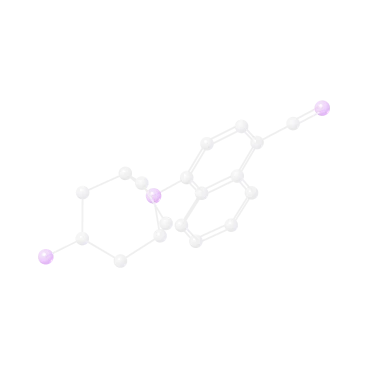
Calculated reference model · not an experimental or batch-certified structure. All 21 atoms shown.
Model data & sources
- Heavy atoms only; hydrogens are omitted from the reference display.
- Source-defined stereochemistry is checked against the calculated coordinates; no energy-minimum, crystal or solution-structure claim is made.
- Reference molecular species only; batch identity, purity, counterions and excipients are not certified.
- Formula
- C18H18N2O
- Method
- RDKit ETKDGv3 / MMFF94s calculated reference conformer
AC-262
AC-262 (AC-262536) Research Standard
AC-262536 (CAS 870888-46-3) is a nonsteroidal selective androgen receptor modulator of the tropanol structural class, supplied as a reference standard for androgen receptor pharmacology and analytical method development. It was identified in a functional cell-based assay as a potent and selective AR ligand with partial agonist activity relative to the natural androgen testosterone — the partial character is the point of the molecule, not a shortcoming.[1]
Mechanism of Action & Research Context
The molecular target is the androgen receptor (AR, NR3C4), a ligand-activated nuclear hormone receptor that functions as a transcription factor.
-
Partial agonism relative to testosterone. In a functional cell-based assay AC-262536 behaves as a potent, selective AR ligand whose maximal response falls below that of testosterone. Partial agonists are useful precisely because they occupy the receptor while producing a submaximal signal, which separates occupancy from efficacy in a way a full agonist cannot.[1]
-
Distinct genomic and non-genomic routes. Nonsteroidal SARMs and endogenous androgens engage AR through different signalling arms and assemble different AR/cofactor complexes at androgen-responsive enhancers, so the two ligand types are not interchangeable in mechanistic work.[4]
-
Coregulator recruitment and dimerisation. A SARM can drive AR transcriptional activity while producing markedly less AR homodimerisation than DHT and recruiting only a restricted subset of cofactors, with p160 coactivators SRC1, TIF2 and NCoA3 notably absent in yeast two-hybrid assays. Differential coregulator recruitment is the leading mechanistic account of tissue selectivity.[5]
Research Applications
Primary fields of in vitro and preclinical laboratory investigation include:
-
AR binding and transactivation assays with nuclear-receptor counter-screens and reporter readouts.[1]
-
Partial-agonist pharmacology separating receptor occupancy from transcriptional efficacy.[1]
-
Coregulator recruitment profiling against steroidal androgens.[4,5]
-
Analytical and forensic method development. Reference material for chromatography-mass spectrometry identification, retention-time matching and metabolite characterisation.[2,3]
Analytical Documentation
Purity and identity vary by manufacturing lot. Kimera Chems does not publish a single fixed purity figure for this item; refer to the batch-specific Certificate of Analysis (COA) issued for the lot received, which reflects third-party analytical testing for that lot.
References
- Piu F, Gardell LR, Son T, et al. Pharmacological characterization of AC-262536, a novel selective androgen receptor modulator. J Steroid Biochem Mol Biol. 2008;109(1–2):129–137. doi:10.1016/j.jsbmb.2007.11.001
- Stacchini C, Botrè F, Comunità F, et al. Simultaneous detection of different chemical classes of selective androgen receptor modulators in urine by liquid chromatography-mass spectrometry-based techniques. J Pharm Biomed Anal. 2021;195:113849. doi:10.1016/j.jpba.2020.113849
- Ventura E, Gadaj A, Buckley T, Mooney MH. Development of a multi-residue high-throughput UHPLC-MS/MS method for routine monitoring of SARM compounds in equine and bovine blood. Drug Test Anal. 2020;12(9):1373–1379. doi:10.1002/dta.2875
- Narayanan R, Coss CC, Yepuru M, et al. Steroidal androgens and nonsteroidal, tissue-selective androgen receptor modulator, S-22, regulate androgen receptor function through distinct genomic and nongenomic signaling pathways. Mol Endocrinol. 2008;22(11):2448–2465. doi:10.1210/me.2008-0160
- Furuya K, Yamamoto N, Ohyabu Y, et al. Mechanism of the tissue-specific action of the selective androgen receptor modulator S-101479. Biol Pharm Bull. 2013;36(3):442–451. doi:10.1248/bpb.b12-00885
Storage & Handling
Store at controlled room temperature. Keep tightly closed. Liquid formats: do not refrigerate or freeze. Cold storage may cause the solution to cloud or precipitate. If this occurs, return to room temperature and mix until clear.
Storage guidance is a house recommendation. Analytical documentation is per-lot release testing.
Related Research Compounds
Research Use Only Disclaimer: This product is labeled and sold "For Research Use Only — NOT FOR HUMAN CONSUMPTION." It is not a drug, dietary supplement, food, cosmetic, or medical device, and it is not approved by the FDA or any other regulator for human or veterinary use. It is supplied to approved account holders as a research chemical for laboratory use and must be handled in accordance with applicable law.