Skip to content

ATPLEX
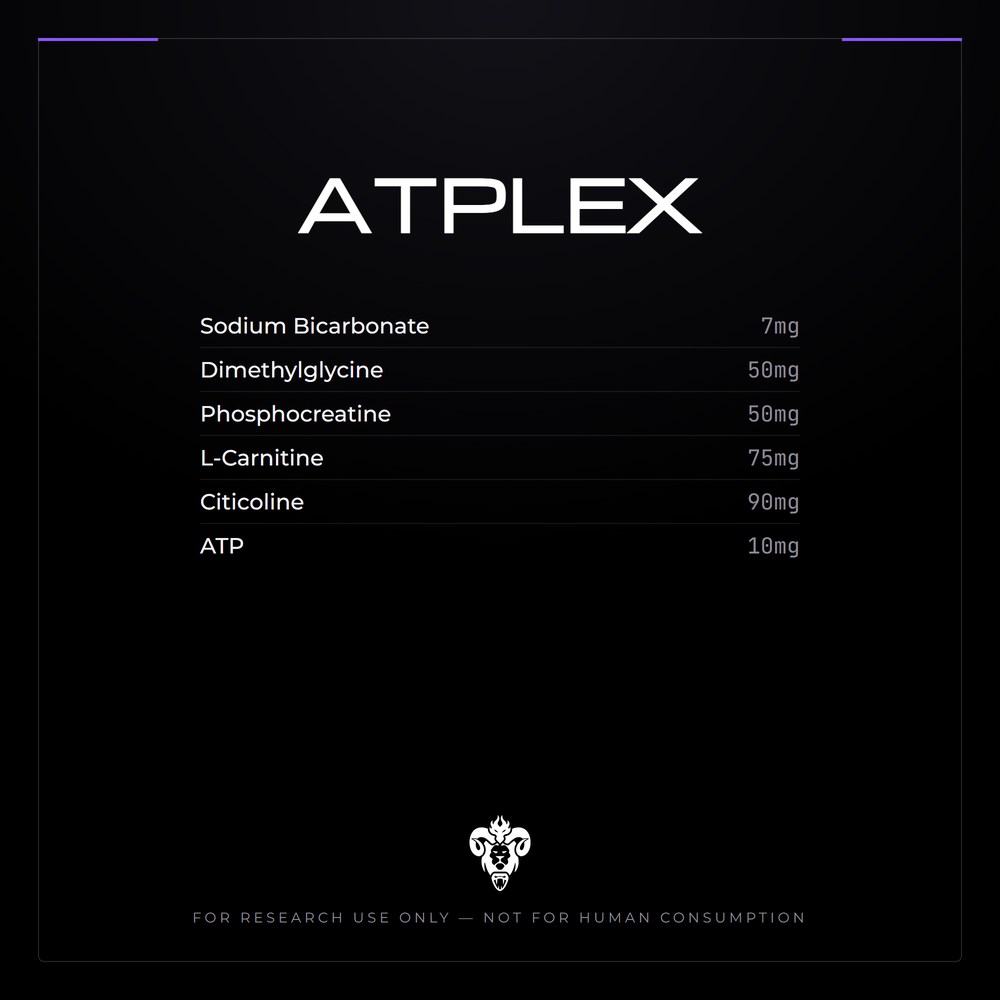
ATPLEX is a sophisticated multi-component research matrix engineered for the comparative study of complex biochemical interactions and metabolic signaling pathways in cell-free environments. By combining distinct chemical families—including inorganic salts, nucleotide intermediates, nucleoside triphosphates, and amino acid derivatives—this formulation serves as a specialized tool for investigators examining co-solute dynamics, molecular buffering capacity, and charge-based intermolecular forces within a unified testing environment.
Technical Specifications
Because ATPLEX is a precisely proportioned multi-component system, its technical profile is defined by its constituent active compounds:
| Component | CAS Number | Molecular Formula | Molecular Weight | Chemical Class |
|---|---|---|---|---|
| Sodium Bicarbonate | 144-55-8 | NaHCO₃ | 84.01 g/mol | Inorganic Salt |
| Dimethylglycine | 1118-68-9 | C₄H₉NO₂ | 103.12 g/mol | Amino Acid Derivative |
| Phosphocreatine | 67-07-2 | C₄H₁₀N₃O₅P | 211.11 g/mol | Phosphorylated Amino Acid |
| L-Carnitine | 541-15-1 | C₇H₁₅NO₃ | 161.20 g/mol | Quaternary Ammonium Derivative |
| Citicoline | 987-78-0 | C₁₄H₂₆N₄O₁₁P₂ | 488.32 g/mol | Nucleotide Intermediate |
| Adenosine Triphosphate (ATP) | 56-65-5 | C₁₀H₁₆N₅O₁₃P₃ | 507.18 g/mol | Nucleoside Triphosphate |
Component IUPAC Identifiers:
-
Sodium Bicarbonate: Sodium hydrogen carbonate
-
Dimethylglycine: 2-(dimethylamino)acetic acid
-
Phosphocreatine: [imino(phosphonoamino)methyl]-N-methylglycine
-
L-Carnitine: (3R)-3-hydroxy-4-(trimethylazaniumyl)butanoate
-
Citicoline: 2-[[[(2R,3S,4R,5R)-5-(4-amino-2-oxopyrimidin-1-yl)-3,4-dihydroxyoxolan-2-yl]methoxy-hydroxyphosphoryl]oxy-hydroxyphosphoryl]oxyethyl-trimethylazanium
-
Adenosine Triphosphate: [[(2R,3S,4R,5R)-5-(6-aminopurin-9-yl)-3,4-dihydroxyoxolan-2-yl]methyl-hydroxyphosphoryl] phosphono hydrogen phosphate
Note: Component identities, absolute structural configurations, and batch consistency are verified via independent High-Performance Liquid Chromatography (HPLC) testing to ensure an optimal analytical standard.
Research Applications & Mechanism of Interest
The primary objective of ATPLEX in laboratory frameworks is the evaluation of how diverse functional groups behave when present simultaneously in an interactive chemical ecosystem. Each constituent compound presents a unique molecular profile that dictates its ionic capabilities and hydrogen-bonding characteristics:
-
Proton Transfer & pH Dynamics: The sodium bicarbonate component dissociates into sodium and bicarbonate ions, enabling researchers to monitor proton acceptance and release mechanics alongside variations in baseline acidity.
-
Ionic Interactions: Dimethylglycine features a carboxyl group paired with a dimethylamino group, providing a clean model for studying amphoteric behaviors and charge-based associations.
-
High-Energy Phosphate Groups: Phosphocreatine and ATP introduce multiple negatively charged phosphate groups alongside guanidino and purine architectures, allowing for the deep analysis of electrostatic repulsion and complex molecular stability under physiological constraints.
-
Zwitterionic Structures: L-Carnitine brings a quaternary ammonium configuration and a carboxyl group, serving as an excellent template for exploring internal charge distributions.
-
Nucleotide Interfaces: Citicoline contributes a cytidine ring and diphosphate segments, expanding the analytical framework to include intricate heterocyclic interactions.
Principal investigative workflows include:
-
Co-Solute Dynamics: Assessing how various molecular structures influence mutual stability and interaction patterns when combined.
-
Charge-Based Associations: Mapping ionic forces and competitive hydrogen-bonding networks across distinct chemical classes.
-
Stability Tracking: Monitoring the specific degradation timelines and structural tolerance of individual components over time within a shared matrix.
Storage & Handling Guidelines
To safeguard the molecular arrangement and avoid premature chemical degradation of the combined components, researchers should maintain strict storage protocols:
-
Thermal Controls: Maintain the material continuously under refrigerated parameters between 2–8°C.
-
Photolytic Isolation: Shield the product completely from direct light exposure to protect light-sensitive nucleotide structures.
-
Atmospheric Seals: Ensure the containment vessel remains tightly and securely sealed immediately after every analytical extraction to block moisture and ambient contaminants.
Related Research Compounds
Further reading: ATPLEX research overview
Research Use Only Disclaimer: This product is distributed and sold strictly as a Research Use Only (RUO) compound. It is not a drug, licensed medication, or dietary supplement, and is strictly prohibited for human or veterinary consumption. Kimera Chems supplies these materials exclusively to qualified scientific institutions and professional investigators for use within controlled in vitro laboratory frameworks.