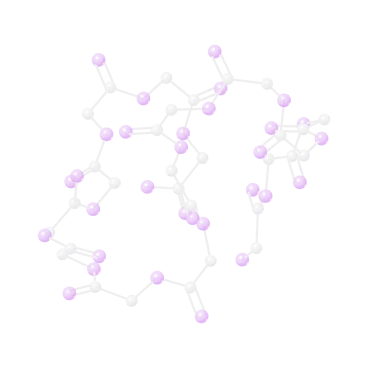
Calculated reference model · not an experimental or batch-certified structure. Backbone view: 61 of 100 atoms.
Model data & sources
- Sequence
- GEPPPGKPADDAGLV
- Formula
- C62H98N16O22
- Method
- RDKit ETKDGv3 / MMFF94s calculated reference conformer
BPC-157
BPC-157 Research Standard
BPC-157 (CAS 137525-51-0) is a synthetic pentadecapeptide, a 15-amino-acid partial sequence of body protection compound originally isolated from human gastric juice. It is supplied as a reference standard for laboratory work on fibroblast migration, cytoskeletal signalling and cell survival under oxidative stress.
Mechanism of Action & Research Context
BPC-157 has no identified receptor. What it does have is a well-defined in vitro signalling readout.
-
BPC-157 is a 15-residue partial sequence of body protection compound, isolated from human gastric juice. Its best in vitro characterisation is in tendon fibroblasts: it accelerated outgrowth from tendon explants, increased survival under H2O2 stress, and dose-dependently increased migration and spreading, with F-actin formation induced and FAK and paxillin phosphorylation raised dose-dependently while total protein was unchanged. Notably it did not directly affect fibroblast proliferation by MTT assay — the effect is on migration and survival, not cell number.[1]
-
The FAK-paxillin pathway. Phosphorylation of focal adhesion kinase and paxillin rose dose-dependently while total protein stayed constant, which points to activation rather than expression change. Focal adhesion turnover is the machinery of cell migration, so this is a mechanistically coherent readout rather than a phenotype alone.[1]
-
Migration and survival, not proliferation. The distinction matters for experimental design: an assay measuring cell number will miss the effect entirely.[1]
How strong is the evidence. Worth stating plainly, because BPC-157 is described online with more confidence than its literature supports. The review above notes that the majority of studies are in small rodent models, efficacy is yet to be confirmed in humans, only a handful of research groups have worked on it in two decades, and the precise healing mechanisms remain unresolved. The in vitro fibroblast work is solid and specific; the broader claims rest on a narrow base.[2]
Research Applications
Primary fields of in vitro and preclinical laboratory investigation include:
-
Transwell migration and spreading assays in tendon and dermal fibroblasts.[1]
-
Explant outgrowth models measuring fibroblast emergence from tissue.[1]
-
Oxidative stress survival assays under H2O2 challenge.[1]
-
Focal adhesion signalling by phospho-FAK and phospho-paxillin western blot, with F-actin staining.[1]
-
Independent replication, which the evidence base needs more than it needs new claims.[2]
Analytical Documentation
Purity, identity and composition vary by manufacturing lot. Kimera Chems does not publish a single fixed purity figure for this item; refer to the batch-specific Certificate of Analysis (COA) issued for the lot received, which reflects third-party analytical testing for that lot.
References
- Chang CH, Tsai WC, Lin MS, Hsu YH, Pang JHS. The promoting effect of pentadecapeptide BPC 157 on tendon healing involves tendon outgrowth, cell survival, and cell migration. J Appl Physiol. 2011;110(3):774–780. doi:10.1152/japplphysiol.00945.2010
- Gwyer D, Wragg NM, Wilson SL. Gastric pentadecapeptide body protection compound BPC 157 and its role in accelerating musculoskeletal soft tissue healing. Cell Tissue Res. 2019;377(2):153–159. doi:10.1007/s00441-019-03016-8
Storage & Handling
Store at controlled room temperature. Keep tightly closed. Liquid formats: do not refrigerate or freeze. Cold storage may cause the solution to cloud or precipitate. If this occurs, return to room temperature and mix until clear.
Storage guidance is a house recommendation. Analytical documentation is per-lot release testing.
Related Research Compounds
Research Use Only Disclaimer: This product is labeled and sold "For Research Use Only - NOT FOR HUMAN CONSUMPTION." It is not a drug, dietary supplement, food, cosmetic, or medical device, and it is not approved by the FDA or any other regulator for human or veterinary use. It is supplied to approved account holders as a research chemical for laboratory use and must be handled in accordance with applicable law.