
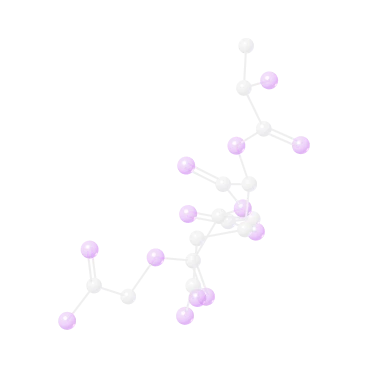
Calculated reference model · not an experimental or batch-certified structure. All 27 atoms shown.
Model data & sources
- Heavy atoms only; hydrogens are omitted from the reference display.
- Source-defined atom stereochemistry is checked against the calculated coordinates; no energy-minimum or observed-fold claim is made.
- Reference molecular species only; batch counterions, excipients and material composition are not certified.
- Sequence
- AEDG
- Formula
- C14H22N4O9
- Method
- RDKit ETKDGv3 / MMFF94s calculated reference conformer
Epithalon: A Four-Residue Peptide Carrying a Twenty-Year Claim
Epithalon (AEDG) Research Standard
Epithalon (CAS 307297-39-8), also written Epitalon and Epithalone, is the tetrapeptide Ala-Glu-Asp-Gly (AEDG), supplied as a 10 mg lyophilized powder in a 3 mL vial. It was synthesised from the amino acid composition of Epithalamin, a bovine pineal gland extract, before being identified in the pineal polypeptide complex itself — so it is a synthetic peptide reverse-engineered from a tissue extract rather than designed against a target.[1]
Mechanism of Action & Research Context
Twenty-five years of in vitro, in vivo and in silico study have produced a list of reported activities and no settled mechanism. Both halves of that sentence belong on this page.
-
What has been reported. Direct influence on melatonin synthesis; altered interleukin-2 mRNA levels; modulation of the mitogenic activity of murine thymocytes; and enhanced activity of several enzymes including acetylcholinesterase, butyrylcholinesterase and telomerase.[1]
-
What has not been settled. The review covering this literature states directly that it remains uncertain whether these are the sole mechanisms of action. The telomerase result in particular circulates far more confidently in secondary sources than in the primary literature.[1]
-
The structural work is thin. Despite the volume of biological and pharmacodynamic study, physico-chemical and structural investigation of this peptide remains quite limited — unusual for a compound studied this long, and worth knowing before designing work that assumes a defined conformation.[1]
-
Mechanisms described as both specific and nonspecific. The reported geroprotective and neuroendocrine effects are attributed to antioxidant, neuroprotective and antimutagenic activity arising from a mix of specific and nonspecific routes, which is another way of saying the target is not identified.[1]
Research Applications
Primary fields of laboratory investigation include:
-
Telomerase activity assays, where independent replication is the useful contribution.[1]
-
Melatonin synthesis and pineal endocrine models.[1]
-
Cholinesterase activity assays for AChE and BuChE.[1]
-
Thymocyte mitogenic assays and IL-2 transcript quantification.[1]
-
Physico-chemical and structural characterisation — the acknowledged gap in this compound's file.[1]
Analytical Documentation
Purity and identity vary by manufacturing lot. Kimera Chems does not publish a single fixed purity figure for this item; refer to the batch-specific Certificate of Analysis (COA) issued for the lot received, which reflects third-party analytical testing for that lot.
References
- Araj SK, Brzezik J, Mądra-Gackowska K, Szeleszczuk Ł. Overview of Epitalon — highly bioactive pineal tetrapeptide with promising properties. Int J Mol Sci. 2025;26(6):2691. doi:10.3390/ijms26062691
Storage & Handling
Store at controlled room temperature, sealed and protected from light.
Storage guidance is a house recommendation. Analytical documentation is per-lot release testing.
Related Research Compounds
Research Use Only Disclaimer: This product is labeled and sold "For Research Use Only - NOT FOR HUMAN CONSUMPTION." It is not a drug, dietary supplement, food, cosmetic, or medical device, and it is not approved by the FDA or any other regulator for human or veterinary use. It is supplied to approved account holders as a research chemical for laboratory use and must be handled in accordance with applicable law.
