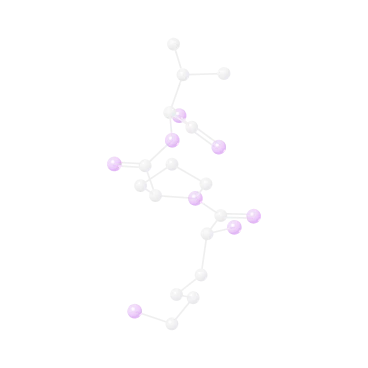
Calculated reference model · not an experimental or batch-certified structure. All 24 atoms shown.
Model data & sources
- Heavy atoms only; hydrogens are omitted from the reference display.
- Source-defined atom stereochemistry is checked against the calculated coordinates; no energy-minimum or observed-fold claim is made.
- Reference molecular species only; batch counterions, excipients and material composition are not certified.
- Sequence
- KPV
- Formula
- C16H30N4O4
- Method
- RDKit ETKDGv3 / MMFF94s calculated reference conformer
KPV: The alpha-MSH Fragment That Skips the Receptor
KPV Research Standard
KPV (CAS 67727-97-3) is the C-terminal tripeptide of α-melanocyte-stimulating hormone, residues 11–13 (Lys-Pro-Val). It is supplied as a reference standard for melanocortin and inflammation research. The reason a three-residue fragment is interesting: most of the anti-inflammatory activity of the full 13-residue parent is attributable to it.[2]
Mechanism of Action & Research Context
KPV sits in the melanocortin system — the same receptor family as the MC3R/MC4R ligands elsewhere in this catalogue, but engaged from the immune rather than the neuroendocrine side.
-
KPV is the C-terminal tripeptide of α-MSH, residues 11–13. Most of α-MSH's anti-inflammatory activity is attributable to it. It binds MC-1R and modulates antigen-presenting cell function; the parent peptide downregulates IL-1, IL-6, TNF-α, IL-2, IFN-γ, IL-4 and IL-13 and the costimulatory molecules CD86, CD40 and ICAM-1, while upregulating IL-10, via inhibition of NF-κB activation.[1,2]
-
NF-κB is the convergence point. At the molecular level the effects run through inhibition of transcription factor activation, which is why the readout spans so many cytokines at once rather than one pathway.[1]
-
Antigen-presenting cells are the target population. The immunomodulating capacity is primarily via MC-1R-expressing monocytes, macrophages and dendritic cells, and both α-MSH and KPV modulate APC function.[1]
-
A related tripeptide worth knowing. K(D)PT, derived from KPV and corresponding to residues 193–195 of IL-1β, is described as a second tripeptide with potent anti-inflammatory effects — useful as a structural comparator.[2]
Research Applications
Primary fields of in vitro laboratory investigation include:
-
Cytokine panel assays measuring IL-1, IL-6, TNF-α, IFN-γ and IL-10.[1]
-
NF-κB activation assays by reporter or translocation readout.[1]
-
Antigen-presenting cell function, including CD86, CD40 and ICAM-1 expression.[1]
-
MC-1R binding and comparative melanocortin pharmacology against full-length α-MSH.[1,2]
Analytical Documentation
Purity, identity and composition vary by manufacturing lot. Kimera Chems does not publish a single fixed purity figure for this item; refer to the batch-specific Certificate of Analysis (COA) issued for the lot received, which reflects third-party analytical testing for that lot.
References
- Luger TA, Scholzen TE, Brzoska T, Böhm M. New insights into the functions of alpha-MSH and related peptides in the immune system. Ann N Y Acad Sci. 2003;994:133–140. doi:10.1111/j.1749-6632.2003.tb03172.x
- Luger TA, Brzoska T. alpha-MSH related peptides: a new class of anti-inflammatory and immunomodulating drugs. Ann Rheum Dis. 2007;66(Suppl 3):iii52–iii55. doi:10.1136/ard.2007.079780
Storage & Handling
Store at controlled room temperature. Keep tightly closed.
Storage guidance is a house recommendation. Analytical documentation is per-lot release testing.
Related Research Compounds
Research Use Only Disclaimer: This product is labeled and sold "For Research Use Only - NOT FOR HUMAN CONSUMPTION." It is not a drug, dietary supplement, food, cosmetic, or medical device, and it is not approved by the FDA or any other regulator for human or veterinary use. It is supplied to approved account holders as a research chemical for laboratory use and must be handled in accordance with applicable law.