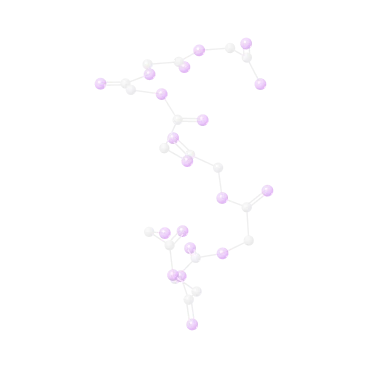
Calculated reference model · not an experimental or batch-certified structure. Backbone view: 37 of 69 atoms.
Model data & sources
- Heavy atoms only; hydrogens are omitted from the reference display.
- Source-defined atom stereochemistry is checked against the calculated coordinates; no energy-minimum or observed-fold claim is made.
- Reference molecular species only; batch counterions, excipients and material composition are not certified.
- Force-field relaxation reached its iteration limit. This is a geometry-checked reference, not a proven equilibrated or minimum-energy structure.
- Sequence
- CYIQNCPLG-NH2
- Formula
- C43H66N12O12S2
- Method
- RDKit ETKDGv3 / MMFF94s calculated reference conformer
Oxytocin: The Unbiased Reference Agonist in a Contested Literature
Oxytocin Research Standard
Oxytocin (CAS 50-56-6) is a cyclic, C-terminally amidated nonapeptide, supplied as a 5 mg lyophilized powder in a 3 mL vial. It shares high sequence and structural homology with arginine-vasopressin — the two differ at only positions 3 and 8 — and that near-identity across four related receptors is what makes the pair a standing test of selectivity.[1]
Mechanism of Action & Research Context
The molecular target is the oxytocin receptor (OTR), one of four GPCRs in this family alongside the V1a, V1b and V2 vasopressin receptors.[1]
-
Oxytocin engages an unusually wide G protein range. Measured by BRET biosensor at the human OT receptor, oxytocin promotes direct engagement and activation of Gq and all the Gi/o subtypes. That breadth is the baseline against which every analogue looks biased.[2]
-
Analogues are strongly biased, and predictably so. Peptidic analogues chosen for substitutions at key structural residues all showed biased activation. No ligand except oxytocin itself activated GoA or GoB. With one exception, every peptide that activated Gq also activated Gi2 and Gi3 but not Gi1, GoA or GoB.[2]
-
Two analogues split individual Gi/o members. DNalOVT and atosiban activated only Gi1 or Gi3, failed to recruit β-arrestins, and did not induce receptor internalisation — the first clear examples of ligands differentiating individual members of the Gi/o family. Both still inhibited cell proliferation, showing a single Gi subtype-mediated pathway suffices for that response.[2]
-
The structures are now solved. Seventy years after the chemical structure of oxytocin was determined, X-ray crystallography and cryo-electron microscopy have resolved the OTR in complex with its natural agonist and with G proteins and β-arrestins — giving direct structural insight into the orthosteric pocket, the activation mechanism, and the transducer interfaces.[1]
Research Applications
Primary fields of in vitro laboratory investigation include:
-
G protein subtype engagement assays using BRET biosensors across Gq and the Gi/o family.[2]
-
Biased agonism and functional selectivity screening, with oxytocin as the unbiased reference.[2]
-
β-arrestin recruitment and receptor internalisation assays.[2]
-
Receptor selectivity panels across OTR and the V1a, V1b and V2 receptors.[1]
-
Structure-based ligand design against the solved receptor complexes.[1]
Analytical Documentation
Purity and identity vary by manufacturing lot. Kimera Chems does not publish a single fixed purity figure for this item; refer to the batch-specific Certificate of Analysis (COA) issued for the lot received, which reflects third-party analytical testing for that lot.
References
- Bous J, Fouillen A, Orcel H, Granier S, Bron P, Mouillac B. Structures of the arginine-vasopressin and oxytocin receptor signaling complexes. Vitam Horm. 2023;123:67–107. doi:10.1016/bs.vh.2022.12.003
- Busnelli M, Saulière A, Manning M, Bouvier M, Galés C, Chini B. Functional selective oxytocin-derived agonists discriminate between individual G protein family subtypes. J Biol Chem. 2012;287(6):3617–3629. doi:10.1074/jbc.M111.277178
Storage & Handling
Store at controlled room temperature, sealed and protected from light.
Storage guidance is a house recommendation. Analytical documentation is per-lot release testing.
Related Research Compounds
Research Use Only Disclaimer: This product is labeled and sold "For Research Use Only - NOT FOR HUMAN CONSUMPTION." It is not a drug, dietary supplement, food, cosmetic, or medical device, and it is not approved by the FDA or any other regulator for human or veterinary use. It is supplied to approved account holders as a research chemical for laboratory use and must be handled in accordance with applicable law.