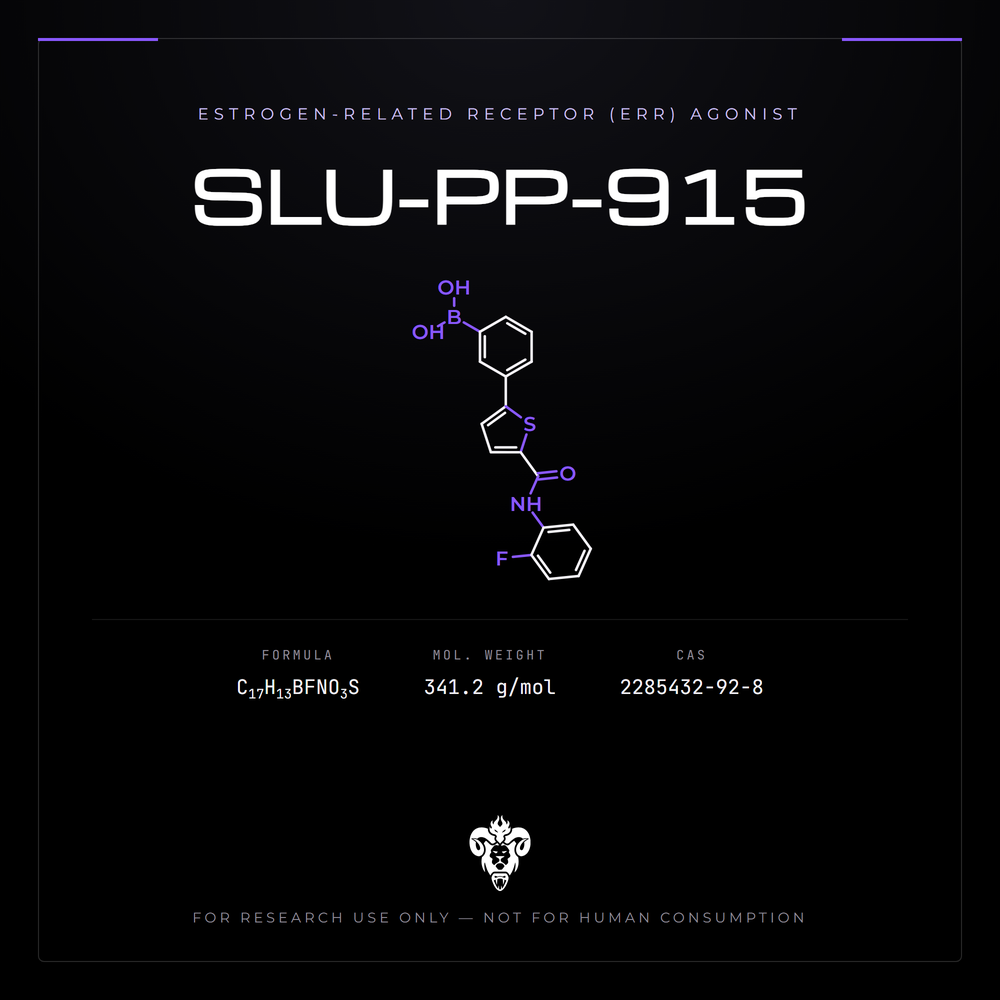

SLU-PP-915 (ERR Pan-Agonist) Research Standard
SLU-PP-915 is a synthetic small-molecule pan-agonist of the Estrogen-Related Receptor (ERR) family, specifically targeting ERRα, ERRβ, and ERRγ. Developed as a second-generation analog of SLU-PP-332, this compound incorporates a phenylboronic acid pharmacophore that preserves potent ERR activation while significantly enhancing metabolic stability and oral bioavailability. As an “exercise mimetic,” SLU-PP-915 is utilized in laboratory research to study the PGC-1α-linked transcriptional programs that regulate mitochondrial biogenesis, fatty-acid oxidation, and autophagy-lysosomal function.
Technical Specifications
| Property | Specification |
|---|---|
| Product Name | SLU-PP-915 |
| CAS Number | 2285432-92-8 |
| Chemical Formula | C₁₇H₁₃BFNO₃S |
| Molecular Weight | 341.16 g/mol |
| Chemical Class | 2,5-disubstituted thiophene amide / phenylboronic acid |
| Target(s) | ERRα, ERRβ, ERRγ (Pan-agonist) |
| Physical Appearance | Brown Crystalline solid |
| Assay Purity | Refer to the batch-specific Certificate of Analysis (COA) supplied for the lot received |
| Solution Base | DMSO, PEG-400 |
Mechanism of Action & Research Context
SLU-PP-915 modulates metabolic phenotype by directly activating nuclear receptors that function as master transcriptional regulators of oxidative metabolism.
-
ERR Isoform Agonism: SLU-PP-915 binds the ligand-binding domain of all three ERR isoforms, with reported EC50 values of approximately 414 nM (ERRα), 435 nM (ERRβ), and 378 nM (ERRγ) in cell-based co-transfection assays.
-
Transcriptional Regulation: The compound promotes the recruitment of coactivators to drive the expression of canonical ERR target genes such as PGC1α, PDK4, and LDHA. It is notably selective for the ERR subfamily, demonstrating no significant activity at classical estrogen receptors (ERα or ERβ).
-
Autophagy-Lysosomal Axis: Beyond mitochondrial biogenesis, SLU-PP-915 upregulates Transcription Factor EB (TFEB) and downstream markers (e.g., LAMP1, LAMP2, CTSD), providing a mechanism to study the coordination between metabolic demand and autophagic clearance in cardiac and skeletal muscle models.
-
Structural Optimization: The substitution of the phenolic hydrogen-bond donor (found in SLU-PP-332) with a phenylboronic acid group was a strategic development to improve microsomal stability, allowing for oral administration in murine models.
Research Applications
SLU-PP-915 serves as a high-precision chemical probe for isolating the effects of chronic ERR activation.
Primary fields of in vitro and in vivo laboratory investigation include:
-
Exercise Mimetic Research: Evaluating transcriptional signatures and exercise capacity (e.g., time-to-exhaustion) in murine treadmill models.
-
Mitochondrial Biogenesis & Oxidative Metabolism: Quantifying mitochondrial density and oxidative phosphorylation efficiency in response to pharmacologically induced ERR activation.
-
Cardiac Function: Investigating the protective effects of ERR activation in pressure-overload heart failure models (e.g., transaortic constriction), particularly regarding lipid metabolism and TFEB-mediated autophagy.
-
Metabolic Reprogramming: Mapping shifts in substrate utilization (e.g., increased fatty acid oxidation) driven by ERR-mediated gene networks.
Storage & Handling Guidelines
To maintain the chemical stability and experimental reliability of the compound:
-
Storage Environment: Store sealed at –20 °C. The compound is sensitive to light and moisture; ensure the container is tightly closed and protected in a dark environment.
-
Solubility: The compound is soluble in DMSO for in vitro applications.
-
In Vivo Delivery: Published preclinical literature indicates the use of DMSO/PEG-300/Tween-80 and DMSO/SBE-β-CD systems for vehicle formulation.
-
Analytical Integrity: Researchers should confirm lot-specific identity (NMR/MS) and purity (HPLC) via the provided third-party COA before commencing experimental protocols.
Related Research Compounds
Further reading: SLU-PP-915 research overview
Research Use Disclaimer
Research Use Only Disclaimer: This product is developed and distributed strictly as a Research Use Only (RUO) laboratory reference chemical intended exclusively for non-clinical analytical and scientific investigation. It is not an FDA-approved drug, medical treatment, dietary supplement, or food ingredient, and is strictly prohibited for human or animal consumption. Kimera Chems supplies this research material solely to qualified institutions and professional investigators for authorized laboratory research.