
Most compounds in the AMPA modulator class failed for the same reason: they worked too hard. Positive allosteric modulators of the AMPA receptor have been chased since the 1990s as cognition and depression targets, and nearly every one carried the same two liabilities — a narrow bell-shaped dose-response and a poor safety margin against seizures.
TAK-653 was built to test a specific hypothesis about why. The answer Takeda’s group arrived at is counterintuitive and makes this compound genuinely interesting: the problem was not that the earlier molecules potentiated too much, but that they activated on their own. Strip out that residual agonism and you get more synaptic potentiation, broader cognitive effects, and a safety margin two orders of magnitude wider.
This guide covers what TAK-653 is, the structural basis of its mechanism, what the preclinical and human data actually show, where the clinical program stands now, and what a defensible certificate of analysis should demonstrate.
What Is TAK-653?
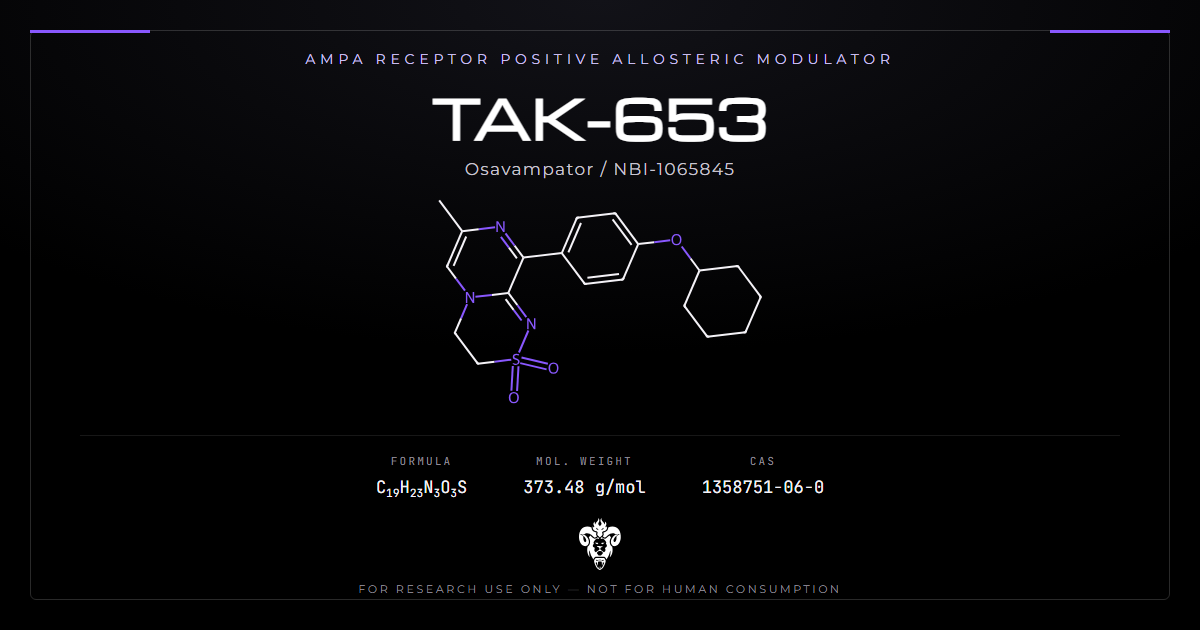
TAK-653 is a synthetic, CNS-penetrant positive allosteric modulator (PAM) of the α-amino-3-hydroxy-5-methyl-4-isoxazolepropionic acid receptor (AMPA-R). It was discovered at Takeda’s Neuroscience Drug Discovery Unit in Fujisawa, Japan, as the successor to an earlier compound in the same chemical series, TAK-137.
The naming is the first thing to get right, because most vendor listings are out of date. TAK-653 has since received the International Nonproprietary Name osavampator, and it carries the development code NBI-1065845 under Neurocrine Biosciences, which holds an exclusive worldwide license from Takeda for all indications outside Japan (Neurocrine, September 2025). All three names refer to the same molecule. Anyone searching the literature or a supplier catalog needs all three.
Identity and Physical Data
| Property | Value |
|---|---|
| IUPAC name | 9-[4-(Cyclohexyloxy)phenyl]-7-methyl-3,4-dihydropyrazino[2,1-c][1,2,4]thiadiazine 2,2-dioxide |
| Synonyms | Osavampator, NBI-1065845, NBI-845, TAK653 |
| CAS Number | 1358751-06-0 |
| Molecular formula | C₁₉H₂₃N₃O₃S |
| Molar mass | 373.47 g/mol |
| Monoisotopic mass | 373.1460 Da |
| InChIKey | PXJBHEHFVQVDDS-UHFFFAOYSA-N |
| PubChem CID | 56655833 |
| ChEMBL | CHEMBL4594403 |
| UNII | 9E3TOE5RIZ |
| Stereocenters | None |
| Appearance | Crystalline solid |
Two structural facts matter downstream. First, the molecule contains no stereocenters — an unusual convenience in this catalog space, since it removes the enantiomeric-purity problem that complicates identity confirmation for many research compounds. Second, it contains sulfur, present as the cyclic sulfonamide (thiadiazine 2,2-dioxide) that defines the scaffold. That single heteroatom gives analysts an orthogonal quantification handle most compounds in the nootropic compound space do not offer.
Kimera stocks research-grade TAK-653 in powder, capsule, and solution formats for laboratory study.
How TAK-653 Works: Agonism Is the Bug, Not the Feature
To understand TAK-653 you have to understand what went wrong with everything before it.
The Class Problem
AMPA receptors mediate fast excitatory transmission throughout the CNS. Direct AMPA-R agonists activate receptors regardless of what the synapse is doing, and they carry a high seizure risk from nonspecific activation of resting receptors (Suzuki et al., 2021). Allosteric potentiators were proposed as the fix: a PAM should only amplify signaling where glutamate is already being released.
In practice, most of them cheated. LY451646, a well-characterized AMPA-R potentiator, shows substantial agonistic activity — it activates the receptor even with no agonist present. So did PF-04958242. Compounds with that profile showed narrow bell-shaped dose-response curves and thin margins against convulsion.
The Design Fix: Steric Interference at Ser750
Takeda’s group had previously shown that structural interference at Ser750 in the GluA2o ligand-binding domain — corresponding to Ser743 in GluA1i — was the lever controlling agonistic effect in their dihydropyridothiadiazine dioxide series (Kunugi et al., 2019).
TAK-653 was designed around that insight. Its terminal cyclohexyl group is bulkier than the phenyl on its predecessor TAK-137, producing greater steric repulsion at Ser750 when the channel sits in the closed state. The practical effect is a molecular gate: the compound binds poorly to a resting receptor and well to one that glutamate has already engaged.
Co-crystallography confirmed the design intent. TAK-653 binds the intradimer interface formed by the ligand-binding core — the region that changes conformation on glutamate binding — and radiolabeled binding to the GluA2o LBD rose in a strictly glutamate-dependent manner. Critically, TAK-653 did not displace tritiated AMPA from the agonist site, confirming it does not occupy the orthosteric pocket at all (Suzuki et al., 2021).
How Little Agonism, Precisely
This is where the numbers separate TAK-653 from the class. In rat primary hippocampal neurons at 30 µM, measured against the maximal agonist-driven response:
| Compound | Ca²⁺ increase without agonist | Current without agonist |
|---|---|---|
| TAK-653 | 4.8% | 1.7% |
| TAK-137 | 7.6% | 6.4% |
| LY451646 | 88% | 39% |
LY451646 at 30 µM produces almost as much calcium influx on its own as a full agonist. TAK-653 produces essentially none. In the presence of glutamate it potentiates robustly — EC₅₀ 3.3 µM for Ca²⁺ influx in hGluA1i CHO cells, 4.4 µM for potentiation of AMPA-elicited currents in primary neurons (Suzuki et al., 2021).
Selectivity and Species Translation
Two further findings from the same characterization deserve mention because they are unusually clean.
Screened at 10 µM against 97 off-target sites, TAK-653 hit only one — 5-lipoxygenase, at an IC₅₀ of 5.9 µM, well above its functional range. And the EC₅₀ difference between rat and human GluA1i was 1.1-fold, essentially no species difference at all. For translational work that is a meaningful property: rodent exposure-response maps onto human receptors without a correction factor.
The Counterintuitive Result: Less Activation, More Effect
Here is the finding that makes TAK-653 scientifically notable rather than merely well-behaved.
If agonism were simply a side effect to be minimized, you would expect a compound with virtually none to be a weaker potentiator. The opposite happened.
In prefrontal cortex slices, with GABA-A, GABA-B, and NMDA receptors pharmacologically blocked, TAK-653 enhanced AMPA-R-mediated polysynaptic EPSPs — increasing both evoked spike number and EPSP duration — more robustly than LY451646. AMPA itself, applied at 0.3 µM, actually reduced EPSP duration and evoked spikes. Adding TAK-653 after LY451646 produced further augmentation, ruling out simple receptor desensitization as the explanation (Suzuki et al., 2021).
The cognitive data followed the same pattern across domains:
- Recognition memory (novel object recognition, rats): TAK-653 improved performance; LY451646 improved it only at doses approaching its seizure threshold; AMPA did not improve it at any tested dose.
- Working memory (radial arm maze under MK-801 challenge, rats): TAK-653 improved performance across a broad dose range. Neither LY451646 nor AMPA improved it at all.
- Working memory (delayed match-to-sample, cynomolgus monkeys): TAK-653 improved accuracy at the 16-second delay interval, with the effect returning to baseline by 48 hours — excluding a training artifact.
- Sustained attention (5-choice serial reaction time, rats): no effect in the whole population, but a significant increase in correct responses and reduction in omissions in the poor-performing subgroup on median split.
The authors’ interpretation is that what matters is facilitating phasic receptor activation driven by physiologically released glutamate — not increasing the raw number of active receptors. Nonspecific activation of resting AMPA-Rs appears to degrade the signal-to-noise ratio of evoked responses, which is why agonism actively interferes with cognitive benefit rather than merely adding risk.
The Safety Margin
Convulsion margins were calculated in rats from GLP-conducted studies, benchmarked against efficacy in the novel object recognition test:
| Compound | Margin (plasma Cmax) | Margin (AUC plasma) |
|---|---|---|
| TAK-653 | 419-fold | 1017-fold |
| TAK-137 | 42-fold | 122-fold |
| LY451646 | 3.4-fold | 4.0-fold |
A hundredfold improvement over LY451646 on the same protocol. TAK-653 produced convulsion in a single animal only at 100 mg/kg orally (Suzuki et al., 2021).
One further result matters for chronic-dosing study design: after 14 days of repeated administration in mice, AMPA-induced BDNF and Gadd45b mRNA expression in hippocampus was unchanged, indicating low risk of receptor desensitization or sensitization on repeat exposure.
Antidepressant-Relevant Signaling
The depression rationale runs through ketamine. Ketamine’s antidepressant action depends on downstream AMPA receptor activation — pretreatment with the AMPA antagonist NBQX abolishes it — which drives BDNF release and mTOR pathway signaling. The hypothesis behind TAK-653 is that direct AMPA potentiation might reproduce that arm without the NMDA blockade responsible for ketamine’s dissociative effects.
In rat primary cortical neurons, TAK-653 increased phosphorylated mTOR and p70S6 kinase along with their upstream regulators Akt and ERK, and raised BDNF protein levels. In the reduction of submissive behavior model, TAK-653 produced antidepressant-like effects, and ketamine’s effect in the same model was blocked by NBQX pretreatment — confirming the AMPA dependence the design assumes (Hara et al., 2021).
Notably, BDNF induction in vivo was agonist-dependent: TAK-653 raised hippocampal BDNF mRNA in AMPA-treated mice but not in mice given TAK-653 alone (Suzuki et al., 2021). The compound amplifies an existing signal rather than generating one.
Researchers building comparative protocols around neuroplasticity and mood-related endpoints often contrast TAK-653 with mechanistically unrelated compounds — for example NSI-189, which was investigated on a neurogenesis rationale rather than a receptor-modulation one, or Sunifiram, a piperazine derivative frequently but loosely described as an ampakine despite a far thinner mechanistic record. Those contrasts are useful precisely because the pathways differ.
Human Data: TMS as a Translational Biomarker
Glutamatergic drug development has long lacked a functional biomarker that works in both animals and people. The TAK-653 program produced one.
Investigators paired transcranial magnetic stimulation of the motor cortex with mechanomyography in rats and electromyography in humans, testing whether TMS-evoked motor responses would capture AMPA receptor potentiation (O’Donnell et al., 2021).
In 31 rats, single-pulse TMS responses increased at 0.3 mg/kg and above, with evoked amplitudes 30–70% higher than vehicle. Brain concentrations confirmed blood-brain barrier penetration.
In 24 healthy volunteers under a double-blind, placebo-controlled crossover design, the 6 mg condition significantly increased motor-evoked potential amplitude versus placebo at 2.5 hours post-dose, at a mean plasma level of roughly 46 ng/mL. The 0.5 mg condition did not. Resting motor threshold was unchanged, and paired-pulse measures of intracortical inhibition were essentially unaffected — consistent with a selective effect on excitatory rather than inhibitory transmission. The authors describe this as the first translational functional biomarker for AMPA receptor potentiation, with rat and human effects appearing at comparable plasma concentrations.
A separate healthy-volunteer study using the NeuroCart battery found a psychostimulant-like pharmacodynamic profile — improvements in adaptive tracking and saccadic peak velocity — without effects on body sway or subjective drug-effect scales, and with no dissociative adverse effects of the kind ketamine produces (Dijkstra et al., 2022). Reported pharmacokinetics across early studies: Tmax roughly 1.25 to 5 hours, terminal half-life 33.1 to 47.8 hours, with cerebrospinal fluid concentrations suggesting rapid brain penetration.
Dose figures throughout this article are reported parameters from published clinical literature. They are not guidance and carry no implication of use outside a controlled research setting.
Clinical Development Status
The development history here is frequently misreported, and the distinction matters.
The withdrawn trial. NCT03312894 was a Takeda study designed to test whether TAK-653 could maintain the antidepressant effect of ketamine in treatment-resistant depression. It was withdrawn before enrolling, recorded as a business decision, and a parallel EU registration was similarly discontinued in 2018 (Borbély et al., 2022). No efficacy data exist from it. Sources that describe TAK-653 as having “failed in TRD” are describing a trial that never ran.
The successful trial. The Phase 2 SAVITRI study (NCT05203341) ran under Neurocrine with a different design: adjunctive treatment in major depressive disorder with inadequate response to an existing oral antidepressant, rather than ketamine maintenance in TRD. It randomized 183 adults 2:1:1 to placebo, 1 mg, or 3 mg once daily for eight weeks.
The study met its primary and key secondary endpoints. One dose produced a placebo-adjusted MADRS improvement of −4.3 at Day 28 (p = 0.0159) and −7.5 at Day 56 (p = 0.0016). The other dose showed only a nonsignificant trend: −3.0 (p = 0.0873) and −3.6 (p = 0.1082). The most common adverse event was headache; the adverse event profile was comparable to placebo, with no deaths or serious adverse events (Neurocrine, April 2024).
A tension worth naming. The dose carried into Phase 3 is 1 mg — the lower of the two. That the higher dose underperformed sits somewhat uneasily beside the preclinical claim that TAK-653 escapes the bell-shaped dose-response of its class. It may reflect exposure-response variability in a small dose-finding study rather than genuine inverted-U pharmacology, and the dose selection rested partly on an exploratory post hoc exposure-response analysis (Psychiatric Times, 2025). But it is an open question, and researchers designing dose-ranging work should not assume monotonicity on the strength of the rodent data alone.
Current status. Neurocrine initiated a five-study Phase 3 registrational program in January 2025, evaluating osavampator as adjunctive therapy in adults with MDD (Neurocrine, January 2025). Expanded SAVITRI data were presented at Psych Congress in September 2025.
TAK-653 is investigational. It is not approved by the FDA or any other regulatory authority, in any jurisdiction, for any indication.
Analytical Verification and COA Expectations
TAK-653 has no legitimate gray-market manufacturing oversight, and an active Phase 3 program tends to increase the volume of material circulating under its name. Documentation matters more than price.
What the scaffold gives you
The molecule is analytically cooperative, which makes a thin COA harder to excuse:
- No stereocenters. There is no enantiomeric purity question, and no risk of an isomer that co-elutes and fragments identically. Identity confirmation is correspondingly cleaner than for compounds like the triphenylethylene SERMs.
- Sulfur in the formula. Elemental analysis returning C, H, N and S provides an absolute compositional check independent of chromatographic area percentage. For a 373.47 g/mol molecule with a single sulfur, the theoretical S content is approximately 8.6% — a value that reconciles poorly with adulterated or solvated material.
- Strong UV chromophore. Extended conjugation across the pyrazine and pendant phenyl supports straightforward HPLC-UV quantification.
- Distinctive ¹H NMR windows. The para-substituted phenyl gives a clean AA’BB’ pattern; the cyclohexyl methine proton adjacent to the ether oxygen resonates well downfield of the remaining cyclohexyl envelope; the aryl methyl and the two ethylene bridges of the thiadiazine ring are each well separated.
What a defensible package should include
- Identity by MS, with the monoisotopic mass of 373.1460 Da resolved
- Chromatographic purity by HPLC using a method that separates polar synthesis intermediates from the parent
- Structural confirmation by ¹H and ¹³C NMR, with the cyclohexyloxy ether intact
- Absolute quantification by qNMR or elemental analysis, not area percentage alone
- Residual solvent and water content — Karl Fischer, GC headspace, and loss on drying should reconcile with one another
One class of impurity is worth resolving specifically. The cyclohexyl aryl ether is installed onto a phenolic intermediate, so incomplete etherification would leave des-cyclohexyl material — the free phenol, 82 Da lighter and substantially more polar, eluting well ahead of the parent on reversed phase. This is an inference from the synthetic logic rather than a documented finding in a published lot, but it is the obvious thing for a purity method to demonstrate it can resolve.
Practical handling note: reported solubility is high in DMSO and poor in both water and ethanol. Vehicle selection should account for that before a dilution series is planned.
Every Kimera lot ships with third-party COA verification, and results publish openly in our public COA archive. Reviewers can pull current documentation and check identity, purity, and impurity data against their own acceptance criteria before ordering.
Anti-Doping Status
TAK-653 does not appear by name on the WADA Prohibited List. It does not need to. Class S0 (Non-Approved Substances) captures any pharmacological substance not currently approved by any governmental regulatory health authority for human therapeutic use, and prohibits it at all times (WADA Prohibited List). An investigational Phase 3 compound with no approval anywhere falls squarely within it.
Frequently Asked Questions
Is TAK-653 the same thing as osavampator? Yes. TAK-653, osavampator, and NBI-1065845 are the same molecule. Osavampator is the International Nonproprietary Name; the other two are development codes from Takeda and Neurocrine respectively.
How does TAK-653 differ from other ampakines? Almost every earlier AMPA potentiator retained intrinsic agonist activity, activating receptors even without glutamate present. TAK-653 has essentially none — roughly 1.7% of the maximal agonist response at 30 µM, versus 39% for LY451646 — which is the basis of both its wider safety margin and its broader cognitive profile in preclinical models.
Did TAK-653 fail in treatment-resistant depression? No. The TRD study (NCT03312894) was withdrawn before enrolling patients as a business decision, so no data were generated. The Phase 2 SAVITRI study, run later under a different adjunctive-MDD design, met its primary and secondary endpoints.
What is TAK-653’s molecular weight? Its formula is C₁₉H₂₃N₃O₃S, with a molar mass of 373.47 g/mol and a monoisotopic mass of 373.1460 Da.
Why is the seizure margin considered significant? AMPA receptor potentiation carries inherent convulsion risk. In rats, TAK-653 showed a 419-fold plasma Cmax margin between cognitive efficacy and seizure, compared with 3.4-fold for LY451646 on the same protocol.
Is TAK-653 approved anywhere? No. It is investigational and remains in Phase 3 development as an adjunctive treatment for major depressive disorder. It holds no marketing approval in any jurisdiction.
Kimera Chems supplies TAK-653 for laboratory and research use only. Not for human consumption, nor for medical, veterinary, or household use. Dose figures cited in this article are reported parameters from published preclinical and clinical literature and are not guidance of any kind. Please review our Terms and Conditions prior to ordering.
References
- Kunugi A, Tanaka M, Suzuki A, Tajima Y, Suzuki N, Suzuki M, Nakamura S, Kuno H, Yokota A, Sogabe S, Kikuchi K, Kimura H. TAK-137, an AMPA-R potentiator with little agonistic effect, has a wide therapeutic window. Neuropsychopharmacology. 2019;44(5):961–970. https://doi.org/10.1038/s41386-018-0213-7
- Suzuki A, Kunugi A, Tajima Y, Suzuki N, Suzuki M, Toyofuku M, Kuno H, Sogabe S, Kosugi Y, Awasaki Y, Kaku T, Kimura H. Strictly regulated agonist-dependent activation of AMPA-R is the key characteristic of TAK-653 for robust synaptic responses and cognitive improvement. Sci Rep. 2021;11(1):14532. https://doi.org/10.1038/s41598-021-93888-0
- Hara H, Suzuki A, Kunugi A, Tajima Y, Yamada R, Kimura H. TAK-653, an AMPA receptor potentiator with minimal agonistic activity, produces an antidepressant-like effect with a favorable safety profile in rats. Pharmacol Biochem Behav. 2021;211:173289. https://pubmed.ncbi.nlm.nih.gov/34655652/
- O’Donnell P, Dijkstra FM, Damar U, Quanhong L, de Goede AA, Xu L, Pascual-Leone A, Buhl DL, Zuiker R, Ruijs TQ, Heuberger JAAC, MacMullin P, Lubell M, Asgharnejad M, Murthy V, Rotenberg A, Jacobs GE, Rosen L. Transcranial magnetic stimulation as a translational biomarker for AMPA receptor modulation. Transl Psychiatry. 2021;11:325. https://doi.org/10.1038/s41398-021-01451-2
- Dijkstra F, O’Donnell P, Klaassen E, Buhl D, Asgharnejad M, Rosen L, Zuiker R, van Gerven J, Jacobs G. Central nervous system effects of TAK-653, an investigational AMPA receptor positive allosteric modulator, in healthy volunteers. Transl Psychiatry. 2022;12:408. https://doi.org/10.1038/s41398-022-02148-w
- Efficacy and Safety of TAK-653 in Treatment-Resistant Depression. ClinicalTrials.gov Identifier NCT03312894. Millennium Pharmaceuticals, Inc. Status: Withdrawn. https://clinicaltrials.gov/study/NCT03312894
- Borbély É, Simon M, Fuchs E, Wiborg O, Czéh B, Helyes Z. Novel drug developmental strategies for treatment-resistant depression. Br J Pharmacol. 2022;179(6):1146–1186. https://doi.org/10.1111/bph.15753
- Neurocrine Biosciences Reports Positive Phase 2 Data for NBI-1065845 in Adults with Major Depressive Disorder. April 23, 2024. https://neurocrine.gcs-web.com/news-releases/news-release-details/neurocrine-biosciences-reports-positive-phase-2-data-nbi-1065845
- New Positive Phase 2 Data on Osavampator for Major Depressive Disorder. Psychiatric Times. https://www.psychiatrictimes.com/view/new-positive-phase-2-data-on-osavampator-for-major-depressive-disorder
- Neurocrine Biosciences Presents Positive New Data from Phase 2 Study of Osavampator in Adults with Major Depressive Disorder. September 22, 2025. https://neurocrine.gcs-web.com/news-releases/news-release-details/neurocrine-biosciences-presents-positive-new-data-phase-2-study
- Neurocrine Biosciences Announces Initiation of Phase 3 Registrational Program for Osavampator as an Adjunctive Therapy for the Treatment of Major Depressive Disorder in Adults. January 2025. https://neurocrine.gcs-web.com/news-releases/news-release-details/neurocrine-biosciences-announces-initiation-phase-3
- World Anti-Doping Agency. Prohibited List — Class S0, Non-Approved Substances. https://www.wada-ama.org/en/prohibited-list
- Osavampator, PubChem Compound Summary CID 56655833. National Center for Biotechnology Information. https://pubchem.ncbi.nlm.nih.gov/compound/56655833
- Kunugi A, Tajima Y, Kuno H, Sogabe S, Kimura H. HBT1, a novel AMPA receptor potentiator with lower agonistic effect, avoided bell-shaped response in in vitro BDNF production. J Pharmacol Exp Ther. 2018;364(3):377–389. https://doi.org/10.1124/jpet.117.245050