
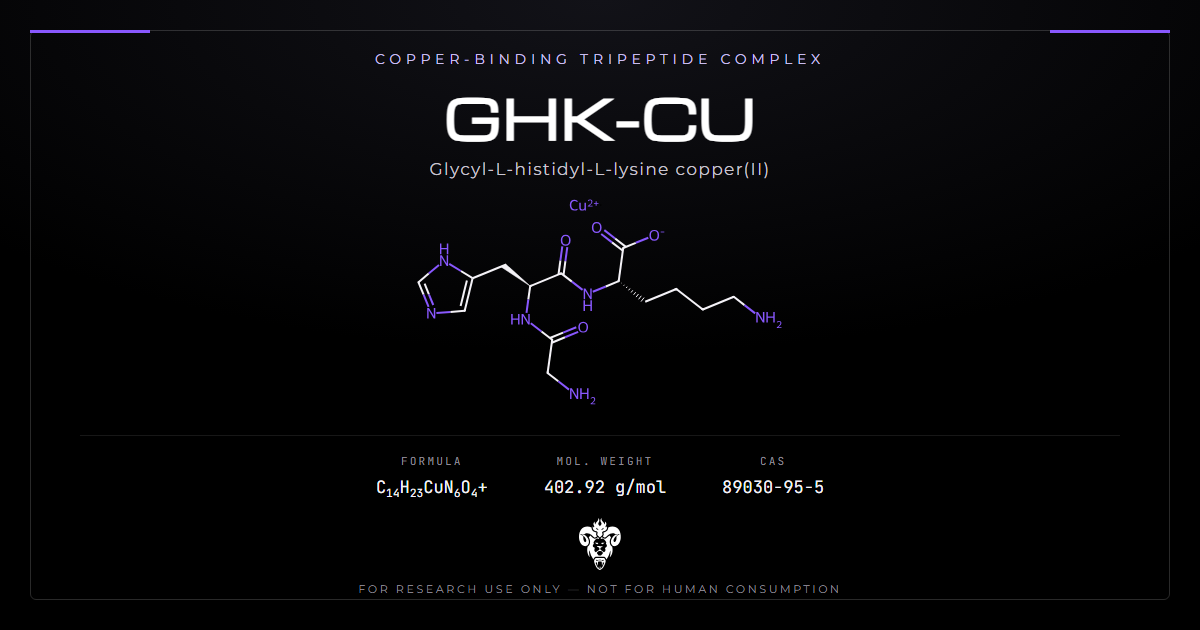
Two molecules share one name. GHK is a tripeptide. GHK-Cu is that tripeptide holding a copper ion.
The literature moves between them without always saying which one it tested. That distinction stops being academic once you read the metalloproteinase work.
One group found GHK-Cu raising MMP-2 in dermal fibroblasts, then asked which component carried the effect. Copper ions alone reproduced it. The peptide alone did not (PMID 11045606).
So in the one assay where somebody separated metal from ligand, the metal did the work [10]. Fifty years of research sit on top of that ambiguity. Almost none of it has gone back to resolve the question.
Chemical identity
A tripeptide with copper held in a square-planar site, sold as a lyophilised powder and listed in cosmetics under its INCI name.
| Property | Value |
|---|---|
| Sequence | Gly-His-Lys |
| Common names | GHK-Cu, copper tripeptide-1, prezatide copper |
| Molecular formula | C14H23CuN6O4 |
| Molecular weight | 402.9 g/mol |
| Monoisotopic mass | 402.1077 Da |
| CAS number | 89030-95-5 |
| PubChem CID | 71587328 |
| InChIKey | NZWIFMYRRCMYMN-ACMTZBLWSA-M |
| Free peptide CID | 73587 |
| Free peptide mass | 340.4 g/mol |
| Residues | 3 |
| Stereocentres | 2 |
| Parent protein | Type I collagen, alpha-2(I) chain |
Reading the complex
Three donor atoms bind the copper. The third one explains why this sequence and not another.
Glycine contributes its N-terminal amine. Histidine contributes an imidazole nitrogen. The peptide bond between the two residues then loses its amide proton, and that deprotonated nitrogen becomes the third donor. Electron spin resonance work describes the result as a tridentate copper complex [4].
Lysine takes no part in holding the metal. Its side-chain amine stays free and protonated at physiological pH. GHK-Cu therefore carries positive charge, and behaves as a strongly hydrophilic species in every formulation problem below.
Two stoichiometries under one name
The catalogue name does not fix the ratio. Two distinct entities circulate under it.
Prezatide copper is the 1:1 complex above. Bisprezatide copper pairs two peptides with one metal ion. That gives C28H46CuN12O8 at 742.3 g/mol, and both appear in chemical databases under copper-peptide synonyms.
Lyophilised material adds a third variable. Acetate or trifluoroacetate counterions remain from purification. A vial labelled by peptide mass may therefore carry less copper than the label implies, so anyone dosing by molarity should ask which number the certificate reports.
Where the sequence comes from
GHK is not a designed molecule. It is a fragment of something larger.
Gly-His-Lys occurs as a triplet in the alpha-2(I) chain of type I collagen. Maquart and colleagues noted the implication: proteases acting at a wound could liberate it in place [3]. That would make the peptide a local signal generated by the damage it responds to.
The origin also sets the concentration scale. A cryptic fragment released by proteolysis arrives in nanomolar amounts. The fibroblast work below found its maximum in exactly that range.
The copper-transport hypothesis
The founding idea came from a purification problem rather than from a receptor model.
Pickart and colleagues isolated the tripeptide from human plasma. It co-purified with roughly equimolar copper through several steps [1]. Maximal effects on hepatoma cells needed the peptide together with copper and iron in the medium.
They also noted a sequence homology between the tripeptide and the copper transport site on albumin. From that came the 1980 proposal in Nature: the peptide facilitates copper uptake into cells [1]. A follow-up paper put the working range in culture at 10 to 200 ng/mL and restated the transport reading [2].
What the ESR work complicated
Nine years later the same collaboration tested the transport step directly. The answer was awkward.
Antholine and colleagues looked by electron spin resonance for adducts between GHK-Cu and either glutathione or Ehrlich ascites cells (PMID 2542448). None formed. The authors read that absence as consistent with poor uptake of the intact complex by cells [4].
Adding free histidine changed the picture. A copper-histidine adduct formed. It then failed to survive contact with the cells, which the authors interpreted as copper moving to a Cu(His)2 species [4].
Read plainly, GHK-Cu may hand its metal to another ligand at the cell surface rather than crossing intact. Nobody has settled that question since. The transport framing still appears in reviews as though somebody had.
What the fibroblast work shows
The most reproducible experimental body sits in cultured dermal fibroblasts. Most of it came from one laboratory in Reims over roughly fifteen years.
Collagen and matrix
Maquart and colleagues measured collagen synthesis across a wide concentration range [3]. Stimulation began between 10-12 and 10-11 M. It peaked at 10-9 M, with no change in cell number, so the effect was synthetic rather than proliferative.
Wegrowski and colleagues ran the equivalent experiment on glycosaminoglycans using radiolabelled glucosamine and sulfate [6]. Total secreted and cell-associated glycosaminoglycans both rose. Dermatan sulfate and heparan sulfate were favoured over the other species.
Pollard and colleagues took a harder model. They explanted human dermal fibroblasts from patients treated with head and neck radiotherapy, then grew them without serum [11]. At 1 nM, GHK-Cu shortened population-doubling times. Irradiated cells came close to untreated normal controls, and basic fibroblast growth factor and vascular endothelial growth factor both rose early after exposure.
Metalloproteinases
Tissue remodelling needs breakdown as well as synthesis. The same group looked at both sides.
Siméon and colleagues found GHK-Cu raising MMP-2 protein and messenger RNA in fibroblast conditioned media [10]. Secretion of the tissue inhibitors TIMP-1 and TIMP-2 rose alongside it.
Rat wound chambers gave the in vivo version. Injections extended MMP-9 expression in wound tissue to day 22 and increased both pro-MMP-2 and its activated form [9]. Interstitial collagenase activity did not change. Matrix output and matrix turnover move together, which is the basis of the remodelling description that follows this compound everywhere.
The bell-shaped curve
Both dose-response experiments found a maximum, then a decline back toward control.
Glycosaminoglycan synthesis peaked between 10-9 and 10-8 M. Above that, the rate returned progressively to untreated levels [6]. Collagen synthesis showed the same shape with its own peak at 10-9 M [3].
Note where that sits against practice. A nanomolar optimum runs four to six orders of magnitude below the concentrations used in cosmetic formulation and in most bench work. Adding more GHK-Cu does not test the mechanism harder. On this evidence it tests something else.
The copper attribution problem
One experiment in the whole file separates peptide from metal, and its answer points at the metal.
Siméon and colleagues reported that the MMP-2 stimulation was reproduced by copper ions and not by the tripeptide alone [10]. That is a clean dissociation. It covers one endpoint in one cell type, and nobody has repeated it across the rest of the panel.
Other controls answer a different question. Maquart and colleagues ran a control tripeptide, glutamyl-histidyl-proline, which did nothing in the wound chamber [7]. That controls for the presence of a tripeptide. It cannot control for copper, because the control peptide binds none.
Buffoni and colleagues did run copper acetate in parallel with GHK-Cu in guinea-pig wounds [8]. Their comparison sits inside a study that found little benefit from either arm, so it settles nothing about the productive case.
Several of the most cited results used free peptide with no added copper. The emphysema fibroblast experiments below are among them [14]. So the field carries two active species, a divided literature, and no modern factorial design comparing peptide, metal, complex and vehicle at matched copper.
Wound healing in animals
The in vivo record is more mixed than the reviews suggest. Its disagreements are informative rather than noise.
| Study | Model | Route and dose | Outcome |
|---|---|---|---|
| Maquart 1993 [7] | Rat wound chamber | 2 mg per injection | Collagen, DNA, glycosaminoglycans all up |
| Buffoni 1995 [8] | Guinea-pig dorsal skin | Topical, copper acetate arm | Slower reorganisation, delayed fibroblasts |
| Parker 2013 [15] | Irradiated rat flap | Topical gel, twice daily | No difference in ischaemia, vessels or VEGF |
| Fu 2015 [17] | Rat ACL reconstruction | Intra-articular, weekly | Laxity better at 6 weeks, gone by 12 |
| Ma 2020 [21] | Bleomycin lung fibrosis | Intraperitoneal, alternate days | Collagen deposition reduced |
The rat wound chamber
The strongest positive result uses a stainless-steel mesh cylinder implanted under rat skin. It collects newly formed connective tissue for analysis.
Maquart and colleagues injected the chamber sequentially with GHK-Cu (PMID 8227353). Dry weight, DNA, total protein, collagen and glycosaminoglycan content all rose in a concentration-dependent way [7]. Collagen synthesis rose about twice as much as non-collagen protein. Type I and type III collagen messenger RNA both increased.
One negative in that paper deserves attention. Transforming growth factor beta messenger RNA did not rise [7]. That places the effect somewhere other than the obvious fibrotic signalling route.
The studies that disagree
Three later animal studies found less. One found the opposite direction.
Buffoni and colleagues treated guinea-pig dorsal wounds. Slower reorganisation of the skin and delayed fibroblast activation were the main effects they reported [8]. Their fibroblast cultures at 10-7 M showed cell reproduction falling while collagen expression rose, which fits the descending limb of the bell curve rather than a failure to act.
Parker and colleagues applied a topical GHK-Cu gel twice daily to irradiated rat dorsal flaps for ten days [15]. Blood vessel counts, luminal areas and VEGF staining all came out indistinguishable from controls. Mean ischaemic area measured 5.0 cm2 in treated animals against 3.8 cm2 in controls, at p = 0.011 against the threshold of 0.01 the authors had set for multiple comparisons.
Fu and colleagues injected 72 rats intra-articularly after anterior cruciate ligament reconstruction [17]. Knee laxity improved at six weeks (p = 0.009) and graft stiffness rose in the lower-dose arm. By twelve weeks every difference had gone, and ultimate load, gait and histology never differed at all.
The emphysema signature and an unbiased screen
The most interesting result in the file came from people with no prior interest in this compound.
Campbell and colleagues profiled gene expression in 64 lung tissue samples, eight regions from each of eight lungs from smokers with COPD (PMID 22937864). Regional emphysema severity was quantified by mean linear intercept on micro-CT. They identified 127 genes whose expression tracked destruction within an individual lung, with inflammatory genes rising and tissue-repair genes falling [14].
They then asked the Broad Institute Connectivity Map which compounds reverse that signature. GHK came back. Treating human fibroblasts with the peptide reproduced transforming-growth-factor-beta expression patterns, organised the actin cytoskeleton and raised integrin beta-1 [14]. It also restored collagen gel contraction in fibroblasts taken from COPD lungs.
What the screen does not show
A computational hit followed by a fibroblast experiment is a hypothesis. The authors framed it that way.
Their conclusion asks for further studies of the mechanism, and of what the reversal does to disease progression [14]. No clinical trial followed in the fourteen years since. The result stands as the best independent support this compound has, and as unfinished work.
Inflammation and fibrosis models
A separate literature tests GHK-Cu systemically in lung injury. Most of it comes from the last decade.
Lung models
Park and colleagues gave GHK-Cu to mice with lipopolysaccharide-induced acute lung injury and to RAW 264.7 macrophages [18]. Reactive oxygen species fell and superoxide dismutase activity rose. TNF-alpha and IL-6 production dropped, with NF-kappaB p65 and p38 MAPK signalling suppressed.
Ma and colleagues dosed bleomycin-treated mice intraperitoneally at 0.2, 2 and 20 µg/g on alternate days [21]. Collagen deposition fell and the MMP-9 to TIMP-1 imbalance reversed. Epithelial-mesenchymal transition was partly prevented through Nrf2, NF-kappaB and TGF-beta1 pathways.
Bian and colleagues went further and named a binding partner. In a silicosis model, GHK-Cu bound peroxiredoxin 6 and reduced alveolar macrophage oxidative stress [23]. Lung inflammation and fibrosis both fell, with no significant systemic toxicity reported.
Hold those against the dermal results. A compound sold to build collagen reduces collagen deposition in fibrotic lung. Remodelling covers both directions by definition, which is also what makes the claim hard to falsify.
Redox chemistry
Part of the antioxidant story runs opposite to the transport hypothesis.
Min and colleagues showed the free peptide binding copper and reducing its redox activity [22]. It prevented copper- and zinc-induced aggregation of bovine serum albumin, and resolubilised protein that had already aggregated. Central nervous system cells survived copper exposure that killed untreated controls.
Miller and colleagues found GHK-Cu inhibiting ferritin-dependent lipid peroxidation [5]. The complex showed no superoxide-dismutase-like or ceruloplasmin-like activity of its own, and the authors proposed that it blocks iron release from ferritin channels. Beretta and colleagues showed the peptide quenching 4-hydroxynonenal by adduct formation, less potently than carnosine [13].
Two of those three mechanisms describe a molecule sequestering a reactive metal rather than delivering one. Both readings appear in the same reviews, sometimes on the same page.
What human trials exist
GHK-Cu has been on cosmetic shelves for decades. The controlled human record is two small trials, and neither one supports what the shelves claim.
Laser-resurfaced skin
Miller and colleagues randomised patients having circumoral carbon dioxide laser resurfacing. One arm used a post-treatment regimen containing GHK-Cu, the other did not [12].
Thirteen patients completed. Computer analysis and blinded evaluators found no significant difference in resolution of erythema. Every patient improved in wrinkles and overall skin quality, with no difference between groups on either measure.
One endpoint did separate. Patient-reported satisfaction with overall skin quality favoured the GHK-Cu arm at p = 0.04 [12]. The objective measures came back null and the subjective one did not, in an unblinded skincare regimen.
Hair growth
Lee and colleagues ran 45 men with pattern hair loss for six months [19]. The active product combined 5-aminolevulinic acid with the tripeptide, tested at two concentrations against placebo.
Hair count rose by 52.6 at the higher concentration, 71.5 at the lower, and 9.6 on placebo. Only the lower-dose ratio reached significance against placebo. Hair length and thickness did not differ across the three groups at six months.
Two problems limit what that shows. The lower dose outperformed the higher one. The peptide also shared a bottle with 5-aminolevulinic acid, so no part of the result can be assigned to either ingredient.
A 2025 review of topical anti-wrinkle peptides reaches the same conclusion for the wider market. It describes a surprising absence of clinical studies on GHK-Cu and its palmitoylated relative, despite their commercial ubiquity [25].
The delivery problem
Everything above depends on the molecule reaching a cell. Its physical chemistry works against that.
Permeability and stability
Badenhorst and colleagues characterised GHK-Cu for topical formulation [16]. Distribution coefficients in octanol against phosphate-buffered saline ran between -2.38 and -2.49 across pH 4.5 to 7.4. That places it firmly among hydrophilic compounds, badly matched to a lipophilic stratum corneum.
Stability came out better than expected. GHK-Cu held in water and in buffers from pH 4.5 to 7.4 for at least two weeks at 60 °C [16]. Base and oxidation drove first-order degradation. One identified degradation product was free histidine, which is worth remembering given that histidine competes for the copper.
A 2025 review of skin permeation methods reaches a blunter conclusion. Transport of liposome-encapsulated material has received little attention, and the data needed to answer the question do not yet exist [24]. An ionic-liquid microemulsion published in 2023 improved local delivery roughly threefold, which measures the size of the obstacle it was built to clear [26].
Route and the powder question
The animal studies that worked did not use skin. They used injection.
Wound chambers received direct injection [7]. The fibrosis work dosed intraperitoneally [21], and the ligament study injected intra-articularly [17]. Both topical animal studies are among the ones that found nothing [8][15].
No human pharmacokinetic profile exists for any route. Nobody has published a plasma concentration curve, a half-life or a bioavailability figure for GHK-Cu. Translating a rodent milligram-per-kilogram figure into anything else is therefore guesswork.
How to read a GHK-Cu study
Four questions separate the papers that transfer from the ones that do not.
Peptide, complex, or copper?
Check which species went into the medium. Free peptide, the 1:1 complex, the 2:1 complex and a copper salt are four different treatments. Results on one do not license claims about another [10][14].
Which concentration?
The dose-response is biphasic with a nanomolar optimum [3][6]. A study run at micromolar concentrations sits past the peak of every curve anyone has measured. It is testing a different part of the response.
Which route?
Injected and topical studies diverge sharply in outcome [7][15]. Any topical result carries the permeation question. Any systemic result in a rodent carries an unmeasured translation step.
Who wrote it?
A large share of the review literature comes from the peptide’s discoverer, who founded and runs a company selling copper-peptide skincare. Those reviews carry the widest claims. One asserts that GHK-Cu modulates at least 4,000 human genes and resets expression toward health [20].
That figure derives from Connectivity Map queries reported inside review articles, not from experiments performed in them. The primary experimental literature is smaller, older and more equivocal, and it is the one this article has followed. The often-quoted plasma decline from roughly 200 ng/mL at age 20 to 80 ng/mL at 60 travels through the same reviews with no accessible primary measurement behind it.
Verifying research material
A three-residue peptide bound to a redox-active metal has failure modes that neither component carries alone.
Identity
Mass spectrometry resolves the free peptide at 340.4 g/mol and the 1:1 complex at 402.9 without difficulty. Copper’s isotope pattern, 69 percent copper-63 and 31 percent copper-65, gives an unambiguous signature. A peptide-only impurity cannot fake it.
Ultraviolet-visible spectroscopy is the faster check. GHK-Cu absorbs in the visible region, which is what gives lyophilised material its blue colour. A colourless powder sold as the complex is free peptide.
The two stoichiometries separate on the same measurement. A 2:1 preparation carries half the copper per unit peptide mass. Any certificate should therefore state copper content by mass, and not only chromatographic purity.
Purity and copper content
Peptide content and copper content are separate questions from HPLC purity. Lyophilised material makes both harder.
Counterions and residual water inflate the apparent mass. Trifluoroacetate left from purification carries its own activity in cell work at low concentrations. That matters more here than usual, given a biological optimum at nanomolar.
Free copper is the impurity that changes the pharmacology rather than diluting it. Uncomplexed copper is redox-active in a way the bound metal is not [22]. A preparation carrying excess salt is a different reagent from one carrying the stoichiometric complex.
Handling and stability
Store the powder cold, dry and dark. Reconstitute close to the point of use.
GHK-Cu tolerates aqueous storage better than most peptides, holding through two weeks at 60 °C in the pH 4.5 to 7.4 window [16]. Alkaline conditions and oxidants do degrade it. One degradation product is the free histidine that then competes for the metal.
Histidine in a biological matrix competes from the outside too. The electron spin resonance work showed a copper-histidine species forming in the presence of the complex [4]. Serum-containing media should be treated as a competing ligand environment rather than an inert one.
Kimera publishes third-party certificates of analysis for every lot in its COA database. Laboratories source GHK-Cu as a copper-peptide reference for matrix and remodelling work. It appears alongside glutathione where metal handling and thiol chemistry are the shared theme, with LL-37 in wound and skin models, or with Selank as a second short peptide whose fragments carry their own activity. Related work appears in the peptides category.
Common questions about GHK-Cu
What is GHK-Cu? A copper(II) complex of the tripeptide glycyl-histidyl-lysine, which occurs as a fragment of the alpha-2(I) chain of type I collagen [3].
Does the peptide or the copper carry the activity? On the one endpoint where somebody tested it, copper ions reproduced the effect and the peptide alone did not [10].
Is more of it better? No. Collagen and glycosaminoglycan synthesis both peak near 10-9 M and fall back toward control above that [3][6].
What human evidence exists? One randomised trial after laser resurfacing, null on every objective measure in 13 patients [12]. One hair-growth trial of a two-ingredient complex in 45 men [19].
Does GHK-Cu get through skin? Poorly. Distribution coefficients near -2.4 place it among hydrophilic compounds, and delivery systems exist because of it [16][24].
Why does it appear in lung fibrosis research? Systemic dosing reduces inflammation and collagen deposition in bleomycin and silica models, with peroxiredoxin 6 named as a binding partner [21][23].
Summary of the evidence
Identity: glycyl-histidyl-lysine with copper(II), C14H23CuN6O4, 402.9 g/mol, CAS 89030-95-5. Binding is tridentate, through the terminal amine, the imidazole and a deprotonated amide nitrogen [4].
Origin: a cryptic fragment of type I collagen, plausibly released by proteases at a wound [3].
Fibroblast evidence: collagen and glycosaminoglycan synthesis stimulated, with maxima near 10-9 M and a decline above that [3][6]. MMP-2 rises alongside TIMP-1 and TIMP-2 [10].
Attribution: copper ions reproduced the metalloproteinase effect and the peptide alone did not [10]. The 1980 transport hypothesis [1] sits unresolved against electron spin resonance evidence of poor cellular uptake [4].
Animal evidence: one strong concentration-dependent wound chamber result [7], two null topical studies [8][15], and one transient orthopaedic result [17].
Independent support: an unbiased Connectivity Map screen on an emphysema gene signature returned the peptide, with fibroblast confirmation and no trial since [14].
Human evidence: two small trials. One null on objective endpoints [12], one confounded by a second ingredient [19]. A 2025 review notes the absence of clinical studies across this ingredient class [25].
Limits: no human pharmacokinetics, poor skin permeation [16][24], no factorial experiment separating peptide from metal, and a review literature dominated by the discoverer’s own company [20].
Status: supplied for laboratory research use only.
References
- Pickart L, Freedman JH, Loker WJ, Peisach J, Perkins CM, Stenkamp RE, Weinstein B. Growth-modulating plasma tripeptide may function by facilitating copper uptake into cells. Nature. 1980;288(5792):715-717. PMID 7453802. DOI
- Pickart L. The use of glycylhistidyllysine in culture systems. In Vitro. 1981;17(6):459-466. PMID 7021400. DOI
- Maquart FX, Pickart L, Laurent M, Gillery P, Monboisse JC, Borel JP. Stimulation of collagen synthesis in fibroblast cultures by the tripeptide-copper complex glycyl-L-histidyl-L-lysine-Cu2+. FEBS Lett. 1988;238(2):343-346. PMID 3169264. DOI
- Antholine WE, Petering DH, Pickart L. ESR studies of the interaction of copper(II)GHK, histidine, and Ehrlich cells. J Inorg Biochem. 1989;35(3):215-224. PMID 2542448. DOI
- Miller DM, DeSilva D, Pickart L, Aust SD. Effects of glycyl-histidyl-lysyl chelated Cu(II) on ferritin dependent lipid peroxidation. Adv Exp Med Biol. 1990;264:79-84. PMID 2244543. DOI
- Wegrowski Y, Maquart FX, Borel JP. Stimulation of sulfated glycosaminoglycan synthesis by the tripeptide-copper complex glycyl-L-histidyl-L-lysine-Cu2+. Life Sci. 1992;51(13):1049-1056. PMID 1522753. DOI
- Maquart FX, Bellon G, Chaqour B, Wegrowski J, Patt LM, Trachy RE, Monboisse JC, Chastang F, Birembaut P, Gillery P, et al. In vivo stimulation of connective tissue accumulation by the tripeptide-copper complex glycyl-L-histidyl-L-lysine-Cu2+ in rat experimental wounds. J Clin Invest. 1993;92(5):2368-2376. PMID 8227353. DOI
- Buffoni F, Pino R, Dal Pozzo A. Effect of tripeptide-copper complexes on the process of skin wound healing and on cultured fibroblasts. Arch Int Pharmacodyn Ther. 1995;330(3):345-360. PMID 8836453.
- Siméon A, Wegrowski Y, Bontemps Y, Maquart FX. Expression of glycosaminoglycans and small proteoglycans in wounds: modulation by the tripeptide-copper complex glycyl-L-histidyl-L-lysine-Cu(2+). J Invest Dermatol. 2000;115(6):962-968. PMID 11121126. DOI
- Siméon A, Emonard H, Hornebeck W, Maquart FX. The tripeptide-copper complex glycyl-L-histidyl-L-lysine-Cu2+ stimulates matrix metalloproteinase-2 expression by fibroblast cultures. Life Sci. 2000;67(18):2257-2265. PMID 11045606. DOI
- Pollard JD, Quan S, Kang T, Koch RJ. Effects of copper tripeptide on the growth and expression of growth factors by normal and irradiated fibroblasts. Arch Facial Plast Surg. 2005;7(1):27-31. PMID 15655171. DOI
- Miller TR, Wagner JD, Baack BR, Eisbach KJ. Effects of topical copper tripeptide complex on CO2 laser-resurfaced skin. Arch Facial Plast Surg. 2006;8(4):252-259. PMID 16847171. DOI
- Beretta G, Artali R, Regazzoni L, Panigati M, Facino RM. Glycyl-histidyl-lysine (GHK) is a quencher of alpha,beta-4-hydroxy-trans-2-nonenal: a comparison with carnosine. Chem Res Toxicol. 2007;20(9):1309-1314. PMID 17672515. DOI
- Campbell JD, McDonough JE, Zeskind JE, Hackett TL, Pechkovsky DV, Brandsma CA, et al. A gene expression signature of emphysema-related lung destruction and its reversal by the tripeptide GHK. Genome Med. 2012;4(8):67. PMID 22937864. DOI
- Parker NP, Ardeshirpour F, Schmechel SC, Lassig AA. Effects of topical copper tripeptide complex on wound healing in an irradiated rat model. Otolaryngol Head Neck Surg. 2013;149(3):384-389. PMID 23744835. DOI
- Badenhorst T, Svirskis D, Wu Z. Physicochemical characterization of native glycyl-L-histidyl-L-lysine tripeptide for wound healing and anti-aging: a preformulation study for dermal delivery. Pharm Dev Technol. 2016;21(2):152-160. PMID 25384620. DOI
- Fu SC, Cheuk YC, Chiu WY, Yung SH, Rolf CG, Chan KM. Tripeptide-copper complex GHK-Cu (II) transiently improved healing outcome in a rat model of ACL reconstruction. J Orthop Res. 2015;33(7):1024-1033. PMID 25731775. DOI
- Park JR, Lee H, Kim SI, Yang SR. The tri-peptide GHK-Cu complex ameliorates lipopolysaccharide-induced acute lung injury in mice. Oncotarget. 2016;7(36):58405-58417. PMID 27517151. DOI
- Lee WJ, Sim HB, Jang YH, Lee SJ, Kim DW, Yim SH. Efficacy of a complex of 5-aminolevulinic acid and glycyl-histidyl-lysine peptide on hair growth. Ann Dermatol. 2016;28(4):438-443. PMID 27489425. DOI
- Pickart L, Margolina A. Regenerative and protective actions of the GHK-Cu peptide in the light of the new gene data. Int J Mol Sci. 2018;19(7):1987. PMID 29986520. DOI
- Ma WH, Li M, Ma HF, Li W, Liu L, Yin Y, Zhou XM, Hou G. Protective effects of GHK-Cu in bleomycin-induced pulmonary fibrosis via anti-oxidative stress and anti-inflammation pathways. Life Sci. 2020;241:117139. PMID 31809714. DOI
- Min JH, Sarlus H, Harris RA. Glycyl-L-histidyl-L-lysine prevents copper- and zinc-induced protein aggregation and central nervous system cell death in vitro. Metallomics. 2024;16(5):mfae019. PMID 38599632. DOI
- Bian Y, Deng M, Liu J, Li J, Zhang Q, Wang Z, et al. The glycyl-L-histidyl-L-lysine-Cu(2+) tripeptide complex attenuates lung inflammation and fibrosis in silicosis by targeting peroxiredoxin 6. Redox Biol. 2024;75:103237. PMID 38879894. DOI
- Ogórek K, Nowak K, Wadych E, Ruzik L, Timerbaev AR, Matczuk M. Are we ready to measure skin permeation of modern antiaging GHK-Cu tripeptide encapsulated in liposomes? Molecules. 2025;30(1):136. PMID 39795193. DOI
- Mortazavi SM, Mohammadi Vadoud SA, Moghimi HR. Topically applied GHK as an anti-wrinkle peptide: advantages, problems and prospective. Bioimpacts. 2025;15:30071. PMID 39963574. DOI
- Liu T, Liu Y, Zhao X, Zhang L, Wang W, Bai D, et al. Thermodynamically stable ionic liquid microemulsions pioneer pathways for topical delivery and peptide application. Bioact Mater. 2023;32:502-513. PMID 38026438. DOI
GHK-Cu is sold for laboratory research use only. Not for human consumption, nor medical, veterinary, or household uses.
Literature retrieved from PubMed.