Skip to content

GHK-CU Research Standard
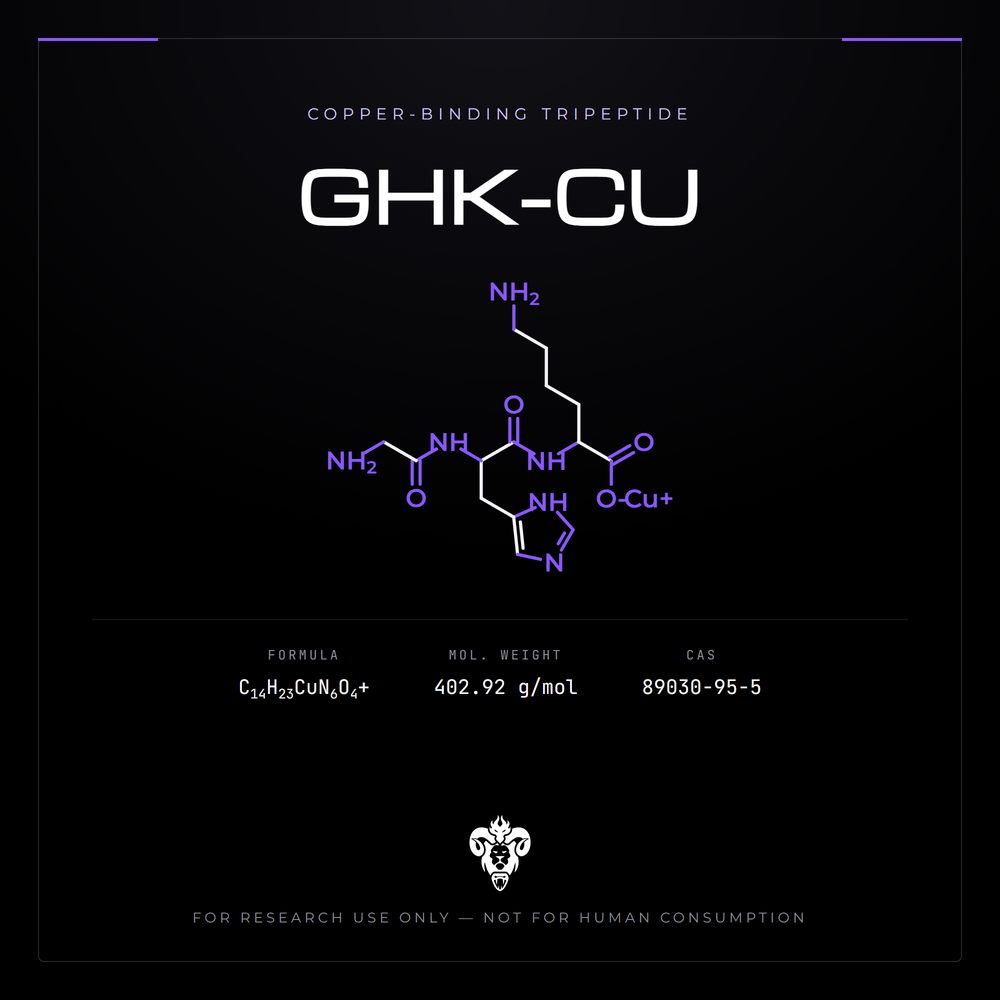
GHK-Cu (CAS 89030-95-5) is the copper(II) complex of glycyl-L-histidyl-L-lysine, an endogenous tripeptide present in human plasma. Supplied as a 50 mg lyophilized powder in a 3 mL vial, it is a reference standard for extracellular matrix biology and copper coordination chemistry. Unlike most peptides in this catalogue its activity is inseparable from a metal ion — the copper is not a counter-ion, it is part of the active species.
Mechanism of Action & Research Context
-
GHK-Cu is an endogenous copper(II)-binding tripeptide. It stimulates collagen synthesis in cultured fibroblasts between 10−12 and 10−9 M,[1] and raises MMP-2 alongside TIMP-1 and TIMP-2 — bidirectional matrix turnover rather than one-way collagen accumulation. Copper ions alone reproduced the MMP-2 effect while GHK alone did not.[2] Bound Cu(II) is redox-attenuated relative to free copper.[4]
-
Defined coordination chemistry. GHK binds Cu(II) and forms ternary complexes with other physiological ligands such as urocanic acid, characterised by potentiometry, circular dichroism and EPR.[3]
-
Redox silencing rather than scavenging. Copper held by GHK shows reduced redox activity compared with free copper, and in a CNS cell model this prevented copper- and zinc-driven protein aggregation and cell death. The relevant chemistry is sequestration, not radical scavenging — a distinction the marketing literature routinely blurs.[4]
-
Attribution is not straightforward. In the MMP-2 experiment, copper ions alone reproduced the effect while GHK alone did not. Activity in that assay cannot be credited to the peptide moiety by itself, which is why a copper-only control arm belongs in the design.[2]
Research Applications
Primary fields of in vitro laboratory investigation include:
-
Dermal fibroblast collagen synthesis assays across the picomolar-to-nanomolar range.[1]
-
MMP and TIMP quantification in conditioned media, with copper-only and peptide-only arms.[2]
-
Copper speciation studies by potentiometry, CD and EPR.[3]
-
Metal-induced aggregation and cytotoxicity models.[4]
Analytical Documentation
Purity, identity and composition vary by manufacturing lot. Kimera Chems does not publish a single fixed purity figure for this item; refer to the batch-specific Certificate of Analysis (COA) issued for the lot received, which reflects third-party analytical testing for that lot.
References
- Maquart FX, Pickart L, Laurent M, et al. Stimulation of collagen synthesis in fibroblast cultures by the tripeptide-copper complex glycyl-L-histidyl-L-lysine-Cu2+. FEBS Lett. 1988;238(2):343–346. doi:10.1016/0014-5793(88)80509-x
- Siméon A, Emonard H, Hornebeck W, Maquart FX. The tripeptide-copper complex glycyl-L-histidyl-L-lysine-Cu2+ stimulates matrix metalloproteinase-2 expression by fibroblast cultures. Life Sci. 2000;67(18):2257–2265. doi:10.1016/s0024-3205(00)00803-1
- Bossak-Ahmad K, Wiśniewska MD, Bal W, Drew SC, Frączyk T. Ternary Cu(II) complex with GHK peptide and urocanic acid as a potential physiologically functional copper chelate. Int J Mol Sci. 2020;21(17):6190. doi:10.3390/ijms21176190
- Min JH, Sarlus H, Harris RA. Glycyl-L-histidyl-L-lysine prevents copper- and zinc-induced protein aggregation and central nervous system cell death in vitro. Metallomics. 2024;16(5):mfae019. doi:10.1093/mtomcs/mfae019
Storage & Handling
Store at controlled room temperature, sealed and protected from light.
Storage guidance is a house recommendation. Analytical documentation is per-lot release testing.
Related Research Compounds
Research Use Only Disclaimer: This product is labeled and sold “For Research Use Only – NOT FOR HUMAN CONSUMPTION.” It is not a drug, dietary supplement, food, cosmetic, or medical device, and it is not approved by the FDA or any other regulator for human or veterinary use. It is supplied to approved account holders as a research chemical for laboratory use and must be handled in accordance with applicable law.